
Published October 11, 2026
You can weigh food raw or cooked, provided the weight matches the nutrition information you use. Log raw chicken against a raw-chicken entry, cooked chicken against a matching cooked entry, dry rice against dry-rice information, and cooked rice against cooked-rice information. Mixing those states is the main source of avoidable error.
For batch cooking, another practical option is to calculate the recipe from its ingredients, weigh the finished edible batch, and assign each serving a fraction of that batch. This guide shows both methods, explains their limits, and provides examples for meat, rice, pasta, mixed meals, and leftovers. You do not have to weigh food to eat well; these techniques are tools for situations where measurement is useful.
Why food weight changes during cooking
Cooking changes the amount of water and sometimes fat in food. Rice and pasta commonly gain weight as they absorb water. Meat commonly loses weight as moisture and some fat leave it. Vegetables can lose water during roasting or gain some during cooking in liquid.
The change in scale weight is not the same as a proportional change in every nutrient. Plain water adds weight without adding protein, carbohydrate, or fat. Fat that drains from meat carries nutrients and energy away. Cooking juices can also contain components that no longer remain in the portion you eat.
The USDA tables of cooking yields for meat and poultry document changes under specific preparation conditions. Their existence is a useful warning against treating one internet conversion factor as universal.
A smaller piece can be more concentrated
Imagine a food loses water while much of its protein remains. The cooked food can then contain more protein per 100 grams, even though cooking did not create protein. The denominator has changed: 100 grams now contains less water and more of the remaining food solids.
This explains why a cooked-chicken entry may list more protein per 100 grams than a raw-chicken entry. It does not mean that weighing a chicken breast after cooking magically reveals extra protein that was absent before cooking.
A heavier bowl can simply contain more water
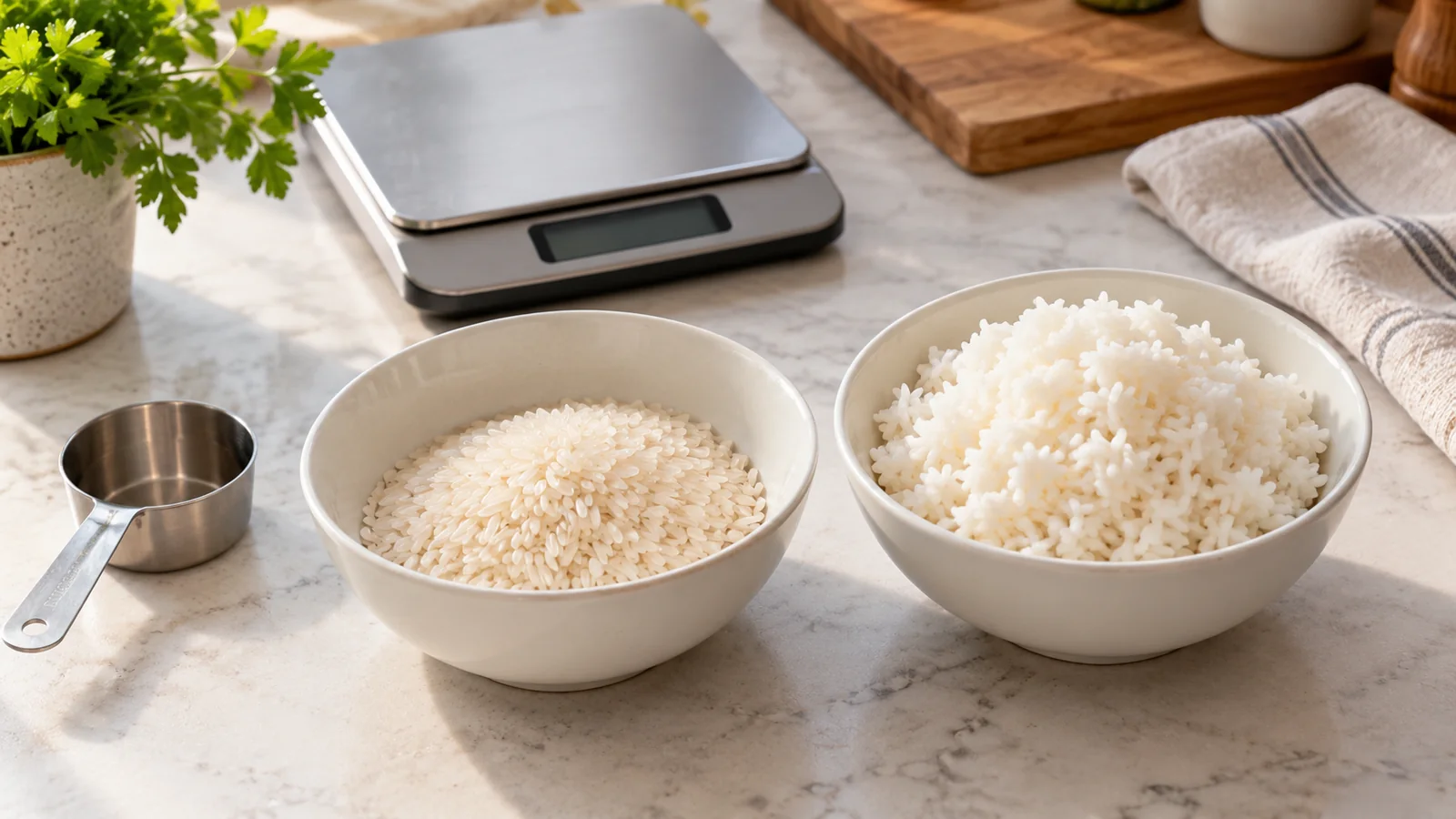
Dry rice becoming heavier after cooking works in the other direction. If a batch absorbs extra water, the nutrient amount per 100 grams becomes more diluted. The whole batch has not gained protein from that water.
This is why 100 grams of dry rice and 100 grams of cooked rice are very different quantities of food. Comparing their nutrition without noting their state creates a misleading result.
Method one: match the weight to the food entry
This is often the simplest approach when you are serving an individual ingredient. Decide when you will weigh it, then select nutrition information describing that state and preparation as closely as possible.
- Identify the food and the edible portion you will eat.
- Check whether the label or entry describes raw, dry, cooked, drained, or prepared food.
- Weigh the food in that same state.
- Use the listed serving weight to scale the nutrient amount.
- Add sauces, oils, toppings, and sides separately when they are not included.
For example, suppose a matching cooked-chicken entry lists 30 grams of protein per 100 grams. A 150-gram cooked portion gives 150 ÷ 100 × 30 = 45 grams of estimated protein.
That 30-gram figure is an explicit illustrative assumption, not a universal value for chicken. The cut, skin, preparation method, and database entry matter. A roasted skinless breast is not interchangeable with breaded chicken, chicken with skin, or a product containing added sauce.
Read the whole food description
USDA FoodData Central documentation explains that food descriptions include characteristics such as whether an item is raw or cooked. Those details are part of the data, not optional decoration around the food name.
When using an app, check units and preparation words before accepting the first search result. A verified-looking entry can still be the wrong food for your meal. If the description is vague, choose a clearer source or the package label when appropriate.
Do not choose the entry with the lowest number or the one closest to a hoped-for result. The useful entry is the one that best describes what you ate.
Method two: calculate the batch, then divide it
A recipe method is useful when you cook several portions together. Record the ingredients in the states described by their labels or selected entries, then measure the finished edible batch after cooking.
- Record ingredient quantities, including cooking oil and sauces that become part of the meal.
- Calculate the recipe’s estimated nutrients from those quantities.
- Weigh the finished edible food without the pot, bones, packaging, or other discarded material.
- Divide a serving’s weight by the finished batch weight.
- Multiply the estimated batch nutrient total by that fraction.
In words: serving nutrient estimate equals batch nutrient estimate multiplied by serving weight divided by finished batch weight.
This works best when the mixture is reasonably uniform. A blended soup is more uniform than a stew with large meat pieces. For chunky meals, distribute major ingredients evenly or portion them separately.
Important limit: ingredients do not all stay in the pot
A basic recipe calculator often assumes the nutrients entered remain in the food. That is an approximation. Drained fat, discarded cooking liquid, uneaten marinade, bones, and other losses can make the finished meal differ from the initial ingredient total.
For a meal with substantial discarded fat or liquid, a suitable cooked-food entry may be more useful than assuming full retention. Professional nutrient analysis can use retention factors and detailed methods. A kitchen scale alone cannot identify how much protein or fat left in the drippings.
Keep the method proportionate to its purpose. Consistent, sensible estimates are usually more practical than pretending a household calculation is exact.
Worked example: rice cooked in water
Suppose you use 180 grams of dry rice. Its label lists 7.5 grams of protein per 100 grams dry. After cooking in plain water, the finished edible rice weighs 540 grams.
- Estimated batch protein: 180 ÷ 100 × 7.5 = 13.5 grams.
- A 150-gram cooked portion is 150 ÷ 540 of the batch.
- Estimated portion protein: 13.5 × 150 ÷ 540 = 3.75 grams.
- The corresponding dry-rice share is 180 × 150 ÷ 540 = 50 grams.
That calculation describes this particular batch. It does not establish that every 50 grams of dry rice always becomes 150 grams cooked. Water amount, rice variety, cooking method, and time affect the yield.
If your next batch still starts with 180 grams dry but finishes at 600 grams, a 150-gram cooked portion is one quarter of the batch. Its estimated protein is 13.5 ÷ 4 = 3.375 grams, or about 3.4 grams. The extra water explains the difference.
Add broth, oil, coconut milk, or other ingredients to the recipe calculation when you use them. Rice prepared with those ingredients is no longer a plain-water example.
Worked example: pasta for three meals
Suppose 300 grams of dry pasta has a label stating 13 grams of protein per 100 grams. After cooking and draining, it weighs 750 grams.
- Estimated batch protein from pasta: 300 ÷ 100 × 13 = 39 grams.
- Three equal portions weigh 750 ÷ 3 = 250 grams cooked each.
- Each portion represents 100 grams of the original dry pasta and approximately 13 grams of protein.
Now imagine you divide that same batch into five equal portions. Each weighs 150 grams cooked and contains approximately 7.8 grams of protein from the pasta. The package’s original serving size does not determine how many portions you actually prepared.
If you add sauce after dividing the pasta, calculate the sauce separately. If you mix everything together first, add the sauce ingredients to the recipe and use the finished combined weight. Avoid weighing sauced pasta and logging it as plain cooked pasta.
Some starch is lost to cooking water, so an ingredient-based calculation is still an estimate. For everyday planning, matching the method and stating the assumptions is more useful than expressing a rounded label value to several decimal places.
For practical meal combinations, see high-protein pasta meals. This weighing method works with ordinary or higher-protein pasta as long as you use the correct label.
Worked example: a batch of chicken
Suppose you start with 800 grams of raw, boneless, skinless chicken and finish with 600 grams cooked. The measured cooking yield is 600 ÷ 800 = 0.75, or 75%.
A 150-gram cooked portion is one quarter of the cooked batch. It therefore corresponds to one quarter of the original raw amount: 200 grams. This is a batch-allocation calculation, not proof that every nutrient was retained.
If the raw-food label or entry states 22 grams of protein per 100 grams, the starting batch contains an estimated 176 grams. Assigning one quarter gives an ingredient-based estimate of 44 grams for the portion. Any nutrient losses with discarded juices are not measured by this simple method.
Alternatively, you could weigh the 150-gram portion and use a suitable cooked-food entry directly. You should choose one coherent method for that serving. Do not log the raw batch share and then add the cooked chicken again.
Why a fixed “multiply by 1.33” shortcut can fail
In the example, converting cooked weight to its raw-batch equivalent means dividing by 0.75. That happens to be the same as multiplying by approximately 1.33.
If another batch yields 70% instead, the conversion changes. A 150-gram cooked portion corresponds to 150 ÷ 0.70, or approximately 214 grams raw. Different cuts and methods need not produce the same yield.
Use your measured batch ratio when you have it. When you do not, a matching cooked-food entry avoids inventing an exact raw conversion.
What about meat with bones, skin, or discarded fat?
Weigh and log the edible portion described by the entry. A bone-in package weight includes material you may not eat. A skinless entry does not describe a portion whose skin you consume.
If you weigh cooked meat on the bone, then later weigh the leftover bones, subtraction can provide an approximate edible weight. It will be less exact if juices, skin, or other scraps are handled inconsistently. Treat it as an estimate rather than a precision procedure.
Ground meat adds another complication because cooking and draining can remove fat. Do not assume the entire raw fat amount remains, and do not assume all fat disappears. Select a cooked entry that describes the meat and preparation when available.
Similarly, a sauce containing pan drippings differs from meat served after those drippings are discarded. The destination of the cooking liquid matters to the recipe, even if both meals started with the same raw package.
Canned, frozen, and prepared foods need their own checks
Canned beans and tuna
Check whether the label uses drained weight or another serving basis. A can’s total net weight can include liquid you discard. Weighing the entire contents and applying a drained-food entry overstates the edible amount described by that entry.
For example, suppose a drained-food label lists 8 grams of protein per 100 grams. If you eat 150 grams drained, the estimate is 12 grams. If the unopened can weighs more because of liquid and packaging, those extra grams do not belong in this calculation.
Rinsing, draining, and retaining sauce also change what is in the meal. Use a method that reflects how you prepare the food.
Frozen foods
Frozen weight may include a glaze or liquid that drains away after thawing. Some foods are sold raw, some fully cooked, and some partially prepared. Read the directions and nutrition panel instead of treating “frozen” as a nutrition state by itself.
Cooking instructions also matter for safety. A frozen product that looks ready to eat may still require cooking. Nutrition tracking should never override the preparation instructions.
Meal kits and mixes
A label may include an “as prepared” column that assumes specific added ingredients. If you use different milk, oil, butter, or portions, the prepared values may no longer match your meal.
The FDA’s Food Labeling Guide distinguishes food as packaged from food as prepared. Read which basis applies rather than assuming every nutrition panel means the same thing. Our protein-label guide covers the related serving-size checks.
Mixed meals: when weighing the whole dish helps
For a casserole, curry, soup, or oat mixture, start with a recipe calculation if you want a repeatable estimate. Include all substantial ingredients and use the finished edible weight as the serving denominator.
Suppose a well-mixed soup has an estimated 120 grams of protein and weighs 2,400 grams. A 600-gram serving represents one quarter of the batch and approximately 30 grams of protein. A 400-gram serving represents one sixth and approximately 20 grams.
Those estimates assume ingredients are distributed evenly. If one bowl contains most of the chicken, equal soup weights will not produce equal protein amounts. Divide the chicken first, stir thoroughly, or accept a broader estimate.
Our high-protein soup guide gives examples with explicit cooked and drained ingredient bases. The same principle applies to overnight oats with Greek yogurt: liquid absorption changes texture and total weight, while the ingredients determine the starting nutrient estimate.
A kitchen-scale workflow that stays simple
Place the scale on a stable surface and check its unit. Grams are convenient for most food weights; milliliters describe volume and should not automatically be treated as grams for every ingredient.
Set an empty bowl on the scale, press tare to subtract its weight, and add the food. For a batch, use a heat-safe container and follow the scale manufacturer’s temperature and capacity limits. Do not put a very hot pot directly on a scale that is not designed for it.
You can record the empty container weight beforehand and subtract it from the filled weight later. For example, if a suitable container weighs 420 grams empty and 1,620 grams filled, the food weighs 1,200 grams. The container contributes no food weight.
Label your note clearly: “600 grams cooked chicken” is more useful than “600 grams chicken.” Include the source entry or package serving basis if you plan to reuse the calculation.
Keep food handling safe while measuring. Do not leave a meal sitting out to obtain a perfect final weight. Cool and refrigerate appropriately, use clean utensils, and prevent raw-food juices from contacting cooked food or the scale’s serving area.
What if leftovers change weight overnight?
A refrigerated dish can lose moisture, release liquid, or absorb sauce into starches. Reheating can remove more water. Those changes mean the same gram weight may represent a slightly different concentration from the original batch.
For a simple routine, portion the finished batch into containers soon after cooking, while following safe cooling practices. Each container then represents a known share. If one portion later becomes lighter after reheating, it is still that original share unless you remove food or add ingredients.
For example, one quarter of a batch may weigh 500 grams when portioned and 470 grams after reheating. You do not need to reclassify it as a smaller share merely because water evaporated. If you add sauce or cheese, include those additions separately when calculating the meal.
If you store the entire batch together and serve it on different days, accept that a weight-based estimate may become less exact as moisture changes. Do not spend more effort chasing a few grams of water than the task warrants. A clear, consistent method is usually the more useful outcome.
Seven common mistakes to avoid
- Using a dry entry for a cooked weight: absorbed water changes the amount of dry food represented.
- Using a raw entry for cooked meat: moisture and fat losses change concentration.
- Counting the same ingredient twice: choose a raw-recipe method or a cooked-entry method for the serving.
- Ignoring oil or sauce: include additions when they become part of the meal.
- Counting bones or packaging: match the edible portion described by the source.
- Assuming every bowl is equal: check actual yield and ingredient distribution.
- Using excess decimal places: precise arithmetic cannot remove uncertainty in food composition or label rounding.
If a result seems implausible, check units, serving size, and food state before changing the meal. A simple entry error is often more likely than a dramatic change in the food itself.
Food safety still comes first
Use a thermometer and appropriate cooking instructions; a target scale weight cannot establish doneness. The USDA temperature chart lists 165°F/74°C for poultry and leftovers, and 145°F/63°C for fish.
Refrigerate perishable food at 40°F or below, approximately 4°C. Keep room-temperature time within two hours, or one hour above 90°F/32°C. Cooked leftovers generally keep three to four days refrigerated, subject to safe handling and any shorter applicable limit. See USDA safe-handling guidance and our meal-prep food-safety guide.
Frequently asked questions
Is raw weighing always more accurate?
No. It can be convenient for packaged ingredients, but the right method depends on the information available and what happens during cooking. A well-matched cooked entry can be more useful than a raw calculation that ignores substantial discarded fat or liquid.
What if I only know the cooked weight?
Use a suitable cooked-food entry. You do not need to reverse-engineer an exact raw weight from an unknown cooking yield.
Should I weigh restaurant meals?
Usually the recipe and cooking details are still unknown, so weighing alone cannot produce exact nutrition. Use available restaurant information or a reasonable estimate if needed, and accept uncertainty.
Do I need to track every meal?
No. This guide explains measurement when it serves a purpose. If tracking feels burdensome or distressing, simpler meal routines or individualized support may be more appropriate.
The rule worth remembering
Match the food’s weight to the state described by the nutrition information. For batches, divide a clearly calculated recipe by its finished edible yield and acknowledge what may have been lost or unevenly distributed. Those habits solve most raw-versus-cooked confusion without pretending kitchen measurements are exact.
To explore a companion for your broader movement routine, visit Workit on the App Store.