
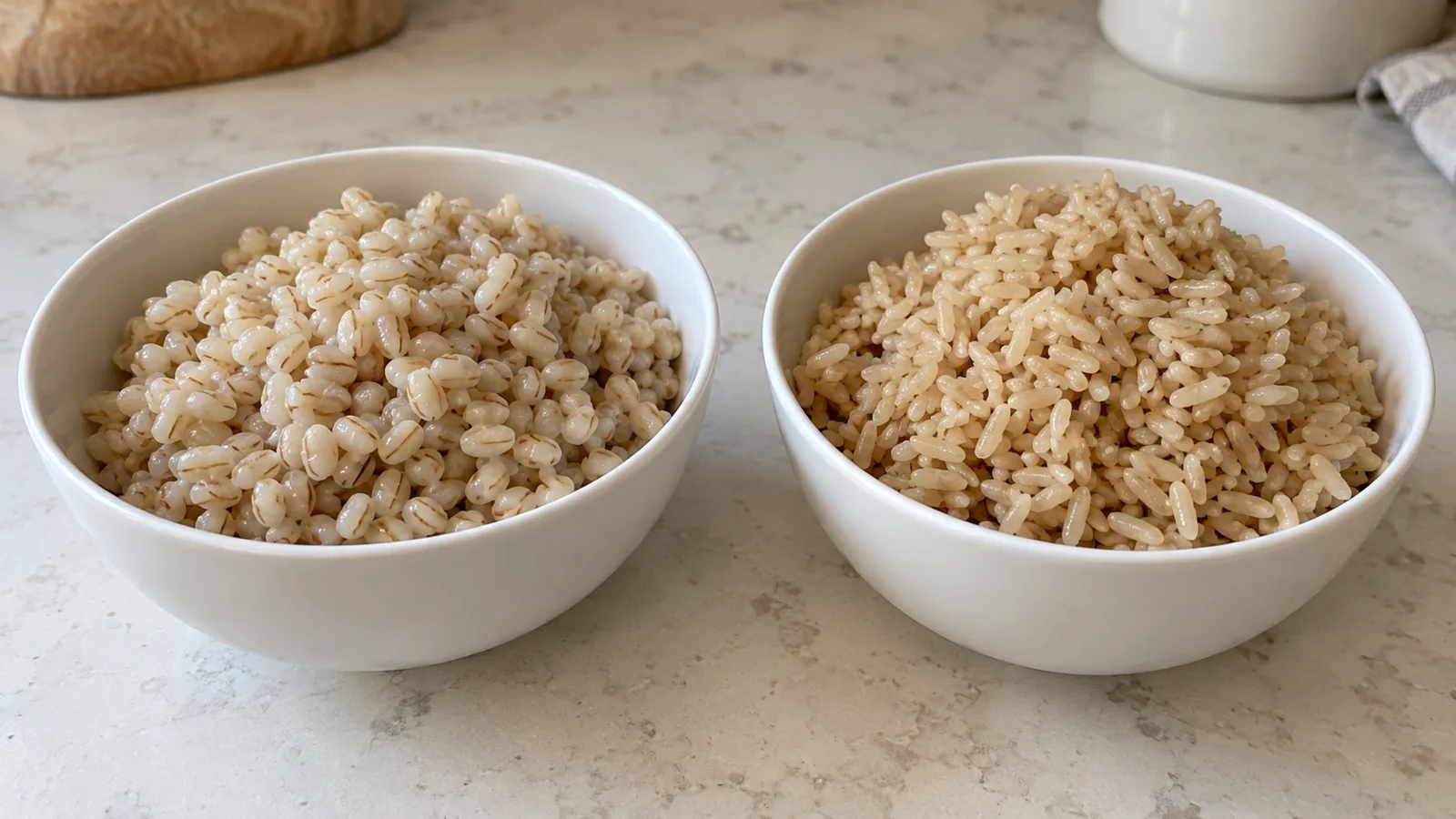
Choose barley when you want a chewy grain with more fiber; choose brown rice when you want a naturally gluten-free whole grain with a more familiar rice texture. In the matched USDA examples below, cooked pearled barley and cooked long-grain brown rice both provide about 123 calories per 100 grams. The useful differences are fiber, texture, gluten, and how each behaves in your meal.
Published October 18, 2026
That comparison needs one important qualification: pearled barley is not a whole grain. It has been polished, removing some of its bran. Hulled barley retains the bran and is a different product with different cooking requirements. A fair barley-versus-brown-rice comparison identifies the barley type and uses the same cooked weight instead of mixing a dry serving with a cooked cup.
Barley vs brown rice: the short decision guide
- For a chewy soup or substantial grain salad: choose pearled barley.
- For a rice bowl, curry, or a familiar side: choose brown rice.
- For a gluten-free meal: choose appropriately labeled brown rice and check everything added to it. Barley contains gluten.
- For more fiber at the same cooked weight: pearled barley has the advantage in the reference comparison.
- For a whole-grain barley option: look specifically for hulled or whole-grain hull-less barley rather than assuming that pearl barley qualifies.
- For convenience: compare the actual packages. Quick-cooking and precooked versions have different instructions from ordinary dry grains.
You do not need to select one grain permanently. Keeping rice for meals where separate grains matter and barley for soups or salads is often more useful than trying to find an overall winner. The food you enjoy enough to cook, portion, and finish earns a practical advantage that a nutrient chart cannot measure.
Nutrition compared on the same cooked-weight basis
The table uses plain cooked pearled barley and plain cooked long-grain brown rice from USDA reference records. It does not describe dry grain, instant mixes, or meals cooked with butter and broth. Values are rounded; your package and cooking method can produce slightly different results.
| Nutrient | Pearled barley | Long-grain brown rice |
|---|---|---|
| Energy | 123 calories | 123 calories |
| Protein | 2.3 g | 2.7 g |
| Carbohydrate | 28.2 g | 25.6 g |
| Fiber | 3.8 g | 1.6 g |
| Fat | 0.4 g | 1.0 g |
Sources: USDA FoodData Central records for cooked pearled barley and cooked long-grain brown rice; the corresponding values are also available in the USDA cereal grains and pasta reference report, records 20006 and 20037.
The clearest difference here is fiber. The small protein difference is unlikely to decide a meal: neither grain supplies much protein at this portion. If you want a protein-focused lunch, the beans, tofu, eggs, fish, chicken, or other main ingredient will make a much larger contribution than switching between these grains.
Likewise, the calorie tie does not mean every bowl is nutritionally identical. A generous pour of oil, a creamy dressing, a larger serving, or extra toppings changes the finished meal. Compare the version you actually eat rather than treating the grain name as a complete nutrition description.
Why a cooked cup can give a misleading comparison
A cup measures volume, not a fixed weight of food. In the USDA reference records, a cooked cup of pearled barley weighs 157 grams, while a cooked cup of this brown rice weighs 202 grams. Those cups provide approximately 193 and 248 calories, respectively. The difference comes partly from putting different weights into the same volume.
That is why a headline claiming barley has dramatically fewer calories can be misleading if it compares cups without stating their weights. At the matched 100-gram cooked amount above, the reference calorie values are the same. Cups still work perfectly well in a kitchen; they simply answer a different question from a gram-for-gram comparison.
Use a kitchen scale if consistency matters to you. If you prefer scooping, use the same cup, avoid alternating between loosely filled and firmly packed portions, and accept some normal variation. There is no need to turn an ordinary side dish into a precision exercise.
Dry and cooked measurements are an even bigger distinction. Water increases the weight of grains during cooking without adding calories. Record a dry amount with a dry-grain entry, or a cooked amount with a cooked-grain entry. The Workit guide to raw versus cooked food weight explains how to keep those measurements consistent across meal prep.
Pearled, hulled, and quick barley are different ingredients
Pearled barley is the smooth, pale barley commonly sold for soups. Its polishing process removes some of the bran, which helps shorten cooking compared with intact whole-grain barley. Bob’s Red Mill describes its pearl barley as having the bran partially removed and also notes that barley contains gluten.
Hulled barley has had its tough, inedible hull removed while retaining the bran. Hull-less barley comes from varieties whose hull separates more readily; check the package for a whole-grain description. These options are worth trying if you enjoy a firmer, more assertive grain, but do not automatically apply pearl-barley timing or nutrition to them.
Quick barley has been processed for faster preparation. Its shorter cooking instructions are not evidence that ordinary pearl barley will cook in the same time. Read the product name before deciding how much liquid to use or when to start dinner.
Brown rice also comes in several forms. Long-grain, short-grain, brown basmati, instant brown rice, and ready-to-heat pouches can differ in texture and preparation. The comparison table uses one clearly identified long-grain cooked reference. It is a starting point, not a promise that every brown-rice package has identical numbers.
Gluten is a decisive difference
Barley is a gluten-containing grain, including pearled barley. Removing the hull or polishing the grain does not make it appropriate for a gluten-free diet. Rice is naturally gluten-free, but flavored rice, sauces, shared equipment, and mixed-grain products still require attention. The FDA’s gluten-free labeling guidance identifies barley among gluten-containing grains and explains the requirements for gluten-free claims.
When cooking for someone with celiac disease, choose suitable labeled ingredients and prevent cross-contact. Do not use a shared spoon from a barley pot to serve their rice. Check the broth, seasoning blend, soy sauce, and dressing as carefully as the grain itself.
If gluten avoidance is medically necessary, there is no reason to weigh barley’s fiber advantage against that requirement. Choose a suitable rice product or another gluten-free grain and get fiber from compatible foods elsewhere in the meal. Individual medical nutrition advice belongs with a qualified clinician or dietitian.
Texture and flavor: which grain fits the dish?
Cooked barley has a rounded, springy bite. It works well when you want the grain to remain noticeable among chopped vegetables or in a spoonful of soup. It also releases starch, which can give broth a thicker feel. That is pleasant in a stew but less useful when you want a light, clear soup.
Long-grain brown rice tends to give a more separate-grained result when cooked well. Its mild, nutty character makes it a flexible base for sauces, beans, roasted vegetables, and stir-fried ingredients. Short-grain brown rice is generally a better choice when you want the grains to cling together.
For cold meals, barley can be especially forgiving because its chew remains part of the intended texture. Brown rice can feel firmer after refrigeration. A little dressing and finely chopped, juicy vegetables can make a cold rice salad more enjoyable, while reheating with a splash of water helps a warm bowl.
Neither grain needs a complicated sauce. Try lemon, herbs, and olive oil with barley; lime, scallions, and a small amount of your preferred sauce with rice. Taste before adding salt when you have cooked the grain in broth.
How to cook barley without guessing
Start with the instructions for the barley you bought. Ordinary pearled barley may need roughly 45 to 60 minutes, while quick barley can be much faster and hulled barley can take longer. The grain should be tender enough to eat comfortably while retaining a pleasant chew. A hard, chalky center usually means it needs more cooking.
For a simple stovetop approach, rinse the grain, place it in a roomy saucepan with the package’s specified water, bring it to a boil, then reduce to a gentle simmer. Watch for foaming and lower the heat if necessary. Stir occasionally and add water if the pot is drying before the grain is tender.
Once cooked, drain any excess liquid if the instructions call for it. For a salad, let steam escape briefly, then cool the barley promptly in shallow containers in the refrigerator. Do not leave a deep pot on the counter until it is completely cold.
When adding barley to soup, remember that it will absorb liquid as it cooks and sits. If you want predictable broth consistency, cook the barley separately and add a measured amount to each serving. That also lets you freeze some grain separately for another meal.
How to cook brown rice with better separation
Brown rice benefits from a measured amount of liquid, a gentle simmer, and a covered rest. As one product-specific example, Lundberg’s long-grain brown rice instructions use two cups of liquid for one cup of dry rice, a 45-minute low simmer, and a 10-minute covered rest. Follow your own package if its directions differ.
A heavy saucepan with a well-fitting lid helps avoid a scorched bottom and an undercooked top. Once the rice is simmering, resist lifting the lid repeatedly. Escaping steam and fluctuating heat make the result harder to predict.
At the end of the rest, fluff gently with a fork. If the rice remains too firm and the pan is dry, add a little water, cover, and continue cooking briefly. If the grains are tender but the mixture is wet, check whether it needs a little more standing time or gentle evaporation rather than aggressive stirring.
For meal prep, portion the rice while it is easy to separate, then refrigerate promptly. Reheat only the amount you need with a small splash of water and a cover that allows steam to escape safely. Avoid repeatedly reheating the entire batch.
Three practical meals that make the choice easier
For a specific topping to serve over a measured grain portion, try our thick turkey and black bean chili. Its protein calculation is separate from the grain, so add your chosen serving rather than treating the combined bowl as the original recipe.
These are flexible meal templates rather than full nutrition calculations. Each makes two servings. Grain weights below are cooked weights; bean weights are drained weights. Add seasonings to taste and adjust the total portion for your appetite.
1. Lemon barley, chickpea, and cucumber bowls
- 300 g cooked pearled barley
- 240 g drained chickpeas
- 200 g diced cucumber and 150 g diced tomatoes
- 15 g olive oil and 20 g lemon juice
- Chopped parsley, black pepper, and optional crumbled feta
Mix the lemon juice and oil in a large bowl. Add the barley and chickpeas, then fold in the vegetables and parsley. Divide into two portions. If packing ahead, keep very juicy tomatoes separate until eating. The barley’s chew makes this a good cold lunch, while the chickpeas add substance beyond the grain itself.
To use brown rice instead, replace the barley with the same cooked weight and keep the dressing slightly generous. That is a culinary substitution, not a claim that the nutrient totals stay identical. For more ideas built around a grain base, see Workit’s high-protein rice bowls.
2. Brown rice, tofu, and broccoli skillet bowls
- 300 g cooked brown rice
- 300 g firm tofu, drained and cubed
- 350 g broccoli florets
- 10 g cooking oil
- 15 g soy sauce or a suitable gluten-free alternative, plus lime juice
Pat the tofu dry and brown it in the oil. Cook the broccoli separately or steam it briefly in the pan after removing the tofu. Add the rice with a splash of water, warm thoroughly, then return the tofu and broccoli. Finish with the sauce and lime. Divide evenly between two bowls.
Rice works well here because it can spread through the pan without dominating every bite. Barley also works if you prefer a chewier result. Choose the texture you want and check the tofu and sauce labels if you need precise nutrition or allergen information.
3. Mushroom barley soup with white beans
- 250 g cooked pearled barley
- 240 g drained white beans
- 250 g sliced mushrooms and 150 g diced carrots
- 10 g olive oil and 750 ml broth
- Thyme, black pepper, and a squeeze of lemon
Brown the mushrooms in the oil, then add the carrots, broth, and thyme. Simmer until the carrots are tender. Stir in the cooked barley and beans and heat through. Finish with lemon, taste, and divide into two servings. Keeping the grain precooked makes the liquid level easier to control.
If storing this soup, expect some thickening. Add extra water or broth when reheating rather than assuming the batch has failed. Brown rice can replace the barley, but its texture will be different after sitting in the broth. Store grain separately when that distinction matters to you.
Portioning a batch without complicated math
Decide how many meals you need before you fill a large pot. A batch that gives you six portions is only useful if you will eat or freeze those portions in time. Cooking a modest amount twice can be easier than finding room for a week’s worth of containers.
If you track nutrition, one useful method is to calculate the dry ingredients for the whole recipe, weigh the finished batch, and divide by the portions you actually serve. For example, if the finished grain weighs 900 grams and you divide it into six equal containers, each gets 150 grams. That is one-sixth of the batch, even if a different cooking day produces a different final water weight.
Include added oil or broth ingredients when relevant. Do not add the dry-grain calories and then log the cooked grain again as a second food. That counts the same ingredient twice.
For a simpler approach, skip the calculations and use a repeatable scoop alongside your usual protein and vegetables. The goal is a meal you can prepare reliably. Consistency does not require knowing the exact weight of every grain.
Cooling, storing, and reheating safely
Cooked grains need prompt refrigeration. Divide leftovers into shallow containers and refrigerate within two hours, or within one hour when the surrounding temperature is above 90°F. Keep the refrigerator at 40°F or below. USDA recommends using refrigerated leftovers within three to four days and reheating leftovers to 165°F. See its leftovers and food-safety guidance.
Freeze portions you will not use within that window. Label them with the grain and cooking date so you do not have to guess later. A shallow, single-meal container is easier to cool and reheat than a deep tub holding the whole batch.
Reheating is not a way to rescue grain that was left out too long. Discard food when its storage history is unsafe or uncertain. For packed lunches, use a reliable cold source and keep the meal refrigerated until you are ready to eat. Workit’s meal-prep food safety guide covers the broader cooling and transport routine.
Common questions about barley and brown rice
Is barley healthier than brown rice?
There is no universal winner. Pearled barley provides more fiber in the matched cooked comparison, while brown rice is a whole grain and naturally gluten-free. The better choice depends on dietary requirements, preferred texture, and what else is in the meal.
Which has more protein?
Brown rice is slightly higher in the specific reference comparison, but the difference is small. Treat both as grain components and choose a separate protein-rich ingredient when you want a more substantial contribution.
Can I replace rice with barley in every recipe?
You can often swap equal cooked weights in bowls, salads, and soups. Do not automatically swap dry grains one-for-one in a tightly timed one-pot recipe: water needs, cooking time, starch release, and final texture can all change.
Which is better before exercise?
Choose a familiar meal that feels comfortable for you, especially close to a workout. A new, large, fiber-heavy meal is a poor experiment immediately before demanding exercise. The serving size, timing, and toppings matter alongside the grain.
Do I need to give up brown rice to get more fiber?
No. You can add beans, vegetables, seeds, or other fiber-containing foods to a rice meal. You can also rotate grains. Improving the whole plate often gives you more flexibility than replacing one ingredient everywhere.
The bottom line
Use barley for its chew and fiber, brown rice for a versatile whole-grain base, and the product label to guide cooking. Keep dry and cooked weights separate, include a meaningful protein source, and store your batch safely. A dependable lunch you enjoy is a useful result from either choice.
For the movement side of your routine, explore Workit on the App Store for workouts and challenges. Pair practical meals with activity you can repeat rather than expecting one grain choice to do all the work.