
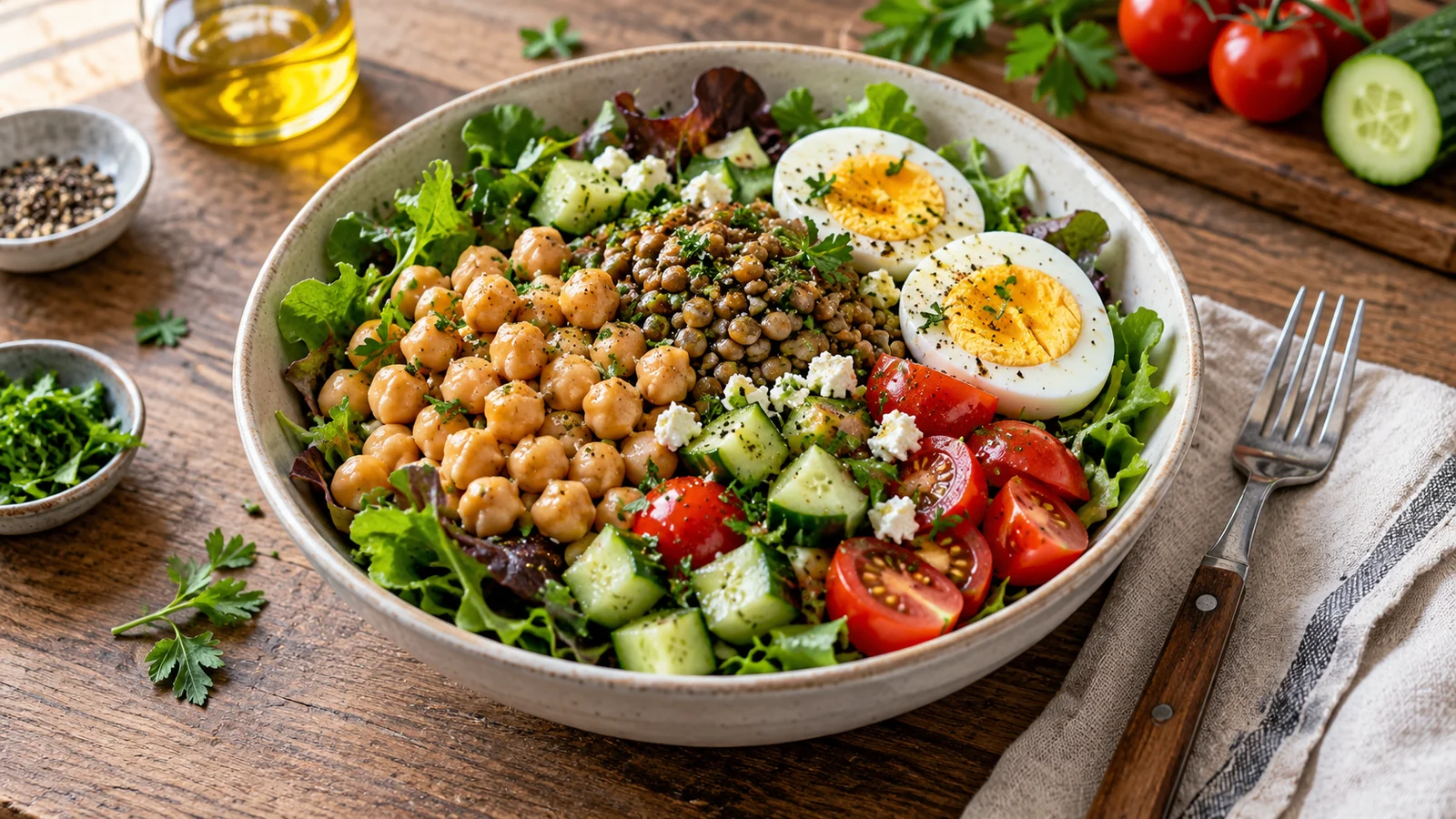
High-protein salads need a deliberate protein portion, enough other food to make a satisfying meal, and a mix of textures that survives until you eat. Start with chicken, fish, tofu, tempeh, eggs, dairy, or cooked legumes, then add vegetables, a grain or other starch if wanted, and dressing. A sprinkle of seeds over a large bowl of leaves is not automatically a protein-focused meal.
Published October 12, 2026
Build the meal around the protein portion
Choose the protein before filling the bowl with greens. This makes it easier to see whether you are preparing a meal or a side salad with a small garnish. You can use one substantial protein component or combine two smaller ones, such as eggs with lentils or tofu with edamame.
There is no single protein amount every salad must contain. Your needs depend on your overall diet, goals, appetite, and circumstances. The examples here show workable portions and transparent estimates; they are not individualized prescriptions. Our protein-per-meal guide provides broader context.
Next, choose how you want the salad to eat. A tender leafy salad, a crunchy chopped bowl, and a dense bean salad require different cutting and dressing decisions. Decide whether the protein should be mixed through every bite or served in distinct pieces on top.
Finally, consider the rest of the meal. Bread, potatoes, grains, fruit, and dressing can help the meal fit your appetite. Increasing leaf volume is not the only way to make lunch more substantial, and choosing a salad does not require keeping carbohydrates or fats out of it.
Use texture as an assembly guide
Pick a base that matches the waiting time
Delicate leaves are pleasant for immediate eating but can wilt quickly after dressing. Shredded cabbage, chopped kale, carrots, and other sturdy vegetables are useful when the meal will wait. You can also skip leafy greens altogether and make a chopped vegetable, bean, or grain salad.
Choose a comfortable bite size. Long strips of kale tangled around a fork may be less appealing than finely cut leaves. Large lettuce pieces can make a small protein portion seem lost. Chop the base enough that it mixes with the other ingredients without becoming a wet, finely minced mass.
Pair soft components with something crisp
Beans, eggs, avocado, and soft cheese can make a bowl feel uniformly creamy. Add a contrasting vegetable or a crunchy topping if you enjoy one. Conversely, a bowl of raw cabbage, carrots, and dry chicken may need a softer component and enough dressing to bring it together.
Crunchy toppings work best added near eating time. Nuts, seeds, toasted bread pieces, and similar ingredients absorb moisture if buried under dressing for hours. Pack a small separate portion rather than expecting them to stay crisp in a sealed, dressed salad.
Keep rich and acidic ingredients in balance
A creamy dressing can complement sharp vegetables, while lemon or vinegar can brighten a richer combination. Start with less dressing than you think you need, toss thoroughly, then taste. Uneven coating often makes one bite dry and the next overwhelmingly dressed.
Acid adds flavor; it does not make a homemade salad shelf-stable. A lemon dressing does not replace refrigeration or erase the storage age of cooked ingredients. Treat a dressed salad according to its perishable components, even when it tastes tangy.
Protein estimates: what the recipe numbers mean
The recipes use explicitly illustrative label assumptions, not a laboratory analysis or a guarantee about any brand. For your own estimate, use the values on the products you buy or a food database entry that matches the ingredient and its preparation state. The FDA explains how serving size relates to the numbers on a label.
- Cooked chicken: assumed 25 grams of protein per 100 grams of cooked edible meat.
- Drained canned salmon: assumed 22 grams per 100 grams of drained fish.
- Drained extra-firm tofu before pressing or cooking: assumed 12 grams per 100 grams.
- Plain tempeh as sold: assumed 18 grams per 85 grams.
- Cooked shelled edamame: assumed 9 grams per half cup.
- Cooked drained lentils: assumed 9 grams per half cup.
- Cooked drained chickpeas: assumed 7 grams per half cup.
- Large eggs: assumed 6 grams each.
- Plain Greek yogurt: assumed 10 grams per 100 grams.
Each calculation counts only named protein ingredients. Grains, vegetables, dressings, seeds, and optional additions are excluded unless explicitly included. Those foods can contribute protein and energy, so the partial estimate is not a complete nutrition panel. No calorie totals are claimed here.
If you cook a batch of tofu weighed before roasting, divide that batch into the planned portions rather than treating its reduced cooked weight as though it were the original label weight. Similarly, a cooked-chicken reference belongs with cooked chicken. Consistency matters more than recording unnecessary decimal places.
Salad 1: chicken, roasted potato, and green bean
For one meal, use 120 grams of safely cooked chicken, one cup of cooked cooled potato pieces, one cup of cooked cooled green beans, a handful of dry salad leaves, and a tablespoon or two of mustard-lemon dressing. Add chopped parsley and black pepper if you like.
- Cut the chicken into bite-sized pieces and the potatoes into pieces that can fit comfortably on a fork.
- Toss potatoes and green beans with a small amount of dressing first. They tolerate mixing better than delicate leaves.
- Add chicken, then fold in the leaves just before eating. Finish with parsley and enough additional dressing to lightly coat the bowl.
The chicken contributes approximately 30 grams of protein under the stated assumption. Potatoes, green beans, leaves, and dressing are not included. If you use a different chicken product, its label may differ, especially when skin, added ingredients, or retained liquid are involved.
This is a useful salad for someone who finds a bowl of raw vegetables unsatisfying. The potato gives the meal another substantial component without requiring a separate side. For oven-prepared components, see sheet-pan meal prep; cool cooked food promptly before assembling a salad intended for later.
Salad 2: tofu and edamame crunch bowl
Use 150 grams of drained extra-firm tofu weighed before cooking, half a cup of cooked shelled edamame, one cup of finely shredded cabbage, half a cup of grated carrot, and a little chopped cucumber. Dress with a mixture of your preferred nut or seed butter, lime juice, and water, adjusted to a pourable consistency.
- Cook the tofu according to package directions, using small cubes or crumbles. Prepare frozen edamame according to its package; do not assume thawing alone is sufficient.
- Refrigerate the cooked components promptly in shallow containers if the salad will be eaten cold later.
- Toss cabbage and carrot with a little dressing. Add tofu and edamame, then cucumber shortly before serving.
- Keep any crunchy topping separate until the meal is ready to eat.
The counted tofu and edamame provide approximately 27 grams of protein: 18 from tofu and 9 from edamame. Dressing, vegetables, and optional toppings are excluded. A nut-free or soy-free requirement needs different ingredients; check all labels rather than assuming a substitution removes every allergen.
For a less chewy bowl, use thinner cabbage shreds or replace part of the cabbage with tender leaves added at the last moment. If you enjoy a more substantial bite, our tofu-versus-tempeh guide explains the texture trade-off and how to compare labels.
Salad 3: salmon, chickpea, and cucumber
For one serving, combine 100 grams of drained canned salmon, half a cup of cooked drained chickpeas, half a cup of chopped cucumber, a handful of halved tomatoes, dill, and lemon dressing. Add a modest amount of finely chopped red onion if you enjoy its stronger flavor.
- Drain the salmon and chickpeas well. Break the salmon into comfortable pieces, checking the product for skin or bones according to your preference and its preparation instructions.
- Toss chickpeas, cucumber, and tomato with the dressing.
- Fold the salmon in gently so it retains some distinct flakes. Add dill and taste before adding more seasoning.
Salmon and chickpeas contribute approximately 29 grams of protein under the assumptions above. The vegetables and dressing are excluded. If you switch to tuna, use its own label rather than retaining the salmon number. Our canned tuna versus salmon comparison discusses the ingredient choice in more detail.
For advance preparation, keep tomatoes and dressing separate from the remaining mixture if you prefer a drier bowl. You can also add the drained fish at eating time when that is convenient, while following the package’s storage directions. Serve with bread or a cooked grain if the salad alone does not fit your appetite.
Salad 4: eggs, lentils, and mustard greens
Use two large hard-cooked eggs, one cup of cooked drained lentils, a handful of arugula or another salad leaf, chopped celery, parsley, and a mustard vinaigrette. Cook eggs until both yolks and whites are firm, then cool and refrigerate safely. Use fully cooked lentils, not raw soaked lentils.
- Toss the lentils with celery, parsley, and a little vinaigrette. The mixture should be moist without sitting in a pool of dressing.
- Fold in leaves shortly before eating. Quarter the eggs and place them on top, or chop them more finely if you prefer protein distributed through the bowl.
- Add bread or roasted vegetables as desired, keeping their nutrition separate from the estimate below.
Two assumed eggs provide 12 grams and one cup of assumed cooked lentils provides 18 grams, for about 30 grams of protein from those ingredients. Leaves, celery, herbs, and dressing are not counted. The volume of lentils is intentionally substantial; reduce it if you prefer a smaller portion and adjust the estimate accordingly.
If a large legume portion is unfamiliar, begin with an amount you comfortably tolerate rather than forcing the full recipe. You can make the salad smaller and serve another food alongside it. A recipe is a starting structure, not a test you have to pass.
Salad 5: smoky tempeh, corn, and chopped peppers
For one serving, use 125 grams of plain tempeh, half a cup of cooked cooled corn, one chopped bell pepper, a handful of shredded romaine, and a lime dressing. Smoked paprika and cumin work well for seasoning the tempeh. Add avocado if you enjoy a softer contrast.
- Cut tempeh into small strips or crumbles. Cook according to its package directions with the chosen seasoning.
- For a cold salad, chill the cooked tempeh promptly in a shallow container before combining it with leaves.
- Mix corn and pepper with a little dressing, add tempeh, and fold in romaine at eating time. Add avocado last if using.
At the illustrative value of 18 grams per 85 grams, 125 grams of tempeh contributes approximately 26.5 grams of protein. Corn, vegetables, dressing, and optional avocado are excluded. This is a tempeh-only estimate, not a full count for the bowl.
Tempeh’s firmer texture works especially well when the pieces are small enough to share a forkful with vegetables. Large slabs can make the salad feel like an unrelated side dish under a main course. Either presentation is acceptable; choose the one you enjoy eating.
Salad 6: creamy chickpea and yogurt chopped salad
Use one cup of cooked drained chickpeas, 150 grams of plain Greek yogurt, chopped cucumber, finely diced bell pepper, dill, lemon zest, and black pepper. Serve over dry romaine or alongside toast. This version uses yogurt as a substantial ingredient rather than a tiny garnish.
- Mash approximately a third of the chickpeas with the yogurt, lemon zest, dill, and pepper. Keep the rest whole for contrast.
- Fold in the chopped vegetables. If cucumber is especially watery, remove some of its seed center and pat the pieces dry.
- Spoon the mixture onto leaves just before eating, or keep it as a chopped salad without a leafy base.
Under the stated assumptions, chickpeas supply 14 grams and yogurt supplies 15 grams, for about 29 grams of protein from counted ingredients. Vegetables, herbs, lemon, and any bread are excluded. Dairy-free yogurt can have very different protein content, so a direct substitution may change the result substantially.
If the yogurt tastes too sharp, adjust the herbs and lemon rather than automatically adding more liquid. The salad should remain spoonable. You can also serve the yogurt as a separate dressing so each person controls how creamy the final bowl becomes.
Wash and dry produce with safety and texture in mind
The FDA recommends washing produce under running water, without soap or household detergent. Wash before cutting, even if you will remove a peel. Produce labeled prewashed or ready-to-eat can be used without rewashing; keep it away from contaminated surfaces.
Dry leaves and cut vegetables with clean equipment. A salad spinner is useful for greens, while a clean towel can remove excess moisture from sturdier ingredients. Water left on leaves dilutes dressing and collects at the bottom of a packed container.
Keep ready-to-eat produce separate from raw meat, poultry, seafood, and their utensils. Prepare vegetables first or use separate equipment, then clean thoroughly between tasks. Raw sprouts require particular caution, especially for people at higher risk of foodborne illness; the recipes here do not require them.
Pack components according to what makes them deteriorate
For a salad eaten soon, a single container may be enough. For tomorrow’s lunch, keep dressing and crunchy toppings separate. For a few days of preparation, store protein, dry vegetables, and delicate leaves separately and assemble only the next meal. This is a texture decision as much as a convenience decision.
Wide containers make salads easier to mix and eat. Tall jars can be useful for transport, but leave room to shake or plan to empty the contents into a bowl. Layering is not magic preservation: wet ingredients still touch one another, and everything perishable still needs refrigeration.
Do not place hot cooked ingredients directly against leaves in a sealed lunch container. Instead, refrigerate cooked components promptly in shallow containers and combine after they chill. This avoids trapped steam without leaving food on the counter for a prolonged cooling period.
Use the oldest cooked ingredient’s date to guide the meal’s storage window. Adding fresh cucumber to three-day-old chicken does not make a new four-day chicken salad. Date the cooked components so you do not have to reconstruct their history later.
Keep salads cold and respect the leftover window
Maintain refrigeration at 40°F or below. Use cooked refrigerated leftovers within three to four days, or freeze suitable components earlier for later meals. Carry perishable salads in an insulated bag with cold sources when needed, and refrigerate on arrival if possible.
USDA’s leftover guidance says to discard perishable food left at room temperature beyond two hours, or one hour above 90°F. Dressing, lemon juice, or a tightly sealed container does not extend that limit. If reheating a cooked component, bring it to 165°F for reheated leftovers before serving it separately or combining it with fresh ingredients.
Follow shorter package instructions where applicable. A three-to-four-day window assumes safe cooking, prompt refrigeration, and continued cold storage; it is not a guarantee after a warm commute or an afternoon on the desk. Smell alone cannot establish that a salad is safe.
Adjust the meal after you have eaten it once
If you are hungry soon afterward, consider the whole meal rather than only adding more protein. You may need a larger portion, a starch, more dressing, or a side. If the bowl feels too large to finish, reduce raw vegetable volume and keep the ingredients you find most satisfying.
If the flavor is flat, add a little acid, herbs, or seasoning and toss again. If every bite is soft, add crisp vegetables or a separately packed topping. If chewing feels like work, cut the base more finely or include cooked vegetables. These small changes often matter more than finding a completely new recipe.
For additional combinations that deliberately include legumes and other fiber-containing foods, explore high-protein, high-fiber meals. Keep the focus on a meal you want to repeat, with portions that fit your day.
Scale a recipe without losing track of the main ingredient
When making several salads, portion the protein into the containers before adding vegetables. This prevents the first bowl from receiving most of the chicken or tofu while the last receives mainly leaves. For a mixed lentil or chickpea salad, stir the batch thoroughly and divide it evenly before adding individually portioned eggs or yogurt.
Scaling also changes mixing space. Doubling a recipe does not mean it will still fit comfortably in the same bowl. Use a larger mixing bowl or work in batches so you can coat ingredients without crushing them. Add dressing gradually; the amount you prefer may not scale perfectly with the written recipe.
For substitutions, match the role first and then reconsider the protein estimate. A handful of nuts can replace a crunchy topping, but it does not necessarily replace the protein portion supplied by chicken. A dairy-free yogurt may replace creaminess without matching Greek yogurt’s protein. Cooked beans can replace another soft component while making the bowl larger. These swaps are workable when you know what changes.
If several people share the meal, put the protein, base, dressing, and toppings in separate serving dishes. Each person can assemble a comfortable portion, and you can refrigerate unused components promptly rather than leaving a large dressed bowl on the table.
Make your next salad a complete, enjoyable meal
Choose the protein portion first, add a base you like, and create a contrast between tender and crisp ingredients. Dress at the right time, keep perishable components cold, and use actual labels when estimating nutrition. A good salad should be straightforward to assemble and pleasant to eat.
Keep everyday meals and movement practical. Explore Workit on the App Store for your fitness routine.