
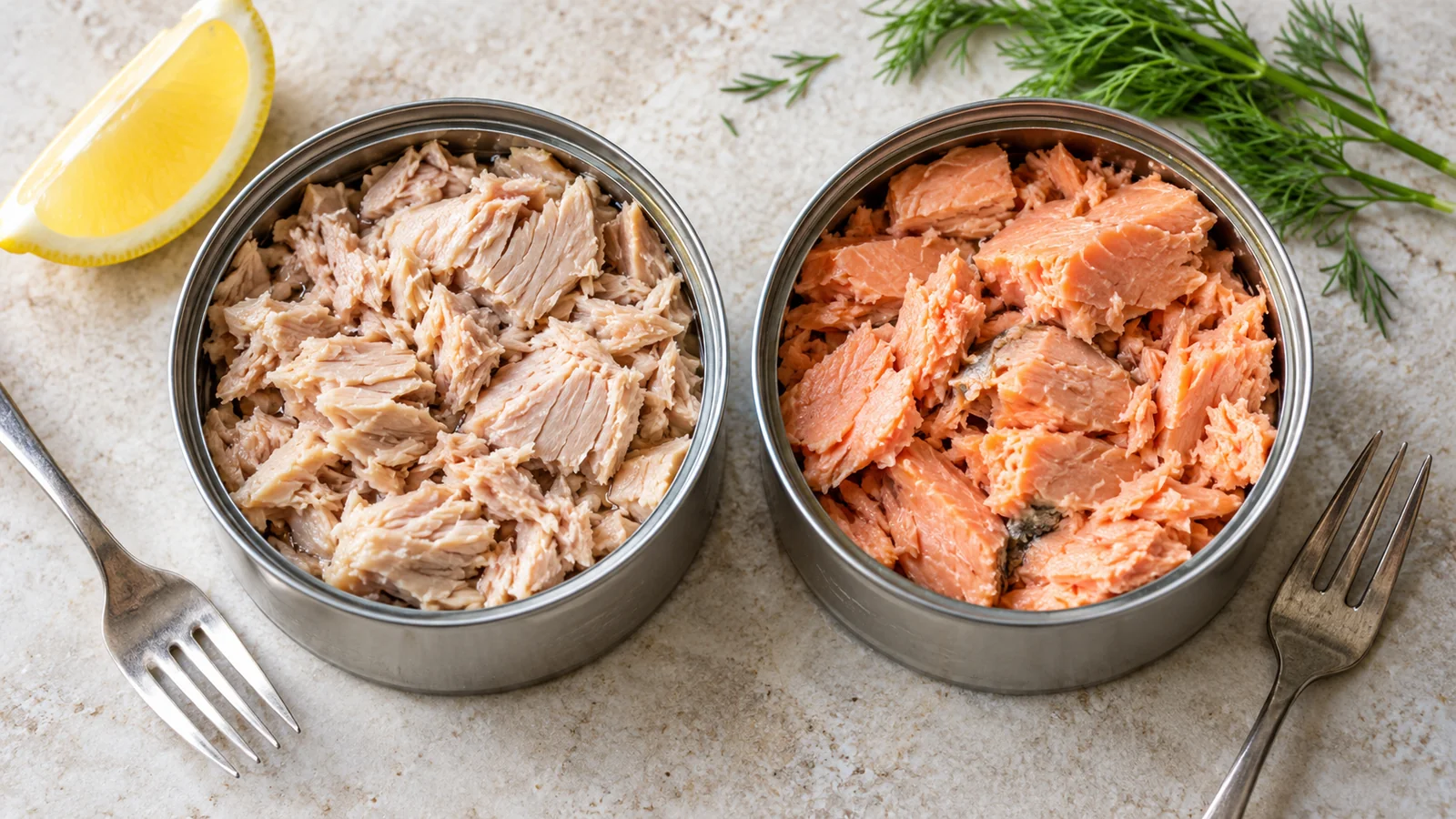
Canned salmon is often the stronger choice when you want more marine omega-3 fats and a lower-mercury fish. Canned light tuna can be a convenient, budget-friendly protein option. Both can fit a varied diet, but tuna species matters: canned light, albacore, yellowfin, and bigeye are not interchangeable when considering mercury.
Published October 10, 2026.
The best purchase depends on more than the largest protein number. Consider the fish species, the portion you will eat, whether it is packed in water or oil, sodium, bones, price, and the meals you enjoy. For pregnancy, breastfeeding, and children, follow the specific FDA/EPA fish guidance rather than a generic recommendation to eat tuna every day.
The quick comparison
- For marine omega-3 fats: canned salmon generally has an advantage over canned light tuna, with amounts varying by product and species.
- For lower-mercury choices: salmon and canned light tuna appear in the FDA/EPA Best Choices category; other tuna types can fall into different categories.
- For calcium: canned salmon that includes edible bones can contribute more than a boneless version.
- For a mild sandwich filling: tuna may match the flavor and texture you prefer, though taste is personal.
- For budget: compare the usable amount and actual shelf price. Neither fish is always cheaper in every store.
- For protein: both are useful options. Compare equal portions and the labels on the products you are buying.
Think of this as a choice between useful ingredients, not a contest with one universally healthy winner. Salmon can be the better fit for one meal and tuna for another. Your usual eating pattern matters more than proving that one can is perfect.
Start by identifying the tuna
“Tuna” describes several species and product categories. The distinction matters because mercury levels differ. The current FDA/EPA fish chart places salmon and canned light tuna, including skipjack, in Best Choices. Albacore or white tuna, including canned albacore, and yellowfin tuna are Good Choices. Bigeye tuna is in Choices to Avoid for the populations covered by the advice.
Read the product name and species information rather than assuming all tuna has the same profile. “White tuna” means albacore, not a lighter-colored version of canned light tuna. If a product specifically identifies yellowfin, do not automatically treat it as equivalent to skipjack because the package looks similar to another tuna can.
When the labeling is unclear, check the manufacturer’s information or choose a clearly identified alternative. You do not need to become a fisheries specialist to shop well. You do need enough information to avoid treating several different fish as one uniform food.
Salmon also comes in different species and preparations, such as pink or sockeye and products with or without skin and bones. These differences can affect taste, texture, price, and nutrients. The same broad product category does not guarantee identical nutrition from can to can.
Mercury guidance for pregnancy, breastfeeding, and children
The FDA/EPA advice is specifically designed for people who might become pregnant, are pregnant, or are breastfeeding, and for children ages one through eleven. For the adult group, it recommends two to three four-ounce servings per week from Best Choices, or one serving from Good Choices. The FDA’s questions and answers clarify that choosing one Good Choices serving means no other fish that week.
For children, the advice recommends two weekly servings from Best Choices, using smaller age-appropriate portions: approximately one ounce at ages one to three, two ounces at ages four to seven, three ounces at ages eight to ten, and four ounces at age eleven. These are fish portions, not necessarily one whole can or pouch.
Keep those categories attached to the guidance. A plan that mixes several albacore meals with additional fish is different from the one-Good-Choices-serving pattern. Likewise, a large can containing several portions is not automatically a single serving because it comes in one package.
The aim is to include nutritious lower-mercury fish, not eliminate fish out of fear. If you have a specific medical situation, unusually frequent fish intake, or questions about a child’s needs, ask your clinician or dietitian how the advice applies. This article is general information, not an individualized exposure assessment.
What about adults outside those groups?
The FDA notes that lower-mercury fish are a good choice for everyone and that everyone can follow its advice. For a practical routine, vary your protein sources and fish choices. There is no need to build a daily tuna habit simply because it is convenient or easy to count.
A rotation can include salmon or canned light tuna alongside eggs, beans, lentils, tofu, dairy foods if suitable, poultry, or other foods you enjoy. This keeps meal planning flexible and reduces reliance on a single product. It also allows you to choose different textures and flavors across the week.
Do not try to solve mercury concerns by rinsing, draining, or reheating tuna. The FDA explains that mercury is present throughout fish tissue and is not removed by ordinary cleaning or cooking. Choosing suitable species and following relevant frequency guidance are more meaningful than changing how you prepare the same fish.
Protein: compare the portions, not the headline
Both canned tuna and salmon can anchor a protein-containing meal. However, comparing “grams per can” can be misleading when cans differ in size or serving count. Packing liquid and drained weight can add another complication. Read the serving basis before deciding which product provides more.
For a hypothetical comparison, suppose a tuna label lists 20 grams of protein per 85-gram drained serving, and a salmon label lists 18 grams per 85-gram drained serving. On that equal basis, the tuna provides two additional grams. These are sample label numbers for explaining the method, not universal values for tuna and salmon.
If you eat one and a half of those tuna servings, the contribution is 20 × 1.5 = 30 grams. If you eat two of those salmon servings, it is 18 × 2 = 36 grams. The product with slightly less protein per equal weight can still contribute more in the portion you actually eat.
Use the same method when a can lists multiple servings. If a can has two servings and each lists 13 grams, the whole can contributes approximately 26 grams. Do not compare that whole-can amount against a different product’s half-can number. Our guide to reading nutrition labels for protein walks through these calculations.
Omega-3 fats: where salmon often stands out
Fish can provide the marine omega-3 fats EPA and DHA. The NIH Office of Dietary Supplements food table lists 0.63 grams of DHA and 0.28 grams of EPA for three ounces of drained canned pink salmon. Added together, that is 0.91 grams of EPA plus DHA.
The same table lists 0.17 grams of DHA and 0.02 grams of EPA for three ounces of drained canned light tuna in water, totaling 0.19 grams. These defined examples illustrate why salmon is often selected for marine omega-3s. They are not guarantees for every brand, tuna species, or can of salmon.
A product’s total fat line does not tell you its EPA and DHA content. Oil added during packing contributes fat but does not automatically make an oil-packed tuna equivalent to salmon in marine omega-3s. Unless the label or manufacturer provides specific information, avoid inferring an exact omega-3 amount from total fat alone.
You also do not need to translate this comparison into a promise that one lunch will improve a particular health marker. Nutrients function within an overall dietary pattern. Use the information to diversify your meals and choose foods that fit your preferences rather than expecting a dramatic effect from a single ingredient.
Calcium, bones, and other label differences
Some canned salmon includes soft, edible bones, while other products are sold boneless. The NIH calcium resource identifies canned salmon with bones as a calcium source. Its example of three ounces of canned pink salmon solids with bones provides 181 milligrams of calcium. A boneless product should not be assumed to provide the same amount.
If you like bone-in canned salmon, mash the soft bones thoroughly into a salad or filling. If the texture bothers you, choose boneless or remove them, recognizing that the nutrition profile changes. There is no benefit in forcing yourself to eat a texture that makes the meal unappealing when other calcium-containing foods can fit your diet.
Products can also differ in vitamin D, sodium, and other nutrients. Compare the actual labels when one of those nutrients is important to you. A generic online entry might describe a different salmon species, packing method, or edible portion than the product in your pantry.
Water-packed, oil-packed, and flavored products
Water-packed fish can be convenient when you want to control the dressing yourself. Oil-packed fish may offer a texture or flavor you prefer. Neither format is automatically the right choice for every meal. Consider whether you plan to use or drain the packing liquid and what the label says about its nutrition basis.
If you add oil-packed fish and then pour all the remaining oil into a salad, your meal differs from one made with drained fish. Conversely, a label based on drained solids should not be treated as an exact estimate for a meal that includes the entire packing liquid. When uncertain, look for the manufacturer’s preparation details.
Flavored pouches can save time, but seasonings, sauces, and portion sizes vary. Compare sodium and ingredients as well as protein. Someone who needs a specific sodium limit should follow their clinical plan rather than assume all canned fish is either unsuitable or low in sodium.
Plain fish plus lemon, herbs, mustard, chopped vegetables, or a dressing you enjoy gives you more control over the final flavor. A flavored product can still be a reasonable convenience choice. The better option is the one that fits your needs and gets used.
Which is better value?
Use the shelf price and usable fish amount rather than a universal assumption that tuna is cheap and salmon is expensive. Sales, package sizes, brands, species, and boneless preparation can all change the comparison. Small pouches may cost more per portion but reduce leftovers if you only need one meal.
Consider an invented example: a $2.40 can provides two usable portions, while a $1.80 pouch provides one. The can costs $1.20 per portion, so it is cheaper if both portions are eaten. If half the can is routinely discarded, that apparent saving disappears.
You can also compare cost per amount of protein, but do not let that erase other benefits. A food that contributes more EPA and DHA or calcium can have value beyond protein alone. Choose the comparison that reflects why you are buying it.
For broader options, use our budget high-protein grocery list. A low-cost food routine usually works best when several affordable staples share the workload rather than one product appearing in every meal.
Four practical meals using either fish
1. Lemon-herb fish and white bean bowl
Combine a portion of drained tuna or salmon with rinsed white beans, chopped cucumber, parsley, lemon juice, and a little olive oil. Serve with bread or a grain you enjoy. Add the fish last and fold gently if you want larger flakes rather than a mashed texture.
For a hypothetical protein calculation, a fish portion providing 22 grams plus beans providing 7 grams gives 29 grams before counting the bread or grain. Replace those sample numbers with your own labels. The beans also help turn a small amount of fish into a more substantial mixed meal.
2. Salmon or tuna yogurt sandwich
Mix drained fish with plain yogurt or mayonnaise, chopped celery, black pepper, and mustard. Use enough dressing for the texture you prefer rather than following a rigid spoon count. Add lettuce or cucumber just before eating so the bread stays firmer.
If you use yogurt, check that it is plain and suitable for your dietary needs. The amount of protein it adds depends on the product and quantity, so do not count a small spoonful as an entire yogurt serving. Pack the prepared sandwich cold.
3. Warm tomato fish pasta
Cook pasta according to its package, warm a tomato sauce with vegetables, and fold in canned fish near the end. Salmon gives a richer flavor; tuna may be a familiar option for a pantry meal. Add lemon zest, capers, or herbs if you like them.
Commercially canned ready-to-eat fish does not need the same preparation as raw fish. Follow package directions and handle the completed dish as perishable food. Cook only the amount you expect to use promptly, or divide leftovers for safe storage.
4. Fish, potato, and green bean plate
Pair cooked potatoes and green beans with flaked fish and a mustard-lemon dressing. This works warm or chilled when stored correctly. Keep the dressing separate if preparing ahead and add it when serving to preserve the textures you prefer.
For portable variations and packing ideas, see high-protein lunches without a microwave. A meal that needs no reheating can still require refrigeration; those are separate considerations.
Store unopened and opened fish differently
An intact, commercially shelf-stable can or pouch can be stored according to its package directions in a cool, dry place. Once opened, the fish becomes perishable. Do not assume a tuna salad remains shelf-stable because its main ingredient originally came from a can.
USDA guidance for opened canned foods gives three to four refrigerated days for low-acid foods such as fish. Transfer leftovers to a covered food-safe container, label the opening date, and keep the refrigerator at 40°F or below. Follow a shorter package instruction when applicable.
Under USDA food-safety guidance, refrigerate perishable food within two hours, or within one hour when the temperature is above 90°F. A work bag, parked car, or picnic table does not provide safe cold storage. Use adequate cold sources when transporting a prepared fish meal.
Do not taste food from a bulging, leaking, or badly dented can to check whether it is safe. USDA’s damaged-can guidance advises against using such products. A bargain is not worth taking a chance on compromised packaging.
Choose a can by the job it needs to do
If you want a fish that contributes marine omega-3s and you enjoy its flavor, start by comparing canned salmon products. Decide whether bones and skin suit the recipe, then look at serving size, sodium, and price. Paying for a boneless product may be worthwhile if that is the version you will actually use.
If your priority is a familiar sandwich filling, compare clearly identified canned light tuna products and keep the relevant fish guidance in view. Choose a package that matches your meal size rather than opening a large container without a plan for the rest. A single-portion pouch can be useful for an occasional lunch even when its unit price is higher.
If you are choosing for a household with different preferences, buy one small package of each before purchasing a multipack. Prepare the same simple meal with both and compare taste, texture, and convenience. A practical taste test tells you something a nutrient table cannot: which option your household will enjoy eating again.
Plan leftovers before opening the package
A large can can serve two separate meals when handled safely. Decide on both meals first: perhaps a fish-and-bean bowl today and a sandwich tomorrow. Portion the unused fish with clean utensils, refrigerate it promptly, and keep its original opening date attached to the container.
Mixing yesterday’s fish into a fresh salad does not give the older ingredient a new storage clock. Likewise, adding lemon juice or vinegar does not make an ordinary homemade fish salad shelf-stable. Use the shortest applicable storage guidance for the ingredients and discard food that has spent too long out of refrigeration.
If you regularly forget leftovers, smaller packages may be the more sensible purchase. For a more complete system of cooling, labeling, and packing meals, read our meal-prep food-safety guide. Convenience works best when safe storage is part of the plan from the beginning.
Frequently asked questions
Is canned salmon always healthier than tuna?
No single label decides the entire question. Salmon often offers more EPA and DHA and is a lower-mercury choice, while tuna may suit your taste, budget, or meal. Compare the species and actual product, then consider your overall eating pattern.
Can I eat tuna every day for protein?
This guide does not recommend daily tuna. Species, portion size, total fish intake, and personal circumstances matter. Use lower-mercury variety and the relevant FDA/EPA guidance, especially during pregnancy or breastfeeding and when feeding children.
Does draining remove mercury?
No. Mercury is in the fish tissue. Draining may change how much packing liquid you consume, but it is not a mercury-removal strategy. Choosing appropriate fish types matters more.
Are canned salmon bones required?
No. Bone-in salmon can contribute calcium, but boneless salmon is a valid preference. Check the label and use other appropriate calcium sources if you do not eat the bones.
For your next grocery trip, choose one clearly identified fish product, compare its serving size, and plan a meal you will enjoy. Keep variety in the week and use the relevant fish guidance. To support the activity side of your routine, explore Workit on the App Store.