
Published October 27, 2026
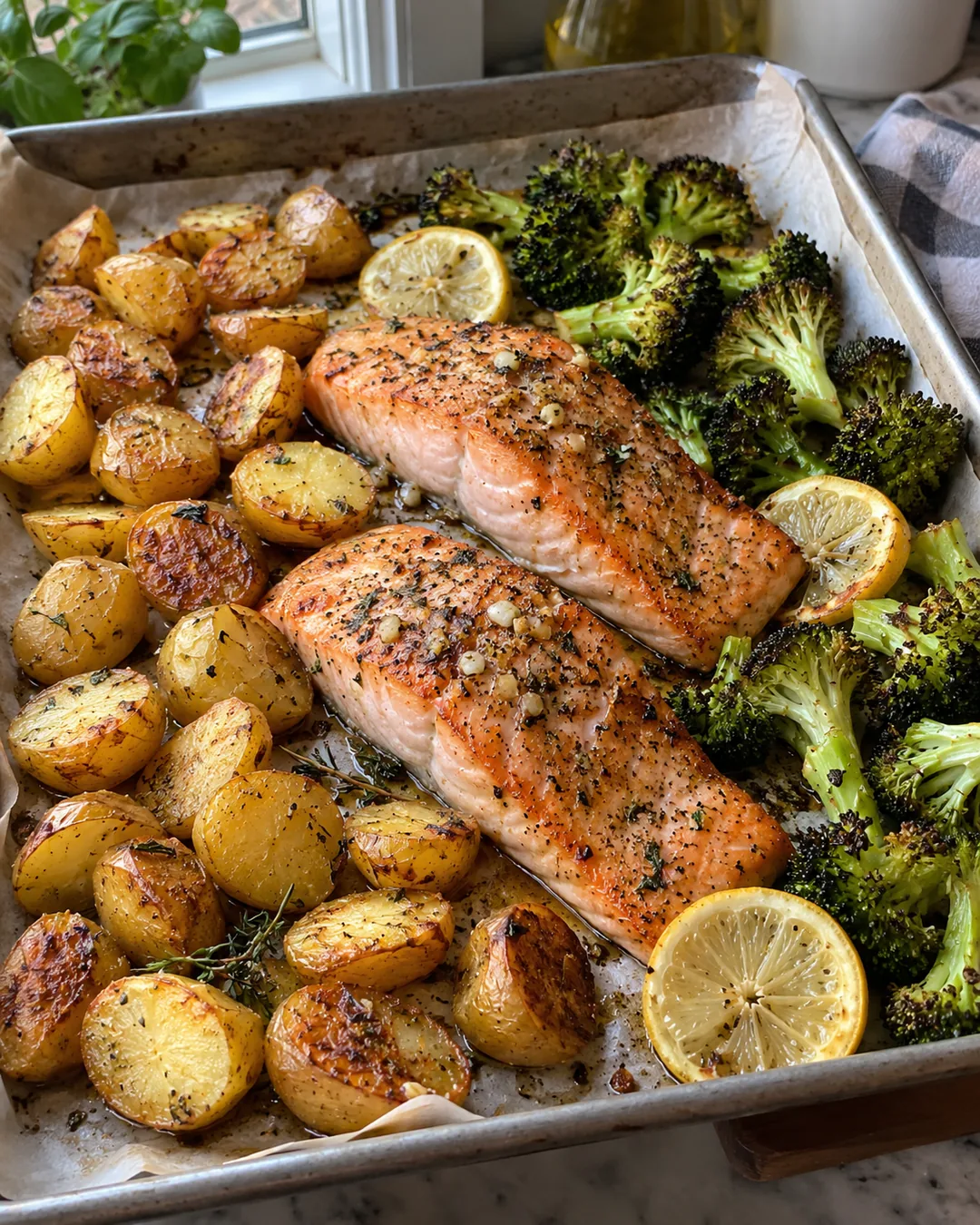
The easiest way to make a salmon traybake with potatoes and broccoli is to roast the potatoes first, add the broccoli next, and add the salmon only when the vegetables are close to ready. This staged method gives each ingredient a suitable cooking window. Check the thickest part of the salmon reaches 145°F/63°C rather than relying on a single oven time.
A traybake is useful because most of the work happens before the food goes into the oven. The challenge is that a potato and a salmon fillet do not cook at the same speed. This lemon-and-paprika version solves that mismatch without requiring several pans on the stove.
Salmon traybake overview
- Serves: four
- Preparation: approximately 20 minutes with thawed fish
- Oven time: approximately 35–45 minutes in stages
- Oven setting: 425°F/220°C conventional, or around 400°F/200°C fan
- Equipment: a large rimmed metal baking tray, mixing bowl, spatula, and food thermometer
Use the timing as a planning range. Oven calibration, tray material, potato size, and fish thickness all affect the result. A second tray is useful if the food cannot sit in a mostly single layer; there is no benefit to forcing a four-person dinner into a pan that is too small.
This recipe is specifically about a complete potato, broccoli, and salmon dinner. For a broader system for combining ingredients across the week, see our sheet-pan meal-prep guide. Here, the important detail is the order of the ingredients, not a promise that every tray meal can go into the oven at once.
Ingredients
- 4 raw salmon fillets, approximately 150 g each, for 600 g total
- 800 g potatoes, scrubbed and cut into approximately 2 cm pieces
- 500 g broccoli, cut into medium florets, with peeled stems sliced thinly
- 3 tablespoons olive oil, divided
- 1 lemon
- 2 teaspoons sweet or smoked paprika, divided
- 1 teaspoon garlic powder, divided
- 1 teaspoon dried oregano or thyme
- 1/2 teaspoon fine salt, divided, or less according to preference
- Black pepper to taste
- Chopped parsley or dill, optional
Skin-on or skinless salmon can work. Use pieces of similar thickness where possible. Four fillets with equal weights may still have different cooking times if one is a thin tail piece and another is a thick center cut.
The potatoes are weighed before cooking, and the salmon weight is raw edible fish. If your package includes a large amount of glaze, packaging liquid, or non-edible material, do not assume the package weight is the same as the amount going onto the tray. Check the product instructions before thawing or preparing it.
Step-by-step method
- Preheat and prepare. Heat the oven to 425°F/220°C conventional or around 400°F/200°C fan. Use a large rimmed metal tray. If lining it, choose parchment rated for the oven temperature and follow its instructions.
- Season the potatoes. Toss the potato pieces with 1 1/2 tablespoons oil, one teaspoon paprika, half the garlic powder, the dried herb, about half the salt, and black pepper. Spread them across the tray with cut sides against the metal where practical.
- Give the potatoes a head start. Roast for about 20 minutes. Turn them, then check a larger piece with a fork. It should be beginning to soften but need more time.
- Add broccoli. Toss the broccoli with one tablespoon oil and a little of the remaining salt. Add it around the potatoes, leaving space for the salmon. Roast for another five to eight minutes.
- Prepare the salmon. Pat the surface dry. Rub with the remaining half-tablespoon oil, remaining paprika and garlic powder, a little lemon zest, and pepper. Use the remaining salt according to preference.
- Add the fish. Place salmon skin-side down, if it has skin, into clear spaces on the tray rather than on top of a mound of vegetables. Return the tray to the oven.
- Check early. Begin checking after about eight minutes. Many fillets may take roughly 10–15 minutes at this stage, but thickness matters. Measure the thickest part and cook to 145°F/63°C. Check each fillet rather than assuming they finish together.
- Separate finished components if necessary. Move cooked salmon to a clean plate if the potatoes need longer. Continue roasting the vegetables until the potatoes are tender and the broccoli reaches your preferred texture.
- Finish and serve. Add lemon juice and herbs after roasting. Divide the salmon, potatoes, and broccoli into four servings.
The salmon temperature follows the FoodSafety.gov minimum-temperature chart. A browned surface is not a substitute for checking the center. Keep the thermometer tip away from the hot tray so you measure the fish, not the metal underneath it.
Why potatoes go first
A 2 cm potato piece needs time for its center to soften. Salmon cooks much more quickly, especially in a thin portion. Starting both together can leave you with firm potatoes and fish that has already been in the oven longer than necessary.
The head start also gives potatoes more contact time with the hot tray before other ingredients release moisture. Spread them rather than leaving them in a heap. The same quantity on a larger surface behaves differently from the same quantity piled several pieces deep.
Cut size is one of the most useful variables you can control. If half the potatoes are 2 cm pieces and the others are much larger, you will spend the final stage waiting for the largest ones. Cut the unusually large pieces again before seasoning.
You do not have to peel the potatoes unless you prefer them that way. Scrub them, remove damaged areas, and keep the pieces reasonably uniform. The point is a dependable dinner, not making every piece geometrically identical.
How to judge salmon thickness
Look at the side of each fillet before cooking. A thick, block-like center cut generally needs more time than a thin, tapering tail piece. If your package contains both, keep the thinner piece in an easy-to-reach spot so you can remove it first.
Do not solve uneven thickness by cooking everything until the largest piece is ready and hoping the others will be fine. Check each one. A small amount of extra attention near the end is more effective than a complicated marinade intended to compensate for overcooking.
For a very thin tail portion, you can fold the thin end underneath to make the piece more even. The folded area still needs a proper temperature check. Do not hide a thick layer underneath and then measure only the top surface.
When using an instant-read thermometer, insert it from the side if that gives better access to the thickest center. Take a moment to read the thermometer instructions so you know where its sensing area is. This matters more than memorizing a universal salmon baking time.
Skin-on versus skinless salmon
Skin-on portions can be convenient because the skin provides a recognizable bottom surface. Place that side against the tray. This recipe does not promise crisp skin: a tray crowded with vegetables and cooking juices is a different environment from a dedicated pan-searing method.
If you do not want to eat the skin, leave it on while cooking and separate the flesh when serving. Account for the edible portion consistently if you are tracking food. A package serving size may describe the product in a different form from what remains on your plate.
Skinless salmon also works. Lightly oil the clear tray spaces or use suitable parchment to reduce sticking. Lift the fillet with a wide spatula instead of trying to pull it up with narrow tongs that can break the flesh.
Check for occasional bones regardless of whether the package describes the fish as boneless. If you find one, remove it carefully before serving. This is especially worth doing when preparing portions for someone who may have difficulty spotting small bones.
Fresh and frozen salmon
Frozen salmon is a practical option, but this staged recipe assumes thawed fish. Follow your package’s directions, particularly for vacuum-packed portions. Do not leave fish in its reduced-oxygen packaging while thawing when the label directs you to remove it.
Florida’s food-safety guidance explains that vacuum-packed fish should be fully removed from the reduced-oxygen package before thawing, rather than merely piercing it. Transfer it to a suitable covered container in the refrigerator and follow the product’s handling instructions.
The FDA advises keeping seafood cold and preventing raw seafood from contaminating ready-to-eat food. Keep lemon wedges and herbs for serving away from the board or plate used for raw salmon.
If the product specifically instructs cooking from frozen, use that method and adjust the vegetable schedule separately. Do not treat a frozen fillet as interchangeable with a thawed one in the stated eight-minute first check. The outside and center will heat differently.
A nutrition example with clear limits
Salmon nutrition differs by species and product. For a concrete label example, High Liner’s Atlantic salmon portion page lists 23 g protein and 230 calories per 113 g portion. These values are an example, not a universal salmon entry.
Using that label, 600 g of salmon provides 600 ÷ 113 × 23, or approximately 122 g protein across the batch. Dividing into four equal portions gives about 30.5 g protein from the salmon per person.
The corresponding salmon-only energy subtotal is 600 ÷ 113 × 230, about 1,221 calories in the batch, or 305 per portion. Potatoes, broccoli, oil, and any sauce add to that. This guide does not present the salmon subtotal as complete traybake nutrition.
If your fillets are already portioned at 113 g each, four of those pieces are 452 g, not 600 g. With that exact product, one labelled portion would supply the stated 23 g protein before adding the rest of the meal. Match the quantity you actually use to the correct label.
Our protein-label guide explains how to compare serving sizes. For this dinner, it is usually simpler to calculate the fish, potatoes, and measured oil separately than to search for a generic “salmon traybake” entry that may describe a very different recipe.
Adjust portions without changing everything
The recipe gives each person one 150 g raw salmon portion, 200 g raw potatoes, and 125 g raw broccoli before cooking. Those are recipe divisions, not a prescription for everybody’s needs. Appetite, other meals, and personal preferences vary.
For a more substantial meal, increase the potatoes or add bread, rice, or another side. If adding more potatoes to the tray, check that there is still enough space. More food can require a second tray even when the ingredient substitution itself is simple.
For a smaller meal, use smaller portions and save the remainder promptly. There is no requirement to remove the potatoes to make the dish suitable for someone who exercises. A satisfying meal can include fish, vegetables, and a starch together.
If your household has different preferences, serve the components separately. One person can take extra broccoli, another extra potatoes, and another a larger piece of fish. Pre-portioning every plate identically is not necessary unless it helps your particular planning system.
Vegetable substitutions and their timing
Cauliflower florets can replace broccoli, but large dense pieces may need a longer head start. Cut them smaller or put them in with the potatoes sooner. Check tenderness before adding the salmon, so the fish is not left waiting for the vegetable.
Green beans can work in the later vegetable stage. Trim them, dry them after washing, and monitor their texture. Very thin beans may need less time than thick broccoli florets, so do not use the same schedule without checking.
Carrots need attention to shape. Thin batons can join the potatoes early; thick rounds take longer. Zucchini, by contrast, releases more moisture and softens quickly, so it belongs later and may benefit from a separate tray.
For frozen vegetables, follow package instructions and expect more released water. The frozen-vegetable guide offers ways to handle that difference. Avoid making the salmon sit in a puddle while trying to evaporate vegetable water at the end.
Flavor variations
For a dill-and-lemon version, omit the paprika and add chopped dill after roasting. Keep the garlic powder, oil, and lemon zest. Fresh herbs are easier to notice when added near serving rather than being exposed to the full potato roasting time.
For a mustard version, spread a small amount of prepared mustard over the salmon before it goes into the oven. Check its salt content and reduce added salt if appropriate. Mustard is an allergen for some people, so treat it as an ingredient change rather than an invisible seasoning.
For a spicier version, add chili flakes to the fish seasoning. Keep some portions mild by seasoning them separately. You can also serve a spicy sauce at the table, which is useful when the rest of the household prefers the base recipe.
A cool yogurt sauce can accompany the meal, but make it in a clean bowl and keep it refrigerated until serving. The sauce is optional. Do not use it to disguise fish that has been stored improperly or left out too long.
Troubleshooting the tray
The potatoes are still hard
Take the cooked salmon off the tray and continue roasting the potatoes. Next time, cut the potatoes smaller or extend their initial stage. The useful correction is more potato time, not more salmon time.
The broccoli is burning at the tips
Use slightly larger florets, move them away from the hottest tray edge, or add them later. If the stems remain hard while the tops darken, cut the stems thinner. A single broccoli floret can contain parts that cook at different rates.
The tray is watery
Dry the washed vegetables and thawed fish surfaces before cooking. Increase tray space and avoid stacking ingredients. If using frozen vegetables, manage their moisture before the fish finishes rather than trying to fix everything with extra roasting time.
The salmon sticks
Use suitable parchment or a lightly oiled tray area, and lift with a broad spatula. Let the utensil slide under the fish instead of pulling upward from one corner. Some sticking is a serving problem, not evidence that the meal is unsafe.
Leftovers and next-day meals
Refrigerate promptly in shallow containers at 40°F/4°C or below. Keep total room-temperature time under two hours, or one hour above 90°F/32°C. Use leftovers within three to four days and reheat to 165°F/74°C, consistent with FoodSafety.gov storage guidance and its temperature chart.
Pack fish and vegetables separately if you want more control over reheating. The potatoes may need a different amount of time from the salmon. Reheat only the amount you will eat, and check the center rather than assuming steaming edges mean the whole portion is ready.
For a cold lunch, keep the food continuously chilled and pack it with an appropriate cold source during transport. A cold salmon-and-potato salad is a serving choice, not a reason to leave cooked fish at room temperature. Add any fresh leaves or dressing at the time of eating.
Frequently asked traybake questions
Can I use a glass baking dish?
A suitable oven-safe dish can cook the meal, but it may not give potatoes the same browned underside as a metal tray. Follow the manufacturer’s temperature and handling instructions, including any restrictions on sudden temperature changes. Do not preheat an empty glass dish unless its instructions explicitly allow that use. If browning is your priority, a rimmed metal tray is the more straightforward choice here.
Should I cover the tray?
This method is designed for uncovered roasting. Covering traps moisture and changes the vegetable texture. If one component needs protection from browning, move or remove it rather than automatically covering the entire meal. Be careful with steam if you do use a cover, and keep any foil away from oven elements according to appliance guidance.
Can I prepare the ingredients the night before?
You can wash the broccoli, measure the seasonings, and organize the tray and utensils. Keep prepared vegetables refrigerated and dry their surfaces before roasting. Prepare and store raw fish according to its package instructions, separately from ready-to-eat foods. Potatoes cut far ahead need suitable storage to prevent discoloration; cutting them shortly before cooking is often the simplest route for this recipe.
What if dinner is for two?
Halve the ingredients but keep the staged method. A smaller quantity does not mean potatoes suddenly cook as quickly as fish. Use a tray that leaves enough room without scattering a tiny amount of food over an unnecessarily large surface. Start checking the fish early, and judge doneness from the actual portions rather than halving the cooking time mathematically.
For a stovetop seafood alternative, try ginger-garlic shrimp stir fry. It uses a different cooking sequence and its own doneness checks; portions and nutrition also depend on the ingredients you use.
Your next traybake can be simpler
Note the size of your potato pieces, the thickness of the salmon, and when you added each ingredient. Those details help you repeat a good result in your own oven. A generic cooking time is less useful than understanding which component needed the head start.
For a different fish recipe, explore our baked cod guide. For support with your exercise routine alongside everyday cooking, see Workit on the App Store. Keep the routine realistic enough to use on an ordinary weeknight.