
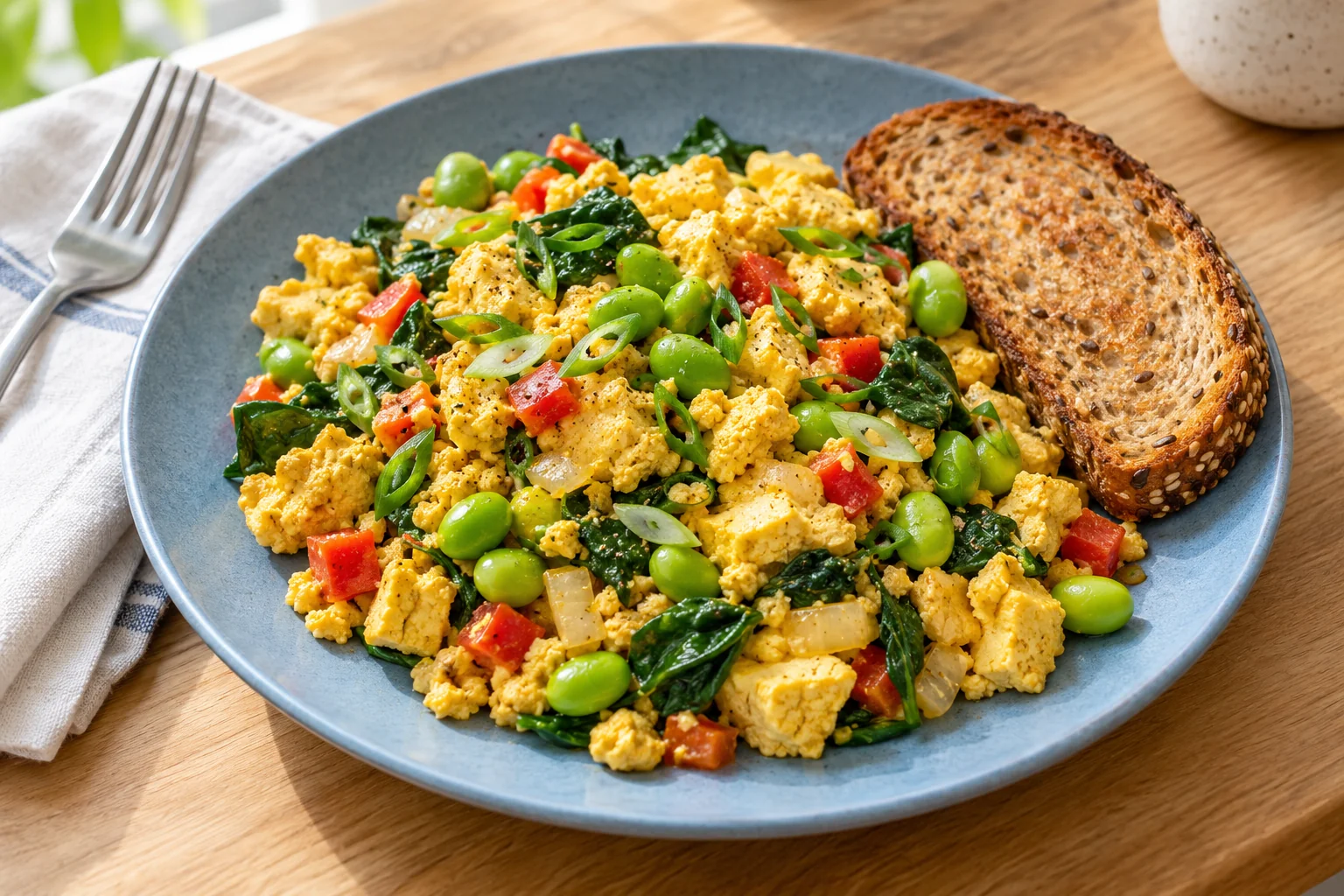
A satisfying high-protein tofu scramble starts with enough tofu, a generous handful of edamame, and a little moisture added at the end. This vegan recipe combines 400 g extra-firm tofu with 160 g shelled edamame, peppers, and spinach to make two substantial servings in about 25–30 minutes. The result is tender and savory, not a pan of dry yellow crumbs.
Published October 20, 2026
Depending on your ingredient labels, the tofu and edamame alone can supply around 33 g protein per serving. That is an example based on specific assumptions explained below, not a guaranteed figure for every tofu brand. Bread, potatoes, toppings, and the other ingredients change the complete meal.
You do not need protein powder or an elaborate spice collection. The useful decisions are simpler: choose tofu with a texture you enjoy, cook watery vegetables first, keep some larger curds, and stop cooking before the pan dries out. This guide covers the full measured recipe, protein math, substitutions, meal prep, and the common reasons a scramble turns bland or rubbery.
High-protein tofu scramble at a glance
- Yield: two substantial breakfast or lunch servings, or four smaller side servings.
- Prep: about 10 minutes.
- Cooking: about 15–20 minutes.
- Total: about 25–30 minutes, depending on the edamame package instructions.
- Dietary pattern: vegan as written.
- Main allergens: soy; check the labels of every packaged ingredient and any sides.
- Equipment: kitchen scale, large nonstick or well-seasoned skillet, spatula, bowl, and the equipment needed to cook the edamame.
A 28–30 cm skillet gives the vegetables and tofu room to cook without piling everything into a deep, steaming layer. A smaller pan is workable if you cook in batches. If you double the recipe, plan on two pans or two rounds rather than expecting one crowded skillet to behave the same way.
Ingredients for two substantial servings
- 400 g extra-firm tofu, drained but not heavily pressed.
- 160 g frozen shelled edamame, weighed without pods, then cooked according to its package instructions and drained.
- 10 g olive oil or another neutral cooking oil.
- 60 g onion, peeled and finely diced.
- 100 g red bell pepper, seeded and finely diced.
- 75 g baby spinach, washed and well drained.
- 60 ml unsweetened soy milk, plus 15–30 ml more if needed.
- 12 g nutritional yeast, optional.
- 2 g garlic powder, approximately ½–¾ teaspoon depending on the product.
- 1 g ground turmeric, approximately ⅓ teaspoon.
- 1 g smoked or sweet paprika, approximately ½ teaspoon.
- 1.5 g fine salt to start, approximately ¼ teaspoon.
- 0.5 g ground black pepper, approximately ¼ teaspoon.
- 5–10 ml lemon juice, to taste.
- 0.5 g kala namak, also called black salt, optional.
- 10 g sliced spring onion or chopped parsley, optional.
For serving, choose toast, a warmed tortilla, cooked potatoes, or another side that suits your appetite. Those additions are not included in the protein example later in this article. Keep optional sauces and toppings separate if you are making more than one meal.
The small spice measurements are flexible, but the tofu and edamame amounts determine much of the protein. Do not substitute a small handful of tofu and assume the nutrition is unchanged. If your block is 396 g rather than 400 g, using the whole drained block is perfectly reasonable; recalculate only if you need a closer estimate.
How to make a tender tofu scramble
1. Prepare the edamame and vegetables
Cook the frozen shelled edamame according to the package instructions, then drain well. Do this while you dice the onion and pepper. Different products have different preparation directions, so do not assume frozen beans are ready to eat merely because they have thawed.
Drain the tofu and gently blot its surface with a clean kitchen towel or paper towel. There is no need to squeeze it until completely dry. Crumble it into a bowl with clean hands or a fork, leaving a mixture of small pieces and curds about 1–2 cm across.
If all the tofu becomes tiny granules, the scramble will be more likely to feel dry. Varied curd sizes make the texture more interesting and leave some tender pieces that do not disappear among the vegetables.
2. Mix the seasoning liquid
In a small bowl, stir together the 60 ml soy milk, optional nutritional yeast, garlic powder, turmeric, paprika, regular salt, and pepper. Break up any large clumps. Keep the lemon juice and optional kala namak aside until the end.
This mixture distributes the spices more evenly than sprinkling turmeric onto a crowded pan. Nutritional yeast adds a savory flavor and helps the liquid cling to the tofu, but the recipe still works without it. If omitting it, begin with 45 ml rather than 60 ml milk, then add more as needed.
3. Cook the onion and pepper
Heat the oil in the skillet over medium heat. Add the onion and pepper and cook for 5–7 minutes, stirring periodically, until the onion softens and the pepper loses its raw crunch. Adjust the heat so the vegetables soften without burning at the edges.
If you prefer a very soft pepper, give this step a few extra minutes. Adding raw vegetables late and overcooking the tofu to compensate is an easy route to a dry scramble.
4. Heat the tofu without pulverizing it
Add the crumbled tofu and spread it across the skillet. Let it cook for about a minute before gently turning it. Continue cooking for 3–4 minutes, allowing excess surface moisture to evaporate while retaining the larger curds.
You can let a few pieces develop light golden edges, but this is not a recipe for crisp tofu. Constant, vigorous stirring breaks the curds down and can make the finished dish look and feel more like a finely minced filling.
5. Add the greens, edamame, and seasoning
Stir in the cooked, drained edamame and spinach. Cook for 1–2 minutes, until the spinach begins to wilt. Pour in the seasoning liquid, reduce the heat slightly, and fold everything together for another 2–3 minutes until the mixture is hot throughout and lightly coated.
The final texture should be moist but not swimming in liquid. If the pan looks dry, add soy milk or water 15 ml at a time. If liquid collects at the bottom, cook uncovered for another minute and check again before increasing the heat.
6. Finish and serve
Turn off the heat. Add 5 ml lemon juice, taste, and add more only if you want extra brightness. Sprinkle over the optional kala namak and herbs. Taste before adding further regular salt, especially if your black salt or toppings are strongly seasoned.
Divide the scramble into two equal portions and serve with your chosen side. For meal prep, transfer the portion you are saving into a suitable shallow container promptly rather than leaving it in the warm skillet while you eat.
Which tofu should you buy?
Extra-firm tofu: the straightforward starting point
Extra-firm tofu generally offers curds that are easy to crumble and turn without falling apart completely. It still contains enough moisture for a tender scramble when you avoid excessive pressing and cooking. Brand textures vary, so use the recipe’s final texture cues rather than expecting every block to behave identically.
Read both the product description and the nutrition panel. A package marketed as extra-firm can have a different protein content from another package with a similar name. The words on the front are useful for shopping, but the label is what you need for a calculation.
Firm tofu: softer, with a little more care
Firm tofu also works if you prefer softer curds. Drain and blot it, crumble gently, and allow any extra liquid to evaporate before adding the seasoning mixture. Begin with slightly less milk, then adjust. Do not press harder simply because the tofu is softer; that is not the only way to control moisture.
Nasoya’s firm-tofu guide identifies scrambles among suitable uses and describes blotting as one preparation option. For this recipe, that gentler approach is more useful than treating every block as if it were destined for crispy baked cubes.
Super-firm or high-protein tofu: check texture as well as numbers
Denser tofu can increase the protein in the same starting weight, depending on the brand. It can also make a chewier scramble. Break it into smaller, irregular curds and be prepared to add an extra splash of liquid at the end.
For a general ingredient comparison, see tofu versus tempeh. Tempeh can make a good savory breakfast, but it has a different structure and flavor. It is not a direct substitute if your goal is a soft tofu-style scramble.
Silken tofu: a different recipe texture
Silken tofu produces a much softer, wetter result and is not a one-for-one replacement in these instructions. It can be useful in creamy preparations, but combining it with the full milk quantity and the same turning method is likely to break it down. Choose firm or extra-firm tofu for the most predictable starting point here.
The protein calculation, without inflated claims
The main sources in this recipe are tofu and edamame. To illustrate the calculation, assume the tofu label lists 12 g protein per 100 g and the shelled edamame label lists 11 g per 100 g:
- 400 g tofu supplies 48 g protein under that assumption.
- 160 g edamame supplies 17.6 g.
- The combined total is 65.6 g, divided into two servings.
- That is about 33 g per serving from those two ingredients alone.
This is an illustrative subtotal, not an analyzed nutrition label. It does not include the soy milk, optional nutritional yeast, vegetables, toast, or toppings. Your actual total can be lower or higher, especially if the tofu label differs or you split the pan into more portions.
For example, a tofu providing 8 g protein per 100 g would contribute 32 g to the batch instead of 48 g. With the same edamame assumption, the two-ingredient subtotal would be about 25 g per serving, not 33 g. Neither result means the recipe failed; it means the ingredient changed.
To calculate from a label showing an 85 g serving, divide the amount you use by 85, then multiply by the listed protein grams. Repeat for each ingredient you want to include and divide the final total by your actual number of servings. Use the weight basis described on the package, particularly for frozen versus prepared foods.
USDA MyPlate includes soy products and legumes among vegetarian protein choices. This is a practical way to build a meal around them, not a promise of muscle gain, a prescription for a specific daily intake, or a requirement to eat the same breakfast every day.
What each flavor ingredient does
Turmeric: a small amount gives the scramble its warm yellow color. It is easy to add too much, producing an earthy or bitter taste. More yellow does not mean more protein or a more successful recipe.
Nutritional yeast: contributes a savory, sometimes cheese-like flavor. It is optional, and products differ. Do not assume it supplies vitamin B12 unless the package specifically lists fortification and the amount. The recipe does not depend on it for the main protein subtotal.
Kala namak: adds an egg-like sulfurous note that some people enjoy and others do not. Use a small amount at the end so you can control the intensity. It is seasoning, not a required ingredient or a reason to ignore the total salt you add.
Unsweetened soy milk: provides moisture and helps carry the seasoning. Check that the carton is plain and unsweetened; vanilla-flavored milk is a poor fit even if it has a similar protein number. Water works when you want the simplest substitution.
Lemon juice: brightens the finished dish. Add it gradually after cooking. A little can make the flavors more distinct, while too much can overpower the mild tofu and compete with toppings such as salsa or hot sauce.
Substitutions and useful variations
Without edamame
Use 160 g cooked, drained black beans or chickpeas. Fold them in gently and heat through. The meal will taste different, and the protein example must be recalculated from the replacement ingredient’s label. Green peas are another option, but they should not be treated as nutritionally identical to soybeans.
Without soy milk
Use water or a plain unsweetened plant drink. Start with the stated amount and adjust the final consistency. Some drinks have a stronger flavor or far less protein, so keep them out of any calculation unless you have checked their label.
Without nutritional yeast or black salt
Both can be omitted. Use the lower initial milk amount described in the method when leaving out nutritional yeast, then season with regular salt, pepper, herbs, and lemon. The scramble will still taste like a savory tofu dish; it does not need to resemble eggs to be worthwhile.
Mushroom variation
Replace the pepper with 150 g finely sliced mushrooms. Cook the mushrooms until their released moisture has mostly evaporated before adding tofu. Keep the spinach amount unchanged. This version has a more earthy flavor and benefits from the same careful final moisture adjustment.
Breakfast-wrap variation
Use the finished scramble as a filling with a small amount of salsa. Let excess steam escape briefly before wrapping so the tortilla does not immediately become soggy, while still following safe cooling limits. Pack wet toppings separately if the wrap will be stored rather than eaten straight away.
Allergy-aware variation
This recipe is not suitable for a soy allergy: both tofu and edamame contain soy, and the milk does too. FDA food-allergy guidance identifies soy among the major food allergens. A chickpea-based scramble would need its own recipe and nutrition calculation, not just a casual substitution of one soy ingredient.
Why tofu scramble turns dry, watery, or bland
Dry, squeaky, or rubbery curds
The usual practical fixes are gentler heat, less cooking time, and a little added moisture. Stir in 15 ml milk or water over low heat, fold rather than mash, and stop once it is absorbed. Next time, avoid heavy pressing and do not wait for every piece of tofu to brown.
A watery puddle around the food
Drain the edamame and spinach well, cook the vegetables before the tofu, and add the final liquid gradually. If the finished pan is already wet, simmer uncovered briefly. Raising the heat aggressively can dry the outer curds while leaving a watery base underneath.
Small yellow crumbs rather than soft curds
Start with larger pieces and turn them fewer times. Tofu does not need to be scrambled continuously like a particular egg technique you may have learned. If you already broke it down too much, use the mixture as a wrap or taco filling rather than trying to reconstruct large curds.
Bland despite plenty of turmeric
Turmeric is not the main savory seasoning. Check salt, garlic, the vegetable cooking step, and the finishing acidity. Taste a little cooled spoonful so heat does not obscure the flavor. Add one adjustment at a time rather than turning the spice jar upside down.
An overpowering egg-like smell
Use less kala namak or skip it. The recipe can be enjoyable without that flavor. Strong hot sauce is not the only remedy; it may simply add another dominant note. For a future batch, add black salt to individual plates so each person can choose the amount.
Make it a meal that fits your day
Toast is a convenient side, but it is not mandatory. A warmed tortilla turns the scramble into a portable lunch. Roasted or boiled potatoes make a more substantial plate, and leftover grains can turn it into a savory bowl.
Choose the portion around your appetite and schedule, not the photograph. Two servings here are substantial. Four smaller portions make sense as part of a larger breakfast spread, but each would contain half as much scramble as the two-serving protein example.
If you prefer to cook once and vary the meals, pair a scramble session with lentil bolognese for dinners. The dishes share ordinary vegetables and simple equipment while tasting different enough to avoid an entire week of nearly identical food.
Meal prep and storage
Refrigerate in shallow containers within two hours, or one hour if the temperature exceeds 90°F/32°C. Keep refrigerated at 40°F/4°C or below, use within three to four days, and reheat leftovers to 165°F/74°C. Stir while reheating and check the center with a thermometer. These limits follow USDA leftover guidance.
For the best eating experience, refrigerate the scramble separately from toast, herbs, salsa, and sliced avocado. Reheat gently in a skillet with a small splash of water, or microwave in a suitable covered, vented container, pausing to stir. The splash restores moisture; it is not a substitute for reaching a safe temperature.
Freezing is possible, but expect the tofu texture to become firmer or more spongy after thawing. If texture matters to you, freeze one portion before committing a large batch. Aim to use frozen portions within about one to two months for quality, thaw in the refrigerator, and reheat thoroughly.
For a broader preparation framework, see high-protein vegetarian meal prep. If your household is small, meal prep for one can help you choose a batch size that actually gets eaten rather than making the largest possible pan.
Frequently asked questions
Do I need to press tofu for a scramble?
Not heavily for this version. Drain and blot it, then control moisture in the skillet. A deeply pressed block may be useful for another dish, but this recipe aims for tender curds rather than crisp cubes. Adjust the finishing liquid to your particular tofu.
Can I make it without oil?
You can soften the vegetables in a good nonstick pan with small additions of water, then continue with the tofu. Expect less browning and a different flavor. Keep a close watch for sticking, and do not compensate by adding so much water that the vegetables boil.
Does tofu scramble taste exactly like eggs?
No. Turmeric changes the color, and optional kala namak can add an egg-like aroma, but tofu has its own texture and flavor. Think of this as a satisfying savory breakfast in its own right rather than a guaranteed indistinguishable replacement.
Can I prepare the ingredients the night before?
Yes. Chop the vegetables and store them refrigerated in covered containers. Mix the seasoning liquid separately and refrigerate it too. Keep tofu refrigerated according to its package instructions. Having the components ready makes the morning cooking simpler without leaving a fully assembled wet mixture sitting overnight.
Can I eat this after a workout?
It can be one meal option if it fits your appetite, dietary needs, and overall intake. Add the sides you want rather than assuming a bowl of tofu alone is the only appropriate choice. The recipe does not promise a particular recovery or muscle-building result.
The simplest way to improve your next scramble
Begin with the tofu label, cook the vegetables first, and keep the curds moist. Those decisions are more useful than chasing the brightest yellow color or the largest protein claim. Once the basic method feels comfortable, change one vegetable or seasoning at a time so you know what works for you.
Want to explore another part of your fitness routine? Explore Workit on the App Store.