
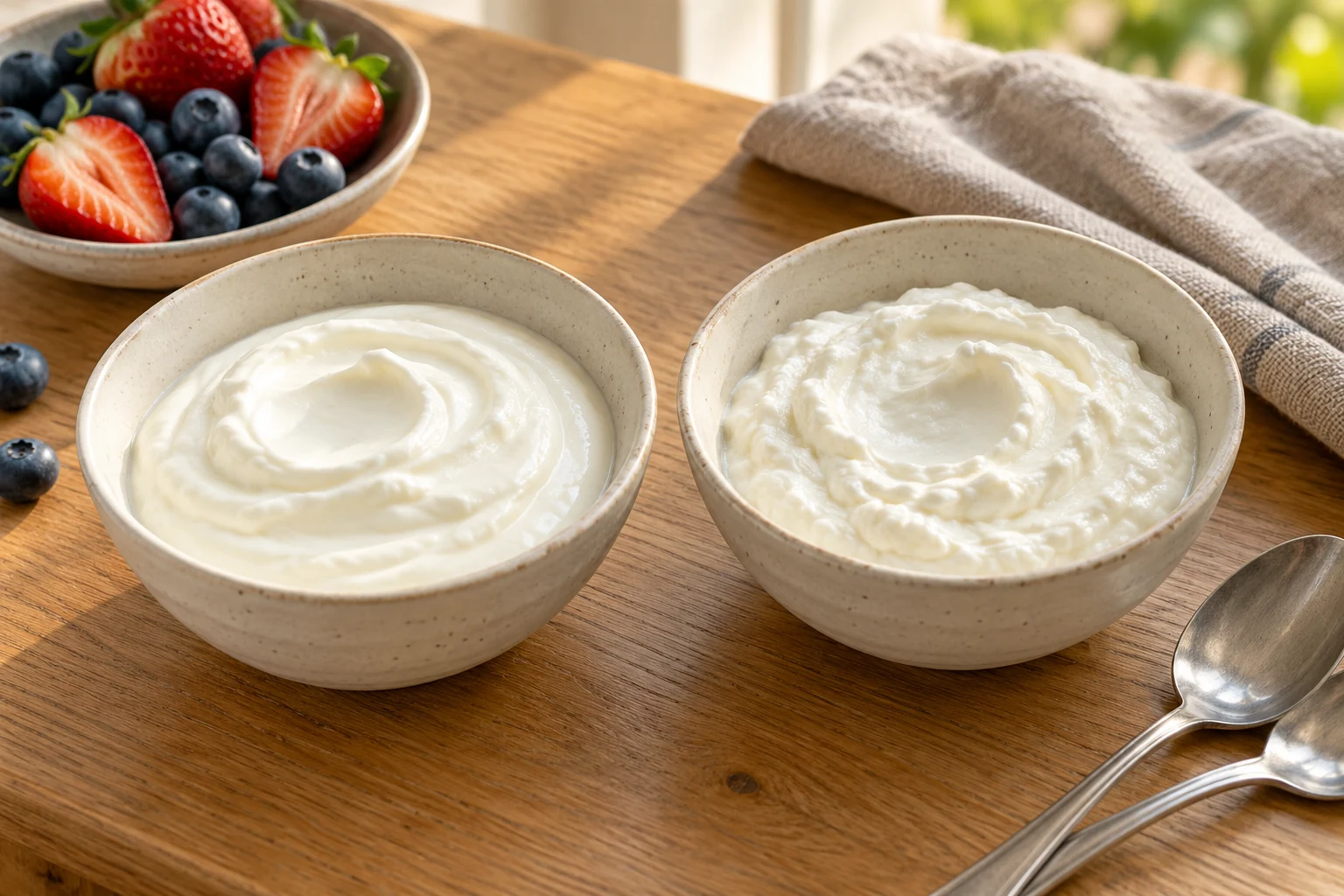
Skyr and Greek yogurt can both be excellent ways to add protein to breakfast or a snack. Neither automatically has more protein, less sugar, or a better effect on your health. The useful comparison is between the actual products you will buy, in the same portion, with the same fat level and flavor.
For example, the plain nonfat products examined below provide almost the same protein per 100 grams. Their package sizes make the headline numbers look more different than they really are. Taste, price, ingredients, and how you plan to use the yogurt may matter more than choosing the “winning” category.
Published October 20, 2026. Product information checked October 20, 2026; packaging and formulations can change.
Skyr vs Greek yogurt: the quick answer
- For protein: compare grams of protein per 100 grams, not just per container. Plain skyr and strained Greek yogurt can be very similar.
- For texture: both are thick cultured dairy foods. Individual products vary in firmness, smoothness, and tang.
- For added sugar: plain versions often have none, but naturally occurring milk sugar still appears under total sugars.
- For cooking: plain versions can often substitute for one another, although thickness and fat level can change the result.
- For value: compare the price of the amount you actually eat, including whether you finish a large tub.
If you already like your Greek yogurt, there is no compelling reason to replace it just because skyr sounds more specialized. If you prefer skyr, it can serve the same practical role. Start with a product you enjoy enough to use regularly.
What is skyr?
Skyr is an Icelandic cultured dairy food commonly sold alongside yogurt. A familiar commercial version starts with cultured skim milk and is strained to concentrate its texture. Siggi’s describes its plain nonfat skyr as a strained yogurt made with pasteurized skim milk and live active cultures. Traditional terminology and manufacturing methods vary, so the name alone does not give you a complete ingredient list. See the manufacturer’s explanation on its plain nonfat skyr product page.
In practical grocery-store terms, think of skyr as a thick spoonable dairy option, rather than a guaranteed nutritional upgrade. Nonfat, low-fat, whole-milk, flavored, and specially formulated products may sit under the same broad label. Read the specific container, especially if you have only tried one brand.
What is Greek yogurt?
Greek yogurt is also a cultured dairy food associated with a concentrated, thick consistency. Traditional strained versions remove some liquid after fermentation. Products described as Greek or Greek-style can differ, which is why an ingredient panel and nutrition label are more informative than the front of the tub.
For the examples in this guide, the Greek yogurt is FAGE Total 0%, a plain nonfat product listing pasteurized skimmed milk and live active yogurt cultures. That makes it a closer comparison with plain nonfat skyr than a sweetened whole-milk yogurt would be. The manufacturer’s current label is the source for the figures below.
Both categories offer options that work well in a high-protein breakfast. If you are also considering a different dairy texture, our Greek yogurt vs cottage cheese comparison helps frame that separate choice.
A fair nutrition comparison using actual labels
The following numbers come from named U.S. manufacturer pages, not from an assumed average for an entire category. Both examples are plain and nonfat so the comparison does not confuse dairy style with fat level. These are examples for label-reading, not a brand ranking or an exhaustive survey.
| Product | Labeled portion | Protein | Calories | Total fat | Total sugars | Added sugars |
|---|---|---|---|---|---|---|
| Siggi’s plain nonfat skyr | 150 g | 16 g | 90 | 0 g | 4 g | 0 g |
| FAGE Total 0% plain Greek yogurt | 170 g | 18 g | 90 | 0 g | 5 g | 0 g |
Sources: Siggi’s, FAGE. Always check the package you purchase if its figures differ.
What happens when the portions match?
Divide the labeled protein by the labeled serving weight, then multiply by 100. Using those rounded label values gives approximately 10.7 grams of protein per 100 grams for the Siggi’s example and 10.6 grams for FAGE.
The two products are effectively a tie for everyday meal planning. Describing one as a dramatically better protein source because its container says 18 grams instead of 16 grams would miss the difference in container size. These calculations are estimates from rounded labels, not laboratory measurements accurate to a tenth of a gram.
The reverse mistake is equally common: comparing a large bowl of skyr with a small pot of Greek yogurt and attributing the entire difference to the food. Portion size is part of the answer, not a nuisance to ignore.
Compare like with like before drawing conclusions
A useful comparison follows three steps: match plain with plain, match the fat level, and match the weight. After that, look at the full meal. A plain nonfat yogurt with a large serving of granola is a different breakfast from the same yogurt with berries, even though the base product has not changed.
There is nothing wrong with flavored yogurt or granola. The point is to judge the meal you actually eat. A food comparison becomes less useful when one side includes all the toppings and the other side only includes the yogurt.
Protein, sugar, fat, and calcium: what deserves attention?
Protein: use the amount in your real serving
Once you have compared equal weights, work out the protein in your usual bowl. If a label gives 18 grams per 170 grams and you use 200 grams, the calculation is 18 multiplied by 200, divided by 170: about 21 grams. A kitchen scale makes that straightforward, but you do not need to weigh every breakfast forever.
Use the calculation to learn what your normal serving looks like. Then choose the amount that fits your appetite and the rest of the meal. A larger scoop is not automatically better, particularly if it crowds out foods you also want to eat.
Sugar: separate naturally occurring from added
Total sugars includes naturally occurring sugar in milk as well as any added sugar. Therefore, a plain dairy yogurt can have several grams of total sugars and zero added sugars. The FDA’s guide to added sugars explains the distinction.
For flavored products, check the added-sugars line rather than assuming “Icelandic,” “Greek,” “vanilla,” or “fruit” tells you the amount. Also remember that honey, maple syrup, or sugar you add at home becomes part of your breakfast. Making a bowl yourself gives you control over sweetness; it does not make the sweetener disappear nutritionally.
Fat: choose deliberately, not by category stereotype
Skyr is not always fat-free, and Greek yogurt is not always high-fat. For example, Icelandic Provisions low-fat plain skyr lists 2.5 grams of fat per 170-gram serving. The product name is too broad to answer that question. Compare the fat percentage and the nutrition panel, then consider the texture you enjoy.
A richer yogurt may be a useful choice if you prefer it plain. A nonfat option may fit a different meal where nuts, seeds, or another food provides fat. Neither requires you to describe the other as unhealthy. If you are following a clinician’s specific dietary advice, use that advice and the actual label rather than a general yogurt comparison.
Calcium and vitamin D: check rather than assume
Dairy yogurt can contribute useful nutrients beyond protein. Calcium and vitamin D deserve their own look at the label because amounts and fortification vary. Do not assume that every yogurt is fortified with vitamin D or that the product with the highest protein necessarily has the most calcium.
USDA’s Dairy Group overview includes yogurt, lactose-free milk, and appropriately fortified soy alternatives. A varied eating pattern matters more than trying to make one breakfast ingredient perform every nutritional job.
Which tastes better and feels thicker?
This is a product and personal-preference question. Both styles can be dense, creamy, and tart. Skyr is often described as particularly thick, but a strained Greek yogurt can also hold a spoonful firmly. Fat level, cultures, processing, and how the product has been stirred all influence the experience.
Rather than buying a large tub based on someone else’s ranking, try a small plain pot of each. Taste one spoonful without toppings, then add the same fruit or seasoning to both. The second comparison may be more relevant if you never eat yogurt plain.
Ask three practical questions: Is the tang pleasant? Does the texture suit the meal? How much sweetener or liquid do I want to add? A yogurt that feels too dense for a smoothie might be excellent in a bowl. One you dislike plain may work well as a savory sauce.
A small amount of separated liquid does not automatically mean the product is spoiled. However, appearance alone cannot establish food safety. Follow the package’s storage instructions and discard yogurt with mold or other clear spoilage; do not try to rescue it by stirring the problem away.
Lactose intolerance, milk allergy, and probiotics
Neither category is automatically lactose-free
Some people with lactose intolerance tolerate yogurt better than certain other dairy foods, but individual tolerance varies. NIDDK suggests yogurt as one option people may find easier to tolerate and explains that lactose tolerance is not the same for everyone. See its lactose-intolerance food guidance.
Do not treat the word skyr as a lactose-free guarantee. If you need lactose-free dairy, choose a product explicitly labeled that way. Total sugar is not a precise lactose test, and comparing two labels cannot tell you how your digestive system will respond.
Milk allergy is a different issue
Standard dairy skyr and Greek yogurt contain milk protein. A lactose-free version still may contain that protein and is not a suitable workaround for a milk allergy. The FDA’s food-allergy guidance advises people with food allergies to read labels and avoid their allergens.
Plant-based products using similar names need their own comparison. Their protein, calcium, and ingredients may be very different from dairy versions. Do not transfer the figures in the table above to a coconut, almond, oat, or soy product.
Live cultures do not establish a universal gut-health winner
Both types may contain live cultures. That alone does not tell you that one will treat a digestive symptom or deliver a particular probiotic benefit. The NIH probiotics fact sheet explains that effects depend on the microorganisms and amounts, and that not all products labeled probiotic have proven benefits.
Choose yogurt as food first. If your main concern is an ongoing digestive problem, investigate that concern with an appropriate health professional rather than trying to solve it by switching between two similar tubs.
Which should you choose for your goal?
For an easy protein-containing breakfast
Choose the product you enjoy, then add foods that make breakfast complete for you. Fruit brings different flavors and textures; oats or whole-grain toast can provide a more substantial meal; nuts or seeds add crunch. You do not have to include all of them every time.
A useful starting template is a generous serving of plain yogurt, one fruit, and one optional crunchy ingredient. Adjust the quantities to your appetite rather than treating the template as a prescription. Our high-protein yogurt bowl guide offers more ways to organize the combinations.
For supporting a training routine
Either can help you include protein in your day. There is no special muscle-building advantage attached to the name skyr. The overall amount and distribution of food, the training itself, and recovery matter more than a tiny difference between two yogurt labels.
NIH’s exercise and athletic performance overview discusses protein in the context of an adequate diet and training. You can apply the practical principle without turning breakfast into a supplement experiment: include a protein source you tolerate, and build meals you can repeat.
For managing energy intake
Compare calories in the portion you plan to eat, but avoid choosing on that number alone. A less satisfying breakfast that leads you to keep searching for food may not be the most useful option for your routine. Likewise, a rich yogurt with toppings might be exactly right for one person and more food than another wants.
Neither food burns fat, and neither guarantees weight change. If you have a weight-related goal, judge the broader eating pattern and seek individualized advice when appropriate. The yogurt decision is one small component.
For a tighter grocery budget
Start with the shelf price per unit weight. Then consider cost per serving and whether any of the tub will go unused. A discounted large tub is only a bargain if you finish it safely; a small pot can be the sensible choice for occasional use.
For a purely hypothetical example, a 900-gram tub costing $6 provides six 150-gram portions at $1 each. A $1.50 single pot costs more per comparable portion but may prevent waste. These are calculation examples, not current retail prices.
If protein value is your main shopping criterion, you can also divide the tub price by its estimated total protein. However, that calculation is only useful between foods you actually like and can tolerate. A cheaper source that regularly goes uneaten is not helping your budget. Keep the comparison local: shelf prices, promotions, and available tub sizes can change enough that a national “best value” ranking may not apply to your store.
Can you substitute skyr for Greek yogurt?
Often, yes, particularly in cold bowls, smoothies, dips, and toppings. Start with an equal weight of plain skyr in place of plain Greek yogurt. Arla similarly notes that equal-amount substitutions can work but that thicker skyr may change consistency. See its manufacturer comparison.
For a dip or dressing, loosen the mixture with a little water, milk, or lemon juice as appropriate, adding small amounts until it reaches the texture you want. For a smoothie, add liquid gradually rather than assuming every tub needs the same quantity.
Baking is less forgiving. Matching the fat level and thickness is a better starting point than substituting a runny flavored product for a thick plain one. Follow an established recipe’s instructions where available. The paired high-protein baked oatmeal guide explains how yogurt fits into a measured oat-and-egg breakfast.
Three practical ways to use either one
- A berry-and-oat bowl: Spoon plain skyr or Greek yogurt into a bowl, add berries, and finish with a small portion of oats or granola. Keep the topping portion consistent when comparing the two yogurts.
- A lemon-herb sauce: Stir plain yogurt with chopped herbs, lemon juice, and a pinch of salt. Thin as needed and serve with vegetables, grain bowls, or another meal you already make.
- A make-ahead breakfast base: Portion yogurt separately from dry toppings. Add fruit and crunch when you are ready to eat so the texture stays closer to what you enjoy.
For a workday, a simple system might be one large tub plus two topping options rather than five elaborate recipes. Use berries on one day and sliced pear with cinnamon on another. The yogurt provides consistency while the additions prevent every breakfast from tasting identical.
Storage and a five-step shopping checklist
Keep dairy yogurt refrigerated and follow its label after opening. For packed breakfasts, use an insulated bag and ice pack when refrigeration will not be available. USDA advises keeping perishable foods out of room temperature for no more than two hours, or one hour when it is above 90°F. Its food-safety basics explain the time and temperature rules.
- Choose the form you actually need: plain for versatile cooking, or a flavor you enjoy for a ready-to-eat snack.
- Check allergens and any required lactose-free labeling before comparing nutrition.
- Match portion weight and fat level, then compare protein and added sugar.
- Check price per weight and decide how much you can realistically finish.
- Buy a small amount first if taste or texture is uncertain.
Frequently asked questions
Does skyr always have more protein than Greek yogurt?
No. The examples above are very close when converted to equal weights. Brand, product formulation, and serving size determine the actual difference.
Is skyr healthier than Greek yogurt?
Neither category is universally healthier. The useful choice depends on the specific label, your dietary needs, your portion, and what you eat with it.
Which has less sugar?
Compare the individual products. Plain versions may have zero added sugar while still containing naturally occurring milk sugar. Flavored versions require a separate label check.
Can I eat either every day?
Either can be part of a varied eating pattern if it suits your needs and you tolerate it. There is no requirement to eat yogurt daily, and a milk allergy changes the answer.
Which is better for overnight oats?
Both can work. Use a plain product you like and adjust the liquid to account for its thickness. A very thick skyr may need a little more liquid than a softer Greek yogurt.
Should I pay more for skyr?
Pay more if its taste, convenience, or ingredients are worth it to you. The category name alone does not establish a meaningful nutritional advantage.
The bottom line
Choose skyr or Greek yogurt by comparing the label, matching the portion, and considering how you will eat it. For many plain high-protein options, the biggest differences are taste, price, and convenience rather than a decisive nutritional winner.
Build breakfast around a choice you can enjoy and repeat. For the activity side of your routine, explore Workit on the App Store.
Comments
One response to “Skyr vs Greek Yogurt: Protein, Nutrition, Taste, and Uses”
[…] when its thickness is similar, but the nutrition estimate will change with the label. Our skyr vs Greek yogurt guide explains why neither category automatically has more […]