
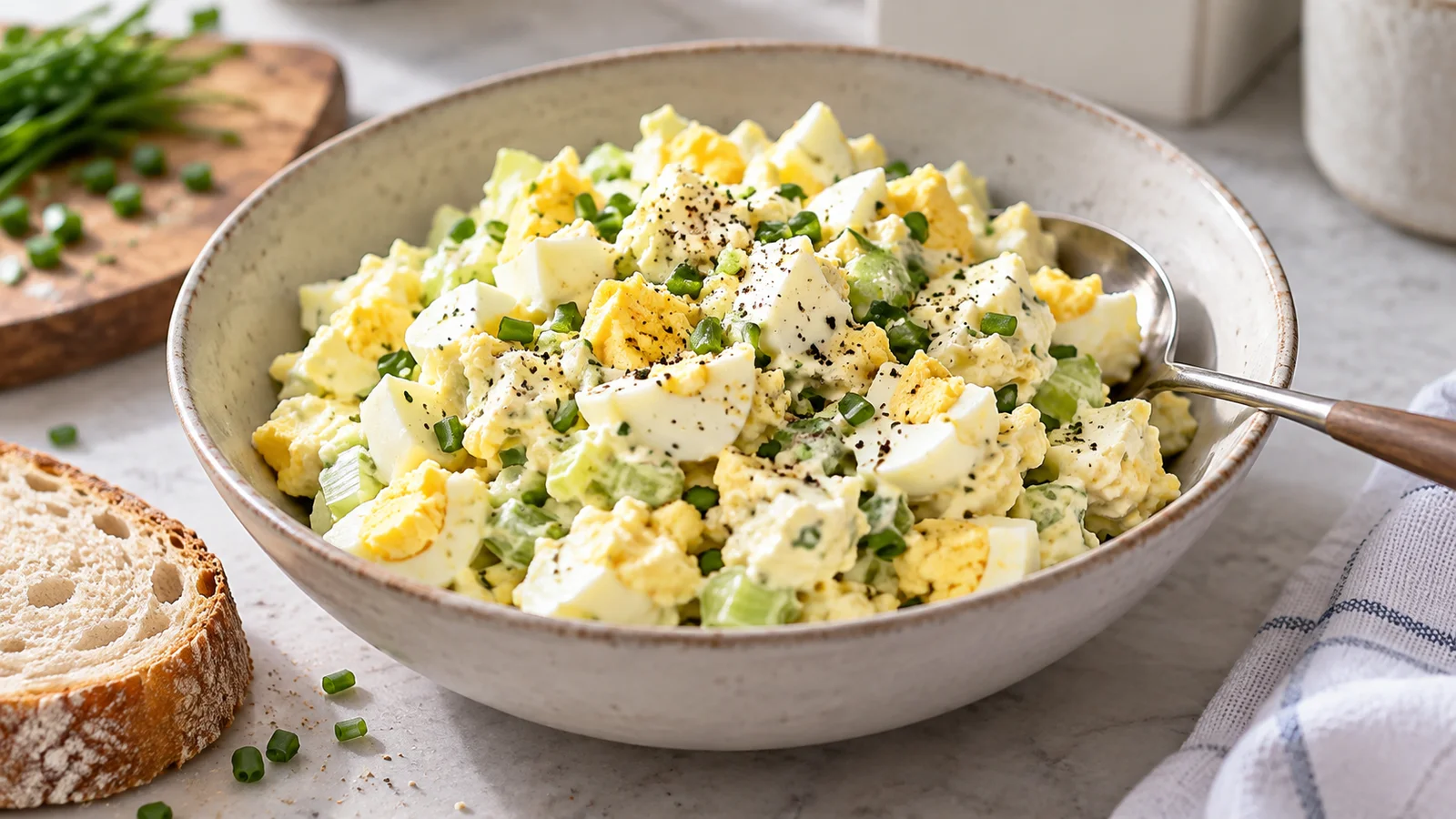
Egg salad with Greek yogurt is made by mixing fully cooked eggs with thick, plain yogurt, mustard, and crisp vegetables. The key to a creamy result is to mash some of the yolks into the dressing before folding in the chopped eggs. That gives the yogurt body, keeps recognizable pieces of egg, and avoids a watery sandwich filling.
Published October 17, 2026.
This version uses eight eggs and 170 grams of Greek yogurt for four lunch portions. With the specific labels used below, eggs and yogurt contribute approximately 16.5 grams of protein per serving, before bread or other additions. It is a practical no-mayo recipe with a deliberately gentle amount of lemon, plenty of texture, and clear guidance for making it ahead.
The recipe: creamy Greek yogurt egg salad
Yield: four portions, each containing the equivalent of two eggs. Time: about 15 minutes if your eggs are already cooked and chilled; approximately 35 minutes or more if cooking and cooling them first. Texture: thick enough to mound on toast, with small pieces of egg white and celery.
Ingredients
- 8 large eggs, approximately 50 grams edible egg each before cooking, hard-cooked and peeled
- 170 grams thick plain Greek yogurt
- 60 grams celery, finely diced
- 20 grams scallions, finely sliced
- 8 grams fresh dill, washed, dried, and chopped
- 10 grams Dijon mustard
- 5 grams lemon juice, about 1 teaspoon
- 1 teaspoon finely grated lemon zest
- Black pepper to taste
- Salt to taste, added after mixing
- Optional: ¼ teaspoon smoked paprika or sweet paprika
For the protein example, the eggs are large Eggland’s Best eggs and the yogurt is FAGE Total 0% from a tub whose label lists 170 grams per serving. These brands are calculation references, not requirements. Choose products you enjoy, and use their labels if estimating your own nutrition.
Step-by-step method
- Start with fully cooked, chilled eggs. If cooking eggs now, place them in a saucepan, cover with cold water by about an inch, bring to a boil, cover, and remove from the heat. USDA’s covered standing method specifies 15 minutes for large eggs; size, equipment, and altitude still affect the result. Both whites and yolks must be firm. Transfer promptly to an ice-water bath, then refrigerate as needed.
- Prepare the vegetables. Wash and dry the celery, scallions, dill, and lemon. Dice the celery finely so each bite has a little crunch rather than one large, watery piece. Pat peeled eggs dry if they are wet from cooling or peeling.
- Make the yolk base. Halve the eggs and put four of the yolks in a mixing bowl. Mash those yolks with a fork. Add all the yogurt, mustard, lemon juice, zest, pepper, and optional paprika. Stir until the yolks are dispersed and the dressing is creamy.
- Chop the remaining egg. Cut all eight egg whites and the remaining four yolks into small pieces. Keep some irregular chunks instead of reducing everything to crumbs.
- Fold, do not beat. Add the chopped eggs, celery, scallions, and dill to the dressing. Use a flexible spatula or broad spoon to fold the mixture just until it is evenly coated. Taste a complete spoonful, then add salt if needed.
- Chill and portion. Serve right away if the ingredients are already cold, or refrigerate promptly in a covered shallow container. Divide into four portions. Add bread, crackers, lettuce, or other accompaniments just before eating when possible.
Preparation times are guides rather than a guarantee for every stove or egg size. For the safety standard, follow USDA’s egg-handling guidance: whites and yolks should be firm. Do not use a soft or runny yolk as a shortcut to creamy cold egg salad.
Why the mashed-yolk method works
Greek yogurt behaves differently from mayonnaise. Mayonnaise has a rich, oily texture, while yogurt brings tang and moisture. Simply replacing a large amount of mayonnaise with a thin yogurt can produce a loose filling that tastes sharper than expected.
Mashing four yolks into the yogurt makes the dressing feel more cohesive. The rest of the yolks stay in small pieces, and the whites keep their bite. You get a creamy coating and recognizable egg texture without needing to blend the entire bowl.
A food processor is unnecessary here. It can turn the whites into tiny rubbery fragments or make the filling too uniform. A fork for the dressing and a knife for the eggs give more control, especially when preparing only four portions.
The final texture should hold a soft mound on a spoon. It does not need to be as stiff as refrigerated mayonnaise. If your preferred sandwich filling is firmer, start with a thicker yogurt and drier additions rather than adding more egg after an overly wet mix is already assembled.
Choosing the right Greek yogurt
Plain means unsweetened and unflavored
Vanilla yogurt can look identical to plain yogurt in a bowl, but its flavor remains obvious with mustard and scallions. Check the product name and ingredients. A yogurt marketed as a dessert, fruit yogurt, or sweetened breakfast cup will create a different salad.
Thickness matters more than the front-of-pack name
Different strained yogurts have different consistencies. Choose one that sits on a spoon rather than immediately running off. If your yogurt is loose, strain it in a fine sieve lined with a suitable clean filter in the refrigerator, then measure the quantity needed. Straining changes the finished yogurt, so a precise nutrition calculation would need to account for that change.
Nonfat, low-fat, and full-fat versions can all work
The recipe’s texture does not depend on using nonfat yogurt. A higher-fat version can taste richer, while a nonfat version may feel sharper. Choose for preference and use the actual label when tracking protein, energy, or fat. The example nutrition number is not automatically transferable between every yogurt in the same brand family.
Deal with separated liquid thoughtfully
A little liquid on top of yogurt can be normal. Stirring it back in makes the yogurt looser; draining it off makes it thicker. For consistent recipe results, pay attention to the consistency you measure. Do not add a large puddle of liquid from the container and then try to fix the salad with extra salt or more chopped vegetables.
How much protein is in this egg salad?
The most transparent estimate is to show the two main ingredients separately. The Eggland’s Best Classic Eggs nutrition panel lists 6 grams protein for one large 50-gram egg. Eight eggs therefore contribute 8 × 6 = 48 grams protein to the whole recipe.
The FAGE Total 0% tub label lists 18 grams protein per 170 grams yogurt. This recipe uses that entire amount, bringing the egg-and-yogurt subtotal to 48 + 18 = 66 grams for the batch.
Divide 66 by four equal portions and the result is 16.5 grams per portion. This subtotal leaves out the small contribution from vegetables and mustard. It also excludes bread, crackers, toppings, and side dishes. The result is an estimate based on rounded labels, not a measured analysis of your finished lunch.
To calculate another yogurt, divide 170 grams by its label serving weight, then multiply by its protein per serving. For example, a different product’s serving might be 150 grams, not 170 grams. Matching the numbers to the actual amount is more important than choosing whichever package has the largest number on the front.
Adding yogurt does not transform every small scoop into a huge protein serving. Portion size still matters. If you split this recipe into eight small appetizer portions, the egg-and-yogurt subtotal is about 8.3 grams each. If you eat a different fraction of the batch, adjust the calculation accordingly.
Control tang, salt, and crunch
Egg salad becomes easier to adjust when each ingredient has a clear job. Yogurt supplies creaminess and tang. Mustard adds a savory sharpness. Celery provides crunch. Scallions and dill add fresh flavor. Lemon zest gives a citrus aroma without requiring much extra liquid.
Start gently with acid
The yogurt is already tangy, so the recipe begins with only 5 grams lemon juice. Taste before adding more. If you prefer less sharpness, omit the juice initially and use zest alone, then decide whether any juice is needed after the egg is mixed in.
Use small, dry pieces of celery
Large celery chunks can dominate a soft sandwich. Cut the stalk lengthwise into thin strips, then dice across them. Dry the washed celery before cutting, and avoid adding a handful of wet leaves by accident. The aim is a little crispness in most bites.
Keep onion flavor in proportion
Scallion greens are a useful option if raw onion tastes too strong to you. Red onion can substitute, but use a small amount, mince it finely, and taste before adding more. Rinsing chopped onion may mellow its bite, but drain and dry it well afterward.
Salt after the mustard is mixed in
Mustards differ in saltiness, and optional pickles or capers add more. Season the finished mixture rather than automatically salting every component separately. If serving on salty crackers, test a bite with a cracker before making the final adjustment.
Troubleshooting common Greek yogurt egg salad problems
Why is my egg salad watery?
Check for thin yogurt, warm eggs, wet celery, and excessive pickle juice or lemon juice. Several small additions can combine into a large amount of liquid. Chill the mixture and stir once to assess it. If free liquid remains, carefully drain what you can rather than adding bread crumbs as an automatic fix.
For the next batch, dry the eggs and vegetables, use thicker yogurt, and mash the yolks into the dressing first. Keep juicy additions such as tomato slices separate until serving. A tomato can be excellent in the sandwich without sitting inside the salad overnight.
Why does it taste too sour?
The yogurt, mustard, lemon, and pickles all contribute sharp flavors. Start by reducing added lemon and using a milder mustard next time. A little extra fully cooked egg can soften an overly tangy batch, but it changes the yield. You can also use part yogurt and part mayonnaise if that is the taste you prefer.
Why is it dry or chalky?
Overcooked yolks can become crumbly, and too little dressing leaves those crumbs uncoated. Mash the yolks thoroughly with the yogurt before folding in the other ingredients. Add any extra yogurt a teaspoon at a time. There is no need to pour in milk, which can loosen the salad more than you intend.
Why are the whites rubbery?
Excessive cooking can make the whites firmer than you want. Use a consistent hard-cooking method, chill promptly after cooking, and avoid repeatedly reheating the eggs. In the finished salad, smaller pieces may make a firm white less noticeable, but dressing cannot undo its texture.
What if there is a gray-green ring around the yolk?
USDA explains that a green ring can result from overcooking and that the green color itself is safe to consume. It is not a substitute for checking storage history. A normal-looking egg can still be unsafe if mishandled, and an unattractive yolk does not tell you how long the salad has been warm.
Serving ideas that protect the texture
A sandwich assembled at lunch
Pack the egg salad separately from the bread when possible. Toast the bread if you enjoy it, let the toast cool before packing, and assemble shortly before eating. Dry lettuce leaves can provide a little separation between bread and filling, though they are not a guarantee against sogginess during long storage.
A cracker-and-vegetable lunch
Place one portion in a small container with crackers packed separately, plus washed vegetables and fruit. This is useful when you do not want to build a sandwich at work. Keep the egg salad cold throughout transport and use a clean utensil rather than repeatedly dipping food into the storage container.
Lettuce cups or a wrap
Dry lettuce thoroughly so water does not thin the filling. For a wrap, keep the salad in the center and avoid overfilling. Bread-free serving changes the accompanying foods, but it does not make the egg salad inherently more suitable for every person or goal.
A warm toast topping
Cold egg salad on freshly toasted bread gives a useful temperature contrast. Add sliced tomato or cucumber at the last moment. Avoid leaving the full storage container on the counter while making several rounds of toast; take out only what you plan to serve.
If you are building a rotation of practical lunches, Workit’s canned chicken meal-prep guide offers another filling that benefits from measured, well-drained ingredients. For a different savory meal format, try the approaches in the savory oatmeal guide.
Variations worth making
Dill pickle version
Add 20 to 30 grams finely chopped, well-drained pickle. Reduce the lemon juice at first, and wait to add salt. Pickle brine is flavorful but can loosen the filling quickly. If you want its flavor, add a few drops to a single serving before changing the entire batch.
Curry-spiced version
Add a small pinch of curry powder to the yogurt dressing, stir, and taste before adding more. A little finely chopped apple can give contrast, but add it near serving if you prefer a crisp result. Spice blends vary, so check ingredients for allergens and salt.
Part-yogurt, part-mayonnaise version
Replace a portion of the yogurt with mayonnaise if you want a familiar richness. For example, replace 30 grams of the yogurt with 30 grams mayonnaise. That reduces the yogurt’s protein contribution and changes other nutrition values, so the original subtotal no longer applies. There is no need to treat the substitution as a failure of the recipe.
Extra egg-white version
Add additional fully cooked egg whites, chopped to match the existing pieces, if you enjoy that texture. Use verified package information or an appropriate food database entry to estimate their contribution. More whites also increase the amount of filling, so recheck how many portions you actually make.
Food safety and storage
Keep the finished egg salad at 40°F or below and use it within three to four days. USDA recommends refrigerating perishables within two hours, shortened to one hour when the temperature is above 90°F. Use shallow containers and refrigerate promptly rather than waiting for a large bowl to cool on the counter.
Hard-cooked eggs have their own storage history. Mixing older eggs with fresh yogurt does not restart their clock. Use the salad by the earliest applicable safe use-by point for any ingredient, and keep the original egg-cooking date in mind. For commercial peeled eggs, follow the package’s storage and opening directions.
For lunch away from home, use adequate cold packs and refrigerate on arrival when possible. Do not assume an insulated bag alone keeps food below 40°F. Discard salad that has spent too long unrefrigerated, even if it looks and smells normal.
Freezing is not recommended for the quality of this particular mixture: egg whites can become unpleasantly firm, and yogurt may separate. Make a smaller batch if you cannot use four portions in time. The half recipe uses four eggs, 85 grams yogurt, and half of every other ingredient.
Allergens and substitutions
This recipe contains egg and milk, and Dijon mustard contains mustard. Bread, crackers, spice blends, and other accompaniments can add wheat, sesame, or other allergens. Check labels and avoid cross-contact when preparing food for someone with an allergy.
Lactose-free dairy yogurt still contains milk proteins and is not a substitute for someone with a milk allergy. A dairy-free yogurt may work for texture, but check its ingredients, flavor, and nutrition. Many alternatives provide a different amount of protein from strained dairy yogurt.
Replacing yogurt with mayonnaise does not make this an egg-free meal, and replacing mayonnaise with yogurt does not make it safe for someone allergic to egg. If egg itself is unsuitable, choose a different recipe rather than attempting to disguise or dilute the egg content.
A small-batch preparation plan
If you are starting from raw eggs, prepare the vegetables while the eggs cook and make the dressing while they chill. Keep the yogurt refrigerated until you need it. Set out a clean container before mixing so the finished salad can go straight back into the refrigerator instead of waiting while you look for a lid.
For a two-person household, half a batch may be more practical than four portions. Measure 85 grams yogurt rather than guessing half of a single-serving cup, because cup sizes differ. Chop only the celery and herbs you need, and store the remaining produce appropriately for another meal.
When packing a shared lunch, use a clean serving spoon to divide portions before anyone begins eating. This keeps the storage container separate from used utensils and makes it easier to return unused food to refrigeration promptly.
Frequently asked questions
Can Greek yogurt replace all the mayonnaise in egg salad?
Yes, this recipe uses yogurt as the dressing base. Expect a tangier flavor and a different texture. Thick plain yogurt, mashed yolks, and modest amounts of added liquid make the substitution easier to manage than simply pouring thin yogurt over chopped eggs.
Can I use store-bought hard-boiled eggs?
Yes. Choose a refrigerated product, follow its label instructions, and pat the peeled eggs dry before chopping. Check the serving weight if calculating protein precisely. The ingredient example here uses eight large eggs, not an unspecified number of very small or jumbo eggs.
Can I make it the night before?
Yes. Prepare it with chilled ingredients, refrigerate promptly, and pack bread and juicy toppings separately. Stir the portion once before serving. The night-before approach can be convenient without requiring a full week’s batch.
Does Greek yogurt make the salad last longer?
No extra storage time is assumed. The salad is still a perishable mixture of eggs, dairy, and vegetables. Keep it cold and follow the stated storage window regardless of whether the dressing contains yogurt, mayonnaise, or a combination.
A simple lunch with a clear method
For dependable egg salad with Greek yogurt, concentrate on three things: fully cooked cold eggs, a thick yogurt-and-yolk base, and dry, finely chopped additions. Those details do more for the final sandwich than an oversized list of toppings or an exaggerated protein claim.
For a sweet breakfast using eggs and Greek yogurt, see our high-protein French toast. Its protein calculation uses different quantities and includes cooking all the egg mixture rather than discarding leftover custard.
Explore Workit’s workout programs and fitness challenges. View Workit on the App Store.