
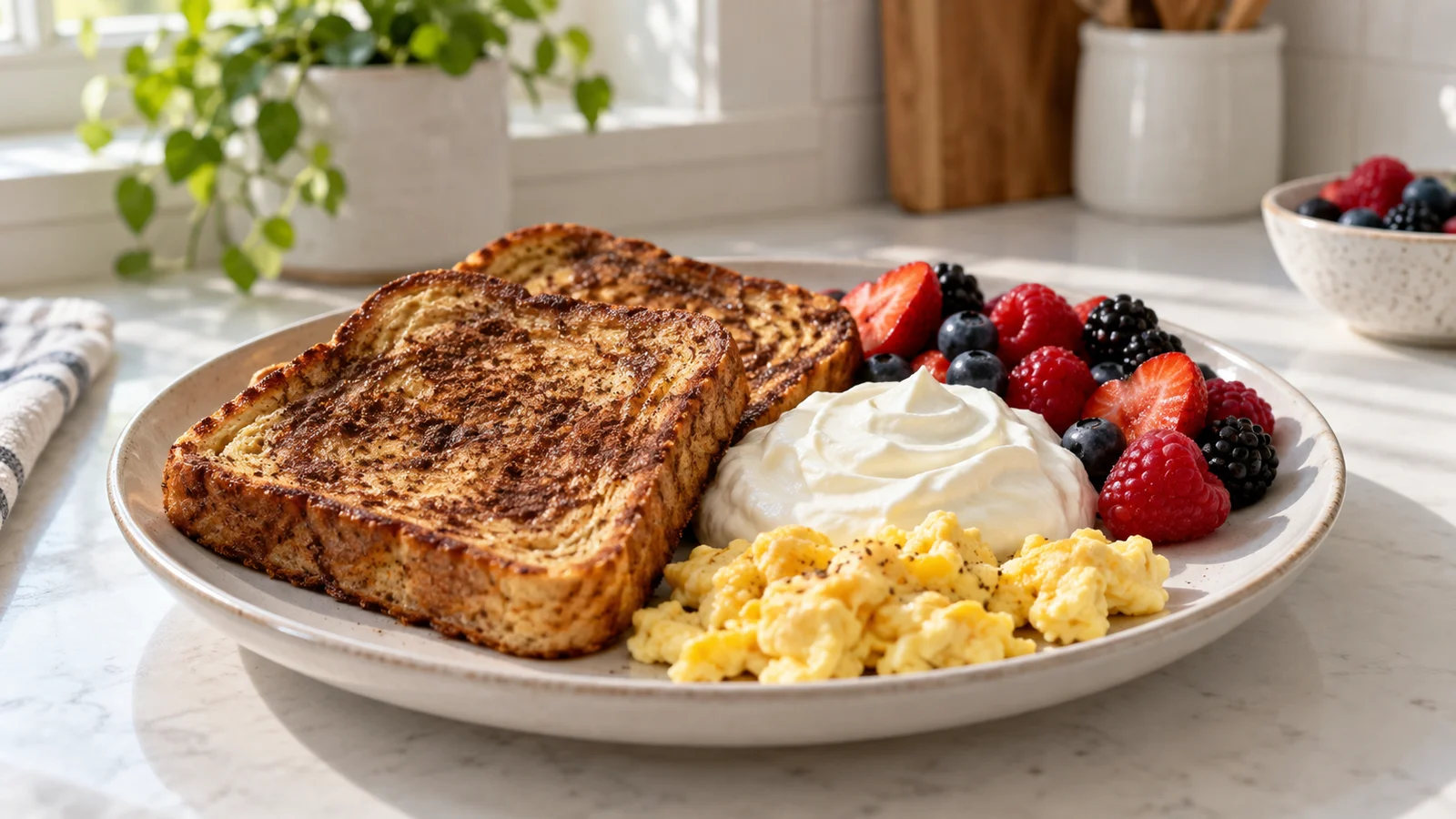
You can make high-protein French toast without protein powder by combining whole eggs with a modest amount of liquid egg whites, then serving the toast with thick Greek yogurt. This two-serving recipe provides approximately 29 grams of protein per serving from the eggs, whites, and yogurt alone, using the reference labels below. Bread adds more. That calculation includes the yogurt and every bit of custard, with any excess cooked separately and served alongside.
Published .
The aim is still good French toast: a browned surface, a tender center, and cinnamon you can smell when the slices hit the pan. Keeping some whole egg supplies richness, while putting the yogurt on the plate makes the protein portion straightforward to measure. There is no blender, specialized bread, or supplement required.
Jump to the recipe, check the protein calculation, or fix a texture problem.
The recipe: cinnamon French toast with Greek yogurt
Yield: 2 servings, each with 2 slices of toast, 170 grams of yogurt, 100 grams of berries, and half of any separately cooked custard. Preparation: about 5 minutes. Cooking: approximately 15–20 minutes in two batches. Allow longer for unusually thick bread; doneness matters more than the timer.
Use four medium, sturdy slices weighing about 40 grams each. A skillet large enough for two slices without overlap is sufficient. Have a shallow dipping dish, whisk, broad spatula, kitchen scale, and thin-tip food thermometer ready.
Ingredients for two servings
- 160 grams bread, approximately 4 medium slices, about ¾ inch thick
- 2 large eggs, approximately 100 grams without shells
- 92 grams pasteurized liquid egg whites; the reference carton lists this as 6 tablespoons
- 30 grams milk, approximately 2 tablespoons
- 4 grams vanilla extract, approximately 1 teaspoon
- 1.3 grams ground cinnamon, approximately ½ teaspoon
- A small pinch of fine salt
- 8 grams neutral cooking oil, approximately 2 teaspoons, divided between batches
- 340 grams plain nonfat Greek yogurt, for serving
- 200 grams berries, washed, dried, and cut as needed
- Optional: maple syrup, lemon zest, or additional cinnamon, to taste
The protein example uses Eggland’s Best large eggs, Bob Evans liquid egg whites, and FAGE Total 0% yogurt from a tub labeled per 170 grams. These are calculation references, not required purchases. Use comparable ingredients you enjoy and recalculate from their packaging when tracking protein.
Method
- Prepare the serving ingredients. Divide the yogurt into two 170-gram portions and the berries into two 100-gram portions. Keep these refrigerated while you cook. If using frozen berries, thaw them separately and drain excess juice so it does not soak the finished toast.
- Whisk a smooth custard. Beat the whole eggs in the shallow dish until the yolks and whites combine. Whisk in the liquid whites, milk, vanilla, cinnamon, and salt. Break up visible strands of egg white. A few cinnamon specks floating on top are normal.
- Warm the skillet. Set a nonstick skillet over medium-low heat and add half the oil, spreading it across the cooking surface. The pan should be warm enough for a gentle sizzle when bread enters, without smoking. A heavy skillet may need a few minutes to warm evenly.
- Dip only the first batch. Lower two bread slices into the custard, turning to wet both faces. Start with roughly 5–10 seconds per side for soft sandwich bread or 15–20 seconds for a firmer slice. Lift carefully and let loose custard drip back. These are starting points, not a requirement to saturate every loaf.
- Cook and check the center. Place the slices in one layer. Cook approximately 3–4 minutes on the first side, then 2–4 minutes on the second, adjusting the heat as needed. Check the thickest egg-soaked center with a thin-tip thermometer inserted from the side. It should reach 160°F, approximately 71°C. Brown color alone does not establish doneness.
- Repeat without crowding. Transfer cooked slices to a clean plate or rack. Add the remaining oil, briefly whisk the custard again, and dip and cook the second pair. If the pan has become too hot, lower the heat before adding them.
- Cook any remaining custard. Pour leftover dipping mixture into the skillet and stir gently until set and at least 160°F in the center. Divide this small egg side evenly between the plates. Never pour raw leftovers over cooked toast. Including this side is necessary if you use the full protein calculation.
- Assemble and serve. Give each person two slices, their yogurt and berries, and half the cooked egg side. Add optional syrup at the table. Wash the dipping dish, utensils, and surfaces that contacted raw egg.
The temperature targets follow USDA guidance for egg dishes. Actual cooking time depends on slice thickness, moisture, pan material, and burner output.
Why this version keeps the familiar French-toast texture
Adding more liquid egg white is an easy way to increase the protein in a mixing bowl. It is less useful when the bread cannot hold that liquid or when the finished coating becomes thick and rubbery. This recipe uses a relatively small custard quantity and moves a substantial share of the protein to the yogurt topping.
Whole eggs keep the custard from being exclusively egg white. A little milk loosens the mixture enough to coat the bread, without turning the dipping dish into a deep bath. The bread stays the structural center of the recipe rather than becoming a way to carry an oversized scramble.
Yogurt is deliberately served separately. It provides a cool, tangy contrast and makes portioning easier: you can weigh what actually reaches the plate. Whisking yogurt into custard is possible, but different brands vary in thickness, and that changes how the coating spreads and cooks. Keeping the first version simple makes troubleshooting much easier.
Finally, restrained heat gives the middle time to cook before the outside becomes too dark. More browning is not always better browning. If a slice is blackening while its center remains wet, turning up the burner cannot solve the underlying mismatch.
How much protein is in the complete breakfast?
The most useful answer separates the ingredients we can verify from the ingredients that depend on your loaf and toppings. Manufacturer labels are rounded, so the figures below are practical estimates rather than laboratory measurements.
| Ingredient | Batch amount and label basis | Protein per serving |
|---|---|---|
| Whole eggs | 2 large eggs (about 100 g); 6 g protein per 50-g egg | 6 g |
| Egg whites | 92 g; 5 g protein per 46 g | 5 g |
| Nonfat Greek yogurt | 340 g; 18 g protein per 170 g | 18 g |
| Subtotal | Half the batch; all prepared custard and yogurt eaten | About 29 g |
| Bread, milk, berries | Recipe amounts; check your labels or food database | Additional |
The reference sources are the Eggland’s Best large-egg nutrition panel, Bob Evans liquid egg-white label, and FAGE Total 0% nutrition information. Check the package you buy: a 150-gram yogurt cup and a 170-gram tub serving are different portions.
Calculate your own portion in one minute
For each ingredient, divide the amount you use by the label’s serving weight, then multiply by the listed protein. Add the ingredients and divide by the number of portions. For bread, count slices only when your slices match the label’s size; weighing is more useful for a hand-cut loaf.
For example, if your bread label lists 4 grams of protein per 40-gram slice, the two slices in one serving contribute 8 grams. Added to the reference subtotal, that gives approximately 37 grams before counting milk and berries. That is an illustration using a hypothetical bread label, not a guaranteed total for every loaf.
Do not log all the eggs and whites if you discard some custard. The portion left behind can vary considerably, and visual guesses cannot establish its exact protein content. Similarly, a spoonful of yogurt is not interchangeable with the measured 170-gram serving. If precise tracking matters, include the separately cooked custard and weigh the topping.
This article does not give a single calorie, carbohydrate, or fat total because bread, milk, optional syrup, and ingredient brands change those values. A protein subtotal should not be mistaken for a complete nutrition panel.
Choosing bread that browns without falling apart
Start with a loaf you like eating. A sturdy sandwich loaf, a relatively close-textured sourdough, or moderately thick brioche can all become French toast. The most helpful characteristics are an intact crumb, manageable thickness, and slices that can be lifted after dipping.
- Whole-wheat sandwich bread: convenient for evenly sized portions. Soft loaves need a short dip; do not assume whole-wheat automatically means sturdy.
- Sourdough: gives a more pronounced flavor and can hold its shape well. Very large holes allow custard to run through, and a thick crust may stay chewy.
- Brioche or challah: adds richness and usually browns readily. Watch the heat and check its own ingredient and nutrition labels.
- Thin-sliced bread: cooks quickly but can tear after soaking. Use a broad spatula and reduce dipping time.
Slightly dry bread is convenient because it is easier to handle. If your loaf is exceptionally soft, lightly toast the slices just until the surface feels drier, then let them cool before dipping. You are aiming to firm the bread, not create a deeply browned crust before the actual cooking begins.
A specialty high-protein loaf is optional. Read its serving size and ingredients rather than choosing by the front-of-package claim alone. Some dense loaves absorb slowly; others become gummy. For the first attempt, keep the custard unchanged and adjust the dip according to the bread’s behavior.
French-toast troubleshooting: change the right variable
The outside is dark but the center is wet
The heat is likely too high for the slice thickness or amount absorbed. Reduce the burner and continue cooking gently, checking the center temperature. If necessary, transfer the slices to a 325°F oven on a suitable tray to finish, monitoring closely. Next time, use a shorter dip or thinner slices. Avoid judging safety from a crisp edge.
The toast is soggy after it reaches the plate
Check what happened after cooking. Stacking hot slices traps steam, and wet berries or a large pool of syrup soften the surface. Rest cooked slices in a single layer on a rack while finishing the batch. Put the yogurt beside the toast and add fruit and syrup immediately before eating.
There is a rubbery egg coating around the bread
Excess custard may have entered the pan with the slice, forming a thick skirt. Let the bread drain briefly before cooking and do not pour extra liquid over it in the skillet. Also check whether you increased the whites without increasing the bread. Cook surplus custard separately rather than forcing it onto the toast.
The bread tears when you lift it
It may be too soft or too thoroughly soaked. Support the whole slice with a broad spatula instead of pulling from one corner with a fork. For the next batch, shorten the dip, dry the bread slightly, or choose a firmer loaf. Fragile bread does not become stronger with a longer soak.
The surface is pale and sticks to the pan
The pan may not have warmed enough, or the coating may need more time to set before turning. Keep a thin film of oil across the cooking area and wait until the underside releases more easily. Avoid repeatedly lifting a slice during its first minute. If necessary, use a clean nonstick skillet rather than adding excessive heat.
The flavor is bland or strongly eggy
Whisk thoroughly so isolated egg-white strands do not cook into visible patches. Measure the vanilla and cinnamon, include the small pinch of salt, and use enough yogurt and fruit to balance the plate. If you prefer a sweeter breakfast, add a little syrup at serving rather than expecting vanilla extract to provide sweetness.
Useful substitutions and flavor variations
Change one major ingredient at a time when learning the recipe. That makes it easier to identify whether a different bread, dairy product, or custard proportion caused the result.
Using whole eggs instead of carton whites
You can replace the 92 grams of liquid whites with approximately 100 grams of beaten whole egg, about two additional large eggs. The full recipe would then use four large eggs. Expect a richer coating and a different nutrition profile. This is a practical cooking variation, not a gram-for-gram nutritional equivalent.
Using a different yogurt or cottage cheese
Plain 2% or whole-milk Greek yogurt works as a topping; use its label for protein and other nutrients. Regular yogurt may be looser, so serve it in a small bowl. Cottage cheese can also go alongside the toast, either as it comes or blended smooth. Neither swap inherits the reference yogurt’s protein number.
Making the flavor your own
- Apple cinnamon: replace the berries with chopped apple cooked separately until tender. Keep the yogurt portion and add extra cinnamon to the apples.
- Lemon berry: stir finely grated lemon zest into the yogurt. Avoid adding a large amount of juice, which can make the topping runny.
- Banana and peanut butter: use sliced banana and a measured spoonful of peanut butter. Count those ingredients separately if tracking nutrition.
- Less-sweet breakfast: leave out optional syrup and use plain yogurt with fruit. The base custard contains no added granulated sugar, but your bread and toppings may.
The base recipe contains egg and milk, and ordinary wheat bread contains wheat. Bread and toppings can introduce other allergens, including soy, sesame, peanuts, or tree nuts. Gluten-free bread, dairy alternatives, and nut-free toppings need their own label and cross-contact checks. A substitution described here is not an assurance that the meal is safe for a particular allergy.
Meal prep, storage, and reheating
For make-ahead breakfasts, cook the toast and any excess custard fully, then store the yogurt and fruit separately. Refrigerate promptly in shallow containers; you do not need to wait for everything to become completely cold on the counter. Keeping toppings separate protects the surface and makes portions easier to adjust.
USDA leftover guidance calls for refrigeration within two hours, or within one hour when the surrounding temperature exceeds 90°F. Keep the refrigerator at 40°F or below, use cooked leftovers within three to four days, and reheat leftovers to 165°F, approximately 74°C. Discard food that has exceeded the safe room-temperature window.
For better surface texture, reheat plain slices in a skillet over moderate heat or in an oven, checking their centers rather than relying on a fixed time. A microwave is convenient but produces softer toast; arrange slices without a thick stack and check for cold spots. Reheat the cooked custard side thoroughly as well.
For freezing, separate cooled, promptly chilled slices with parchment and pack airtight. Label the date and freeze the yogurt and fruit separately only if you are comfortable with their changed texture after thawing. Thaw toast in the refrigerator or reheat from frozen using a method that heats the center fully. Follow the same reheating target.
When scaling up, double ingredients by weight and cook in batches. Four servings do not fit into a two-slice skillet all at once. Keep raw custard refrigerated between extended rounds, and divide the separately cooked remainder evenly so the intended portions stay consistent.
Cooking for one without awkward leftovers
Halve the recipe: use 80 grams of bread, one large egg, 46 grams of liquid whites, 15 grams of milk, ½ teaspoon vanilla, ¼ teaspoon cinnamon, a small pinch of salt, and 4 grams of oil. Serve with 170 grams of yogurt and 100 grams of berries. Cooking time may be shorter because you need only one pan batch; the center-temperature target stays the same.
Buy the bread you prefer and freeze spare slices before they become stale. That lets you make this breakfast occasionally without planning several identical meals in a row. Follow the carton’s instructions for opened egg whites, and do not assume their storage life is the same as cooked leftovers.
Frequently asked questions
Can I make high-protein French toast without protein powder?
Yes. The recipe above uses whole eggs, liquid egg whites, and Greek yogurt. The yogurt belongs to the complete breakfast, so include it when comparing the protein amount with other recipes. Ordinary bread works; buying a fortified loaf is optional.
Do I need to add all the custard to the bread?
No. Bread varies in absorbency, and forcing all the mixture into a few slices can spoil the texture. Cook what remains as a separate side. If you choose to discard it, the full ingredient-based protein subtotal no longer describes what you eat.
Can I use freshly separated egg whites?
Yes, measure 92 grams for the batch rather than assuming a particular number of whites will weigh exactly that much. The carton label calculation specifically describes the reference product; use a suitable nutrition source for fresh whites if precise logging matters.
Is this an appropriate breakfast before a workout?
That depends on your appetite, timing, and what feels comfortable during exercise. You can eat a smaller portion and save the rest safely for later. There is no need to force the full serving immediately before training or treat one breakfast as a guarantee of fitness results.
What should I try if I prefer a different breakfast texture?
If you enjoy a more uniform, soft breakfast, explore Workit’s high-protein pancakes. For a change from sweet toppings, try savory oatmeal. Choose a breakfast you can prepare consistently and actually look forward to eating.
Make the next breakfast easier
Once you find a loaf that works, note its slice weight, your starting dip time, and the burner setting that gives steady browning. Those small details are more useful than adding another ingredient. Keep the yogurt portion measurable, cook the egg mixture fully, and adjust toppings to your taste.
If you prefer a savory use for eggs and Greek yogurt, our Greek-yogurt egg salad provides a separate portion and storage example. Treat it as another meal option, not an addition required to complete this breakfast.
Explore Workit’s workout programs and fitness challenges. View Workit on the App Store.
Comments
One response to “High-Protein French Toast Without Protein Powder”
[…] a sweet breakfast using eggs and Greek yogurt, see our high-protein French toast. Its protein calculation uses different quantities and includes cooking all the egg mixture rather […]