
Published October 14, 2026
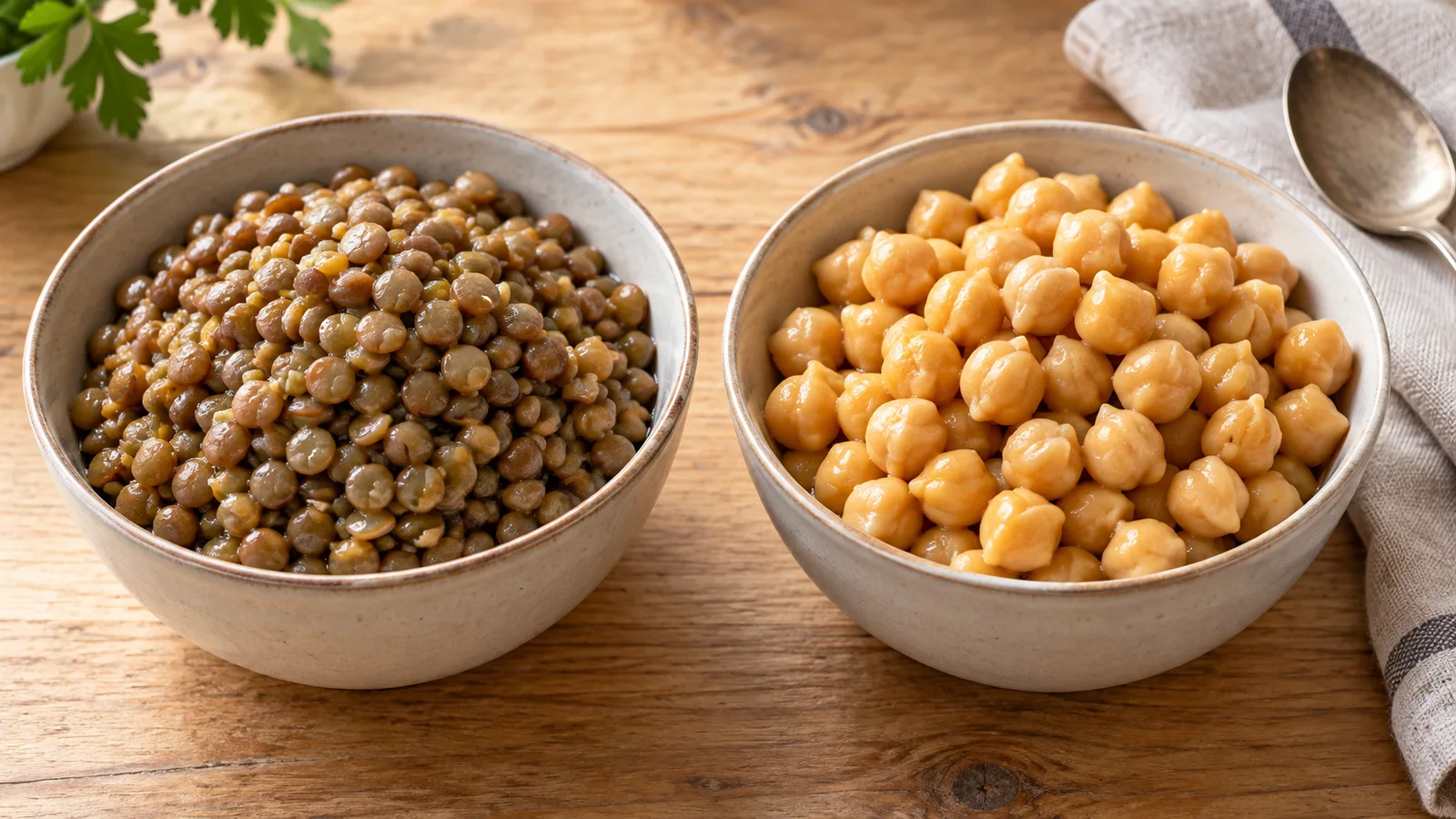
Lentils and chickpeas provide very similar amounts of protein and fiber when you compare the same weight of cooked food. Lentils usually win on cooking speed and work especially well in sauces, soups, and soft fillings. Chickpeas hold their shape, bring a firmer bite to bowls, and can be mashed into a substantial sandwich filling.
The useful answer to “lentils vs chickpeas” is therefore less about finding a nutritional champion and more about choosing the right ingredient for dinner. Start with the texture you want, the time you have, and whether you are opening a can or cooking from dry. Both can earn a regular place in a varied diet.
This guide compares plain cooked legumes on an equal basis, explains when substitutions work, and gives you three practical recipes. The recipes are everyday food ideas for adults, rather than a medical diet or a promise about weight change.
Lentils vs chickpeas: the quick decision
- Choose lentils for a quick dry-pantry meal. Most lentils do not need soaking, and split red lentils soften into a thick sauce particularly well.
- Choose chickpeas for a distinct bite. Their larger, rounder shape works in chunky salads, tray bakes, and meals where you want individual pieces.
- Choose whole green or brown lentils for a middle ground. Cooked gently, they can stay separate enough for a salad while requiring less planning than dried chickpeas.
- Choose either in ready-cooked form when time is short. A drained can or refrigerated pouch changes the convenience comparison considerably.
- Choose the one you will enjoy eating. A small difference in a nutrient database is rarely a good reason to force an ingredient into a recipe where its texture does not work.
A fair nutrition comparison: 100 grams cooked
The following figures use two specific USDA FoodData Central SR Legacy records: lentils, mature seeds, cooked, boiled, without salt, FDC 172421, and chickpeas, mature seeds, cooked, boiled, without salt, FDC 173757. Each amount refers to 100 grams of the cooked edible legumes, drained for weighing, without sauce or added oil.
- Protein: lentils 9.02 grams; chickpeas 8.86 grams.
- Fiber: lentils 7.9 grams; chickpeas 7.6 grams.
- Carbohydrate: lentils 20.13 grams; chickpeas 27.42 grams.
- Fat: lentils 0.38 grams; chickpeas 2.59 grams.
- Energy: lentils 116 calories; chickpeas 164 calories.
- Iron: lentils 3.33 milligrams; chickpeas 2.89 milligrams.
- Folate: lentils 181 micrograms; chickpeas 172 micrograms.
In these records, protein differs by only 0.16 gram per 100 grams. That is too small to make one a meaningfully different protein strategy. Chickpeas supply more energy at the same cooked weight, but “more” is not automatically better or worse. The portion and the rest of the meal still matter.
These are reference foods, not laboratory results for your exact pan. Variety, hydration, draining, and cooking change the amount of water in a serving. Canned products also have their own labels. Use those labels when calculating a specific canned product rather than assuming it matches a boiled-from-dry entry.
Why dry-versus-cooked comparisons go wrong
A hundred grams of dry lentils and a hundred grams of cooked chickpeas are different starting points. Cooking adds water and increases weight. Comparing them makes the dry ingredient appear dramatically more concentrated, even though you would not normally eat the dry portion as it stands.
Keep both sides of a comparison in the same state. For a recipe made with dry ingredients, calculate from the dry quantities and divide the finished batch into its intended servings. For cooked leftovers added to a bowl, use their cooked weight with an appropriate cooked entry. Our guide to raw vs cooked food weight explains this distinction across other foods.
Texture is the biggest everyday difference
Whole lentils: small, earthy, and adaptable
Brown and green lentils are useful when you want small pieces that distribute evenly through a dish. A spoonful of rice, vegetables, and lentils can include all three components without a large bean dominating the bite. Black lentils and some green varieties can be especially useful when keeping a defined shape is the goal.
A gentle simmer gives you more control than a vigorous boil. Start checking before the package’s longest suggested cooking time, and drain once the centers are tender. Leaving finished lentils sitting in hot cooking water continues to soften them. For a salad, tender but intact is usually the target; for a mash, extra softness is welcome.
Split red lentils: useful when breakdown is the point
Split red lentils are a different cooking tool. They soften and break down readily, helping make a thick soup, a spoonable tomato sauce, or a soft curry-style dish. Expect the final color to be more muted than the dry ingredient.
They are a poor direct substitute when a recipe depends on individual chickpeas staying visible and firm. They can still taste good, but you will have changed the dish into something closer to a stew. Make that choice deliberately rather than discovering it halfway through cooking.
Chickpeas: larger pieces and a creamy center
Chickpeas offer a firmer outer bite with a softer interior when properly cooked. They suit chunky combinations with roasted carrots, cucumber, herbs, or tomatoes. Mash some and leave some whole when you want a spread with structure rather than a smooth puree.
For hummus-style blending, very tender chickpeas are helpful. For a mixed bowl, stop when they are tender all the way through but still intact. Dry, chalky centers are a sign to keep cooking, not a desirable version of firmness.
Cooking from dry without turning dinner into a project
Colorado State University Extension’s pulse guide explains sorting, rinsing, soaking, and cooking these pantry ingredients. The practical methods below use tenderness as the final check because age, variety, and equipment affect timing. Follow your package if it gives more specific directions.
A reliable pot of whole lentils
- Sort through 1 cup of dry brown or green lentils and remove stones or damaged pieces. Rinse in a fine-mesh sieve.
- Add to a saucepan with 3 cups of water. Bring to a boil, then reduce to a gentle simmer.
- Start tasting at about 15 minutes. Many batches take roughly 20–35 minutes, but some varieties need longer. Add water if the lentils are no longer covered.
- When tender, drain well. Season while warm, or portion into shallow containers for prompt refrigeration.
For split red lentils, begin checking sooner and expect a softer result. When making a sauce, keep the cooking liquid instead of draining it. Add extra water in small amounts if the mixture becomes thick before the lentils are tender.
A practical batch of dried chickpeas
- Sort and rinse 1 cup of dried chickpeas. Cover generously with water in a large container and soak overnight in the refrigerator, allowing room for expansion.
- Drain, rinse, and transfer to a saucepan. Add fresh water to cover by a few inches.
- Bring to a boil, then simmer gently. Start checking around 45 minutes; allow roughly 1–2 hours and potentially longer for older chickpeas.
- Check several pieces. Each should crush easily without a hard center. Add hot water during cooking as needed to keep the chickpeas covered.
For pressure cooking, use a tested recipe or the appliance manufacturer’s instructions for your specific cooker, including fill limits for expanding foods. A stovetop timing estimate does not transfer directly to a pressure cooker.
When canned makes more sense
If tonight’s meal matters more than batch cooking, ready-cooked legumes are a sensible choice. Drain them, rinse if appropriate for the recipe, and measure the solids you will actually use. A can’s net weight includes liquid and is not necessarily the amount available for a filling.
Compare cost by edible servings and include your time in the decision. A large dry bag is not a saving if most of the cooked batch is discarded. For a deeper look at format, draining, and shopping trade-offs, see canned vs dried beans.
How much belongs in a meal?
Think about the role first. A few spoonfuls scattered over a salad are an addition. A generous mound alongside grains and vegetables is a substantial part of the meal. Neither automatically tells you the meal’s total protein.
For example, a 150-gram cooked portion provides about 13.5 grams of protein from lentils or 13.3 grams from chickpeas using the reference entries above. That calculation is simply the per-100-gram figure multiplied by 1.5. It does not include bread, rice, dressing, or another protein food.
If you want more protein without a much larger legume portion, build the meal with another ingredient you like: tofu, eggs, yogurt, fish, poultry, or a suitable alternative. For plant-based combinations, high-protein vegetarian meal prep offers ways to organize several protein sources across a few days.
Also consider how a portion feels. If you rarely eat legumes, suddenly making them most of a large meal may be uncomfortable. University of Maine Cooperative Extension suggests introducing beans in small amounts as your intake increases. You can begin with a smaller serving and add more gradually rather than treating the recipe portion as compulsory.
Recipe 1: lemon lentils with roasted carrots
Makes 2 generous side dishes or 2 meal bases. Use whole lentils rather than split red lentils so the finished dish remains spoonable without becoming a puree. Preparation takes about 10 minutes; roasting takes approximately 25–30 minutes.
Ingredients
- 300 grams cooked, drained brown or green lentils
- 300 grams carrots, cut into roughly 1-centimeter pieces
- 1 tablespoon olive oil, divided
- 1 tablespoon lemon juice, plus a little zest if desired
- 1 teaspoon Dijon mustard
- 2 tablespoons chopped parsley
- 1/2 teaspoon ground cumin
- Black pepper and salt to taste
Method
- Heat the oven to 425°F/220°C. Toss the carrots with 2 teaspoons of the oil, cumin, pepper, and a little salt. Spread on a sheet pan with space between pieces.
- Roast for approximately 25–30 minutes, turning once, until tender and browned at the edges.
- Whisk the remaining teaspoon of oil with lemon juice and mustard. Fold through the lentils, carrots, and parsley.
- Divide equally. Serve as a side, or build a larger meal with an additional protein food and bread or another starch according to appetite.
Protein calculation: 300 grams lentils × 9.02/100 = 27.06 grams in the batch; divided by 2 = about 13.5 grams per serving from the lentils. This is a lentil-only contribution, not a complete nutrient analysis; the vegetables and any additions are excluded.
Texture adjustment: if the lentils are very wet, leave them in a sieve briefly before dressing. If they are breaking apart, fold gently with a broad spoon. Chickpeas can replace them by equal cooked weight, but the finished dish will feel chunkier.
Recipe 2: smoky chickpea and pepper skillet
Makes 2 servings. This is a thick, spoonable topping rather than a soup. It works over toast or as part of a dinner plate. You can also use it with the ideas in our high-protein baked potatoes guide.
Ingredients
- 300 grams cooked, drained chickpeas
- 1 medium bell pepper, diced, about 150 grams
- 1 small onion, diced, about 100 grams
- 200 grams chopped canned tomatoes with their juice
- 1 tablespoon olive oil
- 1 garlic clove, finely chopped
- 1 teaspoon smoked paprika
- 1/2 teaspoon dried oregano
- 2–4 tablespoons water as needed
- Black pepper and salt to taste
Method
- Heat the oil in a medium skillet over medium heat. Add onion and pepper; cook for 7–9 minutes, stirring, until softened.
- Add garlic, paprika, and oregano. Stir for about 30 seconds, then add tomatoes and chickpeas.
- Simmer for 8–12 minutes, stirring occasionally. Add water a tablespoon at a time if the pan becomes dry before the pepper is tender.
- Mash a few chickpeas against the side of the pan to thicken the mixture. Taste and divide into two portions.
Protein calculation: 300 grams chickpeas × 8.86/100 = 26.58 grams in the batch; divided by 2 = about 13.3 grams per serving from chickpeas. This excludes vegetables, bread, potatoes, and other additions. If using canned chickpeas, calculate from that product’s label when available.
Substitution: cooked whole lentils work here, but add them near the end and stir gently. Dry lentils cannot replace cooked chickpeas without changing the cooking liquid and time.
Recipe 3: chunky lentil-chickpea herb mash
Makes 3 filling portions. Mixing the two legumes gives you the small pieces of lentils and the chunkier structure of chickpeas. This is useful for toast, sandwiches, or a plate with crisp vegetables. Allow about 15 minutes when starting with chilled cooked ingredients.
Ingredients
- 225 grams cooked, drained whole lentils
- 225 grams cooked, drained chickpeas
- 2 tablespoons tahini
- 1 tablespoon lemon juice
- 1 teaspoon Dijon mustard
- 60 grams celery, finely diced
- 2 tablespoons chopped dill or parsley
- 1–2 tablespoons water, only if needed
- Black pepper and salt to taste
Method
- Mash the chickpeas with a fork until no large round pieces remain, leaving some texture.
- Mix the tahini, lemon juice, and mustard separately. If very stiff, add water one teaspoon at a time until the mixture can be stirred.
- Fold the dressing into the chickpeas, then add lentils, celery, and herbs. Mash a little more if the filling will not hold together.
- Divide into three portions. Keep refrigerated and assemble on bread shortly before eating for the best texture.
Protein calculation: lentils contribute 225 × 9.02/100 = 20.30 grams; chickpeas contribute 225 × 8.86/100 = 19.94 grams. Together, that is about 40.2 grams per batch or 13.4 grams per portion from legumes alone. Tahini, bread, and vegetables are not included in this subtotal.
Practical adjustment: add thick dressing gradually. It is easier to loosen a dry mash than rescue a wet sandwich filling. Keep diced cucumber or tomatoes separate until serving because their moisture can make the mixture watery.
Substitution mistakes you can avoid
Replacing cooked with dry: a recipe calling for 300 grams of cooked chickpeas is not asking for 300 grams dry. Cook first, drain, and then measure the required amount. Freeze extra portions if they will not be used soon.
Expecting every lentil to hold its shape: choose whole lentils for salads and split lentils for thickening. The word “lentils” on its own is not enough information to predict texture.
Adding more dressing before draining: liquid at the bottom of the bowl can come from cooking water or vegetables, not insufficient mixing. Drain the main ingredient and dry washed vegetables before combining.
Assuming roasted means shelf-stable: homemade roasted chickpeas are cooked food. An ordinary home roasting method does not establish that they can be stored safely at room temperature for days. Refrigerate leftovers promptly; they may soften during storage.
Overplanning the week: start with two or three meals you actually want. A smaller batch that gets eaten is more useful than a refrigerator full of similar containers. Our meal prep for one guide can help scale the shopping and portions.
Cooling, storage, and reheating
Follow USDA leftover guidance: refrigerate cooked food in shallow containers within 2 hours, or within 1 hour when the temperature is above 90°F/32°C. Keep the refrigerator at 40°F or below, about 4°C. Do not leave a large pot on the counter until completely cool.
Use refrigerated cooked legumes and prepared leftovers within 3–4 days, or freeze portions for later. Label containers with the cooking date. Combining older cooked lentils with freshly chopped vegetables does not restart their storage clock.
Thaw frozen portions in the refrigerator. When reheating leftovers, bring them to 165°F/74°C and check with a food thermometer. Stir thick mixtures so the center heats evenly. Cold dishes can be eaten cold when their ingredients were cooked and chilled safely and kept refrigerated.
Make the next batch easier to use
Keep a small note of the variety, dry quantity, cooking time, and drained yield when you cook a successful batch. Your own pot and preferred texture are more useful for planning than assuming every bag produces exactly the same result. Use the note to estimate how much to cook next time, while still checking tenderness.
Portion some legumes plain before dressing the rest. Plain lentils can move into tomato sauce, while the dressed portion becomes a side dish. Plain chickpeas can become a mash one day and a skillet topping another. This gives you variety without cooking a completely separate ingredient for every meal.
Freeze portions in the size you will actually use. A flat container holding one meal’s amount is easier to thaw than a solid block containing the whole batch. Label the food, amount, and date, and keep a short list of frozen portions where you plan meals.
Which should you buy this week?
For one quick pantry dinner, buy lentils and choose a recipe that suits the variety. For a chunky bowl or mash with a firmer bite, buy chickpeas. If convenience is the deciding factor, start with ready-cooked versions of either.
You do not need to alternate them on a strict schedule or choose one permanently. Keep a small bag of lentils for soups and sauces and a can of chickpeas for a quick topping. Use whichever makes the meal you already want easier to prepare.
The main takeaway is simple: similar protein and fiber, different cooking jobs. Match the legume to the dish, compare equivalent cooked portions, and make enough to enjoy without creating leftovers you will struggle to use.
Explore Workit on the App Store.
Sources
The USDA FoodData Central links open official detailed data records in JSON format. Match the food name and FDC number when comparing entries.
- USDA FoodData Central: cooked lentils, without salt, FDC 172421.
- USDA FoodData Central: cooked chickpeas, without salt, FDC 173757.
- Colorado State University Extension: preparing, storing, and enjoying pulses.
- University of Maine Cooperative Extension: dried beans, peas, and lentils.
- USDA Food Safety and Inspection Service: leftovers and food safety.