
Published
A practical gym machine workout for beginners is a repeatable full-body session built around a leg press, chest press, seated row, leg curl, and lat pulldown. Start with one or two working sets per exercise, use a weight you can control for 8–12 repetitions, and train on two nonconsecutive days each week. Add a little weight only after the current setting becomes consistently manageable.
This guide gives you a machine-only starting routine, explains how to adjust the equipment, and shows what to do when a machine is busy or a weight increase feels too large. The aim is to leave your first sessions knowing exactly what to repeat, rather than trying every station in the room.
The plan is a general example for adults who can exercise without restrictions. If you have an injury, recent surgery, a condition that affects exercise tolerance, or symptoms you do not understand, get individual advice before following it. Sharp pain, dizziness, chest pain, or unusual breathlessness are reasons to stop, not reasons to finish the set.
Your beginner machine workout at a glance
Use this session twice a week, with at least one nonlifting day between visits. Monday and Thursday are one option. The first visit may take longer because you are learning the settings; later sessions will often fit into roughly 40–55 minutes, depending on rest and equipment availability.
- Seated leg press: 2 sets of 8–12 repetitions.
- Seated chest press: 2 sets of 8–12 repetitions.
- Chest-supported or seated machine row: 2 sets of 8–12 repetitions.
- Seated leg curl: 2 sets of 10–15 repetitions.
- Lat pulldown: 2 sets of 8–12 repetitions.
- Optional abdominal machine: 1–2 sets of 10–15 comfortable repetitions, after staff show you the setup.
For your first one or two visits, one working set of each exercise is enough to learn the sequence and assess your response. Build toward the listed two sets if recovery and technique are comfortable. Warm-up sets are additional, lighter practice sets; they do not need to feel demanding.
Rest about two minutes between the leg press, chest press, row, and pulldown sets. Start with 60–90 seconds for leg curls and the optional abdominal exercise, taking longer if needed. These are starting suggestions, not deadlines. Begin again when your breathing has settled and you can repeat the movement with attention.
This is a focused equipment guide. For a broader schedule that includes free-weight choices and weekly planning, use the two-day full-body workout guide.
Why machines can be a useful place to start
Many resistance machines support your torso or guide the movement path. That can make it easier to concentrate on a few essentials: adjusting the seat, moving through a comfortable range, breathing, and selecting a suitable load. You can also change many machine loads with a pin rather than moving several plates.
Machines still require skill. A guided path does not guarantee that every machine fits every body, and a heavy weight can still pull you out of position. Treat a machine as adjustable equipment that needs to suit you, rather than assuming its default settings are correct.
The American College of Sports Medicine’s 2026 resistance-training update emphasizes regular participation and individualization. It reports that equipment type did not consistently determine outcomes for the average healthy adult. That supports choosing an approach you can repeat; it does not mean every machine and free-weight exercise is interchangeable.
You do not need to “graduate” from machines on a deadline. If your goal later involves a barbell lift, sport, or bodyweight skill, practice that specific task as well. General machine strength can support it, but movement skills develop through appropriate practice.
What to do before your first working set
Ask for a short equipment orientation
Ask gym staff to show you the five main stations, their adjustment levers, the weight selector, and how to get in and out. Explain that you want to learn a simple machine routine. A five-minute explanation of a seat lock or safety stop can remove a lot of guesswork.
Follow the instructions on the particular machine, because models differ. Inspect for obvious damage or a loose seat. Keep fingers away from cables, moving arms, and the weight stack. Insert the selector pin fully while the stack is resting. Do not adjust a load while someone else is using the machine.
Warm up without exhausting yourself
Spend about five minutes on an easy stationary bike, treadmill, or another comfortable cardio machine. You should feel warmer rather than tired. Then rehearse your first lower-body exercise and first upper-body exercise with a light load.
For example, before leg-press working sets, perform eight easy repetitions at a lighter setting. If your planned load is substantially heavier, add another brief preparation set. For each unfamiliar station, do a few light repetitions to check the seat and range before committing to a full set. The distinction between warm-up sets and working sets helps keep preparation useful without doubling your workout.
Choose a conservative first weight
There is no universal starting number. Ten units on one machine may feel very different from ten on another because the levers, cables, and labeling differ. Start light, perform several repetitions, and decide whether the movement feels controlled.
For your first working sets, finish with roughly three repetitions still possible using the same technique. Later, about two or three repetitions in reserve is a useful target for this example. You do not need to test your maximum to estimate it. If your last repetition already requires twisting, bouncing, or a very short range, reduce the load.
How to use each machine in the routine
1. Seated leg press
Choose a selectorized seated leg press if available. It usually has a seat or backrest adjustment and a platform for your feet. Ask staff to identify the model’s start-position and safety controls before using it; a plate-loaded sled can operate differently.
Place both feet fully on the platform at a comfortable width. Adjust the starting position so you can bend your knees without your pelvis rolling away from the pad. Keep your back supported, press evenly through your feet, and extend your legs without forcefully snapping the knees straight.
Lower the platform or seat under control. Stop before you lose your back and hip position, even if someone else uses a deeper range. The useful depth is the range you can repeat comfortably. NASM’s leg press demonstration is a useful visual reference for a supported setup and controlled movement.
A common first-session mistake is choosing a seat position that makes the knees crowd the torso immediately. Adjust the fit before lowering the weight further. If the machine still feels awkward or painful, ask for a different model rather than forcing the position.
2. Seated chest press
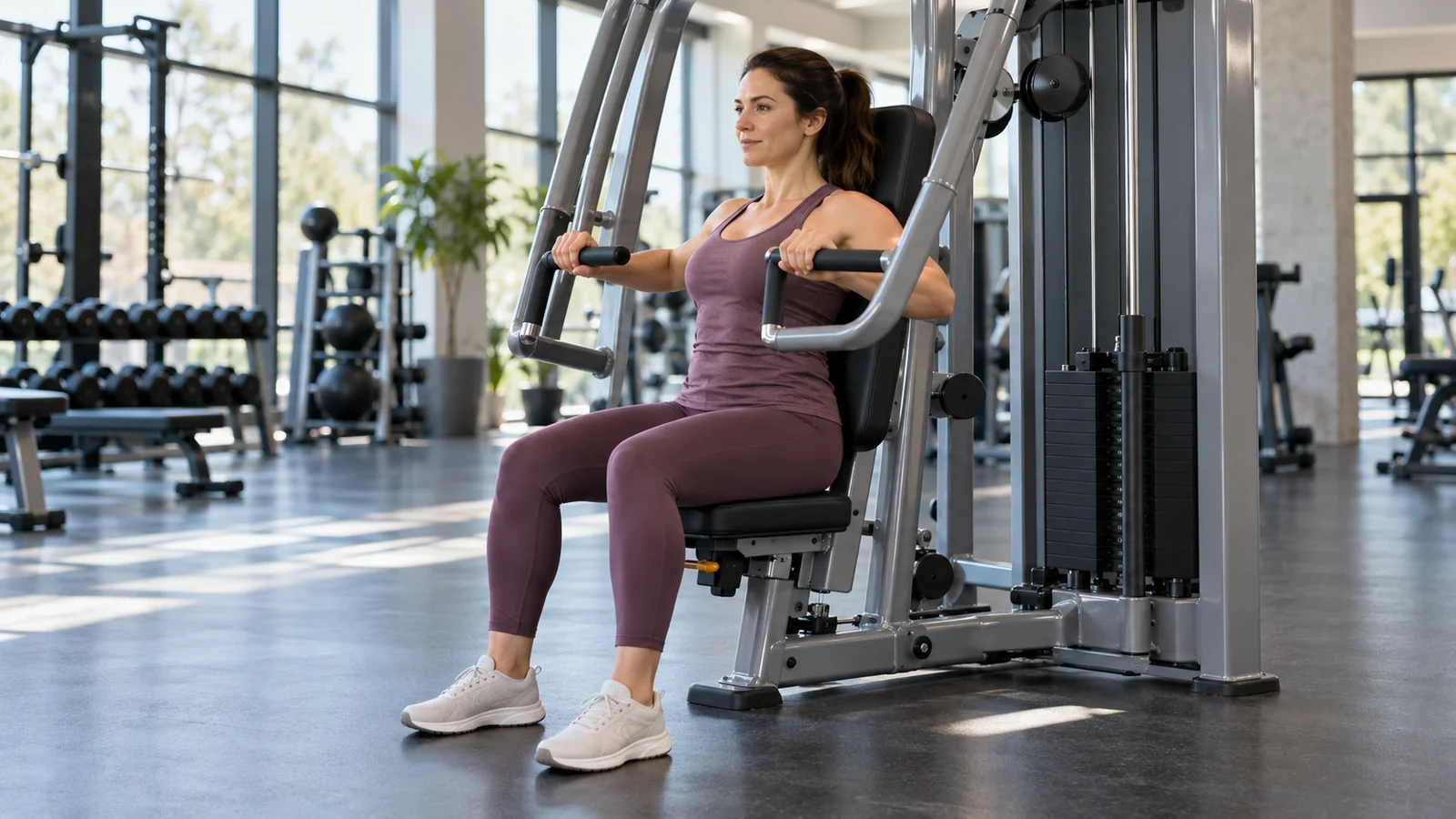
Set the seat so the handles are around mid-chest level, according to the machine’s instructions. Keep your feet supported and your back against the pad. Your wrists should feel comfortable rather than bent sharply backward.
Press the handles forward without lifting your hips or pushing your head into the pad. Return until you reach a comfortable shoulder position, keeping control of the load. You do not need to chase the deepest possible stretch or slam the stack between repetitions.
If the handles start too far behind you, look for a range adjustment or ask staff to help. An uncomfortable start is a setup issue to investigate, not something to overcome with momentum. A neutral-grip machine may suit some people better, but no grip is universally pain-free.
3. Seated machine row
A chest-supported row is a straightforward option. Adjust the seat and pad so you can reach the handles without your torso losing contact with the support. If your gym has a seated row without a chest pad, keep the torso steady instead of repeatedly rocking backward.
Pull the handles toward your torso while your elbows travel back in a comfortable path. Let your shoulder blades move naturally. Pause briefly if it helps you avoid rushing, then return the handles with control.
Use a range that does not require thrusting your chin forward or shrugging hard. A smaller load usually gives you a clearer sense of the movement. Do not turn every repetition into an attempt to move the stack at any cost.
4. Seated leg curl
Align the knee area with the machine’s indicated pivot as closely as the design allows. Adjust the lower pad against the back of your lower legs, above the heels, and position the thigh restraint securely without uncomfortable pressure.
Bend your knees to pull the pad down and back through a comfortable range. Keep your hips on the seat. Return slowly enough that you remain in control, but there is no need to count an exaggerated lowering tempo.
Start with 10–15 repetitions because small machines can have relatively large load increments. If you cannot keep your hips settled or feel pressure in the wrong place, check the pads and reduce the weight. A lying leg curl can substitute if staff teach you its setup.
5. Lat pulldown
Adjust the thigh pad so it holds you securely without pinching. Choose a comfortable handle and grip width. Sit tall with a small, stable backward lean if needed, then pull the handle toward the upper chest in front of your head.
Avoid pulling behind the neck or leaning farther back with each repetition. Let the arms reach upward again under control without allowing the stack to jerk you out of the seat. You can shorten the movement slightly if the end position is uncomfortable while seeking help with the setup.
The pulldown provides adjustable pulling practice. If a bodyweight pull-up becomes a goal, the first pull-up progression guide explains how to add assisted practice rather than assuming a particular stack weight guarantees success.
6. Optional abdominal machine
An abdominal machine is optional because the first five stations already make a substantial learning session. If you use one, ask for instruction specific to that model. Adjust the pads, keep the movement small and controlled, and avoid pulling forcefully with your arms or jerking your neck.
Skip this station if the machine does not fit or the movement is uncomfortable. You can address trunk training separately when you have learned a suitable exercise. There is no need to fill every available minute on day one.
How hard should the workout feel?
Expect the last few repetitions to take concentration. They should not feel like an emergency. You should still be able to control the return, keep the intended range, and finish without help.
Repetitions in reserve, often shortened to RIR, describe how many more comparable repetitions you think you could complete. Beginners will estimate imperfectly. The practical point is to leave a margin rather than repeatedly discovering your limit. See the reps-in-reserve explanation for examples of the scale.
Try breathing continuously, usually exhaling during the harder portion and inhaling on the return. Avoid deliberately holding your breath for prolonged periods while learning. If you have been given individual breathing or exercise guidance by a clinician, follow that instead of a generic cue.
Muscle effort and a mild burning sensation can occur during a demanding set. Sharp, catching, radiating, or increasing joint pain calls for stopping and reassessing. Do not use the absence of pain as permission to ignore unstable equipment or visibly deteriorating technique.
A simple four-week introduction
Week 1: Learn the setup
Complete two visits. Use one working set per exercise, with a second only if the first feels straightforward and you are comfortable continuing. Record the machine name, seat setting, load, and repetitions. Choose weights that leave a generous margin.
Your useful outcome this week is familiarity. You should know where the stations are, which handles you used, and how to return the equipment to a safe resting position. Soreness is not a score.
Week 2: Make the session repeatable
If recovery is comfortable, move toward two working sets at each of the five main stations. Keep the same loads unless they were clearly too easy or too hard. Compare your technique and effort between sets.
If soreness changes how you walk or use your arms, reduce the next session’s sets and load. Allow more recovery rather than forcing the calendar. Significant swelling, weakness, or symptoms that concern you deserve medical advice.
Weeks 3 and 4: Add repetitions before load
Stay within each exercise’s repetition range. On an 8–12 exercise, you might record 10 and 9 repetitions one visit, then 11 and 10 the next. Once both sets reach 12 with a similar comfortable margin on two visits, try the smallest available increase.
After increasing the load, returning to eight or nine repetitions is normal. If you cannot reach the bottom of the range without losing control, return to the previous setting. This is a practical version of double progression, with consistency taking priority over a scheduled increase.
What if the machine is busy or unavailable?
You do not need to reserve five machines at once. Complete your sets at one station, clean it according to gym rules, and move on. If the next station is occupied, train another movement and return later.
- A horizontal chest-press machine can replace another chest-press model, after a new setup check.
- A chest-supported row can replace another seated machine row.
- A lying leg curl can replace a seated leg curl if you can use it comfortably.
- A different pulldown handle can work if the grip and movement remain comfortable.
Do not transfer the same displayed load automatically to a different model. Treat the substitute as a new exercise and start conservatively. Record which machine you used so that next week’s comparison is meaningful.
If there is no comfortable leg press, ask a qualified trainer for a lower-body alternative rather than replacing it randomly with several isolation stations. The purpose of the plan is a workable starting routine, not rigid loyalty to equipment that does not fit.
Common problems and useful adjustments
The smallest weight increase is too difficult
Stay at the current load and make the repetitions more repeatable. You can spend additional sessions near the top of the range before trying again. Use manufacturer-approved small increments only if the gym provides them; do not attach improvised weights to a stack.
The first set is good but the second collapses
Rest longer, reduce the first set slightly, or lower the load. A drop from 12 controlled repetitions to five strained repetitions usually means the session needs adjusting. Read how long to rest between sets if you tend to rush because you feel watched.
You cannot remember the settings
Write a compact note after each station: “Chest press, seat 4, neutral handles, 20, 10/10.” Include the displayed unit if known. A quick record saves time and keeps an accidental seat change from looking like a sudden loss of strength.
You only have 25 minutes
Do the warm-up and one controlled working set at all five main stations. If you have extra time, add a second set to one or two exercises. A shorter, focused visit is a reasonable fallback; it does not need a frantic circuit with no recovery.
What progress can look like in your training record
Imagine your first chest-press entry is a comfortable 15 kilograms for 9 repetitions, with the seat at position 3. At the next visit you repeat 9, then complete a second set of 8. The following week you manage 10 and 9. Those are useful improvements even though the selected weight has not changed.
Now imagine you move to a different machine and its 15-kilogram setting feels much harder. That is a new baseline, not evidence that the previous training stopped working. Keep separate records for different models when possible.
Also record anything that explains an unusual session: a poor night of sleep, a shortened rest, or an unfamiliar handle. One disappointing workout is not enough to rewrite the program. Look for a pattern across comparable visits, and change one thing at a time so you can tell whether the adjustment helped.
Frequently asked questions
Can beginners build muscle using only machines?
Machines can provide progressively challenging resistance and support muscle growth. Results depend on the training you repeat, your recovery, and other individual factors. The equipment label alone does not determine the outcome, and this introductory routine is intentionally modest rather than an attempt to maximize every variable immediately.
Should you train every day?
Start with the two nonconsecutive sessions here. The CDC’s adult activity guidance includes muscle-strengthening activity on at least two days a week, alongside aerobic activity. That is a broad health recommendation, not a requirement to repeat this exact workout daily.
Do you need a shoulder-press machine?
You can learn it later if overhead pressing suits you. The chest press already involves the shoulders and triceps, and adding more stations can make the first weeks unnecessarily crowded. A trainer can help expand the routine when your goals, comfort, and available time are clearer.
When should you try free weights or push-ups?
Whenever you want to learn them and can get appropriate instruction. Replace one movement at a time so you can understand the new demand. If push-ups interest you, begin with the beginner push-up progression and use an elevation that makes controlled repetitions possible.
Make your next visit easy to repeat
Save the five main exercises, choose your two training days, and record the settings that fit. Your first useful milestone is returning to the gym and performing the same movements with a little more confidence. More repetitions or a heavier stack can follow when the current work is ready to progress.
For app-based workout support, explore Workit on the App Store. Keep your plan simple enough to use, and judge progress by controlled work you can repeat.