
Published October 10, 2026.
The difference between a leg curl and a leg extension is the direction your knee moves and the muscles doing most of the work. A leg curl bends your knee and primarily trains the hamstrings at the back of your thigh. A leg extension straightens your knee and trains the quadriceps at the front. They complement each other; one does not replace the other.
Choose a curl when you need direct knee-flexion work for the hamstrings. Choose an extension when you want direct quadriceps work. Many lower-body routines can include both, but you do not need to add both automatically to every workout. Start by looking at what your existing exercises already cover and what you want to improve.
This guide explains the muscles, machine setup, practical differences, and ways to fit the exercises into a realistic routine. The examples are for generally healthy adults. Existing knee problems, recent surgery, or rehabilitation restrictions need an individualized plan.
Leg curl versus leg extension at a glance
- Leg curl: bend the knee against resistance; main target is the hamstrings.
- Leg extension: straighten the knee against resistance; main target is the quadriceps.
- Common curl versions: seated, lying, and standing machines.
- Common extension version: seated machine with a roller against the lower shins.
- Shared advantage: a stable setup makes it easier to focus on a specific knee movement.
- Shared limitation: neither exercise alone covers all the movement patterns of lower-body training.
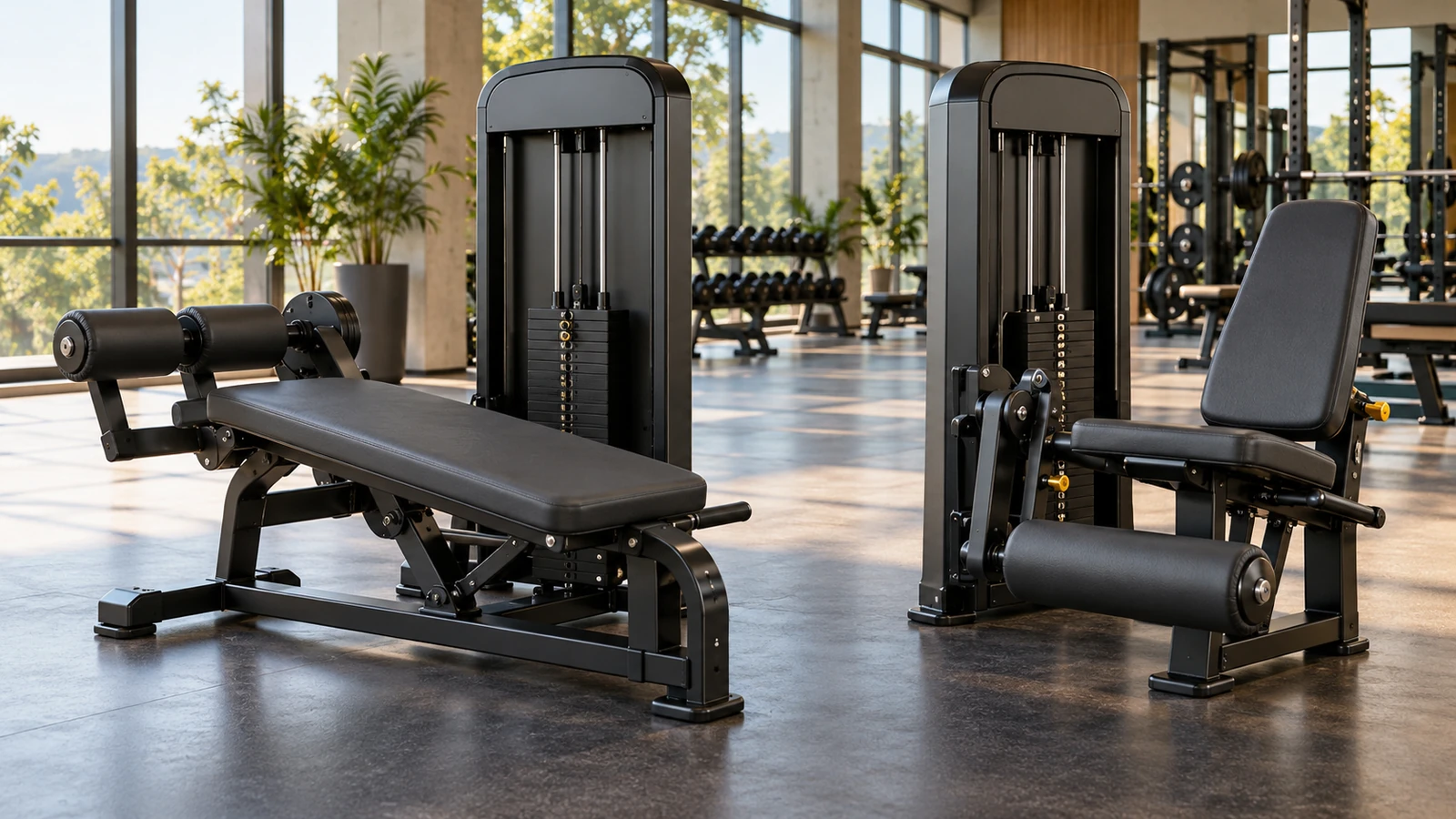
On a seated curl, your heels travel down and back under the seat. On an extension, your feet travel forward and upward as the knees straighten. Dual-function machines may perform both, but the starting arm position and pad arrangements must change.
If the equipment looks unfamiliar, use its instructions or ask a staff member to demonstrate it. Do not assume the previous person’s settings fit you. The Life Fitness description of a combined curl-and-extension machine, for example, identifies separate work-arm, back-pad, and lower-leg adjustments. The controls on your gym’s model may differ.
Which muscles does each exercise train?
Leg curls train the knee-flexion role of the hamstrings
The hamstrings run along the back of the thigh. Most of the hamstring group crosses both the hip and knee, contributing to hip extension as well as knee flexion. The short head of the biceps femoris crosses the knee but not the hip.
A leg curl directly loads the knee-flexion action. The calf can also contribute to bending the knee, so feeling some calf effort does not automatically mean the machine is being used incorrectly. However, uncomfortable cramping is a reason to pause and check the load, position, and execution.
A hip-hinge exercise and a curl are therefore related but different. A Romanian deadlift challenges the hamstrings in a hip-dominant movement; a curl asks them to bend the knee against resistance. You can use both in a broader program without treating them as duplicates.
Leg extensions train the knee-extension role of the quadriceps
The quadriceps are four muscles at the front of the thigh. They extend the knee. One member, the rectus femoris, also crosses the hip. The other three are the vastus lateralis, vastus medialis, and vastus intermedius.
Squats and leg presses also train the quadriceps, but that does not make a leg extension pointless. Exercise selection can affect which regions receive the strongest growth stimulus. A randomized trial comparing Smith-machine squats with leg extensions found different regional quadriceps growth responses, including rectus femoris growth in the extension group.
That does not establish one universally superior leg exercise. It supports a more useful conclusion: a single-joint exercise can contribute something different from a multi-joint movement, even when both train the same broad muscle group.
How to set up and perform a seated leg curl
The first job is to fit the machine to your body. A poor fit can make a light load feel awkward and encourage you to slide or lift out of position.
- Adjust the seat or back support. Sit fully against the support and bring the side of your knee into approximate alignment with the machine’s rotation point, following the model’s diagram.
- Position the lower roller. It should contact the lower part of the back of your legs according to the machine instructions, rather than pressing painfully into a joint.
- Set the thigh pad. It should hold your thighs securely without crushing them or sitting directly on the kneecaps.
- Select a manageable starting position. Your knees should begin comfortably extended within the machine’s available range, without being forced beyond control.
- Try a light rehearsal. Bend your knees to draw the roller down and back. Keep your hips on the seat and use the handles for stability.
- Return under control. Let the knees straighten gradually. Do not let the stack drag you abruptly into the starting position.
The machine should allow you to move your lower legs without repeatedly readjusting your whole body. If your hips lift, the thigh pad shifts, or the knee no longer lines up comfortably, stop and check the settings.
Manufacturer details can help you identify the purpose of each adjustment. For example, Precor’s seated-leg-curl documentation describes adjustable back support, starting position, and thigh stabilization. Use the specific instructions on your machine rather than copying another model’s numbered settings.
How to set up and perform a leg extension
- Set the seat depth. Sit against the back support with the backs of your knees near the seat edge, positioned as the manufacturer directs.
- Align the knee and machine axis. The knee should move comfortably around the machine’s intended pivot region. Ask for help if the seat does not seem to fit.
- Adjust the shin roller. Place it across the lower shins above the ankle area, not on top of the feet or against the kneecaps.
- Choose an appropriate starting angle. Begin from a bent-knee position that feels controlled and matches any professional restrictions you have been given.
- Straighten the knees smoothly. Lift the roller without kicking, swinging, or throwing your torso backward.
- Return slowly enough to stay in control. Keep contact with the seat and avoid letting the stack slam down between repetitions.
You can reach a comfortably straight knee without snapping it forcefully into the end position. “Do not slam into lockout” and “never straighten your knee” are different instructions. The useful goal is a smooth, controlled range that suits you.
Keep the feet in a natural, comfortable position. Dramatically twisting the toes to chase a particular part of the quadriceps adds unnecessary complexity for most beginners. If a setting or movement causes sharp discomfort, stop rather than forcing your way through the repetition.
Seated, lying, or standing leg curl: which should you choose?
Seated leg curl
The seated version places the hip in a flexed position while you bend the knee. This lengthens the hamstring muscles that cross both joints compared with a more extended hip position.
In a 12-week study comparing seated and prone leg curls, both versions increased hamstring size, but the seated condition produced greater growth in the biarticular hamstrings. The study did not show that seated curls were better at protecting against the muscle damage assessed in its testing.
That is a reasonable point in favor of seated curls when growth is your goal and the machine fits comfortably. It is not a reason to abandon a lying curl that you can use well or to assume one exercise prevents injury.
Lying leg curl
The lying, or prone, version places you face down. Adjust the lower-leg roller and position your knees as shown on the machine. Keep your hips supported instead of lifting them to move a load you cannot control.
This option can be useful when the seated machine is unavailable or simply does not fit you well. The ability to complete smooth repetitions in a suitable position matters more than forcing a theoretically preferred machine.
Standing leg curl
A standing machine typically trains one side at a time. Use the support provided, keep the pelvis steady, and bend the working knee without swinging the thigh to create momentum.
It can be convenient for side-to-side practice, but unilateral does not automatically mean more effective. Choose a version you can set up reliably and repeat without unnecessary balancing demands.
Do you need both if you already squat or leg press?
Not necessarily in every session. Start with the role of your current exercises. A squat or leg press provides multi-joint lower-body work with substantial quadriceps involvement. It does not perform the same loaded knee-flexion task as a curl.
If your routine is only squats, leg presses, and lunges, adding a suitable curl may fill a more obvious movement gap than adding another quadriceps exercise. That is a programming decision, not a claim that the hamstrings receive no activity during those other movements.
If you already have squats, a hinge, and curls, an extension becomes optional targeted quadriceps work. It might be useful if quadriceps development is a priority and the extra work fits your capacity and schedule. It might be unnecessary if the session is already long and difficult.
Think in terms of jobs rather than exercise counts:
- A squat, leg press, or lunge supplies a knee-and-hip movement.
- A suitable hinge supplies a hip-dominant movement.
- A curl supplies direct resisted knee flexion.
- An extension supplies direct resisted knee extension.
You do not have to check every box in each workout. Across the week, build a manageable plan that supports your goal. The beginner machine-workout guide offers a broader starting structure.
Which one should come first?
For a general lower-body workout, put your main squat, leg press, or hinge before these targeted machine exercises. Then place the curl and extension according to your priority and the equipment available.
If improving the curl itself is a main goal, it can come earlier. Expect subsequent hamstring-demanding work to feel different. If direct quadriceps training is the main goal, the extension can move forward, but hard extension sets may reduce your later squat or leg-press performance.
Neither order is automatically wrong. The important part is knowing why you chose it and not comparing a fatigued exercise with a fresh performance as though the conditions were identical.
For most beginners, start with the simpler arrangement: main movement first, targeted machine work afterward. Our guide to exercise order explains how to adapt that sequence for full-body days and busy gyms.
Practical sets, repetitions, and effort
A conservative starting example is one or two working sets of each selected machine exercise for roughly 10–15 controlled repetitions. After you are comfortable with the setup and how you recover, two or three sets can be a reasonable option. These are examples, not requirements for everyone.
Choose a load that allows the last repetitions to require effort without changing the movement into a kick, body swing, or partial repetition you did not intend. Initially, finish while you believe you could still perform a few clean repetitions.
If you cannot tell how much effort remains, learn the idea of reps in reserve. The estimate does not have to be perfect to help you avoid treating every set as a maximum test.
Allow enough time between sets that you can regain control and repeat the exercise well. You do not need to rush between a curl and extension simply because they target different muscle groups.
Keep the machine settings, range, and execution consistent when deciding whether a load has become easier. More stack weight accompanied by bouncing and reduced movement is a different performance, not a straightforward improvement.
Three ways to fit them into a workout
Option 1: a beginner machine session
After a general warm-up and lighter practice sets, use a leg press as your main lower-body exercise. Add a seated curl, then include an extension only if it fits the day’s plan.
- Leg press: two manageable working sets.
- Seated leg curl: one or two sets of 10–15 repetitions.
- Leg extension: one or two sets of 10–15 repetitions, if included.
This is a lower-body portion of a session, not a complete balanced weekly program. Add the upper-body work and other movements your plan requires. Start smaller rather than adding every available leg machine on your first visit.
Option 2: a squat-focused lower-body day
Complete your prepared squat work first. Follow it with an appropriate hip-dominant movement if your program includes one, then add curls. Extensions can be the optional final quadriceps exercise.
The reason to make extensions optional is practical: the quads have already worked during squats. Whether more direct work is useful depends on your goal and total workload, not the belief that a leg day is incomplete without a burning finish.
Option 3: distribute the exercises across two full-body days
On the first day, combine a squat or leg press with a curl. On the second day, combine a suitable hinge with an extension and whatever additional lower-body movement your plan needs.
This spreads the machine work out and may make each session easier to finish. It is one possible arrangement within a two-day full-body routine, not a rule that each muscle may only appear on one day.
Do the weights need to match?
No. There is no requirement to curl and extend the same number on the weight stack. The exercises involve different muscles, leverages, and machine designs. Even two machines labeled in the same units can feel different because of their pulley systems and movement arms.
A larger extension number does not by itself diagnose a hamstring weakness. A smaller curl number does not tell you that your knees are unsafe. Clinical or sport-specific strength testing uses more controlled conditions than comparing two gym stacks.
Track each exercise against itself on the same machine. Record the seat and pad settings if you tend to forget them. Compare repetitions completed with the same range and level of control.
If one side appears consistently different, a light single-leg version may help you observe the difference when the equipment supports it. Persistent pain, a sudden change, or a pronounced unexplained weakness deserves professional assessment rather than an improvised correction program.
Are leg extensions bad for your knees?
It is not useful to label an exercise universally safe or dangerous from its name alone. Resistance, range of motion, machine fit, training history, and an individual’s knee condition all affect whether a movement is appropriate.
For a generally healthy person, a controlled leg extension can be a normal part of strength training. That does not mean every load or range is appropriate for every knee. A rehabilitation plan after ligament surgery, for example, may include restrictions that differ from general gym advice.
If the exercise hurts, do not assume the answer is to keep going until the joint “warms up.” Stop the painful set. Check the machine fit and discuss persistent symptoms with a qualified health professional. Swelling, locking, giving way, or pain after an injury needs more than a technique cue.
The same caution applies to leg curls. A supported machine controls part of the movement, but it does not automatically make any resistance suitable.
Common mistakes and straightforward fixes
Using the previous person’s settings
Check seat depth, pivot alignment, roller placement, and starting range before selecting a working load. A quick light repetition is more informative than assuming a setting is correct because you can reach the handles.
Moving the torso to lift the stack
If you repeatedly rock backward during extensions or lift your hips during curls, reduce the load and check the restraints. Your body should feel supported while the knee performs the intended movement.
Letting the stack decide the speed
Keep control during the return. If you cannot prevent a sudden drop or collision, the resistance or range may exceed what you can manage smoothly.
Adding both exercises without considering the whole session
More exercises are not automatically a better plan. Identify the reason for each one. A curl filling a missing knee-flexion role is a different decision from adding another extension variation to an already crowded quadriceps session.
What if your gym does not have these machines?
For knee flexion, a securely anchored resistance-band curl or an appropriate slider curl may be an option. Slider curls can be demanding and also require hip control, so use a variation you can manage rather than assuming they are a direct beginner substitute.
For knee extension, a properly secured band can provide resistance, although the feel differs from a selectorized machine. Squats, supported split squats, and step-ups can train the quadriceps through multi-joint movements when they suit your abilities.
Do not improvise a machine by trapping a heavy dumbbell between your feet. Choose equipment that can be secured and controlled, and follow its instructions. A substitute does not need to look identical to be useful, but its different demands should be acknowledged.
The practical choice
Choose the leg curl for direct hamstring knee-flexion work and the leg extension for direct quadriceps knee-extension work. Use both when each has a clear job in your routine. Use one when it fills the more important gap, and keep the rest of your lower-body training in view.
Good setup, a comfortable controlled range, and a manageable workload matter more than winning a comparison between two exercises designed to do different things.