
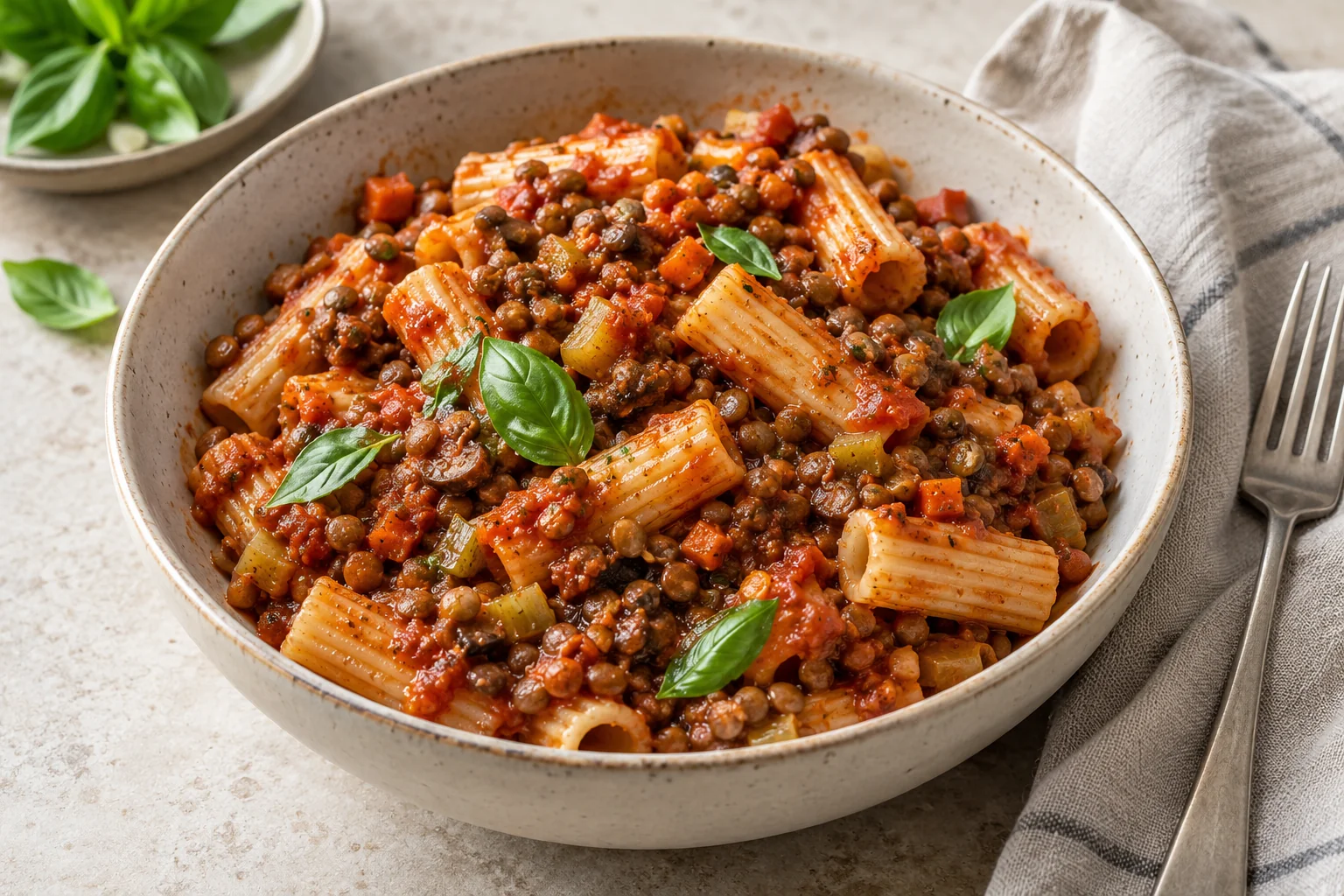
For a rich lentil bolognese with distinct, tender lentils, cook brown or green lentils separately, brown the mushrooms and vegetables, then combine everything with tomatoes. This vegan recipe makes four generous servings and takes about 50–60 minutes. The sauce can be refrigerated or frozen separately from the pasta, so one cooking session can cover several meals.
Published October 20, 2026
The goal is a deeply savory vegetable ragù, not an exact imitation of ground beef. Finely chopped mushrooms supply a darker, softer background; lentils give the sauce substance; and tomato paste helps everything taste rounded rather than watery. You do not need wine, a meat substitute, a blender, or an expensive specialty ingredient.
Below you will find measured ingredients, a canned-lentil shortcut, practical fixes for common texture problems, and a transparent way to estimate protein using your own labels. Start with the recipe, then use the variations to fit the ingredients and time you actually have.
Lentil bolognese recipe at a glance
- Yield: four generous main-course servings.
- Prep: about 15 minutes.
- Cooking: about 35–45 minutes, with the lentils and sauce cooking in parallel.
- Total: allow 50–60 minutes; older lentils may need longer.
- Dietary pattern: vegan as written when the pasta and stock are vegan.
- Main equipment: kitchen scale, medium saucepan, large deep sauté pan or wide pot, sieve, knife, chopping board, and a pasta pot.
A wide pan matters more than a fancy one. Mushrooms release water as they cook, and a broad surface gives that moisture somewhere to go. A small saucepan can make the same ingredients steam into a pale mixture instead of developing the browned flavor that anchors this sauce.
Ingredients: four servings
For the lentils
- 240 g dried brown or ordinary green lentils, picked over and rinsed.
- 1.2 liters water for cooking, plus more if needed.
- 1 bay leaf, optional.
For the bolognese sauce
- 20 g olive oil, divided.
- 250 g cremini or button mushrooms, finely chopped.
- 150 g onion, peeled and finely diced.
- 100 g carrot, trimmed and finely diced.
- 75 g celery, trimmed and finely diced.
- 12 g garlic, peeled and minced.
- 40 g tomato paste.
- 800 g canned crushed tomatoes, including their juices.
- 150 ml low-sodium vegetable stock, plus up to 150 ml more for adjusting consistency.
- 2 g dried oregano, approximately 2 teaspoons.
- 1 g dried thyme, approximately 1 teaspoon.
- 2 g fine salt to start, plus more to taste.
- 0.5 g ground black pepper, approximately ¼ teaspoon.
- 5–10 ml balsamic vinegar, optional, added only after tasting.
- 10 g fresh basil or parsley, chopped, optional.
To serve
- 320 g dried egg-free pasta, such as rigatoni, penne, or spaghetti.
- Water and salt for cooking pasta, according to preference and any relevant dietary guidance.
- A little reserved pasta cooking water to loosen the finished sauce.
The gram weights are the main measurements. Vegetable sizes vary considerably, so “one onion” can produce a very different sauce from one kitchen to another. There is no need to measure dried herbs to a tenth of a gram: the spoon measures are useful approximations for those small quantities.
Keep the optional vinegar beside the stove rather than pouring it in automatically. Some tomatoes are already bright and sharp. The vinegar is a finishing adjustment for a sauce that tastes flat, not a required treatment for every can of tomatoes.
How to make lentil bolognese
1. Cook the lentils until tender
Put the rinsed lentils, 1.2 liters of water, and optional bay leaf in a medium saucepan. Bring to a boil, then reduce to a gentle simmer. Cook for about 20–30 minutes, checking from 18 minutes onward. Add hot water if necessary to keep the lentils comfortably submerged.
Taste several lentils, not just one. They should be tender all the way through with no chalky center, but still mostly hold their shape. Drain well and remove the bay leaf. If the packet gives a longer cooking time, use it as a guide and let tenderness determine when they are ready.
Cooking the lentils separately makes the timing easier to control. Colorado State University Extension notes that substantial amounts of acidic ingredients, including tomatoes, can interfere with pulses softening and recommends adding them after the pulses soften. It also explains that lentils do not generally need soaking.
2. Brown the mushrooms
While the lentils simmer, heat 10 g of the olive oil in a large, deep pan over medium-high heat. Add the chopped mushrooms and spread them out. Cook for 7–10 minutes, stirring occasionally, until their released liquid has largely evaporated and some pieces begin to brown.
If the mushrooms crowd the pan in a deep layer, cook them in two batches. Do not add more liquid at this stage. You want to remove their excess moisture before building the sauce, not trap it beneath the tomatoes.
3. Soften the aromatic vegetables
Add the remaining 10 g olive oil, onion, carrot, and celery. Reduce the heat to medium. Cook for 8–10 minutes, stirring regularly, until the onion is soft and the carrot pieces are beginning to soften. Add the garlic and stir for another 30–60 seconds.
Keep the dice small, roughly 3–5 mm, so the vegetables blend into the ragù. Large carrot chunks need longer cooking and produce a different eating experience. If the base begins catching before the vegetables soften, add a tablespoon of water and scrape up the browned bits.
4. Build and simmer the tomato sauce
Stir in the tomato paste and cook for 1–2 minutes, moving it around the pan so it darkens slightly without burning. Add the crushed tomatoes, 150 ml stock, oregano, thyme, salt, and pepper. Stir thoroughly, including the edges and bottom of the pan.
Bring to a gentle bubble, then simmer uncovered for 12–15 minutes. Stir every few minutes. The sauce should thicken and lose its raw tomato-paste taste. Lower the heat if it spits aggressively; a calm simmer is easier to control than a hard boil.
5. Combine and adjust
Fold in the drained, fully tender lentils and simmer for 8–10 minutes. Add extra stock in small splashes if the mixture becomes stiff. If it looks loose, continue simmering uncovered until a spoon drawn through the sauce leaves a brief trail.
For a more cohesive texture, press a few spoonfuls of lentils against the side of the pan, then stir them back through. Leave most of the lentils whole. Taste before adding any more salt or the optional vinegar. Finish with herbs if using.
6. Cook the pasta and bring everything together
Cook the pasta according to its packet instructions while the sauce finishes. Before draining, reserve about 250 ml of the cooking water. Toss the pasta with the portion of sauce you plan to serve immediately, adding cooking water a tablespoon at a time until the sauce coats it comfortably.
If you are meal prepping, keep the remaining sauce separate. You can cook fresh pasta later, or refrigerate cooked pasta separately. Divide the sauce into four equal portions rather than assuming an exact finished weight: evaporation, mushroom moisture, and lentil water absorption all affect the yield.
Which lentils work best?
Ordinary brown and green lentils are the most straightforward choice here. They can become tender while retaining enough structure to make the sauce feel substantial. Check the package rather than relying entirely on color, because names and cooking instructions vary between producers.
Small French green lentils and black lentils can also work, but their more distinct texture may remain noticeable. Cook them separately until they are pleasantly tender before adding them. A sauce filled with firm lentils will not become more comforting simply because it has simmered in tomatoes for longer.
Split red lentils are a different option, not a direct texture match. They soften and break down more readily, creating a smoother, thicker sauce. If you want that result, cook them separately with close attention and fold them in gently. Expect a creamier lentil sauce rather than the distinct pieces pictured here.
For a broader comparison of useful pantry legumes, see lentils versus chickpeas. The best choice depends on the dish: chickpeas provide a firmer bite, while lentils integrate into a finely textured sauce with less work.
Can you use canned lentils?
Yes. Replace the 240 g dried lentils with approximately 600 g cooked, drained lentils. Treat this as a practical recipe substitution, not an exact nutritional equivalence. The amount of water absorbed during cooking varies, and canned products have their own nutrition labels.
Weigh the lentils after draining and rinsing. A can labeled 400 g or 15 ounces includes packing liquid, so two cans may not provide 600 g drained lentils. Look for the stated drained weight or use your scale. Add the canned lentils at the combining step and simmer only long enough to heat through and bring the flavors together.
The shortcut removes the separate lentil-cooking step, but it does not eliminate the time needed to brown mushrooms and soften vegetables. Allow about 35–45 minutes overall. If you already have cooked lentils in the fridge, use them only while they remain within their safe storage window.
How much protein is in lentil bolognese?
The answer depends on both the sauce and what you serve with it. Pasta contributes protein too, so a bowl of lentil bolognese with pasta is not nutritionally interchangeable with the same sauce over zucchini noodles.
Here is a transparent planning example, not a laboratory analysis. Assume your dried lentil label lists 24 g protein per 100 g, and your dried pasta label lists 12 g per 100 g:
- 240 g dry lentils would contribute about 58 g protein to the batch.
- 320 g dry pasta would contribute about 38 g.
- Together, those two ingredients would provide about 96 g across four servings, or approximately 24 g per serving.
That subtotal excludes smaller contributions from mushrooms, vegetables, and other ingredients. It is not a full nutrition panel, and it will change with brands, substitutions, serving size, and how evenly you divide the meal. Use the values on your actual packets if you track intake.
The calculation is ingredient weight divided by the label’s serving weight, multiplied by the protein listed for that serving. Use dry weights with dry-food labels, and cooked weights only with labels or database entries explicitly describing cooked food. Water changes food weight, not the meaning of the original ingredient amount.
USDA MyPlate includes lentils among vegetarian protein-food options. That supports treating them as a useful protein ingredient; it does not mean every lentil-based meal automatically meets your individual needs or that one fixed serving works for everyone.
Build the serving around your appetite
The recipe’s four portions are generous meals, not a rule about how much anyone should eat. For a smaller lunch, serve less pasta and sauce, then save the remainder promptly. For a larger meal, add bread, a larger pasta portion, or another side you enjoy.
Whole-wheat pasta is an option if you like its flavor and texture. Chickpea or lentil pasta changes the nutrition and can soften differently, so follow its own cooking instructions. Taste it early and avoid leaving it in a hot pan of sauce while you finish unrelated kitchen tasks.
A crunchy side salad or roasted green vegetables offers contrast to the soft ragù. You do not need to turn the meal into a collection of additions simply because it appears on a fitness website. A repeatable dinner that fits your appetite and schedule is more useful than an elaborate bowl you rarely make.
Substitutions that preserve the recipe’s structure
Without mushrooms
Replace the mushrooms with 200 g finely diced zucchini and 50 g extra carrot. Cook them until excess moisture evaporates before continuing. The result will be lighter and less earthy. Do not replace mushrooms with the same weight of walnuts without reconsidering both the recipe balance and allergens.
Without celery
Use 75 g additional onion or carrot. The flavor will change slightly, but the sauce will still work. Cut the replacement finely, and judge the vegetable-softening step by tenderness rather than the clock alone.
Without stock
Use water in the same amount. Taste the finished sauce before adjusting salt. A concentrated stock cube can contain considerably more salt than a low-sodium liquid stock, so do not automatically use a whole cube in the relatively small volume required here.
Gluten-free or soy-free choices
The base recipe does not require soy sauce. For a gluten-free meal, choose appropriate pasta and verify the stock and other packaged ingredients. For allergies, check every label and preparation surface rather than assuming a recipe name guarantees suitability.
Troubleshooting: texture and flavor
The lentils are still hard
If they are still in their separate saucepan, continue simmering with enough water and test again. Storage age, variety, and cooking conditions can affect timing. If you already mixed undercooked lentils into the sauce, add water and simmer gently, but recognize that the tomatoes can make softening less predictable. Next time, finish cooking the lentils first.
The sauce is watery
Simmer uncovered in a wide pan and stir so the bottom does not catch. Avoid adding flour immediately: the problem may simply be excess mushroom liquid or insufficient reduction. Once the lentils are tender, mashing a small amount can also help bind the sauce.
The sauce is dry or pasty
Add warm stock, water, or reserved pasta water in 15–30 ml increments. Stir, let the sauce settle, and check again. Lentils and pasta can continue taking up moisture, so a sauce that looks perfect in the pan may need a small splash just before serving.
It tastes sharp
Skip the vinegar. Check that the vegetables are fully softened and the tomato paste was cooked rather than scorched. A longer gentle simmer may help integrate the flavors. If needed, add a small pinch of sugar, taste, and stop before the sauce becomes sweet. Sugar changes perceived balance; it does not make the sauce shelf-stable.
It tastes bland
First check salt, then acidity, then herbs. Add one adjustment at a time. If the sauce lacks depth, better mushroom browning is usually a more useful change for the next batch than doubling every spice. Strong smoked paprika can be enjoyable, but it changes the character of the dish rather than repairing every problem.
Meal prep, refrigeration, and freezing
Refrigerate leftovers in shallow containers within two hours, or within one hour above 90°F/32°C. Keep the refrigerator at 40°F/4°C or below and use refrigerated leftovers within three to four days. Reheat to 165°F/74°C, checking the center and stirring for even heating. These are USDA leftover-safety recommendations, not a reason to leave a large pot cooling on the counter.
Freeze portions you will not use in that window. For this recipe, aim to use frozen sauce within about two to three months for enjoyable texture; that is a quality target, not a claim that the sauce becomes unsafe immediately afterward. Thaw in the refrigerator, not on the kitchen counter.
Leave room in freezer-safe containers for expansion and label them with the dish and date. Flat freezer bags save space if they are suitable for freezing and sealed securely. Keep pasta separate when practical, because it is easier to control its texture when you cook it fresh.
For a practical portioning system, see freezer meal prep. If you cook for yourself, meal prep for one can help you plan a mixture of refrigerated meals and frozen portions rather than committing to the same dinner repeatedly.
Frequently asked questions
Is lentil bolognese traditional bolognese?
No. This is a plant-based sauce inspired by the savory, slow-cooked character of a ragù. Calling it lentil bolognese describes the intended use and style; it does not claim that lentils are part of a traditional meat ragù recipe.
Do I need to soak the lentils overnight?
Not for this recipe. Rinse and inspect them, then cook until tender. Soaking would change the timing, so if you use already-soaked lentils, begin checking much earlier rather than following the full dry-lentil cooking window automatically.
Can I double the recipe?
Yes, but use a sufficiently large pot and brown the mushrooms in batches. Doubling ingredients does not mean doubling every cooking time. Allow more time for chopping, reheating the larger mass, and reducing moisture, and prepare enough shallow containers before you finish.
Can I make this without pasta?
Yes. Spoon the sauce over a baked potato, polenta, or cooked grains. The protein example above includes 80 g dry pasta per serving, so it no longer applies unchanged. Calculate the actual base you choose rather than carrying over the pasta version’s number.
What is another savory plant-based meal to prep?
Try the high-protein tofu scramble for a breakfast or lunch built around a different texture. Alternating a tomato-based lentil dinner with a quick tofu meal can make a small repertoire feel less repetitive without requiring a completely different shopping list.
A reliable dinner starts with a manageable method
Cook the lentils until tender, give the mushrooms room to brown, and reduce the sauce before you judge the seasoning. Those three decisions do more for this lentil bolognese than a long list of specialty ingredients. Make the full batch when it suits your schedule, portion it deliberately, and keep the serving flexible.
Looking for another part of your fitness routine to explore? Explore Workit on the App Store.
Comments
One response to “Lentil Bolognese: A Rich Vegan Sauce for Pasta and Meal Prep”
[…] you prefer to cook once and vary the meals, pair a scramble session with lentil bolognese for dinners. The dishes share ordinary vegetables and simple equipment while tasting different […]