
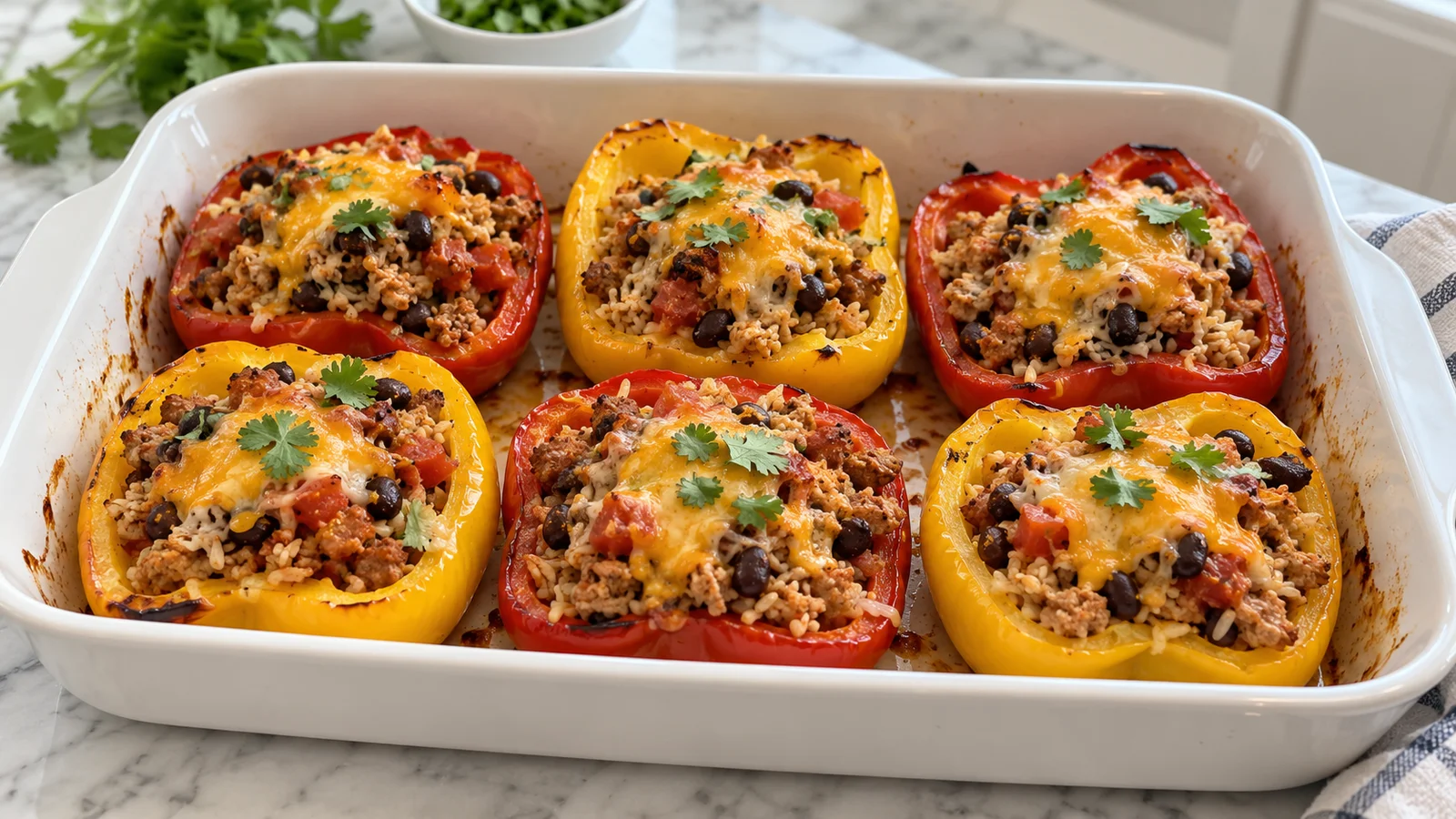
For high-protein stuffed peppers that stay tender without turning watery, roast the pepper halves first, cook the turkey filling separately, and add the cheese near the end. This turkey, black bean, and brown rice recipe makes six generously filled halves, or three dinner portions of two halves each. The turkey alone contributes an estimated 29.7 grams of protein per dinner portion using the example label explained below.
Published October 19, 2026.
The key is managing three different ingredients: a vegetable shell that releases water, a filling that needs to stay moist, and a topping that browns faster than the pepper softens. Cooking them in stages gives you more control than packing raw ingredients together and hoping everything finishes at the same time.
The recipe at a glance
- Yield: six large pepper halves; three servings of two halves, plus any evenly divided extra filling.
- Active preparation: approximately 25 minutes.
- Oven time: approximately 35–45 minutes across both roasting stages.
- Oven temperature: 400°F, or about 205°C, conventional oven.
- Equipment: a large skillet, a rimmed baking dish, foil, a kitchen scale if available, and a food thermometer.
- Food-safety endpoint: ground turkey and the center of the finished filling must reach 165°F, or 74°C.
Cooking times are estimates. Very thick-walled peppers, chilled filling, and a crowded baking dish can all extend the second stage. Use a fork to judge the pepper’s texture and a thermometer to judge the filling’s temperature. Those are different checks, and neither replaces the other.
Ingredients for turkey and black bean stuffed peppers
- Three large bell peppers, approximately 650–750 grams total before trimming, preferably red, yellow, or orange
- One pound ground turkey, approximately 454 grams; a lean blend around 93% works well
- 130 grams cooked black beans, measured after draining and rinsing
- 100 grams cooked brown rice, approximately half a cup depending on the rice
- 75 grams finely diced onion
- Two garlic cloves, finely chopped
- 150 grams canned crushed tomatoes
- One tablespoon tomato paste
- Two teaspoons olive oil, divided
- One teaspoon ground cumin
- One teaspoon smoked paprika
- Half a teaspoon dried oregano
- Half a teaspoon fine salt, divided, plus more only if needed
- Quarter teaspoon black pepper
- 42 grams shredded cheddar, divided evenly
- One tablespoon lime juice
- Two tablespoons chopped cilantro, optional
The rice and beans are already cooked before they enter the skillet. Dry rice cannot replace the cooked rice by weight: it needs additional liquid and cooking time. Likewise, the drained bean weight is a kitchen measurement for this recipe; do not assume it matches a canned product’s nutrition-label serving basis.
Choose the peppers before committing to the yield. Large peppers with broad sides create better boats than tall, narrow ones. If your peppers are small, use four and make eight halves, then divide the entire batch into three meal portions if you want the same nutrition-calculation basis.
Step one: make stable pepper boats
Heat the oven to 400°F. Rinse the whole peppers under running water and dry them. Cut each lengthwise through the stem area, leaving a small part of the stem attached if that helps the halves hold their shape. Remove seeds and the pale internal ribs with a small knife or spoon.
Try setting each half in the empty baking dish. If one rocks badly, trim a very thin sliver from its outside bottom without cutting a hole through the wall. You want the filling to stay inside during cooking, so do not turn the pepper into a flat-bottomed bowl at the cost of puncturing it.
Brush the cut interiors lightly with one teaspoon of the oil and sprinkle with a little of the measured salt. Place cut-side down in a lightly greased baking dish. Roast for approximately 15 minutes, until the peppers begin to soften but can still be lifted without collapsing.
Carefully turn them cut-side up. Pour off any pooled liquid or blot each cavity gently with a clean paper towel held in tongs. The peppers will release more moisture later, but removing this first accumulation keeps it from diluting the filling immediately.
Step two: cook a filling that holds together
While the peppers roast, warm the remaining teaspoon of oil in a large skillet over medium heat. Add the onion and cook for 4–5 minutes, stirring, until softened. Add the garlic, cumin, paprika, and oregano and stir for about 30 seconds, stopping before the garlic browns darkly.
Add the turkey. Break it into small, uneven crumbles with a sturdy spoon and cook, stirring periodically, until cooked through. Small crumbles fit into a pepper more neatly than large chunks, but crushing the meat continuously into a paste is unnecessary.
Use a food thermometer to verify 165°F in the cooked turkey. Gather a thick portion of the crumbles together so the probe’s sensing area is surrounded by food and does not touch the skillet. FoodSafety.gov lists 165°F as the minimum for ground poultry; browned color alone does not establish safety.
Stir in the tomato paste, crushed tomatoes, beans, cooked rice, remaining measured salt, and black pepper. Simmer uncovered for about 4–6 minutes, stirring occasionally. The mixture should look moist and cohesive, with no watery moat collecting when you drag a spoon through it. Turn off the heat and add the lime juice.
Once the turkey is fully cooked, taste the filling and adjust seasoning if needed. If it seems dry and crumbly, add one tablespoon of water at a time. If it looks loose, cook uncovered a little longer. The goal is a spoonable filling that can form a low mound, not a dry crumble or a soup.
Step three: fill, cover, and finish
Divide the hot filling among the six pepper halves. Start with a modest spoonful in every pepper, then go around again until the mixture is distributed. Press lightly into the corners so each half holds together, but do not compact the meat and rice into a hard plug.
If the peppers cannot hold all the filling, place the remainder in a small oven-safe dish and heat it alongside them. It is part of the recipe yield. Divide that extra filling between the three plates instead of quietly treating it as an uncounted fourth portion.
Cover the main dish loosely with foil and bake for approximately 15 minutes. Uncover, sprinkle each half with 7 grams of cheddar, and bake another 5–10 minutes, until the cheese melts and the peppers are as tender as you like. Check the center of several filled halves; each should reach 165°F.
Rest for about 5 minutes before serving so the filling settles and the peppers are easier to move. Slide a wide spatula underneath rather than lifting them by the stem. Add cilantro if using and serve two halves per person, with the appropriate share of any extra filling.
Why the two-stage method helps
The pepper gets a head start
A firm raw pepper and a cooked turkey filling need different amounts of heat. Pre-roasting softens the shell before the filling goes in. That lets you finish the dish without subjecting the turkey to a long, unnecessary bake while you wait for the pepper walls to become tender.
Cutting lengthwise also exposes more of the pepper to heat and makes it easier to inspect the texture. Upright whole peppers can be attractive, but their thick bottom and deep cavity often need a different cooking schedule. Use halves for this recipe rather than mixing both shapes in the same pan.
The filling’s moisture is visible before assembly
Cooking the filling in a skillet lets you see and correct excess liquid. Crushed tomatoes vary by brand, and freshly cooked rice can be wetter than cooled rice. A few minutes uncovered is easier to control than trying to evaporate liquid trapped inside a stuffed pepper.
Do not compensate for every wet ingredient by adding more rice. That changes both the yield and the balance of the meal. First drain the beans well, measure the tomato, and give the skillet time to reduce the liquid already present.
The cheese finishes the dish instead of insulating it
Adding cheese near the end keeps it from becoming leathery while the peppers soften. A measured topping gives a little cheese on every bite without hiding the filling. Finely shredded cheese spreads more evenly than a few large clumps, especially when you are dividing a small amount across six halves.
Protein math with a clearly defined serving
The estimate in the introduction uses JENNIE-O Lean Ground Turkey’s label, which lists 22 grams protein per 112 grams raw turkey. For the recipe’s measured 454 grams, the turkey-input estimate is 454 divided by 112, multiplied by 22: approximately 89.18 grams for the full batch.
Divide by three dinner portions and the turkey-only protein subtotal is approximately 29.7 grams per serving. Each serving means two of the six equally filled halves plus one-third of any extra filling. If you serve one half instead, its turkey-only subtotal is approximately 14.9 grams.
This is a partial protein estimate, not full meal macros. Beans, rice, cheese, peppers, and other ingredients are excluded. Their omission does not make them nutritionally invisible; it means this particular calculation is deliberately limited. It also does not represent a laboratory measurement of the cooked food. Labels are rounded, meat varies, and cooking losses affect the final composition.
For a complete log, enter each ingredient using its actual label and the correct raw, cooked, or drained basis, then divide the recipe by your real yield. Oil, cheese, and any sauce on the plate belong in that full calculation too. A recipe described as high-protein is not automatically low-calorie or suitable for every nutrition target.
Choose your ingredients by how they cook
Ground turkey
A moderately lean turkey blend gives the filling some richness without requiring a lot of additional oil. Extra-lean ground turkey breast can work, but watch it closely and avoid a prolonged uncovered simmer after it is cooked. If your meat package is larger than one pound, either weigh the recipe amount or scale all the other ingredients.
If turkey releases substantial liquid, allow the skillet to evaporate excess moisture while cooking. Avoid pouring away a large amount of liquid and then assuming a raw-input nutrition calculation perfectly describes the retained food. The figures here are estimates even when the full mixture is kept.
Beans and rice
Black beans bring texture and make the filling less uniformly meaty. Pinto or kidney beans also work if fully cooked, drained, and measured in the same amount. For more detail on preparing either starting format, see our canned vs dried beans guide.
Brown rice should be tender before assembly. If using refrigerated leftover rice, handle it within its safe storage window and heat the finished filling thoroughly. A freshly opened pouch of plain ready-cooked rice can simplify the recipe; check whether the pouch contains added oil, salt, or seasonings before adjusting the skillet.
Peppers and tomatoes
Red, orange, and yellow peppers give this version a sweeter background. Green peppers bring a more assertive flavor and are a reasonable preference-based swap. Do not assume color tells you how quickly a particular pepper will soften; wall thickness and size matter too.
Crushed tomatoes are easier to distribute than large tomato chunks. If all you have are diced canned tomatoes, chop them a little more and drain off some excess liquid before measuring the recipe amount. Save that liquid separately for another use rather than flooding the pepper filling with it.
Three variations with specific adjustments
Smoky corn and bean peppers
Replace 50 grams of the cooked rice with 50 grams of thawed corn, patted dry. Keep the other ingredients unchanged. Stir the corn into the skillet with the beans so it heats through. The result has a sweeter bite and less rice without requiring a different assembly method.
For heat, add a pinch of chili flakes or a little chopped chipotle to the cooked filling, then taste before adding more. Chipotle products can carry substantial salt, so hold back some of the recipe’s salt until you know the final flavor.
Italian-inspired turkey peppers
Omit cumin, smoked paprika, lime, and cilantro. Use one teaspoon Italian herb seasoning, keep the tomato base, and finish with 42 grams shredded mozzarella instead of cheddar. Stir chopped basil into the finished filling if you have it. White beans can replace black beans at the same cooked, drained weight.
This changes the flavor profile without changing the basic moisture-management steps. Check the replacement cheese and turkey labels if you need full nutrition figures. The turkey-only protein calculation remains tied to the measured turkey and the same three-serving yield.
Rice-free peppers
Replace the 100 grams cooked rice with 100 grams finely chopped mushrooms that have been sautéed until their released moisture evaporates. Measure the mushrooms after cooking for this substitution. Raw mushrooms added directly to the assembled filling can release water into the pepper.
The rice-free version will have a looser texture and a different carbohydrate amount. It is not a promise of a particular low-carbohydrate total because the beans, peppers, tomatoes, and other ingredients still contribute carbohydrates.
Troubleshooting: fix the cause, not just the symptom
The baking dish has a puddle
Some liquid release is normal. Before changing the recipe, check whether you drained the pre-roasted peppers, dried the beans, and reduced the tomato filling. If the meal is already cooked, lift the peppers onto plates with a slotted spatula. Do not bake them indefinitely just to make the dish completely dry.
The peppers are still too firm
Cover the dish again and continue baking in short intervals. If the cheese is already browned, the foil protects it while the pepper softens. For your next batch, extend the first roast by a few minutes and choose similarly sized peppers so one thick shell does not dictate the timing for every portion.
The filling is dry
Check whether the turkey was extra lean, the skillet simmer lasted too long, or the rice was packed tightly. Add a spoonful of warm crushed tomato or water to an individual serving and cover while reheating. Next time, stop reducing when the filling holds together but still looks moist.
The halves fall apart when lifted
The peppers may be very soft, or a large amount of filling may be concentrated in the center. Use a wider spatula, let them rest briefly, and serve from the baking dish if needed. A soft pepper still makes a good dinner. For future batches, shorten the first roast slightly rather than underheating the finished poultry filling.
Serving, scaling, and storing the finished dish
Two halves are the defined meal portion here. Add a side salad, roasted vegetables, or extra rice according to appetite. If you prefer a bowl without the pepper shell, the same turkey-and-bean flavor direction is also useful in our high-protein chili recipe, which has its own liquid balance and cooking method.
For a double batch, use two baking dishes and a larger skillet or cook the filling in batches. Crowding doubles the food without doubling the pan’s ability to evaporate moisture. Rotate dishes if your oven heats unevenly, and check temperatures in both rather than assuming the same timing guarantees identical results.
Refrigerate leftovers promptly in shallow containers, within two hours of cooking or one hour above 90°F. Keep the refrigerator at 40°F or below. Use within three to four days or freeze; reheat the center to 165°F. These limits follow USDA leftover guidance. Reheating does not make improperly stored food safe.
For a softer reheated pepper, cover the serving with a vented microwave-safe lid and rotate it during heating. Check more than one spot in the filling. For a firmer cheese surface, reheat covered in the oven, then uncover briefly at the end. Freeze portions individually once promptly chilled; our freezer meal prep guide explains portioning approaches for other dishes too.
If you want to assemble the peppers ahead
Cook the turkey filling completely, then cool it promptly in a shallow container and refrigerate it separately from the pre-roasted peppers. Assemble the chilled components shortly before baking. Keeping them separate until then makes it easier to drain any liquid the peppers release and prevents the rice from absorbing it overnight.
Start the covered baking stage earlier than you would with hot filling, and expect it to take longer. The timer is especially unreliable when the centers begin refrigerator-cold. Check multiple peppers and continue until their filling reaches 165°F; do not shorten that step because the cheese already looks melted.
Use the storage date of the oldest cooked ingredient when deciding how long to keep the assembled dish. Combining yesterday’s rice with freshly cooked turkey does not give the rice a new storage history. If either component was left unrefrigerated too long, discard it rather than mixing it into the batch. Never partly cook ground turkey and refrigerate it with plans to finish the cooking later.
A repeatable dinner starts with texture
For another dinner using a one-pound package of ground turkey, try baked turkey meatballs. Their smaller portions work well when you want to serve the vegetables and grain separately instead of packing everything into pepper halves.
The most useful habit is to evaluate the shell and filling separately: soften the pepper first, reduce the filling to a moist spoonable consistency, and melt the cheese last. Once those steps feel familiar, changing beans, herbs, or the side dish is straightforward.
For a simple way to organize training alongside meals you enjoy, Workit provides personalized workouts and lets you log weights, reps, and sets.