
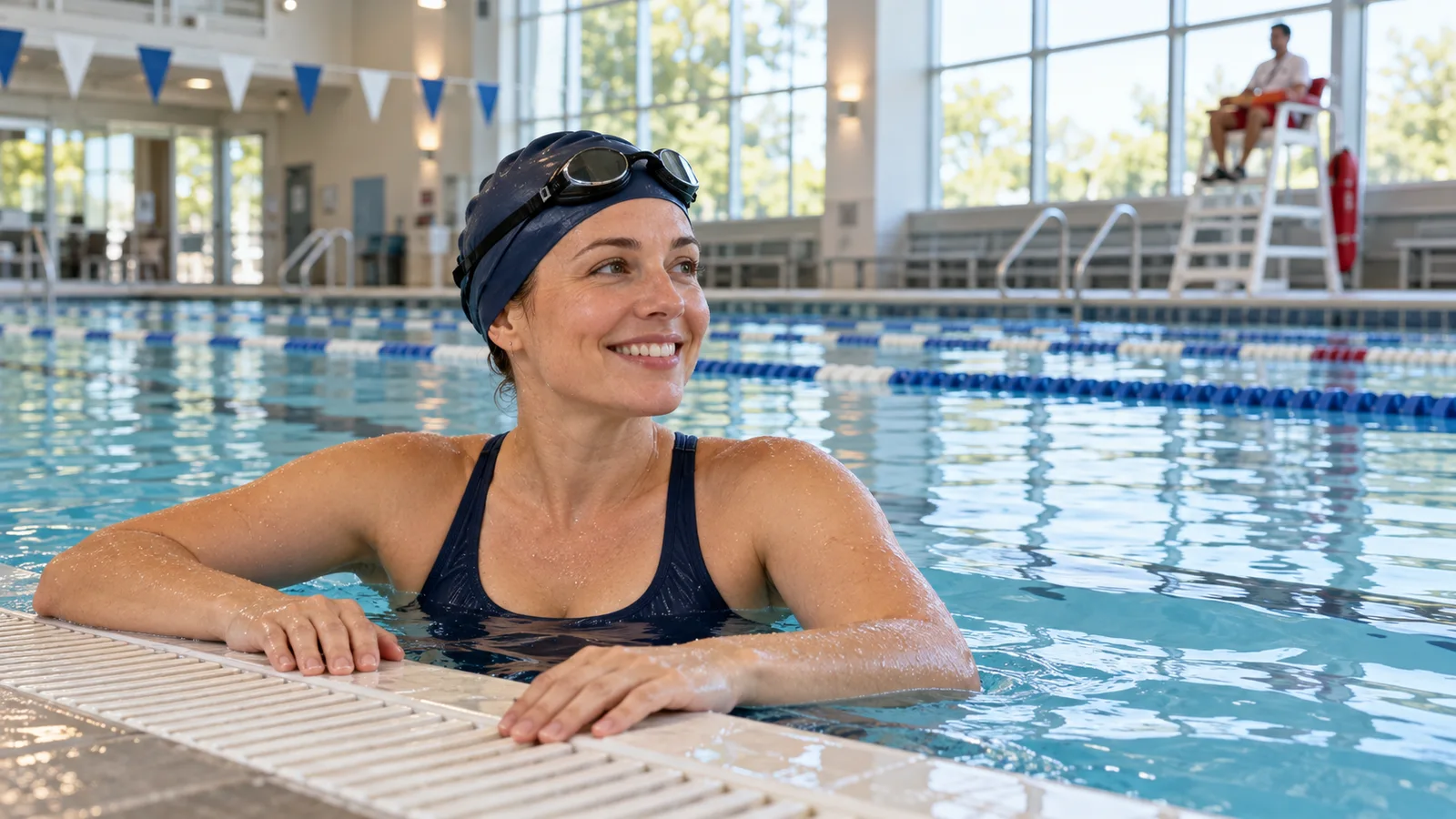
A swimming workout for beginners can start with four to eight easy lengths, resting securely at the wall after every length. This plan is only for adults who are already water competent and can comfortably swim the full pool length with controlled breathing. Use a lifeguarded pool, swim with a buddy, and stop before fatigue makes swimming difficult. If you cannot yet swim comfortably and exit the water safely, start with adult swimming lessons instead.
Published October 14, 2026
“Beginner” here means new to structured swim workouts, not new to staying safe in water. The aim is to make a modest session repeatable: choose a familiar stroke, take generous rests, and leave with enough energy to get out comfortably. The example distances and progressions below are original planning suggestions, not a clinically tested program or a swimming lesson.
Who this workout is for
You should already be comfortable entering the pool, floating or treading water, orienting yourself, swimming to an exit, and getting out. You should also know the depth and be able to complete the planned length without needing to stop in the middle. If any of that is uncertain, ask a qualified swimming instructor to assess you before using a lap workout.
The American Red Cross’s water-safety guidance describes water competency as more than the ability to move through the water: it includes safety knowledge and practical skills. It also advises against swimming alone. A fitness article cannot establish that you are ready.
This session is for a supervised pool, not open water, a private pool without supervision, or a solo challenge. If a health condition, recent illness, medication, or previous episode in the water raises questions about your safety, get appropriate professional advice before starting.
Choose the right pool session
Check the facility’s lap-swimming timetable, lane lengths, depth, lifeguard coverage, and rules before arriving. A quieter session with a lane suited to your speed can make the experience easier. Tell staff that you are a competent swimmer beginning structured workouts and ask which lane and rest position are appropriate.
The example below assumes a 25-meter or 25-yard pool. A 50-meter pool doubles the uninterrupted distance compared with a 25-meter pool. Do not attempt that longer length simply to match a workout written for a shorter pool. Look for a session divided into shorter lanes or get help adapting the workout.
Arrange to swim with a buddy in the supervised setting. Agree that either person can stop without needing to justify it. Being alongside a faster swimmer should not turn an easy session into a race or encourage you to continue when tired.
What to bring
You need suitable swimwear, a towel, and goggles that fit well enough to remain comfortable. A swim cap can help manage hair and may be required by the facility. Bring whatever is needed for lockers, changing, and showering, plus a water bottle if permitted on deck.
Test goggles before beginning lengths. If they leak, stop at the wall and adjust them rather than repeatedly disrupting your breathing mid-length. You do not need an expensive watch, pace tracker, fins, paddles, or a kickboard for this starter session.
Training aids change the task and can introduce their own skill demands. A kickboard is not a substitute for water competency or a safety device. Save unfamiliar equipment for instruction rather than using it to compensate for difficulty completing the planned swim.
A waterproof note with a few simple instructions can be more useful than a complicated app screen. Write the pool length, the number of easy lengths, and “rest after every length.” Keep the plan short enough to remember without repeatedly checking it.
Understand lengths, distance, and rest
One length means traveling from one end of the pool to the other. People use “lap” inconsistently, so this guide uses lengths and explicit distances. In a 25-meter pool, four lengths equal 100 meters. In a 25-yard pool, four lengths equal 100 yards. Those units are not interchangeable.
A prescription of “4 × 25 meters, rest after each” means four separate 25-meter swims, not one continuous 100-meter swim. Touch the wall, recover, and decide whether you are ready before the next length.
U.S. Masters Swimming explains the difference between rest intervals and send-off intervals. A rest interval begins when you finish swimming; a send-off schedules the next start from the previous start time. This beginner plan uses rest after finishing, with permission to take longer, so a slower length does not steal your recovery.
For example, if a length takes 40 seconds and you rest for 45 seconds, the next begins about 85 seconds after the previous start. You do not need to calculate that during the workout. Simply recover at the wall and begin again when comfortable.
Your first easy pool workout
Use a stroke you already perform comfortably. Keep the whole session easy, and treat every distance below as an upper option rather than something you must complete.
Before entering
Confirm the lane direction, check where you can rest without obstructing others, and identify the nearest exit. Walk around or move your arms comfortably for a few minutes if helpful. Enter using an appropriate ladder, steps, or the facility’s designated entry; a dive is unnecessary.
Warm-up: two separate easy lengths
Swim one easy 25-meter length, then rest securely at the wall for roughly 30 to 60 seconds or longer as needed. If you feel settled and the first length was comfortable, repeat once. You should finish ready to decide whether to continue, rather than already struggling.
Main set: up to four separate easy lengths
Swim up to four more lengths, stopping at the wall after each. Use the same familiar stroke and easy effort. Rest until your breathing is comfortable and you feel confident about the next length. Skip remaining repetitions if your technique or confidence deteriorates.
Finish: up to two easy lengths
If you still feel comfortable, finish with one or two relaxed lengths, resting between them. If you are tired, finish the session at your current safe exit instead. A cooldown distance is never a reason to keep swimming when you should stop.
Completing all eight lengths in a 25-meter pool totals 200 meters: 50 warm-up, 100 main set, and 50 easy finish. In a 25-yard pool, the same eight lengths total 200 yards. Resting time is part of the session, so do not compare this with 200 meters of continuous swimming.
A smaller four-length option
Even the eight-length version may be more than you need for an introduction. A smaller plan is one easy length, two additional easy lengths, and one final easy length, with full recovery at every wall. That totals 100 meters in a 25-meter pool or 100 yards in a 25-yard pool.
This is appropriate only if each individual length is already comfortable. Reducing total volume does not solve an inability to swim the length safely. If the length itself is too demanding, choose lessons or instructor-led practice rather than trying to stop halfway across a lane.
Think of the first visit as gathering information: how the lane works, how your goggles fit, what an easy effort feels like, and whether the plan leaves you comfortably in control. Four calm lengths can provide more useful information than a much longer session completed in a rush.
How hard should it feel?
Start below the effort you might use in a hard gym workout. The first length should feel deliberately unhurried, with a stroke and breathing pattern you already know. You are building familiarity with repeated swimming, not testing maximum speed.
At the wall, check whether you can speak comfortably and whether breathing settles readily. This is a practical recovery check, not a precise measure of swimming intensity. Do not try to perform a talk test while your face is in the water.
If every length leaves you gasping, the session is too demanding for the present plan. Take a proper rest and stop if you are not comfortably recovered. A qualified instructor can help determine whether pacing, technique, confidence, or the distance needs attention.
Fitness from running or cycling does not remove the need to learn swimming-specific breathing and coordination. Avoid using your ability in another sport as a reason to ignore difficulty in the pool.
Breathing: keep it familiar and unrestricted
Use your normal, learned breathing rhythm for the stroke you choose. Do not deliberately reduce the number of breaths to make the workout harder. There is no need to impose a fixed “breathe every three strokes” rule if it makes you uncomfortable or short of air.
Do not hyperventilate before swimming, practice extended underwater breath holds, or compete to see how far you can travel without breathing. The Red Cross warns about hypoxic blackout associated with dangerous underwater breath-holding practices. This workout contains no hypoxic drills or underwater-distance targets.
If breathing feels uncoordinated, ask a qualified instructor for help. Written cues cannot replace feedback in the water. In particular, do not solve an uncomfortable stroke by repeatedly holding your breath longer. Your next useful step may be a lesson rather than more lengths.
Which stroke should you use?
Choose the stroke you can already swim comfortably with reliable breathing and awareness of other swimmers. Front crawl is common, but it is not mandatory. A familiar breaststroke may suit some swimmers better at first. Backstroke requires particular awareness of the wall and lane traffic.
A different stroke is not automatically easier for everyone. Do not switch to an unfamiliar stroke midway through a session merely because the original feels tiring. If you already swim more than one comfortably, you can alternate them, provided the lane rules and spacing allow it.
For a first structured session, using one familiar stroke keeps the task simple. Later, instruction can help improve technique or introduce another stroke. Avoid trying to learn multiple technical changes while also increasing total distance.
If a particular stroke causes pain, stop that stroke and get appropriate guidance. Swimming should not be presented as universally comfortable or suitable for every joint problem.
Lane etiquette that reduces uncertainty
Follow the facility’s lane signs rather than assuming that every pool uses the same direction or lane-sharing system. Ask staff when uncertain. Join a lane appropriate for your current speed and allow enough space before pushing off.
Swim England’s lane-etiquette guidance emphasizes matching lane speed, following posted direction, letting faster swimmers pass at the end, and leaving room for turns when resting. These are useful starting principles; the pool’s own rules take priority.
Do not let concern about slowing someone else down push you into unsafe effort. Move to a more suitable lane or ask the lifeguard for help. When resting, stay in the designated wall area with a secure hold and keep the turning space clear as instructed.
Etiquette never overrides immediate safety. If you become distressed, signal for help and use the nearest safe support or exit. Do not force yourself to finish a length merely to avoid inconveniencing someone.
Build the plan across repeated visits
Begin with one or two modest sessions per week if that fits your schedule and recovery. Keep the first few sessions similar so you can learn what is reliably comfortable. There is no requirement to increase at every visit.
Use three questions before adding work: were individual lengths comfortable, did breathing recover readily at each wall, and did you finish able to exit without feeling drained? If any answer is no, repeat a smaller session or seek instruction.
One progression is to add one or two separate lengths while keeping the stroke, pace, and rest unchanged. In a 25-meter pool, moving from eight to ten lengths changes the total from 200 to 250 meters. Moving to twelve totals 300 meters. These are optional examples, not weekly deadlines.
Do not add distance, shorten rests, and speed up at the same time. Keeping most variables steady makes it easier to understand how the change affects you. If the longer session is less comfortable, return to the earlier version.
A worked example of sensible progress
Imagine an already water-competent adult returning to lap swimming after a long break. At the first visit, they choose four separate easy lengths and discover that their goggles need adjustment. They stop there, fix the fit before the next visit, and repeat the same amount.
On later visits, six separate lengths feel comfortable. They keep resting about a minute between them and do not chase the swimmer in the next lane. After several similarly comfortable sessions, they try eight lengths.
One day the pool is crowded and the lane pace is too fast. They choose a different session time instead of interpreting that day’s difficulty as lost fitness. Another day they feel unusually tired, so they stop after the warm-up. Neither situation requires “making up” missed distance.
This example illustrates decision-making rather than promising a particular rate of improvement. Your useful progression might involve clearer technique, calmer breathing, or a more convenient schedule before total distance changes.
Track something more useful than calories
Record the pool length and unit, number of completed lengths, stroke, approximate rest, and a brief comfort note. “25-meter pool, six easy lengths, about one minute at each wall, comfortable throughout” is a useful entry.
Keep total visit time separate from actual swimming time when that distinction matters. Twenty minutes at the pool can include substantial rest and setup. It is not automatically twenty minutes of continuous moderate or vigorous activity.
A generic workout log template can be adapted with these fields. You do not need precise calorie estimates to decide what to repeat next time. Differences in stroke, skill, body size, pace, and device assumptions make those estimates an uncertain guide.
Try tracking one small process goal as well: following the same easy pace, taking all planned rests, or asking for one piece of technique feedback. Those goals remain meaningful even when the total distance stays unchanged.
Fit swimming around other activity
Swimming can be one part of your week, but there is no need to replace activities you already enjoy. An easy beginner walking session or a comfortable stationary-bike workout can fill days when the pool timetable is inconvenient.
If you prefer indoor cardio without pool logistics, a beginner rowing-machine session is another option, although it has its own technique demands. Choose according to access, comfort, and what you can repeat.
Strength work also deserves its own place. A manageable two-day full-body routine can complement aerobic activity. If you are learning a kettlebell deadlift or other new lift, introduce it gradually rather than making every part of the week harder at once.
CDC adult guidelines describe a broader goal of aerobic activity alongside strengthening major muscle groups. The short swim sessions here are a starting point; they are not claimed to meet the full weekly recommendations on their own.
Hydration, food, and the trip home
Bring water if pool rules allow it and take comfortable drink breaks. Being in water does not eliminate the need to pay attention to thirst and comfort. There is no need to prescribe a large fixed volume for a short easy session.
Our workout hydration guide covers the broader planning questions. Keep a first pool visit simple rather than introducing unfamiliar drinks or supplements at the same time as a new routine.
Allow time to exit, shower, change, and get home without rushing. The workout is not finished if you are too exhausted to climb the ladder comfortably. Choose a session size that leaves plenty of energy for those ordinary tasks.
Frequently asked questions
Can I use this if I cannot swim a full length?
No. Start with adult lessons or supervised instruction tailored to your current skills. This workout assumes that every planned length is already comfortable. Do not turn the workout into an unsupervised test of whether you can make it across.
Is twenty minutes enough?
A short, manageable visit can be a useful start. How much you swim during those minutes varies with rest and pace. Use comfort and control to choose the dose rather than treating twenty minutes as a minimum you must remain in the water.
When should I try continuous swimming?
There is no requirement to remove wall rests. After repeated comfortable sessions, an instructor or coach can help decide whether a longer repeat fits your skills. Continuing with short repeats is a valid training choice.
What if I feel panicky or unusually breathless?
Stop, get to the nearest safe support if possible, and signal the lifeguard for help. Do not try to overcome distress by forcing more swimming. Seek urgent assistance for severe or persistent symptoms, and get appropriate guidance before returning.
The practical takeaway
For an already water-competent adult, begin with a few easy lengths in a lifeguarded pool with a buddy, resting at every wall. Keep breathing unrestricted, use a familiar stroke, and finish while you are still comfortably in control. Repeat that manageable session before adding distance.