
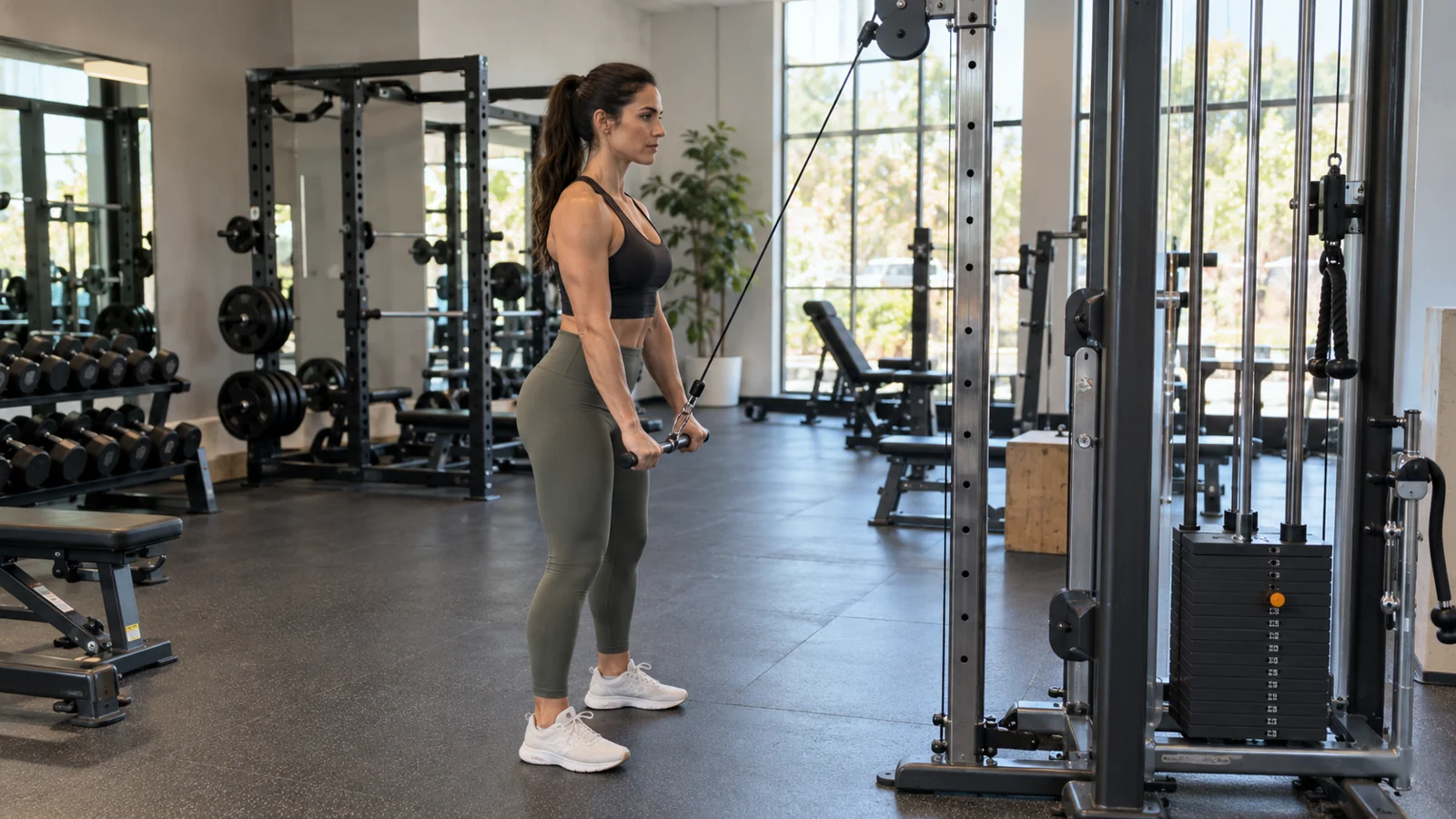
The straight-arm pulldown trains your back by moving your upper arms from an elevated position toward your sides while keeping a small, steady bend in your elbows. Use a high cable pulley, a stable stance, and a light load. Sweep the attachment toward your thighs without bending your elbows into a row, arching your back, or turning the movement into a triceps pressdown.
Published October 18, 2026.
For a first session, try one or two sets of 10–15 controlled repetitions after your main back exercise. Finish with about three good repetitions still available. The useful starting point is a repeatable movement, not a particular number on the weight stack.
What makes a straight-arm pulldown different?
In a conventional lat pulldown, your elbows bend as you bring the bar toward your upper chest. In a straight-arm pulldown, the elbow angle changes very little. Most of the visible movement comes from the shoulders as your upper arms travel down toward your torso. This distinction makes the exercise useful when you want extra back work without making every set another bent-elbow pull.
The exercise is also called a cable pullover or standing cable pullover. Names vary between gyms and tracking apps, so use the equipment and movement to identify it. You stand facing a high pulley and move the attachment in an arc rather than pulling it toward your chest.
“Straight arm” does not mean forcing your elbows into a hard lock. A small bend is usually easier to maintain. Think of your arms as long levers whose shape remains fairly consistent throughout the repetition.
The Catalyst Athletics demonstration illustrates the defining pattern: relatively fixed elbows and a shoulder-driven pull. Use that distinction to recognize the exercise, while choosing the stance, attachment, and comfortable range that fit your equipment.
Muscles worked and realistic benefits
The latissimus dorsi, the broad muscles along the sides of your back, contribute to moving your upper arms down and back. Other muscles around the shoulders assist or stabilize the movement. Your trunk also works to keep the cable from pulling you into an exaggerated arch or forward sway.
You may feel some effort around the back of your upper arms. That does not automatically mean the exercise is wrong: muscles can contribute without producing a large visible movement at the elbow. What matters is whether the exercise remains a shoulder-driven arc rather than becoming repeated elbow straightening.
A useful reason to include straight-arm pulldowns is that they give you another way to practice controlled shoulder movement under resistance. They can complement rows and conventional pulldowns, especially when those exercises already make up the main part of your back training.
They cannot selectively remove fat from your back or guarantee a wider-looking torso. Muscle development depends on the broader training program, gradual progression, recovery, and individual factors. Feeling a strong contraction is feedback, not proof that this exercise is better than every alternative.
Set up the cable station before choosing the weight
Use a suitable high pulley
Set an adjustable pulley high enough that the cable pulls upward and forward when your hands are near your thighs. A pulley at shoulder height changes the line of pull and usually makes it harder to reproduce the standard version.
Make all height and attachment adjustments while the machine is unloaded and the stack is resting. Fully engage the selector pin and adjustment locks. Check the attachment connection before taking tension. Do not use a frayed cable, damaged handle, or clip that will not close properly; tell gym staff.
Cable machines differ in pulley ratios, attachment travel, and available adjustment positions. A displayed load on one machine may feel different on another. Follow the station’s instructions and ask staff about unfamiliar features rather than treating a weight-stack number as a universal measure of strength.
Start with a bar or rope you can hold comfortably
A short straight bar offers an obvious hand position and a simple reference for keeping both sides level. An angled bar may feel more comfortable at the wrists. A rope lets your hands separate near the bottom, which can give you more room around your thighs.
None of these attachments is essential for results. Choose one that allows a secure grip and a comfortable path. Avoid stretching a rope aggressively outward just to make the finish look wider. That turns a simple setup choice into an unnecessary coordination task.
Find your distance from the machine
Stand far enough back that the attachment can move through its arc without hitting the tower. Keep enough room behind you to hold your stance. Start with feet about hip-width apart, knees soft, and a small forward hinge if it helps the cable clear your head.
You should not need to lean your whole body backward to counterbalance the weight. If the cable pulls you onto your toes or forces a large hip shift, lower the load and reset. A staggered stance is also reasonable when it makes you steadier, provided the torso stays square.
How to do the straight-arm pulldown step by step
- Take a secure grip. Hold the bar around shoulder width or grasp the rope ends. Keep your wrists comfortable rather than bending them sharply to control the attachment.
- Establish your stance. Step back, soften the knees, and hinge slightly at the hips if needed. Keep your ribs comfortably over your pelvis rather than lifting your chest into a large back arch.
- Choose the starting height. Let your arms rise forward and upward only as far as you can control without discomfort or changing your trunk position. Full overhead reach is not a requirement.
- Set a small elbow bend. Keep that angle approximately the same. You are preserving the shape of the arms, not trying to make them rigid.
- Sweep the arms downward. Move your upper arms toward your sides while the attachment follows an arc toward the front of your thighs. Exhale naturally as you pull.
- Finish without leaning back. Stop when your arms reach a comfortable position near your torso. Do not drive the hands behind your hips or thrust the pelvis forward.
- Return under control. Let your arms rise while resisting the cable. Inhale normally and keep the same stance. Stop the return before the weight pulls you into a position you cannot control.
For learning, make both directions deliberate. A roughly two-second return can help you notice whether the cable is pulling you out of position, but no exact tempo is mandatory. The stack should move smoothly rather than slam between repetitions.
At the end of the set, return the load gently and approach the machine as needed to put down the attachment safely. Do not release it under tension or let a rope snap upward toward your face.
How far should you reach at the top?
Use the largest comfortable range you can repeat with a stable torso. For some people, that means raising the arms well above shoulder height. Others will start lower because of shoulder comfort, pulley placement, or the way the cable pulls them forward.
A longer reach is not automatically a better repetition. If the last part of the return requires your ribs to flare, your lower back to arch, or your shoulders to pinch, shorten that part of the movement. You can test a slightly larger range later with a lighter load.
Allow your shoulder blades to move naturally as your arms rise. Trying to clamp them permanently down and together can make the movement awkward. A useful distinction is staying controlled versus trying to freeze every joint except the shoulders.
At the bottom, the attachment does not need to hit your thighs. Body proportions and attachment length affect where it ends. Finish the shoulder movement comfortably, pause briefly if helpful, and reverse without adding a backward swing.
Choose a load using the quality of the last repetition
Start lighter than you expect. The relatively long arm position makes modest resistance challenging, and cable-stack labels are not directly comparable with conventional pulldown loads.
Try a short practice set. If you can keep the elbow angle, stance, and return consistent, perform a set of 10–15 repetitions. Stop while you believe about three more repetitions with the same technique would be possible. This estimate is called repetitions in reserve, or RIR.
You do not need to prove the estimate by continuing until you fail. Beginners often find RIR difficult to judge. Use visible changes as another limit: if your elbows start bending much more, your torso swings, or the return becomes uncontrolled, the set is over even if the planned rep count is unfinished.
The American College of Sports Medicine’s 2026 resistance-training update emphasizes consistency and notes that training to momentary failure is not consistently necessary for results in the average healthy adult. The starter prescription here is a practical, conservative example, not a claim that one exact rep range is optimal for everyone.
Common mistakes and the simplest corrections
The exercise becomes a triceps pressdown
If your upper arms stay still while the elbows bend and straighten, you have changed the movement. Lower the weight, raise the hands to a comfortable starting point, and focus on moving the upper arms toward your sides. Keep the elbow bend small and steady.
You turn it into a standing row
If the elbows bend substantially and travel backward, the attachment may approach your stomach instead of your thighs. Reduce the load and practice the arc with only a few repetitions. A side view can make the difference easier to see.
Your back arches at the bottom
Finishing by leaning backward can make a heavy weight move without adding useful shoulder motion. Stop the set, reset your ribs over your pelvis, and choose a lighter load. You should be able to finish without pushing your hips toward the machine.
You cannot control the return
If the cable yanks your arms upward, reduce the weight before trying to slow it down. Also check whether you are standing so far back that the cable pulls your entire body forward. A small stance adjustment can help, but it should not compensate for an excessive load.
Your wrists or hands become the limiting factor
Try an angled attachment or rope if a straight bar forces an uncomfortable grip. Keep the hands secure without bending the wrists to finish each repetition. If grip fatigue persists, shorten the set. Do not use a loose grip that risks dropping the attachment.
You feel your shoulders more than your back
Some shoulder effort is normal, and muscle sensation alone cannot diagnose your technique. First check that the movement is smooth and comfortable. Then try less weight, a slightly lower starting height, or a different attachment. Sharp pain or pinching is a reason to stop, not to search for a stronger “lat squeeze.”
Rope, bar, and single-arm variations
Rope straight-arm pulldown: useful when a fixed bar crowds your thighs or bothers your wrists. Keep both hands moving evenly. Separate them only enough to allow a comfortable finish.
Bar straight-arm pulldown: useful when you want a stable, easily repeated grip. The bar should remain roughly level. Do not force an extra-wide grip in the hope of isolating a different strip of back muscle.
Single-arm cable pulldown: use a handle and much lighter resistance. Stand square to the pulley and move one arm through the same shoulder-driven arc. Keep the opposite side of your torso from rotating forward and backward. Match the comfortable range and controlled effort between sides instead of forcing an identical reach.
A single-arm variation can help you notice differences in control, but it does not establish the cause of those differences. Persistent pain, marked weakness, or a new asymmetry deserves individual assessment rather than increasingly elaborate corrective drills.
Keep one variation for several sessions while learning. Changing the attachment, stance, and grip every workout makes it difficult to tell whether you are progressing or simply creating a different exercise.
How to fit it into a back workout
For most beginners, straight-arm pulldowns fit after a main pulling exercise. That keeps your freshest effort available for a row, pulldown, or another movement central to your program. You can also use a very light practice set beforehand, but avoid making a warm-up tiring.
Here is a modest example for the pulling portion of a full-body session:
- One or two practice sets for your main pulling exercise
- Two working sets of a comfortable row or conventional pulldown
- One or two sets of straight-arm pulldowns for 10–15 controlled repetitions
Rest roughly 60–90 seconds between straight-arm sets, or longer if needed to restore steady breathing and control. These are starting suggestions. If your existing program already contains substantial back training, replace some accessory work rather than automatically adding more.
Workit’s guide to choosing a lat pulldown grip covers the bent-elbow exercise that can serve as a main pull. A chest-supported dumbbell row offers another main movement with external torso support.
Two nonconsecutive training days can make a simple starting schedule. The whole program should still address the other major muscle groups. A straight-arm pulldown is a small part of that plan, not a complete back or full-body workout by itself.
A simple progression you can actually track
Use the same machine, attachment, stance, and comfortable range when comparing sessions. Record the displayed weight, repetitions, sets, and a short effort note. “Twelve smooth reps, about three left” is more useful than recording weight alone.
For example, begin with two sets of 10 at an easy-to-control setting. Over later sessions, work toward two sets of 15 without changing the movement or pushing to failure. Once both sets feel repeatable with two or three good repetitions still available, try the smallest supported weight increase.
After increasing resistance, expect the rep count to fall toward the lower end of the range. If the next stack increment is too large, keep the previous load and improve consistency. Do not hang loose weights from the pin or improvise an attachment unless the manufacturer specifically provides a safe method.
Progress is not always a heavier stack. A steadier torso, a controlled return, or the same repetitions at lower perceived effort can all be useful improvements. If you miss training for a while, return conservatively rather than trying to recover every missed repetition in one session.
Alternatives when the cable station is busy
A conventional pulldown or row can cover general back-training needs even though its movement differs. If your aim is simply to complete a balanced workout, you do not have to recreate the straight-arm pulldown exactly.
A machine pullover may provide a similar shoulder-driven pattern, but its seat, pads, and range adjustment require machine-specific instructions. Ask for a demonstration before using an unfamiliar model.
A band straight-arm pulldown needs a high anchor designed for exercise and rated for the intended use. Do not attach a band to an unverified door handle, furniture edge, or overhead fixture. Without a suitable anchor, choose another exercise rather than improvising.
Dumbbell pullovers also move the arms through an overhead arc, but loading, balance, and shoulder demands differ. They are not an automatic substitute for someone who finds the cable version uncomfortable. Choose the option you can set up and control confidently.
When to stop or get individual guidance
Stop the set for sharp or increasing pain, numbness, tingling, sudden weakness, or a feeling that the shoulder is unstable. Stop exercise and seek urgent help for symptoms such as chest pain, fainting, or severe unusual breathlessness.
Ordinary muscular effort can feel demanding, but pushing through joint pain is not necessary to make this movement useful. If reducing the load and range does not make it comfortable, leave it out and get advice from a qualified clinician or exercise professional as appropriate.
If you are returning after a shoulder injury or surgery, follow your rehabilitation plan. The AAOS shoulder-conditioning guidance emphasizes individualized professional supervision for rehabilitation. A general exercise article cannot determine your readiness for overhead loading.
Frequently asked questions
Should my elbows be completely straight?
No. A slight, consistent bend is a sensible starting point. Avoid forcefully locking the elbows or changing the bend substantially to move more weight.
Can beginners do straight-arm pulldowns?
Yes, when they can use the equipment safely and perform the movement comfortably. Begin with a light practice set and keep the first working sets well short of technique breakdown. It is optional, so you can also build confidence with a simpler main pulling exercise first.
Is it better than a normal lat pulldown?
Neither is universally better. A conventional pulldown includes substantial elbow bending, while this variation emphasizes a relatively fixed-elbow shoulder movement. Choose based on the role in your program, comfort, and available equipment.
Why do I need much less weight?
The arm position and leverage differ from bent-elbow pulling exercises. Cable systems also vary. Compare your performance with your own previous sessions on the same setup rather than another exercise’s weight.
Should I do it every day?
Daily hard sets are unnecessary for a beginner. Start with a small amount of work in your regular sessions and allow recovery. Add volume only when it serves a clear purpose and your overall program remains manageable.
Your next session
If your program also includes a chest isolation movement, see the pec deck fly setup guide. Keep its chest-fly motion distinct from this pulldown and choose accessory volume that fits the rest of your session.
Pick one comfortable attachment, establish a stable stance, and keep a small elbow bend. Perform a light practice set, then one or two controlled working sets with several repetitions left in reserve. Write down the setup so your next session starts from something repeatable.
Explore workout programs and fitness challenges with Workit.