
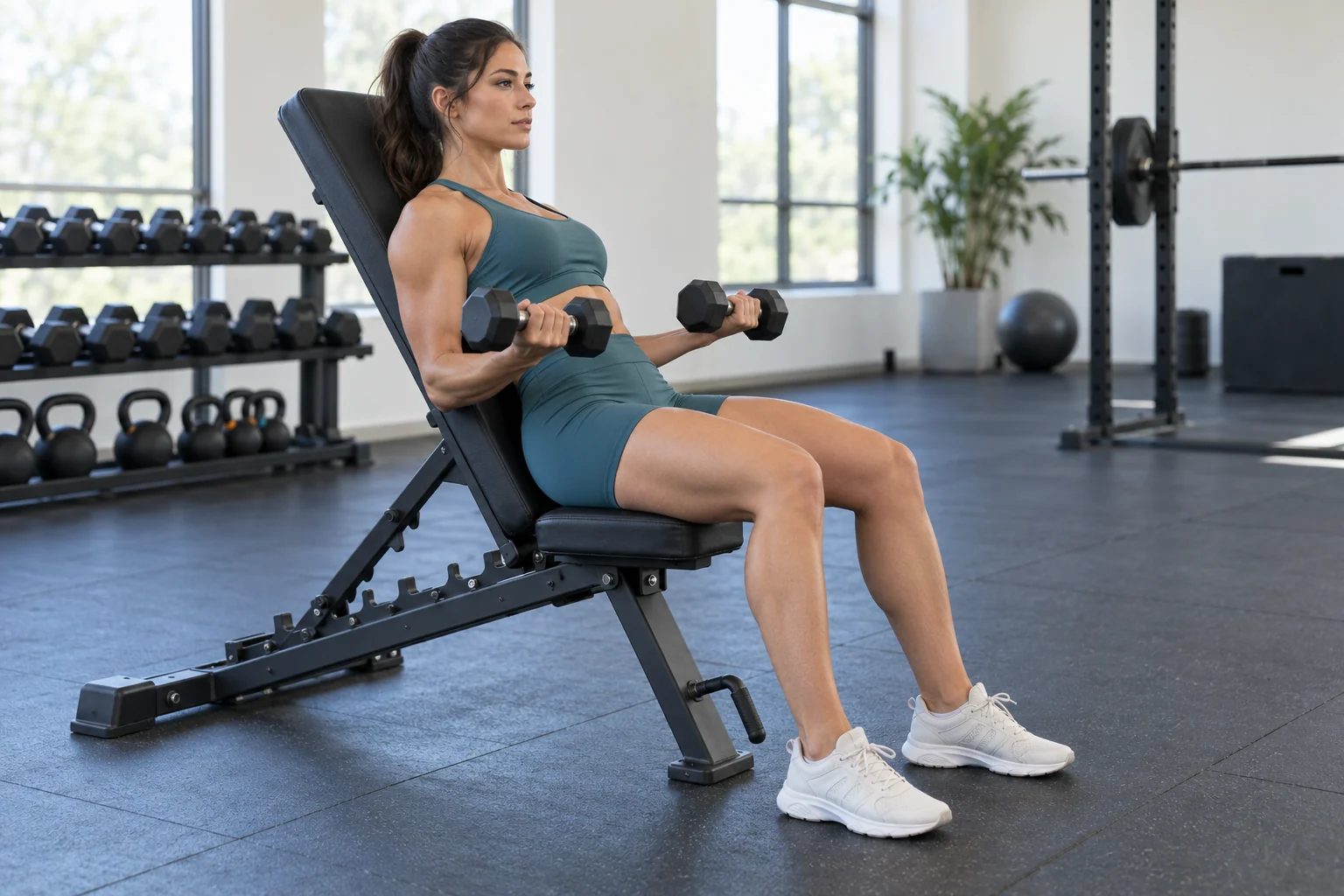
The incline dumbbell curl is a seated biceps exercise performed with your back against an inclined bench and your arms hanging beside you. Keep your upper arms mostly still, bend your elbows to lift the dumbbells, and lower them under control. A moderately upright bench, light starting weights, and a comfortable bottom position make the movement easier to learn.
Published October 20, 2026.
The appeal is simple: the bench removes some of the temptation to lean backward and swing. It also places your upper arms behind the plane of your torso when they hang vertically, changing the shoulder position compared with a standing curl. That difference is useful, but it does not make the exercise mandatory or turn it into a way to isolate one tiny section of your biceps.
This guide explains the setup, the difference between a stretch and useful loading, how to choose a bench angle, and how to make progress without letting increasingly heavy dumbbells change the exercise.
Incline dumbbell curl at a glance
- Primary movement: elbow flexion, or bending your elbow against resistance.
- Main muscles: biceps brachii, with help from the other elbow flexors.
- Equipment: an adjustable weight bench and a matched pair of dumbbells.
- Starting bench setting: approximately 60 degrees above horizontal, adjusted for comfort.
- Suggested first prescription: 2 sets of 10–15 controlled repetitions, stopping with 2–3 clean repetitions still possible.
- Best role: a biceps accessory after your main pulling exercises or within a balanced upper-body workout.
These numbers are practical starting options, not a test you must pass. Your equipment, training history, and ability to hold the same position matter more than matching another person’s dumbbell weight.
Set up the bench before choosing the weight
Start around 60 degrees, not as low as possible
Bench angles here are measured from the floor: 90 degrees is upright and 0 degrees is flat. Begin around 60 degrees. If your bench only has numbered notches, choose a moderately upright setting and remember which notch you used.
A lower backrest places the torso farther behind the arms when they hang down. Some people like that position; others find it uncomfortable or struggle to keep their back supported. A 45-degree setting is an option, not a requirement. There is no established universal angle that guarantees the best results for every lifter.
Try several repetitions with very light dumbbells before committing to a working set. If the bottom feels awkward, move the backrest more upright rather than forcing your shoulders into more extension. Keep the selected angle consistent while comparing sessions.
Make the seat and floor work for you
Set the seat so you do not slide forward. Keep both feet planted with enough space to balance. Your hips and upper back should rest comfortably against the pads. A small natural lower-back curve is fine; deliberately exaggerating an arch to escape the bottom position defeats the purpose of the support.
Check that each dumbbell clears the bench frame and the floor. This matters with large adjustable dumbbells, a wide back pad, or a low bench. If a weight catches on the equipment, change the setup before adding load. Do not shorten every repetition around a collision.
Let your arms hang rather than pinning them backward
With your torso reclined, relaxed upper arms naturally sit behind the torso’s plane. You do not need to actively drag your elbows toward the back of the bench. Start with shoulders comfortable, wrists straight, and a secure grip.
You can begin with palms facing forward and keep that orientation throughout. Alternatively, begin with a slightly more neutral grip and rotate smoothly as you curl. Choose the version you can repeat comfortably, then record it. Comparing a rotating curl with a fixed palms-up curl can make a weight change look more meaningful than it is.
How to do the incline dumbbell curl
- Get settled. Sit with the dumbbells near your thighs, then lean against the backrest without dropping the weights into a stretched position.
- Find your start. Let the arms hang and straighten the elbows within a comfortable range. Keep a soft, controlled finish rather than forcing the joints straight.
- Curl through the elbow. Bring the dumbbells upward while keeping the upper arms mostly still. Avoid turning the motion into a forward shoulder lift.
- Finish where control ends. Lift as far as you can without rolling the shoulders forward, bending the wrists, or moving the elbows substantially.
- Lower deliberately. Reverse the path and return toward the same bottom position. About two seconds down is a useful learning cue, not a magic tempo.
- Repeat without a bounce. Exhale during the effort if that feels natural, inhale as you lower, and avoid unnecessary breath-holding.
At the end of the set, bring the dumbbells toward your thighs and sit upright under control. Do not let your arms suddenly drop behind you or throw the weights onto the floor.
A three-question form check
Ask: Is my back still supported? Are my elbows moving much less than my hands? Does the last repetition look recognizably like the first? If the answers change before you reach your target, stop the set or use a lighter weight. A clean stopping point is more useful than a fixed repetition number reached by changing the movement.
What muscles do incline dumbbell curls work?
The biceps brachii helps bend the elbow and turn the forearm palm-up. The brachialis and brachioradialis also contribute to elbow flexion. Your hands and forearms hold the dumbbells, while muscles around the shoulder help maintain the arm position.
Because the biceps crosses the shoulder as well as the elbow, reclining the torso changes its starting length. This is the basis for calling the incline curl a lengthened-position curl. However, muscle position and external resistance are not the same thing.
A stretch at the bottom does not mean maximum resistance there
Gravity pulls a dumbbell downward. When the weight hangs almost directly below the elbow, it has a short horizontal lever arm around that joint. As the forearm moves toward horizontal, that lever arm increases. The exercise can therefore feel stretched near the bottom while placing a greater external turning demand on the elbow farther into the repetition.
This explains why dropping the bench lower is not automatically a better way to load the bottom. It changes shoulder position, but it does not change gravity’s direction. A cable can change the line of pull, which is one reason a cable curl and a dumbbell curl may feel different despite a similar arm position.
Does it isolate the long head?
No curl cleanly switches off one biceps head while working only the other. It is reasonable to discuss shoulder position and exercise differences, but “long-head isolation” overstates what this movement does.
A study comparing muscle activity during three dumbbell curl variations found broadly similar biceps activation patterns across the incline and conventional curls. This was an acute EMG experiment, not a study of long-term muscle growth. An activation reading cannot establish that one exercise will produce the biggest arms.
A separate eight-week trial comparing incline and preacher curls found differences in where elbow-flexor thickness increased, alongside exercise-specific strength changes. It involved young women and a particular training protocol, so it does not provide a universal ranking. The practical takeaway is that both variations can be useful, and the one you can train consistently deserves a place in the conversation.
Seven common mistakes and what to change
1. Choosing the weight from your standing curl
The bench limits some ways of helping the dumbbells upward. Start lighter than you expect, then judge the set by its final controlled repetitions. Matching a standing-curl number is not a useful goal if the incline version becomes a shoulder swing.
2. Turning every repetition into a front raise
Some natural upper-arm movement is not a catastrophe. The problem is using a large forward elbow movement to finish every difficult rep. Reduce the weight and think about folding the forearm toward the upper arm, rather than lifting the entire arm toward the ceiling.
3. Chasing an extreme stretch
Do not pull the elbows behind the bench or force an uncomfortable bottom range. The goal is a repeatable curl, not the strongest possible stretching sensation. Raise the backrest or choose another curl if the position does not suit you.
4. Bending the wrist to finish
Wrist curling changes the position of the dumbbell without necessarily improving the elbow movement. Keep your knuckles roughly in line with your forearm. If the wrist repeatedly collapses, use a lighter load or a grip orientation that feels more natural.
5. Bouncing out of the bottom
A rapid drop and rebound makes it difficult to judge whether you control the start of the next rep. Lower smoothly and change direction deliberately. You do not need a long pause, but you should be able to remove the bounce without losing several repetitions.
6. Lifting your head and shoulders off the pad
Moving forward can turn the final repetitions into a different exercise. Check the bench angle and load first. If the pad is uncomfortable or does not fit your proportions, a standing or supported alternative may be a better choice than constantly fighting the equipment.
7. Adding volume whenever progress slows
More curls are not automatically the solution. Look at recent pulling work, rest between sets, exercise order, and recovery. A hard row session can affect curl performance. Compare similar workouts before concluding that your biceps need extra sets.
Sets, reps, rest, and a sensible starting weight
For a beginner learning the movement, try 2 working sets of 10–15 repetitions once or twice per week within a balanced program. Leave roughly 2–3 repetitions in reserve: you should feel challenged, but still believe you could complete a few more without changing form.
Rest about 90–120 seconds between sets, or longer if you cannot repeat the movement well. There is no benefit to racing the clock when the next set becomes a different exercise. Take a light practice set first, particularly when the bench setup is new.
Choose the initial load by performing 10 slow, comfortable repetitions. If you could easily do many more, increase a small amount on the next set. If you cannot reach 10 without swinging or losing the bottom position, reduce it. There is no universal starting weight based only on age or body size.
The American College of Sports Medicine’s 2026 resistance-training update emphasizes consistent training and individualization, rather than complicated routines. It also notes that training to momentary failure is not consistently necessary for the average healthy adult. The prescription here is a conservative way to practice one accessory exercise, not a complete strength program or a requirement to exhaust your arms.
Use double progression instead of guessing
Keep the weight and bench setting unchanged while you build repetitions inside your chosen range. Once both working sets reach the top of that range with the same technique and a little reserve, try the smallest available increase.
For example, imagine you use a particular pair of dumbbells for 12 and 10 repetitions. Next time you manage 13 and 11, then 14 and 12. There is no need to increase the load yet. After reaching 15 and 15 cleanly, a small increase might bring you back to 11 and 10. That is a normal progression pattern, not lost progress.
If the next dumbbell pair is a large jump, keep the current weight longer, use smaller increments if your equipment supports them safely, or choose an exercise with finer load adjustments. Do not compensate by shortening the range, changing the angle, and swinging simultaneously.
Where incline curls fit in a workout
Put the exercises you most want to improve earlier in the session. If your priority is a stronger row or pull-up, do that work before curls. If biceps practice is the day’s main goal, placing curls earlier can make sense, provided it does not interfere with other important work.
A simple upper-body arrangement is a horizontal press, a row, another push or pull as needed, and then two modest arm accessories. For the row, the chest-supported dumbbell row offers another supported position, although the movement and training purpose are different.
One example arm finish is 2 sets of incline curls followed by 2 sets of dumbbell triceps kickbacks. Rest as needed between exercises. This pairs elbow flexion with elbow extension without requiring a long list of curl variations. It is an example to adapt, not an instruction to add four sets on top of an already demanding arm session.
Leave time between demanding sessions for the same muscles and watch the next workout’s performance. If your elbows remain irritated or your technique is deteriorating across sessions, reduce the work and reassess rather than pushing through.
Incline curls versus other curl variations
Incline curl versus preacher curl
The incline curl positions the upper arm behind the torso’s plane. A preacher curl supports the upper arm in front. They also differ in where gravity creates the largest external demand through their respective setups. The preacher curl guide explains how to use the pad without bouncing at the bottom.
You do not need both in every workout. Choose one for several weeks so you can evaluate it fairly, or distribute them across different sessions if your overall program has room.
Incline curl versus hammer curl
A hammer curl uses a neutral grip, with palms facing inward. That changes forearm orientation rather than merely the bench angle. You can also perform neutral-grip curls on an incline bench. Treat that as a separate variation in your log rather than switching grips midway through a set to extend it.
What if you do not have an adjustable bench?
Use a standing dumbbell curl, a supported concentration curl, or another stable setup you already have. Do not improvise an incline by propping an unstable chair against furniture. The exact exercise is optional; consistent, controlled elbow-flexion training is the useful part.
A first-month practice plan
In your first week, learn one bench setting and find a load that leaves clear reserve. In the second week, repeat that setup and aim to make the same repetitions more consistent. In weeks three and four, add repetitions when they are available without changing the movement.
There is no scheduled obligation to increase weight every week. Your log might read “60-degree setting, palms forward, 12/11, last reps controlled.” That gives you more actionable information than recording only the heaviest dumbbell you touched.
After a month, ask whether the movement is comfortable, whether repetitions or control have improved, and whether it fits your sessions. Keep it if those answers are positive. Change it if another curl is easier to perform and progress. Switching exercises thoughtfully is different from changing them every time a workout feels difficult.
Frequently asked questions
Is 45 or 60 degrees better for incline dumbbell curls?
Neither is universally best. Around 60 degrees is a practical starting point because it is moderately reclined. A lower setting changes shoulder position more. Choose the angle that allows comfortable, controlled repetitions and keep it consistent when tracking progress.
Should I straighten my elbows all the way?
Use a comfortable range you can control. Many people can approach full elbow extension without forcing it. Do not snap into the bottom, chase discomfort, or assume that a deeper stretch is always more productive.
Should I curl both arms together or alternate?
Either can work. Simultaneous repetitions make the set straightforward. Alternating may help you focus on one side, but avoid rotating your torso. Use the same method when comparing sessions because alternating gives each arm brief rests between repetitions.
Why do incline curls feel weaker than standing curls?
The position is different, and the backrest reduces your ability to create momentum. A lighter dumbbell does not mean the set is ineffective. Compare your incline-curl performance with previous incline-curl sessions, not with an entirely different variation.
Do I need to feel a strong biceps burn?
No. A burning sensation is not a score for growth or technique. Look for repeatable form, appropriate effort, and gradual progress. You can train effectively without chasing a dramatic pump every session.
What if the front of my shoulder hurts?
Stop the painful set. You can try a more upright position or a different curl only if it is comfortable, but do not use this guide to diagnose the cause. Persistent or recurring pain deserves assessment by a qualified healthcare professional.
Can beginners do incline curls?
Yes, if the setup is comfortable and the weight is manageable. A standing curl may be simpler to start with, but incline curls are not reserved for advanced lifters. Learn the position with light loads before trying to make the exercise demanding.
The bottom line
An effective incline dumbbell curl is controlled, comfortable, and repeatable. Pick a sensible bench angle, let your upper arms hang naturally, and build repetitions before forcing a heavier weight. Use the exercise as one option in a balanced routine, not as a shortcut to a particular arm shape.
Explore Workit on the App Store.
Sources and evidence notes
- Effect of the shoulder position on the biceps brachii EMG in different dumbbell curls: acute muscle-activity research, not a hypertrophy trial.
- Distinct muscle growth and strength adaptations after preacher and incline biceps curls: an eight-week comparison with a specific study population and protocol.
- ACSM’s 2026 resistance-training guidance: broader context for consistency, individualization, and effort.
This is general exercise education. The example sets, progression, and workout arrangements are practical illustrations, not individualized medical or rehabilitation advice.
Comments
One response to “Incline Dumbbell Curl: Form, Bench Angle, and Progression”
[…] simple arm pairing is 2 sets of incline dumbbell curls and 2 sets of supported kickbacks. You can alternate exercises if time is limited, but rest enough […]