
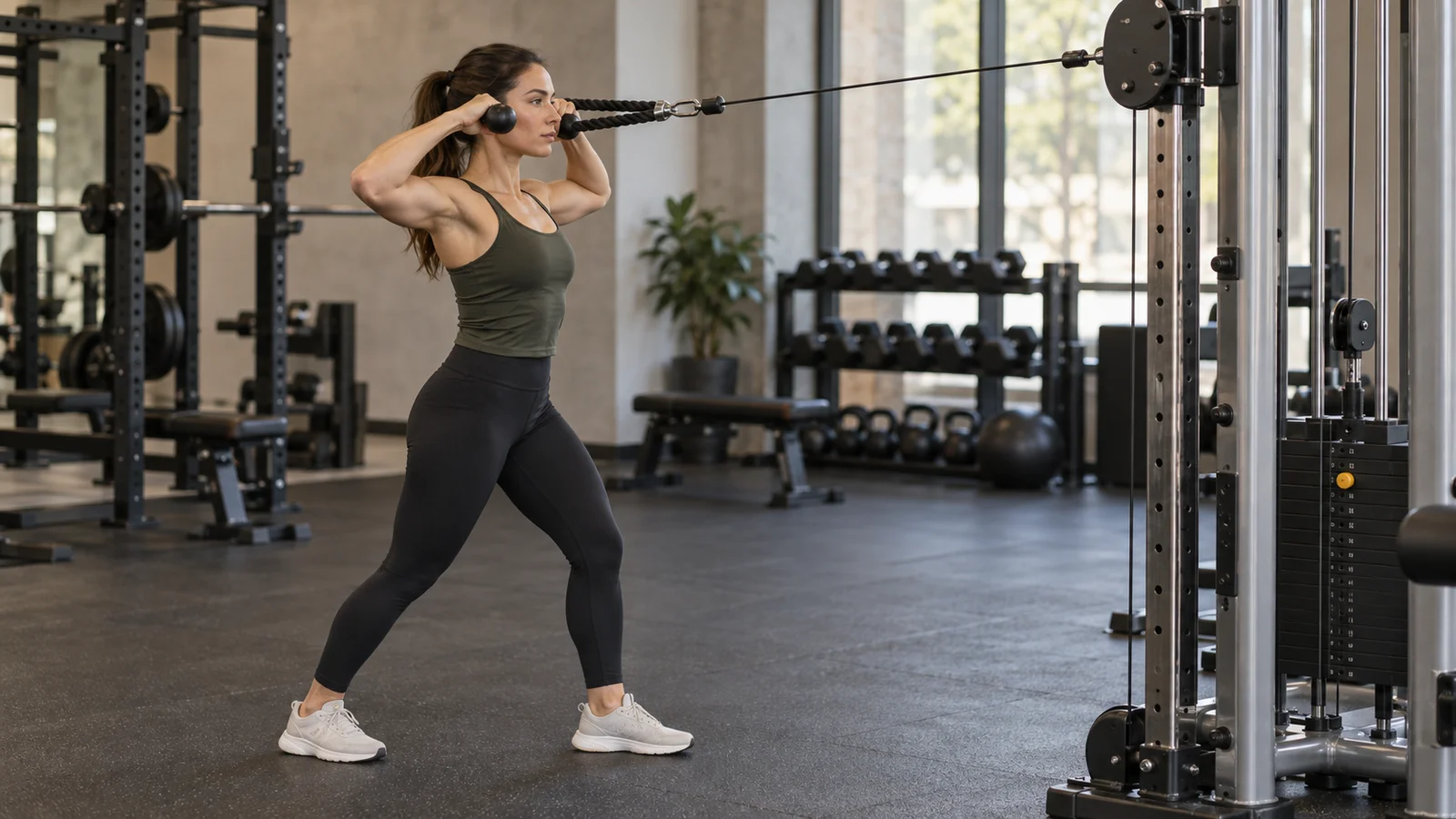
A face pull is a cable or resistance-band exercise that trains the rear shoulders and upper back. To do one, set a rope attachment around eye height, stand securely, and pull the rope toward your face while letting your hands separate. Return under control. Start with a light load that lets your torso stay still and your shoulders move comfortably.
Published October 17, 2026.
The exercise is simple to recognize but surprisingly easy to turn into something else. Too much weight makes it a leaning row. A cramped attachment makes the finish awkward. Trying to copy an exaggerated position from a video can leave you thinking your shoulders are supposed to move farther than they comfortably can.
This guide focuses on a repeatable, ordinary gym version: a standing rope face pull. You will learn how to set up the cable, choose a useful range of motion, troubleshoot common problems, and add a modest amount of work to an existing routine. The examples are general fitness suggestions for healthy adults, not a rehabilitation plan.
What does a face pull work?
The main areas are the posterior deltoids, which are the back portions of the shoulders, and the muscles of the upper back. The shoulder blades move as the arms pull back. Depending on how you perform the finish, muscles involved in rotating the upper arm also contribute.
NASM’s face-pull exercise guide identifies the posterior deltoids and rhomboids as primary muscles, with contributions from the middle trapezius, infraspinatus, and biceps. That makes it a useful accessory movement for rear-shoulder and upper-back training. It does not make it a complete back workout or a substitute for every other shoulder exercise.
Think of the movement as a small piece of a balanced program. If your routine already includes presses and a heavier row, a face pull offers another way to train the back of the shoulder without needing another heavy lift. The goal is a controlled repetition that you can reproduce, not the highest possible number on the cable stack.
Face pull versus a seated cable row
In a typical seated row, you bring the handle toward your torso and can usually handle more resistance. In a face pull, the destination is higher, the hands separate, and the elbows travel outward as well as back. Both are pulling exercises, but their setups and priorities differ.
If your face pull finishes at your stomach with the elbows close to your sides, you have changed the exercise substantially. That is not a moral failure or automatically dangerous; it simply makes your training log less informative. Keep the intended movement consistent so that improvement means something.
Set up the cable before choosing your working weight
Take a moment to check the station rather than starting with the previous person’s settings. The cable should move smoothly, the rope should be intact, and the attachment clip should be securely closed. Do not use visibly damaged equipment. Ask gym staff if the height adjustment or locking mechanism is unfamiliar.
Pulley height
Eye height is a straightforward starting point for the standing variation. It lets the rope approach your face without turning the repetition into a pronounced upward or downward pull. Your height, the machine, and the rope length may require a small adjustment.
Choose a setting that allows a comfortable finish while your head remains still. There is no need to insist that every person’s pulley line match an exact point on the forehead. What matters is that you can repeat the chosen setup without shrugging, ducking, or arching to reach the attachment.
Rope length and grip
Hold an end of the rope in each hand with a secure, comfortable grip. Your hands need enough room to travel to either side of your face. A very short attachment may feel cramped, particularly if you try to force a wide finish.
If the gym provides a suitable longer rope, try it with a light load. Use only attachments and connection methods intended for the machine. Do not improvise a longer handle by tying loose equipment together. A comfortable grip is more useful than a rigid rule about exactly where every knuckle must point.
Stance and distance
Begin with feet about hip-width apart, or use a small staggered stance if it helps you remain steady. Step back enough to take up slack while keeping clear of the machine and other gym users. Leave room to extend your arms without the attachment hitting the stack or your body.
You should not have to sit backward against the cable to avoid being pulled forward. If balance determines whether you finish the set, reduce the load. Mark your usual position mentally using a floor seam or tile so you can find roughly the same distance next time.
How to do a face pull: a practical repetition checklist
- Start tall and comfortable. Hold the rope with your arms reaching toward the pulley. Keep a slight bend in your knees and your head in line with your torso.
- Make your trunk steady. Breathe normally and use enough abdominal tension to prevent your ribs and pelvis from drifting apart. Avoid a dramatic chest lift.
- Pull toward your face. Bend your elbows and guide them outward and back. Let the rope ends separate as they approach either side of your head.
- Finish within your available motion. Stop where you can maintain a comfortable shoulder position without pushing your head forward or forcing the hands behind you.
- Reverse smoothly. Let your arms travel forward as the cable returns. Keep control until you reach the same starting position.
- Repeat the same movement. End the set before you need to lean, bounce, or shorten every repetition just to keep going.
The most useful cue may be the simplest: move the rope while keeping your body quiet. You do not need to freeze your shoulder blades in place throughout the repetition. Let them move naturally with the arms rather than aggressively pinning them together before the cable moves.
Try a short practice set before counting work sets. If the first few repetitions feel awkward, change one variable at a time. Adjust the load first, then consider the pulley or grip. Changing the stance, height, rope, and weight together makes it hard to know what helped.
How far should you pull, and should you rotate your shoulders?
Face-pull demonstrations vary. Some finish with the hands near the cheeks and elbows out. Others add a more visible external-rotation action, ending with the forearms more upright. These are related variations rather than a reason to force every shoulder into one photograph.
For a first version, prioritize a smooth pull and a comfortable separation of the rope ends. Do not chase a dramatic hands-behind-head finish. If you want a particular rotation-focused variation, have a qualified trainer demonstrate it and check that the equipment setup suits you.
Range of motion should be something you control, not something the cable extracts from you. A useful endpoint is the last position before your head moves, your ribs flare, or your shoulder starts to pinch. Choosing that endpoint is not permission to ignore symptoms. If discomfort persists after reducing the load and adjusting the setup, stop the exercise.
Seven common face-pull problems and what to change
1. You lean farther back with every repetition
The load is probably asking more from your stance than this version is meant to require. Reduce it and reset your feet. Compare the first and final repetition: your trunk angle should look similar. A small, stable lean can occur naturally, but repeated backward heaving changes the task.
2. The rope travels toward your chest
Check the pulley height and your intended destination. Imagine pulling the two rope ends toward the sides of your face rather than dragging one handle toward the sternum. If you can only reach that destination with a lighter setting, use the lighter setting.
3. Your neck does most of the work
Notice whether you lift your chin or push your head toward the rope. Keep the head still and bring the attachment to you. Give yourself permission to stop the pull earlier. Persistent neck discomfort is a reason to stop and seek individualized advice, not to add more repetitions.
4. Your hands cannot separate comfortably
A short rope or an overly ambitious finishing position may be the problem. Test a longer approved attachment or a less exaggerated finish. Do not wrench your wrists sideways to manufacture extra range. The wrists should feel like secure links between your arms and the rope.
5. You mainly notice your biceps
Your elbows bend during a face pull, so some arm effort is expected. It is not proof that the repetition is useless. Check whether you are curling the rope inward while leaving the upper arms almost stationary. Guide the elbows back as the hands separate, and use a load that lets you coordinate both actions.
6. The weight stack crashes
Slow the return enough to control it. If the stack repeatedly lands before your arms reach the intended start position, check your distance and the machine’s usable travel. Do not move so far away that you compromise stability or obstruct a walkway. Ask staff if the station cannot accommodate the movement.
7. Every repetition is technically different
Pick a small number of checkpoints: still head, steady torso, same hand destination, quiet return. You do not need to monitor ten anatomy cues simultaneously. A brief side-view video, where gym rules and others’ privacy allow it, can help you spot changes that are difficult to feel.
For a broader pulling pattern, see the seated cable row guide. Use it for a different training purpose rather than simply copying its heavier load into a face pull.
How much weight should you use for face pulls?
Start below what you expect to lift. A cable-stack label is only a setting on that particular machine; different pulley systems can feel very different. The number is useful for tracking your own sessions on the same station, not for comparing yourself with someone online.
For your first work set, select a load that allows 10 to 15 controlled repetitions with a few good repetitions still possible. If you are learning the movement, an even easier practice set is sensible. You should finish because you reached the planned amount or began losing consistency, not because the cable dragged you out of position.
A useful test is whether you could pause briefly at the finish without changing your posture. This is a practical control check, not a requirement to hold every repetition for several seconds. If the finish exists only as a moment during a fast swing, reduce the load.
Do not increase weight just because the exercise feels less dramatic than a heavy row. Small accessory movements can earn their place through reliable, repeatable work. More load is useful only when it preserves the movement you chose to train.
A modest beginner face-pull plan
The following is an original starting example, not an official prescription for everyone:
- One light practice set of about 8 repetitions.
- One or two work sets of 10 to 15 controlled repetitions.
- About 60 to 90 seconds of rest, or longer if needed to regain control and comfortable breathing.
- One or two sessions per week to begin, with recovery between harder sessions.
- Stop each work set while another two or three clean repetitions still seem possible.
You can adjust downward if you are new to resistance training or already have substantial pulling work in your program. The face pull is an accessory, so adding it should not turn a manageable workout into one you cannot recover from.
ACSM’s 2026 resistance-training guidance emphasizes consistent participation and an individualized program. Its review also found that reaching momentary muscle failure is not consistently necessary for the average healthy adult. That supports a practical beginner approach: accumulate controlled work before experimenting with exhausting finishers.
Where to put face pulls in a workout
After your main upper-body exercises is an uncomplicated option. For example, complete your planned press and row, then add one or two face-pull sets. This keeps the accessory from using up attention or energy needed for your priority lifts.
A very light set can also serve as movement practice before an upper-body session if it feels comfortable. Keep that distinct from a demanding work set. A warm-up should prepare you to train, not leave your shoulders tired before your first main exercise.
Progress without turning it into a heavier row
Use a small repetition range and a clear standard. Suppose your plan is two sets of 10 to 15. Keep the same weight until you can complete both sets near the top of that range with the same posture and range of motion. Then try the smallest available increase at a later session.
At the new setting, fewer repetitions are expected. If the increase immediately makes you lean or jerk, return to the earlier load. You can continue practicing or use an approved smaller increment if the machine offers one. Do not attach improvised weights to the stack.
A simple four-session example might be 12 and 11 repetitions, then 13 and 12, then 14 and 13, and finally 15 and 15. These are illustrations, not targets you must achieve on schedule. If you repeat a performance, that can still be a useful session.
Log the pulley setting, attachment, load, repetitions, and one short note such as “steady finish” or “reduced range on final rep.” Those details tell you more than a weight alone. If you change machines, establish a fresh starting point instead of assuming the old number transfers.
Cable face pull alternatives
Resistance-band face pull
A band can provide a similar pulling direction when anchored securely at an appropriate height. Use an anchor and band intended for the task, inspect them for damage, and follow the manufacturer’s setup instructions. Because the line of pull points toward your face, attachment security deserves particular attention.
Start with an easy band and modest tension. The NSCA explains that band resistance increases as the band stretches, so the finish may feel disproportionately demanding. Do not assume that a band color translates to a particular cable-stack load. If you cannot anchor it reliably, choose a different exercise.
Reverse fly or rear-delt machine
These are options when your main goal is direct rear-shoulder work and the cable setup is inconvenient. They use a different arm action and should be learned on their own terms. Avoid treating a reverse fly as a face pull performed with straight elbows; choose the machine or dumbbell setup deliberately.
A supported row
A supported row may be a practical upper-back option if standing against a cable is frustrating. It is not an identical replacement, but it can fit the broader goal of including pulling work. Choose the movement you can perform consistently rather than forcing an exercise simply because it appears on a popular list.
Use your first session to answer three questions
First, can you find the setup again? If you cannot remember the pulley height or where you stood, write those details down before moving to the next exercise. A slightly different setup is not automatically wrong, but it makes early progress harder to interpret.
Second, does the movement stay comfortable from the first repetition to the last? If the final few repetitions only work after you change your head position, finish the set earlier next time. You have identified a useful stopping point, not a reason to push through.
Third, does the exercise fit the rest of the workout? If you are already exhausted after several pulling movements, a single controlled face-pull set may be a better starting choice than adding three more demanding sets. Reassess after several repeatable sessions rather than after one unusually good or bad day.
What face pulls cannot promise
Face pulls are often advertised as a way to fix posture or protect every shoulder. A general exercise guide cannot establish why someone has pain or how their posture relates to symptoms. Building strength is worthwhile, but a single movement is not a diagnosis or a guarantee against injury.
You also do not need a daily face-pull challenge to justify the exercise. More repetitions do not automatically mean better results. If a small amount fits your routine, feels comfortable, and becomes easier to perform well, that is a more useful signal than chasing an arbitrary daily total.
Stop for sharp pain, pinching that does not resolve with an easy setup, tingling, or sudden weakness. If you have a recent injury, surgery, or an ongoing shoulder or neck problem, get advice from an appropriately qualified healthcare professional before using this article as a training plan.
Face-pull FAQ
Should I feel face pulls between my shoulder blades?
You may feel effort there and at the back of the shoulders. Sensation varies, and a strong burn is not a precise measure of training quality. Use comfortable motion, a steady torso, and repeatable repetitions as your main checks.
Are face pulls a back or shoulder exercise?
They involve both the rear shoulders and upper back. Put them wherever they fit your program and recovery. The label matters less than recognizing that they add work to muscles already used in other pulling exercises.
Can I do face pulls every day?
Daily practice is unnecessary for most beginners. Start with a small amount in one or two weekly workouts and see how you recover. A harder training set and an easy practice repetition are different things; neither needs to become a daily obligation.
Is heavier always better?
No. A heavier setting that changes the movement is difficult to compare with your earlier work. Progress can mean more controlled repetitions, a more repeatable setup, or eventually a small load increase while those qualities remain.
Your next session
Choose one rope, one pulley height, and one comfortable finishing position. Perform an easy practice set, then a modest amount of controlled work. Record enough detail to repeat the setup next time. That turns a confusing accessory into a useful part of your routine.
Explore Workit’s workout programs and fitness challenges. View Workit on the App Store.
Comments
One response to “Face Pull: Cable Setup, Form, Muscles Worked, and Beginner Sets”
[…] cable station can also train a different movement pattern. Our face-pull guide covers a higher pull for the rear shoulders and upper back; it has a different role from an […]