
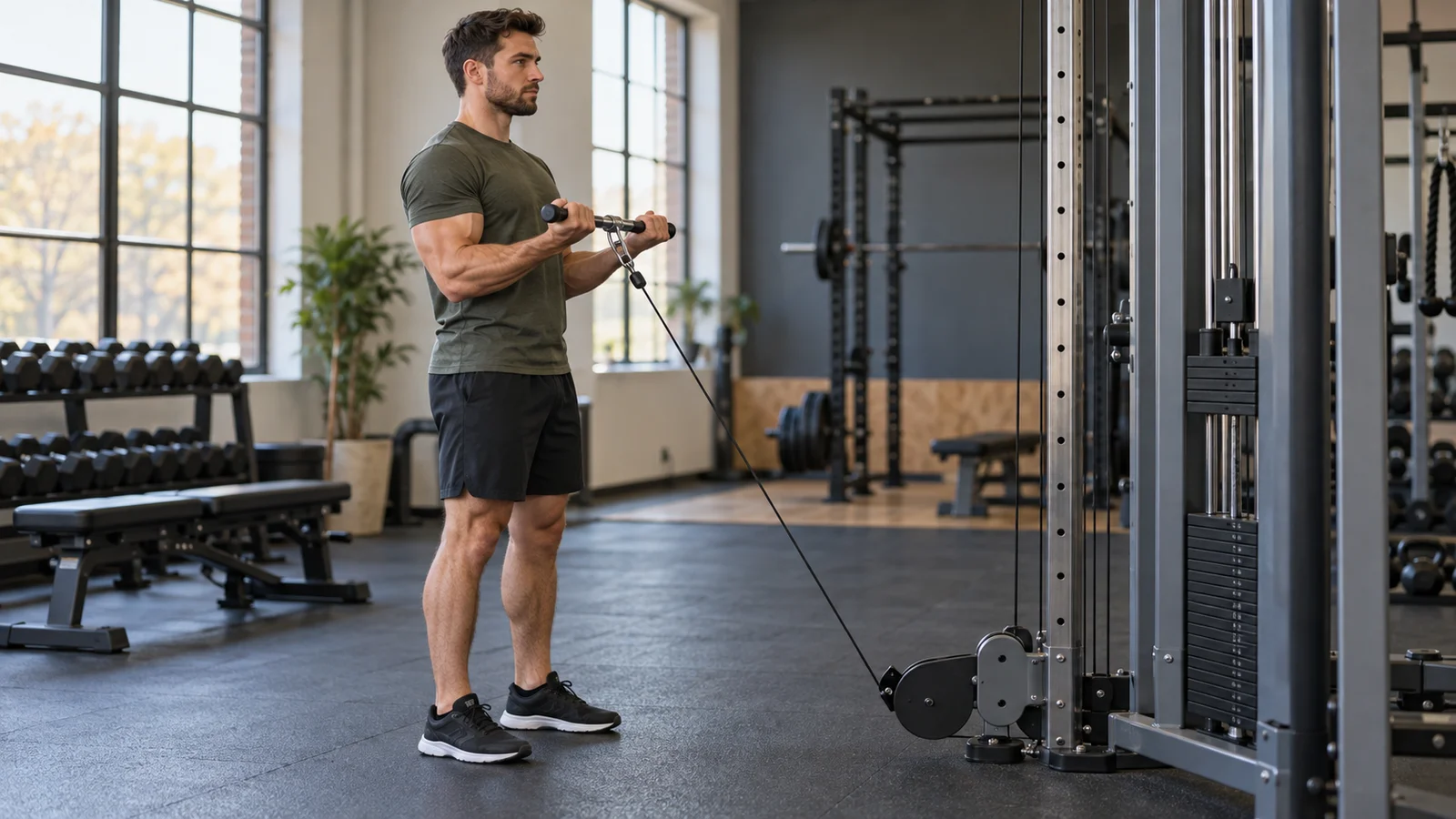
A cable biceps curl trains the front of the upper arm by bending the elbow against resistance from a cable machine. For the basic version, attach a handle or curl bar to a low pulley, face the machine, and curl while keeping your torso steady. Lower the attachment under control. Start with a light load and a grip that feels comfortable at your wrists.
Published October 17, 2026.
The cable station gives you several useful choices: a straight bar, an angled bar, separate handles, one arm at a time, or a different shoulder position. Those options can help you find a comfortable movement, but they also create unnecessary confusion. You do not need to master every variation before your first productive set.
This guide starts with the standing low-pulley curl and then explains when to change the attachment, how cable resistance differs from a dumbbell, and how to progress without turning the exercise into a full-body swing. The sample plan is general beginner guidance, not treatment for an elbow, wrist, or shoulder condition.
What muscles do cable biceps curls work?
The biceps brachii is the most obvious target. It helps bend the elbow and turn the forearm so the palm faces upward. Other elbow flexors, including the brachialis and brachioradialis, contribute, while the forearm muscles maintain your grip.
The American Council on Exercise’s biceps overview explains the biceps’ roles in elbow flexion and forearm supination. In practical terms, a palm-up curl is a straightforward way to include direct biceps work after your larger pulling movements.
Do not expect the rest of your body to become inactive. You still stand, hold the attachment, and resist being pulled toward the machine. The goal is to make those tasks quiet enough that repeated elbow bending remains the main movement.
Do cable curls isolate the long head or short head?
Both heads belong to the same biceps muscle and contribute to the exercise. Changes in grip and shoulder position can change how a variation feels and the mechanics involved, but claims that a particular cable attachment completely switches one head off are too simplistic.
For a beginner, selecting a comfortable variation and tracking it consistently is more useful than assigning every handle to a tiny region of the arm. You can add variety later when you have a clear reason, such as equipment availability or a preference for unilateral training.
Choose an attachment that suits your wrists
Straight bar
A straight bar is easy to set up and lets both arms curl together. Start with a grip near shoulder width and adjust slightly if the bar allows it. Your wrists should remain in a comfortable line with the forearms rather than bending backward to keep the bar moving.
If a straight bar feels awkward even with a light load, there is no special benefit in forcing it. The attachment fixes the relationship between your hands, so it will not suit every person’s preferred position.
Angled or EZ-style cable bar
An angled bar provides a different hand position. Some people find that easier to maintain comfortably. Try it with an easy practice set before assuming the same stack setting will feel identical. Grip width, handle shape, and cable position can all change the experience.
Single D-handle
A single handle lets one arm work at a time and gives the hand more freedom to find a comfortable orientation. It is useful when a fixed bar is the main source of awkwardness. The tradeoff is time: training both arms separately takes longer.
Keep your body facing the same direction throughout the set. A handle that moves freely does not require you to twist your whole torso as it rises. Choose one palm position or a smooth, comfortable turning motion and repeat it consistently.
Rope attachment
A rope usually encourages a more neutral, palms-facing grip and is commonly used for a cable hammer curl. It is a valid option, but it changes the variation. If your goal is to track a palm-up cable biceps curl, switching to a rope should be recorded as a different exercise rather than treated as an equivalent load increase.
How to set up the low-pulley cable curl
Place the pulley in a low position, attach the selected handle securely, and choose an easy starting resistance. Inspect the clip and cable visually. If the attachment is damaged or the cable does not move smoothly, use another station and tell gym staff.
Stand facing the pulley with enough room for the handle to travel from the lower position toward your shoulders. Keep your feet stable and your knees comfortably unlocked. Hold the attachment with your arms near your sides, then step back only as far as needed for clearance and a usable cable path.
You do not need a large backward lean. If the stack pulls you onto your toes or makes you brace as if you are beginning a heavy row, the load is too ambitious for this starting version.
Before the first work set, note three details: which pulley slot you used, approximately where you stood, and which attachment you selected. These small setup choices are part of the exercise. Recording them makes later sessions easier to compare.
How to do a cable biceps curl, step by step
- Begin in a steady position. Stand tall with the attachment in front of your thighs and your upper arms comfortably near your torso.
- Keep the wrists comfortable. Hold firmly without aggressively bending the wrists forward or backward.
- Bend your elbows. Bring the attachment upward through a comfortable range while keeping your trunk quiet.
- Finish without chasing your shoulders. Stop the upward motion before you need to lift your elbows dramatically or lean backward to gain extra height.
- Lower under control. Extend the elbows toward a comfortable straight-arm position. Do not let the cable snap your arms down.
- Repeat the same range. End the set when maintaining that pattern becomes difficult, rather than adding several swinging repetitions.
ACE’s cable-training guide describes the basic low-pulley curl with the elbows near the sides and a controlled return. Use that simple framework as your starting point. A little natural movement is normal; your aim is consistent technique, not pretending the body is a machine with every other joint locked.
For breathing, an easy pattern is to breathe out as you curl and breathe in as you lower. Do not hold your breath through an entire high-repetition set. If you are spending more attention on surviving the effort than controlling the handle, reduce the resistance.
How far should you extend your elbows?
Use a comfortable range you can control. At the bottom, let the elbow straighten naturally without forcefully jamming it into an end position. At the top, bend the elbow as far as you can without turning the finish into a large shoulder movement.
You do not have to keep a large bend in the elbow merely to avoid a moment that feels easier. Equally, there is no reason to force an uncomfortable stretched position because a video describes it as essential. Range and load need to work together.
If you repeatedly shorten the bottom half of the curl as the set becomes harder, count only the repetitions that meet your chosen standard. Reducing the weight is usually more informative than pretending a set of partial, swinging repetitions is directly comparable with your earlier full repetitions.
Does a cable provide constant tension?
The cable can continue pulling on the handle throughout a repetition when the weight stack stays engaged. That does not mean the demand on your elbow or biceps is identical at every point. The angle between your arm and the cable changes as you move, and that changes the mechanical challenge.
A dumbbell pulls downward through gravity. A cable pulls along its own line. Moving the pulley or changing your distance from it changes that line, which is why two cable curls can feel different even with the same attachment and stack setting.
For practical training, you do not need to calculate the forces. You do need to avoid assuming that the words “constant tension” automatically make cables superior. Use the setup that is comfortable, available, and easy to progress.
Cable curls versus dumbbell curls
Dumbbells are convenient when the cable station is busy, and they let each arm move independently. Cables provide more choices about the direction of resistance and can make small load changes convenient when the stack increments suit you.
Neither tool excuses swinging or an uncomfortable grip. If both feel good, choose the one you can perform regularly. You can also use one as your usual exercise and the other as a backup, keeping separate entries in your training log.
Standing cable curl, Bayesian curl, or cable preacher curl?
Standing curl with arms near the sides
This is an uncomplicated place to begin. Face the pulley, keep your upper arms reasonably still, and learn to control the return. The setup is quick and does not require a bench or a large amount of space.
Behind-the-body or Bayesian cable curl
In this variation, you generally face away from the pulley and position the upper arm behind the torso. That changes the shoulder position and the cable’s direction. It can be useful, but it is optional, and a stronger stretching sensation does not automatically mean a better exercise.
Do not walk farther forward simply to force the shoulder backward. If you cannot maintain the position comfortably with a light load, use the ordinary standing curl. Learn a new setup from a qualified trainer if the machine’s travel or your positioning is unclear.
Cable preacher curl
A preacher setup supports the upper arm in front of the torso. It requires a suitable bench and cable arrangement, so it is less convenient in some gyms. For the bench-specific details, see Workit’s preacher curl guide. Treat cable and free-weight versions as different setups when logging performance.
What does current research say about shoulder position?
A 2026 controlled cable-curl study compared a neutral shoulder position with greater shoulder extension. Twenty-four untrained men completed ten weeks. When resistance profiles, elbow range, and effort were matched, the researchers did not find a meaningful difference in measured elbow-flexor growth between conditions.
This was a specific, supervised study in untrained men, not proof that every curl setup produces identical results for everyone. The practical takeaway is narrower: you do not need to force your arm far behind your body to make cable curls worthwhile. Comfort and a reproducible setup remain good reasons to choose a variation.
Six cable-curl mistakes worth fixing
1. Rocking forward and backward
Watch whether your torso begins each repetition by moving away from the pulley. If it does, lower the stack setting. A good check is whether your last repetition begins from the same body position as the first.
2. Turning the curl into a front raise
If your elbows travel dramatically upward while the handle barely gets closer to your upper arms, the shoulder movement is doing more of the visible work. Keep the upper arms quieter, lower the load, and stop the curl at a comfortable height.
3. Bending the wrists to finish
A wrist curl added at the top is not extra biceps range. Relax the urge to lift the bar a final inch and keep the wrist position consistent. If the attachment itself feels restrictive, test an angled bar or a single handle.
4. Letting the stack slam down
Control the downward phase until the repetition is complete. If the stack touches down too early, check your distance and setup. Do not solve it by standing in a walkway or using more cable travel than the station is designed to provide.
5. Comparing numbers across machines
Different pulley arrangements and equipment designs can make the same printed weight feel different. When you change stations, choose the load from your movement quality and effort. A lower number on a different machine is not evidence that you lost strength.
6. Adding curls without counting existing work
Rows and pulldowns already involve the elbow flexors. If you also perform several other curl variations, adding more cable sets may be redundant. Begin by replacing one curl rather than automatically expanding the workout.
A beginner cable-biceps-curl plan
Here is a conservative example for someone who is learning the exercise and already following a general strength routine:
- Perform one light practice set of about 8 repetitions.
- Start with one or two work sets of 8 to 12 repetitions.
- Choose a weight that leaves roughly two or three good repetitions available.
- Rest around 60 to 90 seconds between sets, or longer if needed.
- Use the exercise in one or two weekly sessions with recovery between them.
This is a starting experiment, not a universal dose. If you are completely new to lifting, one work set can be enough to practice the setup and see how you respond. If your existing program already contains direct biceps work, substitute cable curls into that slot before adding more.
The CDC’s adult activity guidance recommends muscle-strengthening activity involving all major muscle groups on at least two days each week. A cable curl can contribute to that broader routine, but arm work alone does not cover the whole body.
Where should curls go in a workout?
After your main pulling exercises is an easy default when back training is the priority. For instance, complete your row or pulldown work, then perform the planned cable curls. If you begin with demanding curls, tired arms may change how the later pulling exercises feel.
If biceps training is your main priority, your program may deliberately place curls earlier. The important point is to keep exercise order reasonably consistent when comparing sessions. A curl performed after a long back workout is a different performance context from one performed fresh.
How to progress without guessing
Use a simple repetition-first approach. If your plan is two sets of 8 to 12, keep the weight steady until both sets reach 12 with comfortable wrists, a quiet torso, and a controlled lowering phase. Then try the smallest available load increase in a later session.
Your repetitions may fall back toward 8 after the increase. That is expected. If the smallest jump makes even the first repetitions swing, return to the previous setting. You can improve consistency or accumulate another clean repetition rather than forcing a premature weight increase.
An illustrative sequence might be 10 and 9 repetitions, then 11 and 10, then 12 and 11, and later 12 and 12. Real progress will not always follow that pattern. Repeat a session when needed, and avoid treating a single lower-repetition day as a reason to redesign the whole program.
What to write in your training log
- Exercise: standing low-pulley cable biceps curl.
- Attachment: straight bar, angled bar, or single handle.
- Station and pulley setting.
- Load and repetitions for each set.
- One useful note: for example, “comfortable wrists” or “last rep started to swing.”
If you train one arm at a time, record each side. Starting with the side that feels less coordinated can make it easier to give it full attention. Use a comparable, controlled workload on both sides rather than chasing extra repetitions with the side that finds the exercise easier.
When cable curls feel uncomfortable
A working muscle may feel fatigued, but sharp pain, tingling, or a sudden pulling sensation is a reason to stop. Do not use the cable to force a joint through a range it does not tolerate.
For minor setup awkwardness without pain, first try a lighter load and a different handle. Make only one change at a time so you can tell whether it helps. If symptoms continue, skip the exercise and get advice from a qualified healthcare professional, especially if you have an existing injury or recent surgery.
A supported dumbbell variation may be convenient when you want a different setup. A concentration curl is one option when you want to work with a single dumbbell and a supported upper arm. An alternative is still a training choice, not a diagnosis or a treatment for painful cable curls.
Cable biceps curl FAQ
Are cable curls good for beginners?
They can be, particularly when the machine permits a light starting load and a comfortable attachment. Learn the station’s adjustments, keep the movement simple, and ask gym staff for help if you are unsure how the cable or clip locks.
Should my elbows be glued to my ribs?
Keep them reasonably stable for the basic version, but do not clamp them painfully against your body. The cue is meant to limit unnecessary swinging and shoulder movement, not force an unnatural position.
Do I need to squeeze hard at the top?
A brief controlled finish is fine. You do not need a long, maximal squeeze or extra wrist bending to validate the repetition. Prioritize the full movement and a smooth return.
Can cable curls replace every other biceps exercise?
They may be your only direct curl for a while if that fits your program. You do not need several variations in every session. Change exercises when there is a practical reason, rather than because a routine feels incomplete without a long list.
Make the next set easier to repeat
Choose one attachment, establish a comfortable stance, and use a load that lets your elbows do the main visible work. Track the setup as carefully as the repetitions. The best starting cable curl is the one you can perform comfortably and recognize again at your next workout.
A cable station can also train a different movement pattern. Our face-pull guide covers a higher pull for the rear shoulders and upper back; it has a different role from an elbow-flexion curl.
Explore Workit’s workout programs and fitness challenges. View Workit on the App Store.