
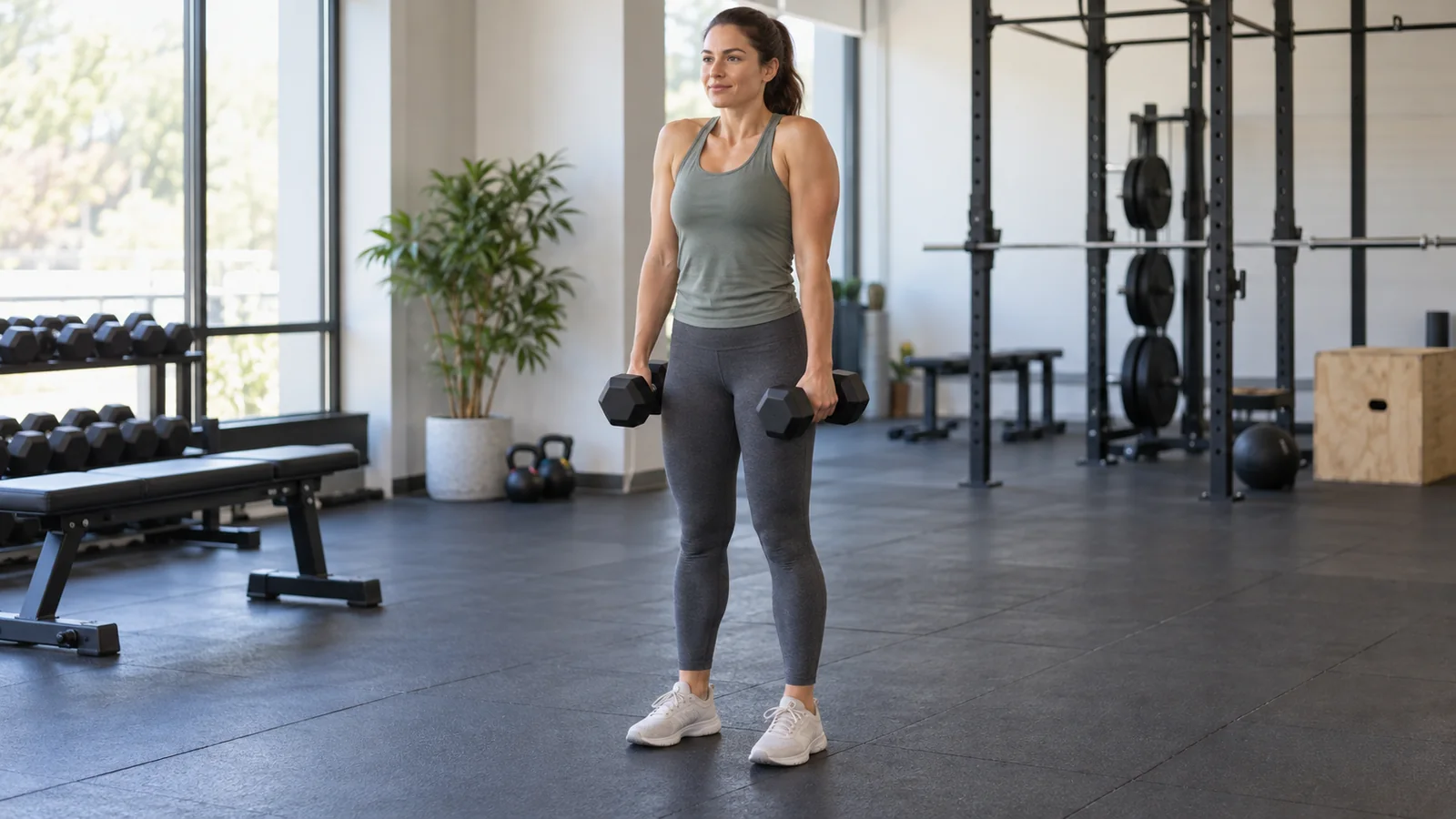
The dumbbell shrug trains the muscles that lift your shoulder blades, with the upper trapezius doing much of the work. Hold a dumbbell at each side, raise your shoulders smoothly, and lower them under control. Keep your elbows nearly straight and your head still. You do not need to roll your shoulders or bounce the weights.
Published October 16, 2026
A useful beginner starting point is two sets of 10–15 repetitions with a weight you can lift without changing your neck position. Leave about two or three controlled repetitions available at the end of each set. The challenge is finding a repeatable shoulder movement, because picking up a heavy dumbbell does not necessarily mean you can shrug it well.
What muscles do dumbbell shrugs work?
A standing shrug mainly emphasizes the upper portion of the trapezius through shoulder-blade elevation. Your shoulder blades slide upward on your rib cage as the dumbbells rise. Other muscles assist with shoulder-blade control, and your forearms work to maintain your grip.
The trapezius is a broad muscle with different regions contributing to different shoulder-blade movements. A standing shrug therefore does not provide a complete workout for every part of your upper back. It is one specific movement to include when direct upper-trap work fits your goals.
Your elbows should contribute very little movement. If you repeatedly bend them to raise the dumbbells, the exercise starts to resemble a small curl or upright pull. Your legs and torso also provide a stable base, but they should not bounce to launch the weights.
Think of a shrug as a short, deliberate accessory exercise. It can complement rows, presses, and carries, but it is optional in a general fitness routine. You can build a useful full-body program without adding a separate exercise for every individual muscle region.
Before you pick up the dumbbells
Leave yourself space to lift and put them down
Choose matching dumbbells and check that adjustable collars or locking mechanisms are secure. Clear enough floor space for both weights and your feet. Stand away from the rack so a passing gym member does not have to squeeze between you and the equipment.
The pickup and return are part of the set. If lifting the dumbbells from the floor is difficult, choose lighter weights or an appropriate rack position. Avoid using a load you can hold briefly but cannot put down with control after your grip becomes tired.
Set a stable stance
Stand with your feet at a comfortable hip-to-shoulder width. Keep your knees soft and your weight distributed across both feet. A small staggered stance is also an option if it helps you stay steady, provided you do not twist or lean to one side.
Let the dumbbells hang beside your thighs with your palms facing inward. Your arms can sit slightly forward or outward if that gives the weights clearance. You do not need to force your hands against your legs or hold your arms away from your body.
Find a comfortable neck and trunk position
Look generally forward with your head balanced over your torso. Keep your ribs stacked over your pelvis without lifting your chest into a large back arch. Brace lightly enough to stay still while continuing to breathe.
A mirror can be useful before the set, but avoid turning your head to inspect each repetition. If checking your shoulders makes you crane your neck, look ahead and use a short recording or a trainer’s feedback afterward.
How to do a dumbbell shrug
- Start with the weights still. Hold both handles securely with your thumbs wrapped around them. Let your shoulders settle into a comfortable starting position without hanging passively into an uncomfortable stretch.
- Raise your shoulder blades. Move your shoulders upward in a smooth shrug. Keep your elbows long and your wrists generally straight.
- Stop at your controlled top position. Lift as high as you comfortably can without jutting your head forward, arching backward, or bending your knees to help.
- Pause briefly if useful. A short pause makes it easier to notice whether the shoulders moved or the whole body bounced. It is a technique option, not a required muscle-building trick.
- Lower deliberately. Return to your original shoulder position. Avoid dropping suddenly and letting the dumbbells tug you into the bottom.
- Repeat the same movement. End the set when you can no longer maintain the range and body position you established.
The American Council on Exercise’s standing-shrug instructions emphasize raising the shoulders without rolling them or bending the elbows, followed by a controlled return. Those are useful basics to preserve before you increase weight.
A simple breathing rhythm is to breathe out as you lift and breathe in while lowering. If coordinating that makes the exercise awkward, focus first on breathing steadily and avoiding a prolonged strain.
Why the movement looks smaller than other exercises
Your shoulder blades cannot travel as far as a dumbbell can during a row or press. A controlled shrug may therefore look modest even when it feels demanding. Trying to make the weights travel much farther often brings in elbow bending, a knee bounce, or a moving head.
Use your own light-weight repetition as the reference. Notice the difference between your relaxed starting shoulder position and your comfortable raised position. Then choose a working weight that preserves most of that movement rather than cutting it to a barely visible twitch.
Some natural shoulder-blade rotation accompanies shoulder movement. The practical instruction to avoid rolling means you should not deliberately draw large circles with loaded shoulders. Follow a smooth, comfortable upward-and-downward path rather than forcing your shoulder blades into a rigid geometric line.
Do not judge quality by whether your shoulders literally touch your ears. People have different neck lengths, shoulder shapes, and available motion. Your head should not move down to meet the shoulders.
Choose a shrug weight you can actually move
Shrugs can tempt people to select the heaviest dumbbells they can carry. Holding a load and repeatedly elevating your shoulders against it are different tasks. Start with an amount that makes the shoulder movement easy to see and control.
Try one easy practice set, rest, then perform 10 repetitions with a candidate weight. Keep that weight if the final repetition resembles the first and you could do another two or three clean repetitions. If your range shrinks rapidly or your grip starts opening, reduce it.
For example, imagine a person can carry two 20 kg dumbbells but shrugs them only a little before bouncing. With two 12 kg dumbbells, the same person can perform 12 smooth repetitions with a brief pause. The lighter pair is the better starting choice for this version of the exercise. These are illustrative numbers, not a recommended weight for every beginner.
Record weight per hand. Writing “12 kg dumbbells” is clearer than recording “24 kg” without explanation. The guide to choosing dumbbell weight explains how to use repetition quality across different exercises rather than relying on one universal starting number.
A simple beginner prescription
Start with the following optional addition to one or two strength sessions each week:
- One light practice set of approximately 8–10 repetitions.
- Two working sets of 10–15 repetitions.
- About two or three good repetitions left at the end of each set.
- Roughly 60–120 seconds of rest, or longer if grip and breathing have not recovered.
- A rest day between demanding sessions for the same muscles while you learn your recovery needs.
This is an example starting plan rather than a special research-tested shrug protocol. The 2026 ACSM resistance-training guidance supports individualizing training and consistently working the major muscle groups. A small accessory movement should fit that broader plan.
If you already have a demanding pulling session with heavy carries, start at the lower end of direct shrug work. You can add a set later if it serves your goals and recovery remains good. There is no need to begin with several shrug variations or a long burnout sequence.
Place shrugs after your main lifts
For most beginners, do rows, pulldowns, and other priority lifts before shrugs. Tiring your grip first may make those movements harder to perform well. Our exercise-order guide provides a broader way to arrange a session around your priorities.
An upper-body example might include a chest press, a row, and a pulldown before two shrug sets. If direct biceps training is also planned, a concentration curl can follow. You do not need to squeeze all of those movements into every workout; use the exercises that fit your overall routine and available time.
Progress with a consistent range
Choose a repetition range and keep the movement similar while you add repetitions. Once you can complete both sets at the upper end with the same shoulder height and control, increase to the next manageable pair of dumbbells.
An example with one fixed pair is 12 and 11 repetitions at the first session, 13 and 12 later, and eventually 15 and 15. Those changes may take several workouts. Returning to 10 or 11 repetitions after a small load increase can be entirely reasonable.
The condition is that the heavier version still looks like the same exercise. If the new weight turns a comfortable rise into a tiny pulse, the increase is premature. Return to the previous pair and keep practicing.
Large dumbbell jumps create a practical problem. Moving from a 10 kg pair to a 12.5 kg pair is a meaningful increase even though the label changes by only 2.5 kg. There is no deadline to take that jump. More controlled repetitions within your planned range, a steadier descent, or a repeatable brief pause are useful ways to consolidate the current load.
Avoid adding progressively longer holds just to make lighter dumbbells exhausting. Once the timing changes substantially, compare it as a different variation in your log rather than claiming a direct improvement over your previous sets.
Common shrug mistakes and how to fix them
Bouncing through the knees
If the knees dip before every shrug, your legs are supplying momentum. Put down the weights and rehearse a few unloaded repetitions with the knees still. Then restart with a lighter pair and pause briefly between repetitions.
Explosive pulling exercises exist, but they have different goals and techniques. A beginner dumbbell shrug does not need a leg drive.
Pushing your head forward
Fatigue can make you reach your chin toward the mirror or tuck your head down between your shoulders. Lower the weight and choose a fixed spot ahead. Think of your head staying still while the shoulders move around it.
Do not force an exaggerated chin tuck either. The goal is a comfortable, stable neck position rather than holding your head in a rigid posture.
Bending the elbows
A small natural elbow softness is fine. Repeatedly curling the dumbbells upward is a different action. Check whether the handles rise while your shoulders barely move. Reduce the load and use the shoulder position as your cue.
Rolling the shoulders
Large circles add movements that are unnecessary for the basic shrug and can make the repetition harder to control. Practice an uncomplicated lift and return. You do not have to squeeze your shoulder blades together forcefully at the top.
Dropping quickly into the bottom
Letting the weights fall makes the transition unpredictable, particularly when grip is tired. Lower at a pace you can stop at any point. The bottom should be a controlled return, not a sudden stretch produced by gravity.
Leaning to make room for the dumbbells
Large dumbbell heads may bump the thighs. Adjust your arm position slightly or use a different style of handle rather than repeatedly tilting your torso. If you need a very wide arm position just to clear the weights, a cable or machine variation may fit better.
What if your grip gives out first?
Forearm fatigue is common because you hold the dumbbells for the entire set. First check the simple things: a secure handle, dry hands, enough rest, and a load that allows you to finish safely. Do not keep shrugging while the handles slide toward your fingertips.
At first, shorter sets or lighter weights may be enough. Keep the weights close to the place where you will set them down, with a clear path. You should not finish a grip-limited set and then have to carry the dumbbells across a busy gym.
Lifting straps can change the grip demand, but they add setup and require a safe release technique. If you choose to use them, learn with light weights and follow the manufacturer’s instructions. Do not use straps to justify a load you cannot otherwise control through the shoulders and torso.
If improving your grip is itself a goal, a farmer’s carry gives you a separate way to practice holding and moving with weights. Keep the purpose clear: a carry trains sustained holding while walking, whereas a shrug practices repeated shoulder elevation.
Variations and alternatives
Seated dumbbell shrug
A stable bench can reduce the temptation to use the legs. Sit upright with both feet planted and enough clearance for the weights beside you. Make sure you can pick up and return the dumbbells safely; a seated position does not automatically make heavy weights easy to handle.
This option suits someone who likes the basic movement but keeps bouncing while standing. It is not automatically easier for every back or hip condition.
Single-arm dumbbell shrug
Using one dumbbell lets you observe one shoulder at a time. It also introduces an uneven load, so the torso must resist leaning. Use a light weight and keep the ribs and pelvis level. This is an optional variation, not the first solution for a substantial left-right difference.
Barbell or machine shrug
A barbell holds the hands in a shared position, while machines vary in handle spacing and movement path. Either can be useful if the setup fits you and allows controlled repetitions. Choose according to comfort, access, and the ease of progressing in manageable increments.
A heavier number on a machine is not directly comparable with your dumbbell total. Record the equipment used and establish a new baseline when changing variations.
Rows and reverse flies
If your goal is broader upper-back training, a row or reverse fly may deserve priority over extra shrug sets. They involve different arm and shoulder-blade movements. They are not identical substitutes, but they may better match what is missing from your existing routine.
For example, someone who already does carries but no horizontal pulling may benefit more from learning a supported row than from adding a second shrug variation. Exercise selection should reflect the whole week.
Comfort, recovery, and when to stop
Muscular effort around the upper back can be expected. Sharp pain, a pinching sensation, tingling, or symptoms spreading down an arm are reasons to stop. Avoid repeatedly changing your neck angle under load to search for a position that lets you push through symptoms.
If you have ongoing neck or shoulder pain, a recent injury, or instructions from a clinician, obtain individualized advice before adding loaded shrugs. This exercise is not a universal treatment for neck pain and does not guarantee that a person’s posture will change.
Some muscle soreness after unfamiliar exercise is possible, but soreness is not a goal or a required sign of progress. Reduce the next session’s load or sets if fatigue substantially affects normal activity or your other exercises. Persistent or worsening pain deserves assessment.
When reviewing recovery, include related activities. Heavy carries, demanding rows, and manual work may all add fatigue to the muscles and grip you use here. A difficult shrug session cannot be interpreted in isolation from the rest of your week.
Frequently asked questions
Are dumbbell shrugs a back or shoulder exercise?
They are commonly grouped with upper-back or pulling exercises because they emphasize the trapezius. They can also appear in a shoulder session. The label matters less than accounting for the overlapping work and placing them where grip fatigue will not interfere with higher-priority lifts.
Should I shrug very heavy for low repetitions?
A beginner does not need maximal or near-maximal shrug attempts. Moderate repetitions give you time to learn the shoulder movement and notice changes in technique. Increase load gradually when your current sets become controlled and repeatable.
Should my shoulders be pulled down and back the whole time?
Start from a comfortable position, but allow the shoulder blades to rise during the shrug. Holding them rigidly down would oppose the movement you are trying to perform. You also do not need a hard backward squeeze at the top of every repetition.
Can shrugs fix rounded shoulders?
No single exercise can promise that. Appearance, comfort, strength, mobility, habits, and individual anatomy all contribute to how someone holds their upper body. Use shrugs for an appropriate strength-training goal and seek individual advice if posture concerns come with pain or functional limitations.
Track the movement, not just the weight
Write down the weight per hand, repetitions, number of sets, and whether you used a pause or straps. If your first set was clean and the second became bouncy, record that rather than counting both as equivalent successes.
You can track sets, reps, and weights in Workit (subscription required). Start the next session by repeating the same stable setup. Keep your head quiet, let the shoulder blades move, and progress only while the shrug stays controlled.