
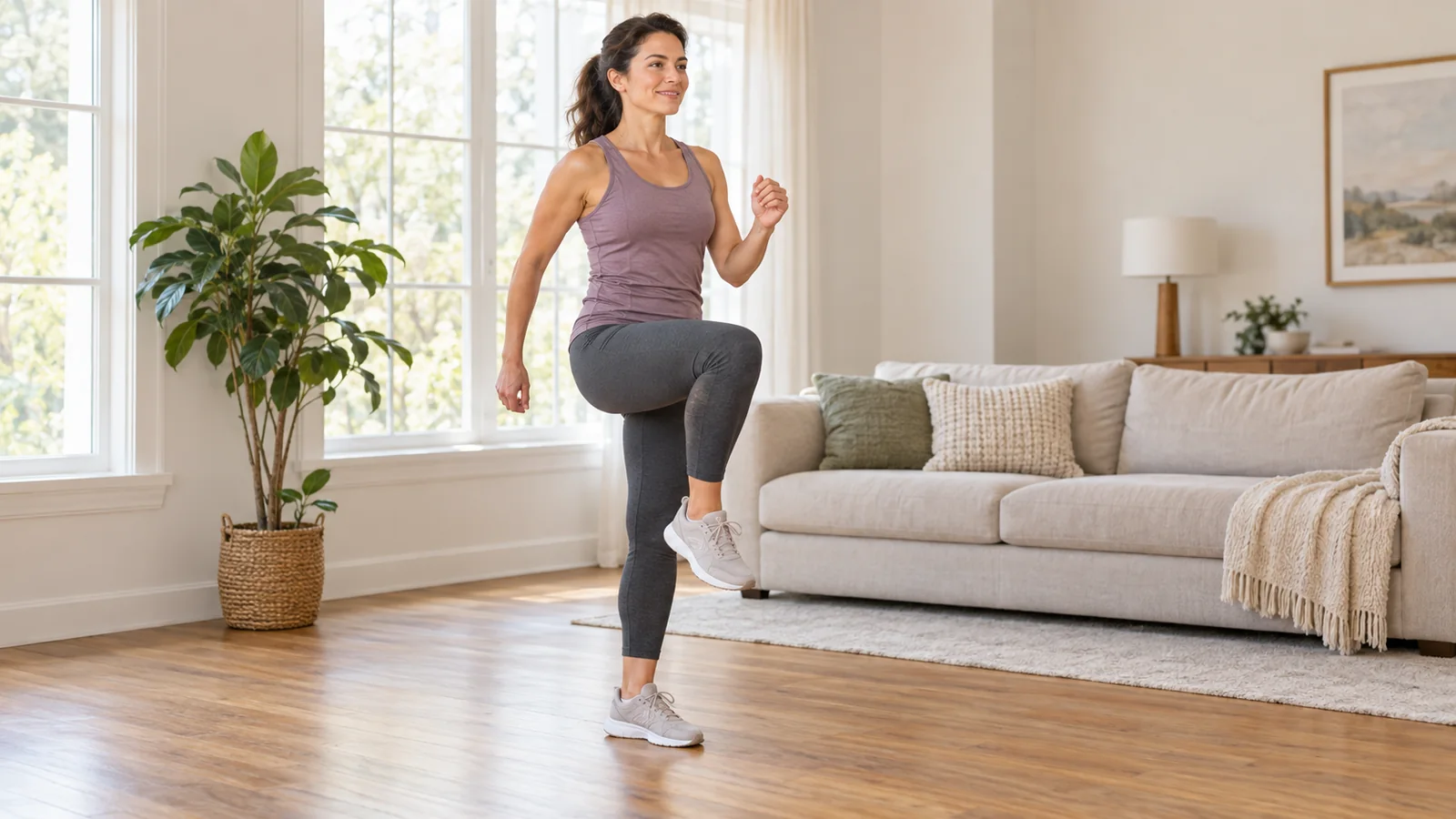
A marching-in-place workout is a simple way to move indoors without a treadmill, a walking route, or jumping. Lift one foot, place it down, and alternate at a pace you can control. The knee lift can stay low, and you can use a stable support if you need help with balance.
Published October 16, 2026
The useful question is not whether your knees are high enough to look athletic. It is whether the movement suits your current ability and produces the level of effort you intend. A gentle march can be a short movement break. A sustained, brisker march may become moderate-intensity cardio for some people.
Below you will find technique cues, a 12-minute beginner example, a longer option, and ways to adjust the session in a small room. These are general fitness examples for adults, not treatment plans. If you have symptoms, a condition that affects exercise, recent surgery, or uncertainty about your balance, ask a qualified healthcare professional what is appropriate for you.
What counts as marching in place?
Marching in place means repeatedly lifting and lowering alternate feet while staying in approximately the same spot. Unlike jogging, it does not require a flight phase with both feet off the ground. You can lift the foot just enough to clear the floor, or use a somewhat higher knee lift if that remains comfortable.
You do not need to copy a military-style march or drive your knees toward your chest. The movement can look ordinary. Quiet, repeatable steps with a relaxed upper body are a useful starting point, especially when you are learning your pace or getting used to regular activity.
This guide is about a stationary indoor session. If you want to build time on an outdoor route, use the separate walking workout for beginners. The two activities can sit in the same week, but they involve different practical decisions about space, surfaces, and pacing.
Is marching in place a good workout?
It can be, depending on the goal. It requires little space, gives you an easy way to alternate effort and recovery, and removes the need to travel before starting. Those practical advantages may make it easier to fit movement into a busy day.
The intensity is not fixed by the exercise name. Someone returning to activity may find a modest pace challenging, while someone already doing regular cardio may find it easy. Low impact describes how you move; it does not guarantee low effort or make an exercise suitable for every injury.
The British Heart Foundation’s home aerobic exercise guidance includes standing and seated marching and emphasizes choosing an effort that matches the person. Its advice also distinguishes comfortable conversation from the harder breathing of more intense activity.
Marching also has limits. A relaxed march is not a complete strength program, and it does not cover every aspect of balance or mobility training. Think of it as one adaptable movement option. You do not need to make it perform every role in your fitness routine.
Prepare a small, safe exercise space
Choose the floor before the playlist
Use a level, dry surface with enough grip for your footwear. Move loose rugs, cables, bags, and small objects out of the area. Avoid placing a thick, unstable cushion or a sliding mat under your feet to make the workout quieter.
Check more than the spot directly beneath you. You should have room to swing your arms and take an unplanned recovery step without hitting a table. Keep pets and young children out of the immediate movement area. Pause if someone needs to pass through the space.
Set up support when you need it
A fixed counter or a suitable handrail may be useful for a supported version. Do not rely on a swivel chair, a folding chair, or furniture that slides when you press on it. Test the support before you begin, then position yourself so you do not need to lean or reach awkwardly.
University Hospitals Sussex describes supported marching with a stable surface and a comfortable knee lift in its standing-exercise instructions. If you have been prescribed a different level of support, follow that plan rather than removing your hands to make a cardio workout harder.
Make the session easy to follow
Place your timer or screen where you can see it without turning repeatedly. Keep water nearby but outside the foot area. Set the volume low enough to hear your surroundings. You should not need to pick up a phone, scroll, or step over equipment while marching.
Comfortable shoes with a secure fit are a practical default, particularly on smooth floors. If your usual exercise footwear slips or catches, solve that problem before increasing your pace. A workout that requires constant corrections to avoid sliding is not ready for progression.
How to march in place with control
- Stand comfortably. Place your feet around hip-width apart, with your knees relaxed and your gaze forward.
- Shift and lift. Transfer enough weight to one leg to lift the opposite foot a small distance. Stay close to upright rather than leaning backward.
- Place the foot down. Return it underneath you with a quiet, controlled contact. Avoid deliberately stamping.
- Alternate. Lift the other foot and continue at a comfortable rhythm. Let each landing happen before the next foot leaves.
- Add relaxed arms if appropriate. A small opposite-arm swing can follow the legs naturally. Keep your hands on support if you need it.
- Keep breathing. You should not need to brace rigidly or hold your breath to maintain a gentle march.
Begin with a low knee lift. Increase it only if you can do so without rocking your torso, tipping your pelvis, or losing the rhythm. There is no requirement for your thigh to reach horizontal. A low march can still become more demanding when you sustain it.
Keep your shoulders easy rather than pulling them up toward your ears. Your arms can move below shoulder height. If coordinating opposite arms and legs feels awkward, leave the arms relaxed for now. Coordination can improve with practice; forcing a complicated pattern is unnecessary.
The NHS uses marching as part of its general exercise warm-up, with relaxed hands and rhythmic arm movement. That is a useful reminder that marching does not have to begin at workout speed. Spend time finding a comfortable rhythm first.
Use the talk test instead of chasing a step rate
At an easy pace, ordinary conversation should feel comfortable. At a moderate effort, breathing is noticeably increased, but you can still speak. The CDC’s talk-test guidance describes moderate intensity as being able to talk but not sing; at vigorous intensity, only a few words are possible before pausing for breath.
For the beginner examples below, stay at easy to moderate effort. If you are breathing so hard that conversation breaks into short fragments, make the march smaller and slower, or stop for a rest. You do not have to work at vigorous intensity for the session to have a purpose.
A metronome or upbeat song can be enjoyable, but it should not set a pace you cannot manage. Different leg lengths, fitness levels, and knee heights make a single steps-per-minute target unhelpful for many beginners. Let your control and breathing guide the pace.
Also separate ordinary exercise effort from unusual symptoms. Stop for dizziness, chest discomfort, unusual breathlessness, or feeling faint. Seek urgent medical help for severe or persistent symptoms. Do not try to complete an interval first or assume every symptom means you are simply out of shape.
A 12-minute marching-in-place workout
This example uses only marching, so there is no choreography to memorize. It includes three minutes of gradual warm-up, six minutes of alternating effort, and three minutes of easing down. Extend the warm-up if you need longer, or shorten the working portion if twelve minutes is too much.
Minutes 0 to 3: start easy
March slowly with a low foot lift. During the first minute, focus on steady landings. During the second, add a relaxed arm swing if you do not need support. During the third, increase the pace slightly only if breathing remains comfortable.
The warm-up should not feel like a test. If you still feel stiff, uncertain, or unusually tired, stay at the easy pace. You can make the whole session gentle today. If movement is painful or you feel unwell, stop instead of trying to warm through the problem.
Minutes 3 to 9: alternate steady and easy
Complete six rounds of thirty seconds of a steadier march followed by thirty seconds of an easy march. A steady interval means a modest increase in pace that still permits conversation. Keep the knee height similar rather than changing several things at once.
During each easier interval, check whether your shoulders have crept upward or your steps have become noisy. Make the movement smaller if needed. If easy marching does not provide enough recovery, stop and rest safely. Pausing is a valid adjustment, even though it changes the session’s elapsed time.
Minutes 9 to 12: ease down
Gradually reduce the pace and arm movement. Finish with a slow, comfortable march before stopping. Give yourself time to feel settled before bending down to move equipment or rushing into another task.
This session lasts twelve planned minutes, but not all twelve are necessarily moderate-intensity activity. Warm-up, recovery, and cool-down minutes may be light. If you are tracking weekly moderate activity, record the minutes that actually reached that effort rather than automatically counting the whole timer.
If twelve minutes is too much
You can begin with a much shorter practice. Try an easy march for twenty to thirty seconds, then rest as needed. Repeat only while the movement remains comfortable and controlled. The first goal can be learning the motion and checking how you feel afterward.
Another option is a brief movement break with no faster intervals. Settle into a gentle march, continue for a comfortable period, and gradually slow before stopping. There is no rule that an introductory session must contain a minimum number of rounds.
Do not compare a short start with someone else’s finished routine. The useful comparison is whether the same dose feels manageable when you repeat it. If even a gentle version causes symptoms or feels unsafe, seek individual guidance before trying to build duration.
A longer 20-minute option
Once the shorter version feels manageable across several sessions and you recover comfortably, you can try this structure. It changes the length of the session without requiring high knees, jumping, or added weights.
- Five minutes: easy marching, gradually moving toward your comfortable working pace.
- Ten minutes: five rounds of one minute of steady marching and one minute of easy marching.
- Five minutes: gradually reduce the pace, finishing comfortably.
Do not simultaneously make the steady intervals much faster. First see whether the extra time suits you. If the final rounds become less controlled, return to the shorter version or remove a round. Progression should preserve the movement that made the earlier sessions manageable.
You can also keep the twelve-minute format indefinitely if it fits your schedule. A longer session is an option, not proof that you are doing the shorter workout correctly. Consistent practice and a suitable effort are more informative than a round number on the timer.
Supported and seated alternatives
Supported standing march
Stand beside or facing a fixed support, depending on what lets you stay upright and secure. Hold it as much as needed. Lift one foot a little, place it down, and alternate slowly. Keep the steps low enough that you do not pull yourself toward the support.
For this version, make progress through comfortable duration or smoother steps rather than automatically reducing hand contact. If you need support for balance, faster hands-free marching is a different challenge and may not be the appropriate next step.
Seated march
Use a sturdy chair that does not roll, swivel, or slide. Sit in a comfortable upright position with both feet able to reach the floor. Lift one foot a small distance, lower it gently, and alternate. Avoid leaning backward to force a higher lift.
Seated marching changes the task and may produce a different level of effort. Do not assume it creates the same intensity as the standing version. Use comfortable breathing and control to set the pace, and follow any advice you have received about chair position or exercise restrictions.
If getting into or out of the chair is difficult, or you are unsure which version fits your needs, a physiotherapist or other appropriately qualified professional can help. An online exercise description cannot establish whether your balance or medical situation permits independent practice.
Adjust the workout without making it complicated
Use one change at a time. You might repeat the same session more comfortably, add one short interval, lengthen a steady interval slightly, or increase the pace a little. Those are separate decisions. Changing all of them together makes it harder to tell which increase was manageable.
A practical sequence is to establish the movement first, then build a little duration, and only later consider a somewhat brisker pace. This is a coaching approach rather than a mandatory progression schedule. Stay with a stage longer whenever it suits your recovery or confidence.
Added ankle weights, hand weights, and forceful overhead movements are unnecessary for this beginner workout. If you want resistance training, a separate session allows you to practice those movements deliberately. Our beginner resistance-band workout provides one possible starting point.
If repetition feels monotonous, change the music or use a simple spoken timer rather than adding several new steps. You can also alternate short marching sessions with another comfortable activity. Variety should make the routine easier to follow, not turn a quiet indoor session into a coordination test.
Common problems in a small room
Your steps are loud
Lower the knee lift and place each foot down more gently. Slow the rhythm until you can avoid stamping. Shoes and floor construction affect noise, so no exercise can be promised silent. Choose a considerate time and avoid unstable padding as a soundproofing shortcut.
You drift forward
Check that you are placing each foot underneath you instead of taking a small forward step. Use a visible point in front of you as an orientation cue, without staring downward throughout the session. Pause and reposition before you get close to furniture.
Your hips or lower back feel uncomfortable
Stop the uncomfortable movement. When appropriate to resume, try a smaller knee lift and slower pace rather than exaggerating the march. Do not assume discomfort is a normal price of working the hip muscles. Persistent or repeated symptoms need professional advice.
You cannot follow the timer and the steps
Remove the intervals for now. March gently at one comfortable pace and stop when you need a break. A simple session you can control is more useful than a precise schedule that repeatedly distracts you from your footing.
How marching fits into your week
The CDC’s adult activity guidance recommends a combination of aerobic activity and muscle-strengthening work. Moderate-intensity activity contributes toward the usual target of 150 minutes per week; strength work should include the major muscle groups on at least two days. Activity can be accumulated in smaller portions.
That target is a broader direction, not an instruction to jump from inactivity to a full schedule immediately. You might start with a few short marching sessions on days that suit you, then reassess. A gentle break is still movement even when it does not reach moderate intensity.
For a simple example, try a short indoor session on two or three nonconsecutive days and observe your comfort and recovery. This is an introductory schedule, not a complete program that meets every guideline. Add suitable strength work separately as your routine develops.
Keep your record straightforward: date, minutes completed, easy or moderate effort, and any adjustment you made. Our workout log template includes examples for describing a session without relying on a calorie estimate.
Frequently asked questions
Does marching in place count as walking?
It is a related stepping activity, but it does not involve traveling along a route. A device may count some or all of the steps differently. Judge the session by what you did and how hard it felt rather than forcing a particular step count.
Can marching in place help with fitness?
It can contribute to an activity routine when the effort and duration suit your goals. A brisk march may provide a cardio challenge for one person and feel light to another. It also gives you a simple way to practice regular movement indoors.
How many calories will I burn?
There is no single dependable number for this workout. Body size, pace, knee height, duration, and individual factors change energy use. A watch or calculator provides an estimate. You do not need a calorie target to make the session useful or worth recording.
Will it reduce belly fat?
Marching does not let you choose where body fat changes. Its practical value here is an accessible activity option. Avoid judging the routine by a promised waist change, and do not use the workout as compensation for eating.
Can I do it while watching television?
Yes, if the screen is positioned comfortably and you can still pay attention to your steps and surroundings. Begin without distraction so you can establish the movement. Pause the workout rather than turning suddenly, reaching for a remote, or navigating around furniture.
Start with the version you can repeat
A useful first session can be quiet and brief. Clear the floor, march with a low lift, use support when needed, and keep your breathing comfortable. Build from a dose that fits your ability rather than from the longest routine you can find.
If your week also includes resistance training, Workit provides a workout journal for sets, reps, and weights; a subscription is required. Keep a simple record of your marching minutes alongside your strength work so your next session starts from what you actually completed.