
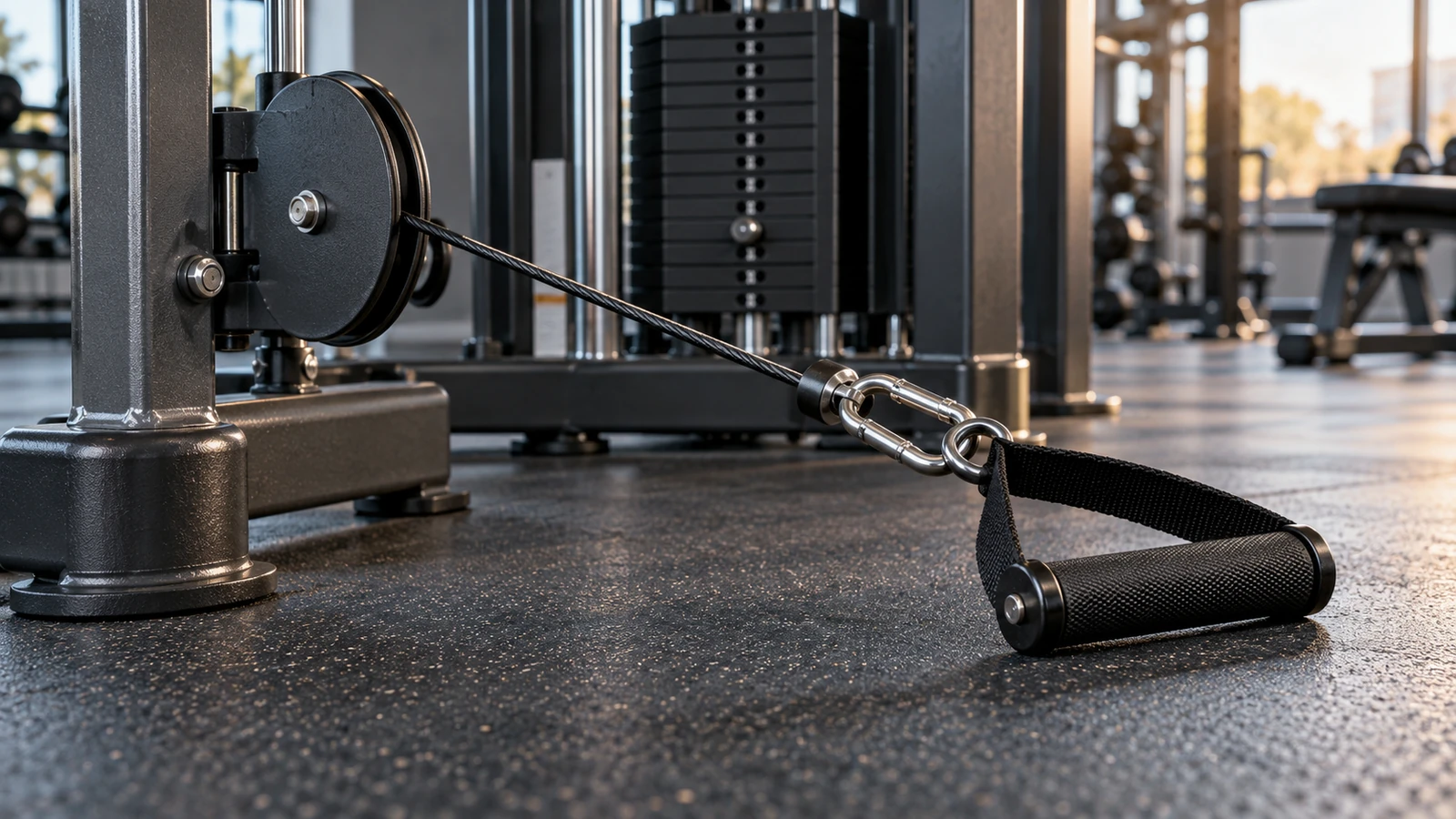
A cable lateral raise trains the side of your shoulder by lifting your arm outward against a cable. Start with a light load, keep a small bend in your elbow, raise your upper arm toward shoulder height through a comfortable path, and lower under control. For a first session, try two sets of 10–15 controlled repetitions per side, stopping before you need to swing or strain.
Published October 10, 2026.
The useful part of the exercise is its adjustability. You can change the cable height, your distance from the machine, and the attachment to find a repeatable setup. That also creates confusion: two people can use the same stack weight and perform noticeably different exercises. This guide explains a straightforward starting version, how to troubleshoot it, and what to record so your next session makes sense.
Cable lateral raise setup at a glance
- Equipment: an adjustable cable station and a single handle.
- Position: stand side-on, with the working arm farther from the machine.
- Cable route: let the cable pass in front of your body without rubbing against your legs.
- Starting height: use a low pulley for the basic version; adjust if the cable catches or the movement feels awkward.
- Arm path: lift outward and slightly forward if that feels more natural than directly sideways.
- Finish: approach shoulder height only while the motion stays comfortable and controlled.
- Starting dose: two working sets per arm, with enough recovery to repeat your technique.
Check that the handle clip, pulley adjustment, and weight pin are secure before loading the movement. Keep fingers away from the stack and moving parts. If you do not know how the station adjusts, ask gym staff for an equipment demonstration. A few minutes learning the machine is more useful than trying to copy someone else’s stance while already holding a loaded handle.
What muscles does a cable lateral raise work?
The main target is the lateral, or middle, portion of the deltoid: the shoulder muscle involved in lifting your upper arm away from your side. Other shoulder muscles and the muscles that move your shoulder blade help coordinate the movement. Your trunk also works to keep your body from leaning toward the cable.
This is an accessory exercise, usually used alongside presses, rows, and other larger movements. It gives you a way to train shoulder abduction directly without having to turn every shoulder exercise into an overhead press. It does not replace a balanced upper-body program or serve as a diagnosis or treatment for shoulder pain.
You do not need to make every assisting muscle disappear. Some shoulder-blade movement is normal when the arm rises. The goal is a controlled arm raise with a stable body, rather than a rigid shoulder position that feels forced. Feeling effort in the side of your shoulder can be helpful feedback, but sensation alone cannot prove how effective a set will be.
How to do a cable lateral raise step by step
1. Choose a light setting and establish your stance
Attach a single handle to a low pulley. Stand with your left side toward the machine to train your right arm. Take the handle in your right hand and stand far enough away for the cable to move freely. Keep your feet around hip-width apart, with a small stagger if that helps your balance.
Your free hand can rest lightly on a stable part of the station that is intended to be held. Avoid leaning on moving components or grabbing the cable. Let your ribs sit comfortably over your pelvis rather than arching your back to make yourself taller. You should feel stable before the first repetition begins.
2. Set your elbow and wrist
Keep a slight bend in your working elbow and maintain roughly the same bend throughout the repetition. Let your wrist stay in line with your forearm. Grip the handle firmly enough to control it without squeezing so hard that your hand becomes the limiting factor.
The handle may begin near your opposite thigh or closer to your working-side thigh, depending on the station and your stance. Do not force your arm far across your body to create a bigger stretch. Use a starting position you can enter and leave smoothly without twisting your torso.
3. Lift your upper arm outward
Move your upper arm away from your body, allowing it to travel slightly forward if that is more comfortable. Think about moving the elbow and hand together in an arc. Keep the elbow softly bent instead of turning the repetition into a curl or pulling the handle straight upward along your body.
Raise toward shoulder height while keeping the movement controlled. You do not need to reach a precise angle on every body type, and you should not push through pinching to match an imaginary line. Use the comfortable range you can repeat. Breathe normally, with an easy exhale during the lifting phase if helpful.
4. Lower without dropping the stack
Return along the same path under control. A smooth lowering phase of roughly two seconds can help you notice whether the weight is manageable, but there is no need to time every repetition perfectly. Avoid letting the handle yank your arm down or the plates slam together.
Pause briefly if you need to reset your stance. If the plates touch at the bottom, make a small setup adjustment only if the equipment permits it and your position remains comfortable. The aim is consistent movement; avoiding every possible moment of reduced tension is not worth distorting the exercise.
5. Stop when the next repetition would change the exercise
End the set when you would need a strong hip drive, a bigger lean, a much shorter range, or a sudden shrug to continue. Put the handle down under control, then turn around and repeat on the other side. A clean set that ends a little early is useful practice, especially while you learn the cable’s pull.
Where should the cable pulley be?
A low pulley is a convenient starting point because it is widely available and easy to set up. It pulls diagonally across your body as your arm rises. A pulley closer to hand or hip height changes the direction of pull and can make the beginning of the raise feel more demanding.
The relevant idea is the angle between your arm and the cable. The stack may exert a fairly steady pull, but the turning demand at your shoulder changes as that angle changes. A cable does not create identical shoulder tension at every point simply because the plates stay lifted.
For your first few sessions, choose the height that allows an unobstructed, comfortable path. Record the setting and keep it consistent. Once the basic movement is familiar, you can try a different height using a lighter load and compare control and comfort. Changing pulley height, stance, range, and load all at once makes it hard to learn which adjustment helped.
There is no universally best distance from the stack. Step far enough away to avoid cable interference, but do not walk across a busy aisle or stretch the cable to its limit. Respect the station’s intended working area. If the setup requires an elaborate lean or constant repositioning, a simpler variation is probably a better choice for that gym.
How much weight should you use?
Use the lightest setting that lets you feel the movement while keeping it smooth. For a first test, perform five easy repetitions. If you can hold your stance, maintain the same elbow bend, and lower without the stack pulling you around, try a working set in the 10–15 repetition range.
The last few repetitions can feel demanding without becoming desperate. As a beginner, finish while you believe you could still perform a few more clean repetitions. You do not need to discover your absolute limit on the first day. If your form changes before the lower end of the range, reduce the load or choose a more manageable alternative.
Cable labels are not standardized measures of what reaches your hand. Pulley arrangements, friction, and machine design can change the effective resistance. Five kilograms on one station may feel very different from five kilograms on another. Compare your performance on the same machine and setup, rather than treating the number as a universal strength score.
The same principle applies when switching to dumbbells. The resistance direction differs, so your cable number does not tell you which dumbbell to pick. Use a fresh trial set and the practical checks in our guide to choosing a dumbbell weight.
When the next weight increment is too large
Suppose you can complete two clean sets of 15 at the current setting, but the next plate makes even eight repetitions messy. Stay at the lighter setting while improving consistency, or use an approved smaller increment if the equipment provides one. You can also use a different machine or dumbbells with smaller jumps. Do not attach improvised weights to a stack or pin.
A small isolation exercise does not need a heavier number every week. Repeating good repetitions with less body movement is meaningful progress. If you change the exercise to move more weight, record it as a setup change rather than assuming the larger number proves stronger shoulders.
Sets, repetitions, rest, and weekly placement
For someone new to this exercise, two sets per side once or twice a week is a reasonable trial. A range such as 10–15 repetitions keeps the first sessions simple. These are starting suggestions, not a proven optimum or a requirement for every lifter. Your broader program, recovery, and previous shoulder training matter.
Place the raises after your main presses and rows when those exercises are the priority. If shoulder isolation is a specific training goal, a different order may make sense, but expect earlier exercises to affect later performance. Our guide to exercise order explains how to make that choice without adding more exercises than you need.
Rest long enough that the next set looks like the previous one. For a simple approach, complete one arm, take a short transition, complete the other arm, then rest around 60–90 seconds before repeating. The first arm has also rested while the second arm worked. Extend the break if your breathing, grip, or shoulder fatigue still limits control.
For example, four total arm-sets lasting 40 seconds each take about two minutes and forty seconds of lifting. Add transitions, a 60–90 second break between rounds, and an initial light practice set, and allow roughly six to nine minutes. Waiting for a station adds more. Do not squeeze the exercise into a promised two-minute finisher by eliminating recovery.
For a fuller explanation of adjusting recovery to the exercise and your performance, see how long to rest between sets. More sets are not automatically better if they turn an otherwise sustainable workout into one you cannot recover from or finish.
Common cable lateral raise mistakes and practical fixes
Swinging your hips to start every repetition
If each raise begins with a knee dip and a sideways throw, the load is probably too heavy for the version you intended. Reduce it and pause in the starting position before lifting. A light touch on the machine with your free hand may help you keep your body steady.
Forcing your shoulder blades downward
Trying to hold your shoulders aggressively down and back can make the movement feel unnatural. Keep your neck relaxed, but allow your shoulder blade to move as your arm rises. A trainer can help you distinguish ordinary shoulder-blade movement from repeatedly hiking your whole shoulder to get a heavy handle upward.
Turning the raise into a high pull
If your elbow folds more and more while the handle travels close to your ribs, you are changing the movement. Set a modest elbow bend before starting and preserve it. Choose a lower weight if you cannot keep the same arm shape. You should not need to pull the handle toward your chin.
Reaching too far behind the body
A behind-the-back cable route is a separate variation, not a compulsory improvement. If it creates an awkward stretch or pinching, return to a cable path in front of your body. More stretch is not automatically more useful, particularly when you cannot control the return.
Chasing a burning sensation
A long set can burn even when the repetitions are inconsistent. Judge the exercise by stable technique, an appropriate challenge, and repeatable performance across sessions. You do not need drop sets, partials, or repeated failure attempts to make a beginner lateral-raise session worthwhile.
Ignoring shoulder discomfort because the weight is light
Light resistance can still irritate an uncomfortable movement. Stop for sharp pain, catching, new weakness, numbness, or tingling. A smaller range or different exercise may be more comfortable, but persistent or recurring symptoms deserve assessment by a qualified clinician. Seek prompt medical attention for severe pain after an injury or a sudden inability to use the arm.
Cable lateral raise variations and alternatives
Single-arm handle version
This is the best place to start for many gym users because it uses one station and makes it easy to notice side-to-side differences. Begin with the side that needs more attention, then use comparable technique on the other. A small difference in repetitions is information; it does not mean you need to add extra exhausting sets immediately.
Cuff attachment
A purpose-made cable cuff can reduce how much the handle grip limits the exercise. Ask staff how the attachment should fit and check that it is secure. The point where resistance attaches changes the lever arm, so treat this as a new setup and reduce the weight initially. Stop if the cuff causes pressure, numbness, or skin irritation.
Dumbbell lateral raise
Dumbbells are a practical alternative when the cable station is occupied or the lightest cable setting is too heavy. They are easy to set up and do not require you to stand across a cable path. Follow the same broad principles of control, a comfortable arm path, and an appropriate load. The American Council on Exercise’s lateral-raise demonstration provides a basic free-weight reference.
Lateral raise machine
A machine may provide a stable alternative, although fit varies. Adjust the seat and pads according to the machine instructions, and make sure the movement feels natural before adding weight. Do not force your body into a machine whose pivot or pad position does not suit you. Equipment availability matters less than finding a version you can perform consistently. If you are still learning the equipment, our beginner gym-machine workout can help you place this accessory alongside the rest of your session.
Are cable lateral raises better than dumbbells?
Cables offer different setup options, but current evidence does not justify saying they are automatically better for shoulder growth. In a 2025 experimental study comparing cable and dumbbell lateral raises, 24 resistance-trained participants trained for eight weeks. Each participant used one method for one arm and the other method for the other arm. Lateral-deltoid muscle thickness increased similarly between conditions.
The study standardized range of motion and tested a particular cable setup. It cannot settle every possible pulley height, training program, or individual preference. Its useful message is narrower: there is no need to abandon dumbbells because someone promises that cables always produce superior results.
Choose the version that fits your equipment, feels comfortable, and allows a repeatable challenge. If both work well, either can have a place in your program. Avoid changing variations every session simply because a new setup looks more advanced.
What to record after the exercise
Write down the machine, pulley height, attachment, selected load, and repetitions for each side. Add one short note if something changed. For example: “Single handle, low pulley, station beside row machine, 12 and 11 each side; no torso swing; repeat setup.” Those details make the next workout easier to reproduce.
Label cable weight as the displayed stack setting if you do not know its effective resistance. When moving to another machine, start a new comparison rather than treating the lower number as a setback. Our workout log template shows ways to record machine settings and unilateral exercises without making your notes complicated.
Cable lateral raise questions
Should your thumb point down?
You do not need to deliberately turn your thumb downward as if pouring out a jug. Keep a comfortable hand position, with your wrist controlled and your arm moving naturally. If a cue creates pinching or makes the exercise harder to coordinate, use a simpler neutral position and reduce the load.
Should you raise above shoulder height?
For this basic version, a comfortable finish near shoulder height is enough. Raising higher changes the movement and is not required to complete the suggested sets. If you want to train a larger range, first establish comfortable control and consider individual guidance, particularly if you have a history of shoulder symptoms.
Can you train both arms at once?
Yes, if a suitable dual-cable station gives you room and a clear cable path. Start lighter and check that you can maintain your position without the cables pulling you off balance. Single-arm training is often easier to set up, especially in a crowded gym, and is entirely adequate for learning the exercise.
Why do cable raises feel harder than expected?
The cable’s direction, the attachment point, and the machine’s mechanics all affect the challenge. Your arm also holds the resistance relatively far from the shoulder. Use the number as a record of that specific setup, not as a judgment about your strength or a comparison with your curl or press.
Make the next session easy to repeat
Start with a light, comfortable setup, keep your body steady, and stop before your repetitions turn into swings. Record the machine settings and repeat the same version long enough to learn it. If you are exploring tools for your fitness routine, you can explore Workit on the App Store.
Comments
One response to “Cable Lateral Raise: Form, Setup, Muscles, and Beginner Sets”
[…] a cable lateral raise, include pulley height and attachment. “Low pulley, single handle, station A” gives the number […]