
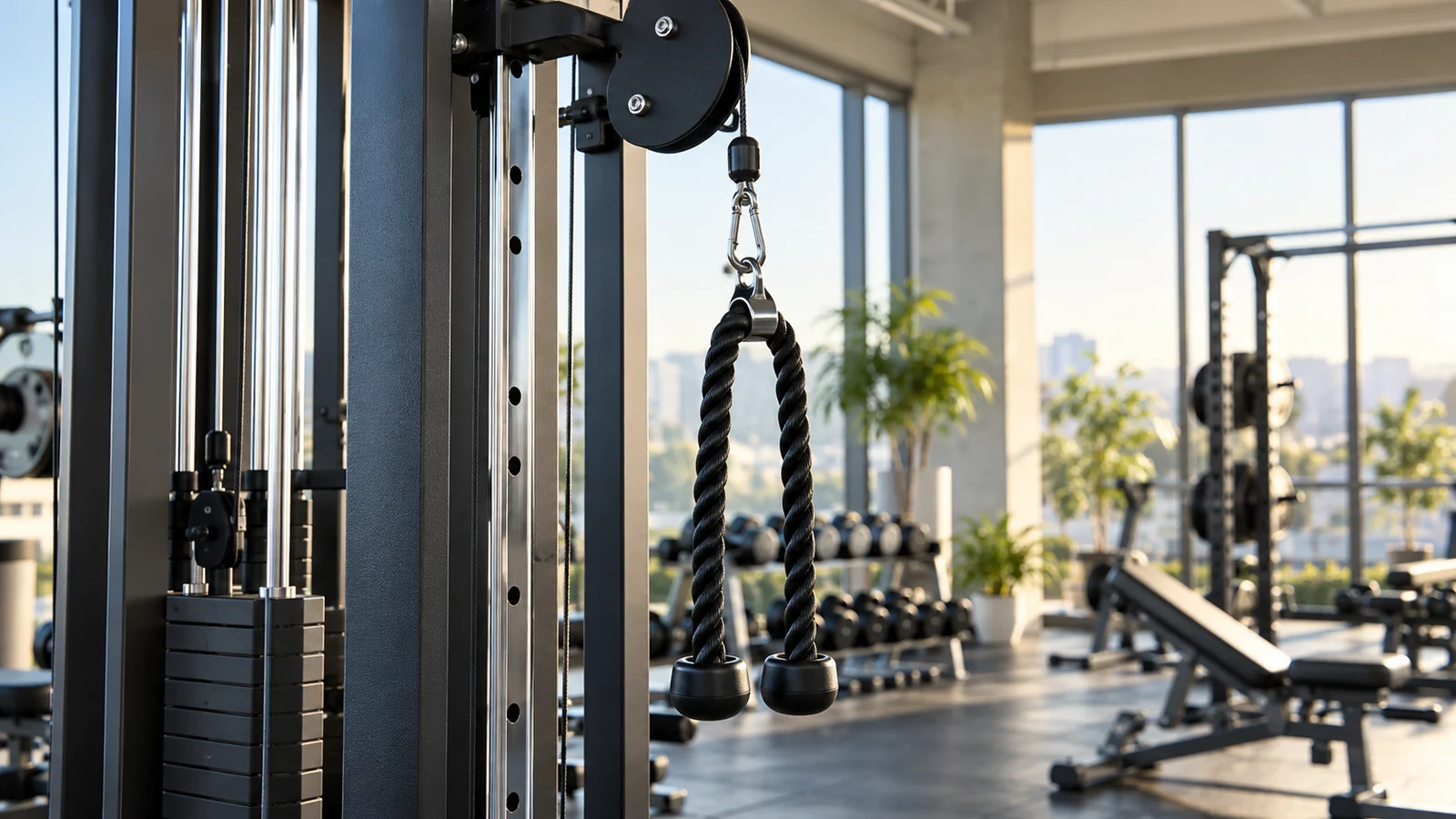
A triceps pushdown trains the back of your upper arms by straightening your elbows against a high cable pulley. Hold a rope or bar, keep your upper arms comfortably near your sides, and press the attachment downward without rocking your torso. Return it slowly. Start light enough that the elbows do the moving and you can finish the set without the weight stack pulling you forward.
Published October 12, 2026
Also called a triceps pressdown, this exercise is straightforward once the cable station is set up properly. Most beginner problems come from using too much weight, standing in an awkward position, or trying to force a particular grip. You can avoid much of that confusion by choosing a comfortable attachment and keeping the same movement standard from one session to the next.
This guide explains rope versus bar options, safe cable setup, common technique fixes, and a practical progression. It also puts pushdowns in context: they can be useful arm work, but they are only one part of a balanced strength routine.
What the triceps pushdown works
Your triceps brachii has three heads and is the main muscle responsible for straightening the elbow. A pushdown loads that elbow-extension movement while your upper arms remain near your torso. Your forearms hold the attachment, and muscles around the shoulders and trunk help maintain your position.
You will often see claims that one handle isolates a particular triceps head. That is an oversimplification. Grip, shoulder position, and the path you choose can affect how an exercise feels, but changing from a rope to a bar does not switch whole parts of the triceps on and off.
The useful beginner question is whether the attachment lets you extend your elbows comfortably while keeping your wrists and torso steady. Choose that first. A complicated handle rotation is not necessary to make the exercise count, and discomfort is not proof that you have found a neglected muscle.
Pushdowns are usually described as an isolation exercise because elbow movement is the main action. That does not mean every other muscle is inactive. It means you should avoid turning each repetition into a large shoulder movement or a body-weight-assisted push.
Set up the cable station before loading it
Check the pulley and attachment
Use a high pulley intended for this movement. With the weight stack fully settled, set the pulley height and make sure its locking mechanism is engaged. Attach a rope, straight bar, or angled handle using the machine’s connector. Check that the connector closes fully and the attachment appears intact.
Do not use a frayed rope, damaged cable, loose connector, or a selector pin that does not seat properly. Report damaged equipment to staff and choose another station. Avoid making mechanical repairs yourself or substituting an improvised clip.
Keep fingers clear of the moving weight stack and pulley mechanism. Change the selector pin only with the stack resting. Use any add-on weights only if the machine is designed for them and staff can explain their proper use.
Find a stable standing position
Stand facing the pulley with feet in a comfortable stance and knees softly unlocked. A small staggered stance is an option if it helps you remain stable. Keep enough distance for the attachment to clear your body, but do not step so far back that the cable pulls strongly forward and balance becomes the main challenge.
A small, steady forward lean can be comfortable. The problem is repeated rocking, not the existence of any lean at all. Choose a position you can maintain during both the downward and return phases. You should not need to throw your shoulders over the handle to start a repetition.
Begin with the elbows comfortably bent
Bring your upper arms near your sides and allow the elbows to bend to a comfortable starting position. Forearms around horizontal can be an easy reference while learning, but there is no need to force an exact angle. Avoid letting the cable drag your elbows high and forward between reps.
The American Council on Exercise’s pressdown demonstration uses a high pulley, rope attachment, and elbows close to the sides. That basic arrangement is a useful starting point before experimenting with other handles.
How to do a triceps pushdown
- Grip securely. Hold both ends of a rope or take an even grip on a bar. Keep your wrists comfortably aligned with your forearms.
- Set your upper arms. Bring them near your torso without forcefully pinning them against your ribs.
- Straighten the elbows. Press the attachment down smoothly while keeping your torso position steady.
- Finish without snapping. Reach a comfortable straight-arm position rather than forcefully driving the joints beyond it.
- Return under control. Bend the elbows as the attachment rises, preserving your stance and upper-arm position.
- End safely. Guide the attachment back until the stack rests before releasing it. Do not let go while the cable is pulling against you.
Breathing out during the push and in during the return is a simple rhythm. Avoid holding your breath through several repetitions. There is no need to brace as if you were attempting a maximal lift; use enough trunk tension to remain steady and breathe normally.
The return is not a rest period in which the cable takes over. You should be able to decide how quickly the attachment rises. If it yanks your arms upward or drags you out of position, reduce the load before the next set.
Rope, straight bar, or angled bar?
Rope pushdown
A rope lets the hands find their own comfortable position and can allow the ends to separate modestly near the bottom. This may feel easier on some wrists than a fixed bar. Hold the rope securely without bending the wrists sharply just to make the ends move farther apart.
You do not have to pull the rope dramatically outward or twist your hands at the bottom. Finish the elbow extension first. If separating the ends makes your shoulders roll forward or your elbows swing backward, use less separation or less weight.
Straight-bar pushdown
A straight bar provides a fixed hand position and can feel stable. Use an overhand grip at a comfortable width, usually somewhere around shoulder width or narrower depending on the bar. Keep the hands evenly spaced so you do not tilt the attachment unnecessarily.
If the bar forces an uncomfortable wrist angle, try a different attachment. Do not assume your wrists will adapt if you repeatedly push through pain. The straight bar is an option, not the standard against which every other version must be judged.
Angled or V-bar pushdown
An angled bar offers another fixed grip that some people find comfortable. Its shape can allow a more natural wrist position than a straight bar. The same movement rules apply: stable torso, fairly steady upper arms, and controlled elbow extension.
Choose one attachment for several sessions so your progress is comparable. If you switch handles, treat the new setup as a new reference point. A heavier stack with one attachment does not prove that it produces a better training effect.
How much weight should a beginner use?
Start at a light stack setting and perform several slow practice repetitions. You should be able to keep your stance, control the return, and stop the attachment deliberately. If you need a body lean or shoulder shove to move the first repetition, the setting is too heavy for learning.
Use your performance rather than an online strength chart. Cable machines differ in pulley ratios, friction, and labeling. A stack marked 20 on one machine may not feel like a stack marked 20 on another. Even identical-looking stations can differ enough that you should test them with an easy set.
For working sets, choose a load that allows your planned repetitions with approximately two or three clean reps still available. Our reps-in-reserve guide explains this effort estimate. At first, the practical goal is simply to stop before your technique clearly changes.
Record the machine, attachment, and stack setting. “Cable station by the windows, rope, pin at 4, 12/11 reps” can be more useful than a guessed weight. If the stack uses kilograms or pounds, record that unit too.
Common mistakes and useful fixes
Rocking your torso on every repetition
Reduce the load and choose a steady stance. It is easy to mistake whole-body movement for stronger triceps when the attachment still reaches the bottom. Watch whether your shoulders travel significantly forward and down as you push. Your torso should look broadly the same at the start and finish.
Letting the elbows swing backward
A little natural movement is not automatically a problem, but a large elbow swing turns the exercise into something different. Keep the upper arms in a comfortable position near your torso and focus on opening the elbow angle. If the shoulders have to pull the entire arm back, use a lighter load.
Flipping the wrists to finish
The wrists should not provide an extra burst of motion at the bottom. Keep them roughly in line with the forearms and use an attachment that permits a secure grip. With a rope, do not mistake an exaggerated wrist twist for a better triceps contraction.
Using only the easiest middle portion
If the load forces you into tiny repetitions, reduce it and restore a comfortable, repeatable range. That does not mean forcing a deep elbow bend or a harsh lockout. Establish endpoints you can control, then use those endpoints consistently before adding weight.
Slamming the stack
Letting the plates crash together makes the finish less controlled and can disturb others. Keep tension and control during the set, then guide the stack gently to rest when you are done. If you cannot manage that return, finish earlier next time or lower the load.
Training through elbow discomfort
Stop a movement that produces sharp, pinching, radiating, or persistent pain. A lighter load or another grip may feel different, but neither identifies the cause of symptoms. If pain continues, or you have an injury or restriction, get individualized guidance rather than using repeated sets as a test.
Beginner sets, reps, and rest
A manageable starting prescription is one or two working sets of 10 to 15 repetitions, once or twice weekly, alongside the rest of your strength program. Keep a couple of controlled reps in reserve. You can use an easier practice set first to check the station and attachment.
Rest about 60 to 90 seconds between working sets. Take longer if your grip, breathing, or arm fatigue prevents the next set from looking similar. Our guide to rest between sets explains why rest should support the quality of the next effort rather than act as a punishment.
The ACSM’s 2026 resistance-training summary emphasizes consistent training and gradual progression, and notes that momentary failure is not consistently necessary for the average healthy adult. You do not need to grind through a final awkward repetition to make beginner pushdowns useful.
Two sets on Monday and two on Thursday equal four direct pushdown sets per week. Presses and push-ups also involve the triceps, so those four sets are not the entirety of your arm workload. Start conservatively, especially if you are adding pushdowns to an established pressing routine.
A simple progression that accounts for cable-stack jumps
Choose a range of 10 to 15 repetitions for two sets. Keep the same station, handle, and stance. Suppose your first session produces 12 and 10 reps with steady form. A later session gives 13 and 12. Continue gradually until both sets reach 15 with your intended effort and control.
Then try the smallest available increase. Repetitions may drop toward the lower end of the range. If you cannot reach ten without rocking or losing the return, go back to the previous setting. A large stack increment can be too much even when the previous weight has become manageable.
For example, a jump from 10 kg to 12.5 kg is a 25% increase in the labeled stack weight. That is substantial. It does not mean you should hang an unsecured dumbbell from the pin to create an intermediate load. Use manufacturer-approved increments or stay at the lighter setting while refining your repetitions.
Our double-progression guide provides the broader framework. Here, the important condition is comparable technique. More repetitions achieved by leaning farther over the attachment do not represent the same task.
Pushdowns versus overhead triceps extensions
Both exercises train elbow extension, but the upper-arm position differs. During a pushdown, the arms stay near the torso. During an overhead extension, the upper arms are raised. That changes the position of the triceps long head, which crosses the shoulder as well as the elbow.
In a 12-week study by Maeo and colleagues, 21 adults trained cable elbow extensions with one arm overhead and the other in a neutral position. Both conditions increased triceps size, with larger increases in the overhead condition. This was a specific training comparison, not proof that every beginner should replace comfortable pushdowns with overhead work.
For a beginner, tolerance, setup, and consistency still matter. Overhead extensions require a different position and may not suit every shoulder. If you later include both, adjust your total sets rather than doubling your arm training overnight. You can also choose one comfortable movement while building a general routine.
Do not use short-term muscle-activation rankings as a guarantee of long-term growth. A handle that creates a stronger sensation during one set is not automatically superior across months of training. Repeatable practice and a workload you recover from are more actionable starting points.
Where pushdowns fit in a workout
Pushdowns usually fit after your main presses in a beginner session. That lets you practice the more demanding multi-joint work while fresh, then add a small amount of direct triceps work. If arm training later becomes a specific priority, exercise order can be adjusted deliberately.
For example, an upper-body session might include two sets of a press, two sets of a row, two sets of a pulldown, and two sets of pushdowns. That is eight working sets total. It is an illustration of placement, not a complete weekly plan or a requirement to use all four movements.
A chest-supported dumbbell row can provide the horizontal pulling movement in that example. On another day, include appropriate lower-body and trunk work so your routine does not become only presses and arm accessories.
If you are organizing push and pull sessions, our push-versus-pull workout guide explains the overall structure. A pushdown belongs with pushing work because its main action is elbow extension, even though you are pulling a cable attachment downward through space.
Single-arm pushdowns and alternatives
Single-arm cable pushdown
A single handle lets each arm work independently and may offer a comfortable wrist position. Use a lighter load than your two-arm version, stand securely, and keep your torso facing forward. Do not twist sideways to help the working arm finish.
Complete the planned repetitions on each side with control. If one side is less capable, let its controlled performance guide the set rather than adding extra repetitions to the stronger side. New or marked weakness, particularly with pain, should be assessed rather than treated as a programming puzzle.
Resistance-band pushdown
A band needs a secure, manufacturer-approved high anchor and an intact band rated for the use. Inspect both before training, keep your face out of the possible recoil path, and do not improvise with a flimsy door handle or unsupported fixture.
Band resistance changes as it stretches, so the bottom may feel particularly challenging. Start with a light band and a stable position. If a safe anchor is unavailable, choose an exercise that does not require one rather than inventing a risky attachment.
Pressing movements
Push-ups and presses also train elbow extension while involving more muscle groups. They are useful alternatives when cable equipment is unavailable, although they are not identical to pushdowns. Beginners can build a productive routine without a dedicated cable-arm exercise at all.
Frequently asked questions
Should you fully straighten your arms?
Use a comfortable straight-arm finish if you can control it. Do not violently snap the elbows or force them beyond their natural range. If reaching the endpoint hurts, stop rather than using a cue about locking out to override the symptom.
Is a triceps pulldown the same thing?
People sometimes use that name for a pushdown, but it can create confusion with a lat pulldown. Describe the movement or attachment when asking for help: a high-pulley elbow extension with the upper arms near your sides.
Do pushdowns remove upper-arm fat?
They train the triceps; they do not selectively remove fat from the upper arms. Evaluate them as a strength exercise. Changes in muscle size and body composition involve broader training, nutrition, recovery, and individual factors, and should not be promised from one movement.
What if the cable station is occupied?
You can skip this accessory for the day, use an already familiar alternative, or return after completing another planned exercise. There is no need to interrupt someone else’s setup or rush through an unfamiliar attachment. If you share the station, agree on turns and restore the other person’s settings between sets when appropriate.
Consistency across weeks matters more than forcing one particular exercise into every session. Write down the substitution or omission so your training record stays accurate. When the station is available again, resume with your usual easy practice set rather than trying to make up every missed repetition.
Your first pushdown session
Choose an intact attachment and a light stack setting. Check the pulley lock, practice a steady stance, and perform an easy rehearsal set. Then complete one or two controlled sets, stopping before you need to rock, shrug, or lose the return. Settle the stack before releasing the handle.
Record the station, attachment, and repetitions so your next session has a clear reference. If you would like another resource for your fitness routine, explore the Workit app. For now, prioritize a smooth elbow movement and a safe finish over the largest number on the stack.