
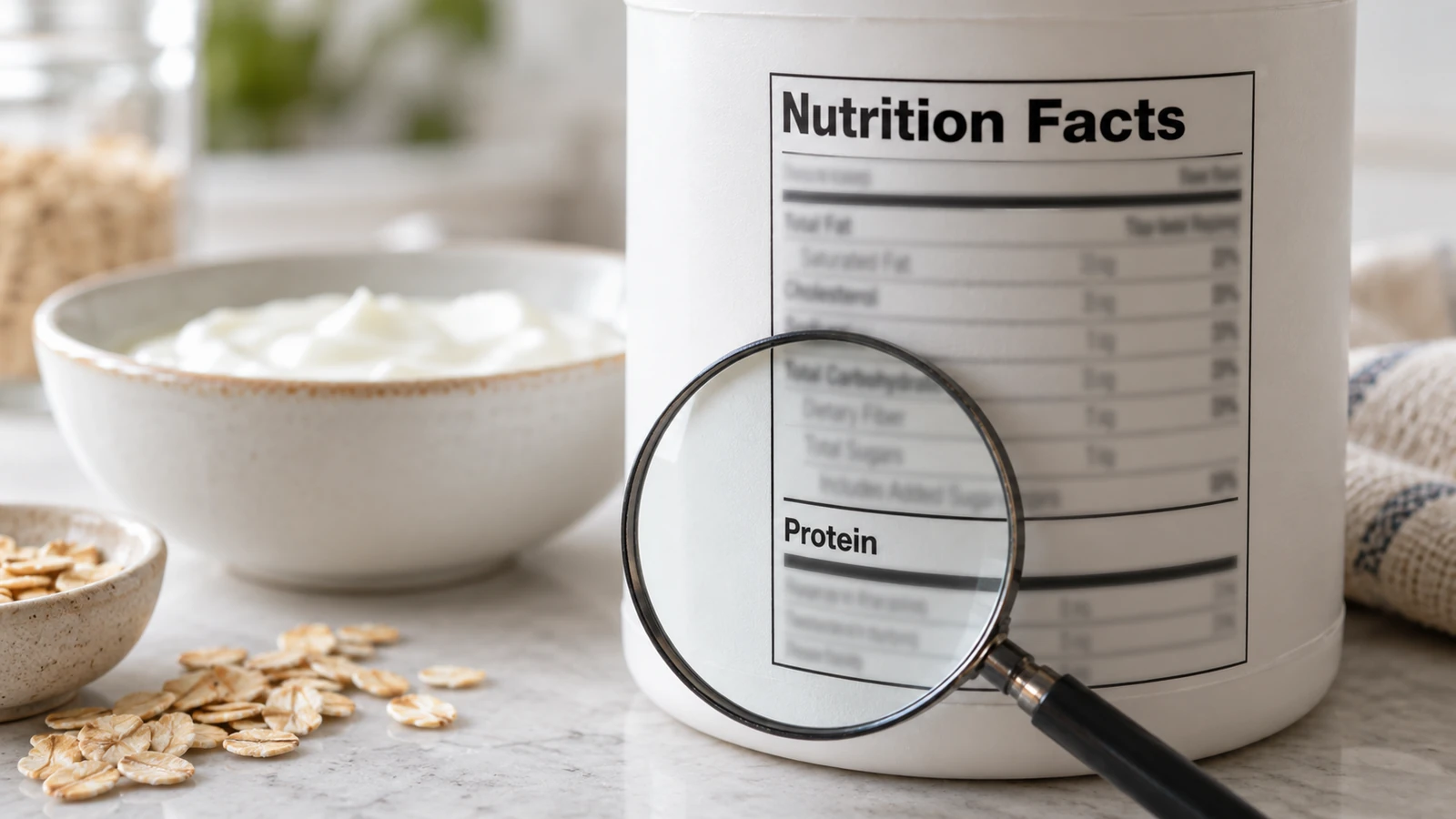
To read a nutrition label for protein, check the serving size first, find the protein grams for that serving, and multiply by the amount you actually eat. Then compare calories, fiber, sodium, and the ingredient list. Protein’s percent Daily Value can be useful, but it is not your personalized protein target and is not always shown.
Published October 10, 2026.
A large number on the front of a package can make a food look like an obvious choice. The back label tells you what that number means. Is it per serving or per container? Does it include milk you have to add? Is the serving measured dry or prepared? Answer those questions and most protein-label confusion becomes straightforward arithmetic.
This guide focuses on U.S. Nutrition Facts labels. Labels in other countries may emphasize values per 100 grams, use different reference values, or follow different rules. The basic comparison method still works, but do not assume every regulatory detail is identical.
The five things to check, in order
- Serving size: identify the household measure and weight or volume.
- Servings per container: decide whether you are eating one serving, a fraction, or the whole package.
- Protein grams: calculate the contribution from your actual portion.
- The rest of the panel: consider the food’s broader role in your meal.
- Ingredients and allergens: make sure the product suits your dietary needs.
This order prevents the most common mistake: comparing the biggest visible protein numbers before noticing that the portions differ. You can complete the process quickly once you know where the information sits. Detailed calculations are useful for unfamiliar foods; familiar staples usually become easy to judge.
Start with serving size, not protein grams
The serving size establishes the basis for the numbers below it. According to the FDA’s serving-size explanation, it reflects an amount people typically consume and is not a recommendation of how much you personally should eat. A listed serving is a measurement reference, not a command.
Suppose a hypothetical yogurt label lists a serving of 170 grams and 17 grams of protein. Eating 170 grams provides the listed 17 grams. Eating 85 grams is half a serving, giving approximately 8.5 grams of protein based on that label. Eating 255 grams is one and a half servings, giving approximately 25.5 grams.
These examples deliberately use hypothetical label values. They are not claims about every yogurt. Brands, varieties, added ingredients, and portion sizes differ. Use the label of the product you bought rather than copying a number from a different flavor or a generic database entry.
A kitchen scale can help when the household measure is awkward or the food packs unevenly into a cup. It is optional, not a requirement for eating well. Weighing a familiar portion once can improve your estimate without turning every future meal into a measurement exercise.
Distinguish one serving from the whole container
Packages do not all use the same approach. Some list a single serving for the entire container. Others contain several servings. Some show two columns, such as per serving and per package. Read the column heading before using a number from a screenshot, shopping app, or label.
Imagine a package with two servings and 14 grams of protein per serving. The whole package contributes 28 grams. If you eat three quarters of the package, you consume one and a half servings, which contributes 21 grams. Counting only 14 grams would understate that portion; assuming every similar package provides 28 grams could also be wrong.
A common error with dual-column labels is multiplying the whole-container number again. If the second column already says 28 grams per container, do not multiply it by the two servings shown elsewhere. Choose either the per-serving route or the whole-package route and stick with it.
When a package says “about” a certain number of servings, your calculation remains an estimate. Small differences can arise from rounding. For routine food planning, consistency matters more than making a rounded label appear precise to several decimal places.
Use one simple portion formula
Protein in your portion equals the listed protein per serving multiplied by the number of servings you eat. When working by weight, the number of servings equals your portion’s weight divided by the label’s serving weight. Use matching units throughout.
For example, a hypothetical tofu label lists 10 grams of protein per 100 grams of tofu. A 180-gram portion is 180 ÷ 100 = 1.8 servings. Its estimated contribution is 1.8 × 10 = 18 grams of protein. If another product lists 14 grams per 100 grams, the same 180-gram portion contributes 25.2 grams.
Do not confuse grams of food with grams of protein. A 100-gram portion of tofu is not 100 grams of protein. The serving weight describes the entire food, including its water, fat, carbohydrate, and other components. The protein line describes one nutrient within that food.
For drinks, keep volume units consistent. If the serving is 240 milliliters and you drink 360 milliliters, you have 1.5 servings. There is no need to convert milliliters to grams unless the label or your measurement method requires it. Avoid creating extra conversion steps that make a simple comparison harder.
Dry, cooked, drained, and prepared are different bases
Dry versus cooked pasta and grains
Check whether pasta or grain information refers to the dry product. Cooking changes weight mainly because food takes up water. A cooked portion weighing twice as much as the dry serving does not automatically contain twice as much protein. Match your measurement to the label’s stated basis.
Suppose you cook a whole box that lists four dry servings, each providing 12 grams of protein. The pasta portion of the cooked batch contains approximately 48 grams total. Dividing that cooked pasta evenly into four meals gives approximately 12 grams per meal from pasta, regardless of the cooked weight after water absorption.
Drained canned foods
For canned beans or fish, look for wording such as drained weight or drained solids. The can’s net weight may include liquid that you discard. If the nutrition information is based on drained food, calculate from that basis. Do not assume the gross weight of the contents equals the edible portion used in your recipe.
As packaged versus as prepared
Some foods show nutrition after preparation with specified ingredients. A cereal or meal mix may have an additional column that includes milk or another ingredient. If you use that prepared column and then add the same milk separately in your calculation, you count it twice.
If you prepare the food differently, use the as-packaged values and add your actual ingredients. Water contributes no protein, while milk, yogurt, or a protein-containing sauce may contribute some. Read the preparation note rather than assuming the headline includes only what is inside the package.
Why protein may have no percent Daily Value
An empty space in the percent Daily Value column does not mean the food has no protein. The gram amount still matters. The FDA explains that protein percent Daily Value is generally not required for foods intended for people age four and older when no protein claim is made. It is required in certain situations, including protein claims and foods intended for younger children.
For general labels for adults and children age four and older, the protein Daily Value is 50 grams. This is a standardized labeling reference, not an individualized prescription for an athlete, an older adult, or someone with a medical nutrition plan. Your personal target can differ without making the label wrong.
Do not assume that a food showing 20% Daily Value supplies 20% of your own protein goal. If your personal plan uses 100 grams per day and a portion lists 10 grams, those grams represent 10% of that numerical goal. The label’s percentage has a different reference and, for protein, an additional complication.
Protein grams and protein percent Daily Value are not interchangeable
Protein percent Daily Value can account for protein quality through an amino-acid and digestibility correction. The FDA’s labeling guidance describes different methods for declaring protein grams and calculating protein percent Daily Value. Consequently, the percentage is not always simply the printed grams divided by 50.
For a simplified mathematical illustration, 10 grams of protein with a quality correction factor of 1 would produce 10 ÷ 50 × 100 = 20% Daily Value. With an illustrative factor of 0.8, the corrected amount would be 8 grams and the percentage would be 16%. These are examples of the arithmetic, not ratings assigned here to any specific food.
That correction does not mean the remaining grams were absent from the food or that a fixed percentage of your meal will fail to enter your bloodstream. A labeling measure is not an individual digestion test. Avoid interpreting a discrepancy between grams and percent Daily Value as proof that a product is fraudulent or that a food has no nutritional value.
For ordinary meal planning, start with the labeled grams and a varied diet. If protein quality is particularly relevant to a specialized diet, discuss the overall pattern with a qualified dietitian. Trying to reverse-engineer every product’s quality score from rounded percentages is usually less helpful than building adequate meals.
Compare products on equal terms
Equal serving weights make comparisons easier. Suppose Product A lists 15 grams of protein in a 150-gram serving and Product B lists 18 grams in a 200-gram serving. Product B has more protein in its listed serving, but Product A has more per equal weight.
For Product A, 15 ÷ 150 × 100 = 10 grams of protein per 100 grams of food. For Product B, 18 ÷ 200 × 100 = 9 grams per 100 grams. That does not automatically make Product A the better purchase. If you intend to eat the whole 200-gram container, the 18-gram contribution may be the number most relevant to your meal.
Ask two separate questions: “Which is more protein-dense?” and “What will my usual portion contribute?” The first helps compare products fairly. The second helps you plan lunch. Confusing them can lead to buying something that wins a mathematical comparison but does not fit how you eat.
For a filling meal, also consider the other ingredients. A slightly lower-protein product can work well when paired with beans, grains, dairy, tofu, or another suitable source. The finished meal is usually more important than winning a contest between two individual packages.
Use protein per calorie carefully
Protein per calorie can be a useful comparison when you specifically want a concentrated protein source. For a hypothetical food containing 20 grams of protein and 200 calories per portion, the calculation is 20 ÷ 200 × 100 = 10 grams of protein per 100 calories.
For another food containing 15 grams and 100 calories, the result is 15 grams per 100 calories. The second food has a higher protein-to-calorie ratio, but the first portion still provides more total protein. Neither calculation determines whether the food is better for your whole diet.
Nuts, beans, whole grains, and many mixed meals offer more than protein. A lower ratio may come with fiber, useful energy, or other nutrients. Treating every food as a protein delivery device can make a varied diet unnecessarily narrow. See high-protein, high-fiber meals for ways to combine priorities.
Avoid using a ratio to justify eating too little overall. If you have a history of restrictive eating or calorie tracking causes distress, comparing ordinary portions without ratios may be a better approach. The label should support decisions rather than turn them into an exhausting optimization exercise.
Compare cost using the portion you can use
Package price alone can be misleading when sizes differ. Consider a hypothetical $4 package containing four servings of 10 grams of protein each. The package provides 40 grams, so the cost is $4 ÷ 40 = $0.10 per gram of protein, or $2 per 20 grams.
A hypothetical $3 package providing 24 grams total costs $3 ÷ 24 = $0.125 per gram, or $2.50 per 20 grams. The cheaper package on the shelf is more expensive by this particular comparison. These prices are invented arithmetic examples, not current retail quotes.
Cost per protein amount is only one consideration. Preparation time, storage, waste, taste, and nutrients beyond protein also matter. A larger package is poor value if half spoils before you eat it. Our budget high-protein grocery list can help translate label comparisons into practical shopping choices.
Read the rest of the panel
Protein content does not erase the rest of a food’s nutritional profile. Check sodium when comparing savory packaged meals, fiber when comparing grain or legume products, and saturated fat or added sugars when those are relevant to your needs. Use equal portions for these comparisons too.
The FDA’s Daily Value guide describes 5% Daily Value or less as low and 20% or more as high for a nutrient per serving. These general guideposts help interpret the panel. Whether a higher or lower amount is desirable depends on the nutrient and your dietary needs.
For example, more fiber may be useful in a meal that otherwise lacks it, while a lower-sodium version may suit someone following a sodium limit. A food does not become universally good or bad because one number crosses a threshold. Consider how the portion fits with the rest of the day.
Ingredients, allergens, and protein marketing
The ingredient list helps explain where the protein comes from and whether the product suits you. Whey and casein are milk proteins. Soy-based ingredients, eggs, fish, wheat, nuts, and other ingredients can matter for allergies or dietary restrictions. A “plant-based” product is not automatically free from all common allergens.
The FDA identifies nine major food allergens: milk, eggs, fish, crustacean shellfish, tree nuts, peanuts, wheat, soybeans, and sesame. Read the full label and follow your clinician’s allergy advice. Do not rely only on a large front-of-package phrase or on what an older version of the product contained.
Protein marketing also does not tell you whether a food is necessary. A specialty snack may be convenient, but an ordinary meal or inexpensive staple can serve the same practical purpose. Compare actual portions, preferences, and cost instead of assuming that a product designed to look athletic is the better choice.
Calculate a mixed meal without double-counting
List the ingredients that contribute meaningful amounts, calculate each one from its label, and add them together. For a hypothetical bowl, assume the tofu portion contributes 18 grams, the grain portion 6 grams, and the beans 8 grams. The bowl provides approximately 32 grams from those ingredients.
For a batch recipe, add the protein in the entire batch before dividing by the portions actually made. If the main ingredients contribute 120 grams total and you divide them evenly into four containers, each gets approximately 30 grams. Dividing into five makes approximately 24 grams each. A recipe’s serving count is therefore part of its nutrition calculation.
If protein-rich ingredients are distributed unevenly, equal total food weights may not give equal protein portions. Divide the tofu, meat, or beans deliberately before adding the remaining ingredients. For more practical batch formats, see high-protein vegetarian meal prep.
Finally, put the meal in context. The right amount for one eating occasion depends on your daily needs and schedule. Our protein-per-meal guide explains how to turn individual food numbers into a flexible daily pattern.
A quick check before you buy
Before putting the product in your cart, ask whether you like it, can store it properly, and know how you will use the package. A strong nutrition comparison is only helpful if the food becomes a meal. Choose the option that fits both the numbers and your actual week, then move on with your shopping.
Frequently asked questions
Does no protein percent Daily Value mean low protein?
No. Check the grams. Many labels are not required to show protein percent Daily Value when no protein claim is made. A blank percentage does not cancel the amount listed beside protein.
Should I subtract protein because of digestibility?
Do not invent your own correction for each food. Use labeled grams for ordinary tracking and build a varied eating pattern. Protein percent Daily Value already follows a specific labeling method, and it is not a personalized absorption estimate.
Why do two tracking entries disagree?
They may describe different brands, serving sizes, preparation states, or older formulations. Check the package you have and choose the matching entry. A precise-looking number is not useful when it refers to the wrong food.
Do I have to weigh everything?
No. A few checks can teach you what your usual portions provide. Repeated meals often become easy to estimate. If tracking is burdensome, use the label to choose practical protein sources and focus on a consistent meal routine.
Start with one product you buy regularly: check its serving, calculate your portion, and compare it with one realistic alternative. That small skill is more useful than memorizing dozens of generic food numbers. To complement your nutrition routine with a fitness habit, explore Workit on the App Store.