
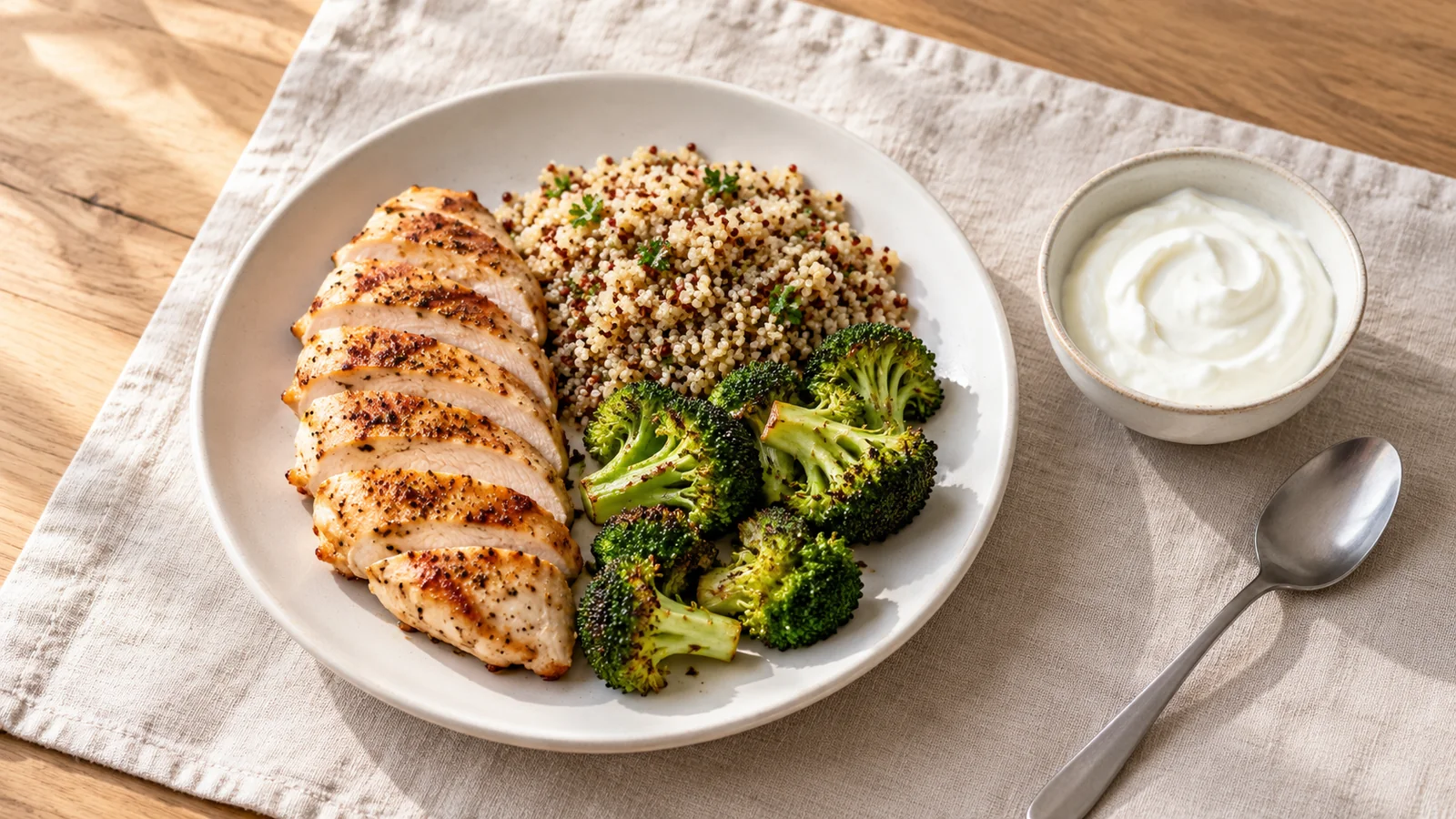
For many active adults, spreading protein across three or four meals is a practical way to meet a daily target. Start with your daily protein goal, divide it across the meals you actually eat, and adjust for appetite and schedule. There is no universal 30-gram absorption limit, and a larger protein-containing dinner is not automatically wasted.
Published October 10, 2026.
The useful question is less “What is the maximum protein my body can absorb?” and more “How can I get enough protein reliably, without making every meal a project?” A sensible distribution helps answer that question. It does not require identical meals, a stopwatch, or a protein shake beside your bed.
How much protein per meal should you aim for?
A meal target depends on the daily amount you are trying to reach. As an illustrative planning example, a 120-gram daily goal could be divided into three meals containing 40 grams each, four eating occasions containing 30 grams each, or meals containing 30, 35, and 40 grams plus a 15-gram snack. All three arrangements total 120 grams. None is automatically best for every person.
For athletic populations, the NIH Office of Dietary Supplements summarizes daily protein guidance of approximately 1.2–2.0 grams per kilogram of body weight. This is a sports-nutrition range, not a requirement for everyone who takes a walk or attends an occasional class. Training demands, age, total food intake, goals, and health conditions all affect the appropriate target.
To understand the arithmetic, a hypothetical 75-kilogram adult using 1.6 grams per kilogram would calculate 75 × 1.6 = 120 grams per day. Four roughly equal eating occasions would provide 30 grams each. This example explains a method; it does not establish that 120 grams is your personal requirement or that 1.6 is a magic number.
If you already have a target from a registered dietitian, use that. If not, avoid choosing the highest number you have seen online simply because it sounds ambitious. A target that fits your situation and leaves room for a varied diet is more useful than one that forces you to replace most other foods.
Absorption and muscle building are different questions
Digestion breaks food proteins into smaller components, including amino acids, which can be absorbed and used throughout the body. Muscle protein synthesis describes the creation of new muscle proteins. These are related processes, but they are not interchangeable. A measurement of muscle protein synthesis after one meal cannot tell you that all protein above a particular amount passed through the body unused.
Amino acids have roles beyond building larger muscles. They contribute to the ongoing turnover of many body proteins. Some can also be used in energy metabolism. Consequently, “not all of this meal became new muscle” is not the same as “this protein was not absorbed.” An absorption ceiling is the wrong model for planning ordinary mixed meals.
A 2023 controlled feeding study compared 25 grams with 100 grams of protein after exercise and found a greater, more prolonged anabolic response with the larger dose over the observation period. This challenges a simple claim that protein above a small meal threshold has no use. It does not establish that everyone should consume 100 grams at a sitting or that one giant meal is best for long-term training results.
Keep the research question attached to the result. An acute laboratory study measures particular outcomes under particular conditions. Your real-world question involves food preferences, digestion, total intake, training over months, and whether you can maintain the routine. A useful meal plan needs to work outside the laboratory.
Why spreading protein can still be useful
Rejecting a hard absorption limit does not mean meal distribution is irrelevant. A breakfast with little protein, a rushed lunch, and a very large evening meal can make a daily goal difficult to reach comfortably. Giving breakfast and lunch a recognizable protein source can reduce the amount of catching up needed at dinner.
Research also provides reasons to investigate distribution. In a small controlled study of healthy adults, a more even distribution produced a higher measured 24-hour muscle protein synthesis response than a dinner-heavy distribution with similar daily protein. The researchers noted the need for longer-duration work. That finding supports a reasonable planning strategy; it does not prove that perfectly equal meals produce a predictable percentage increase in muscle size.
Another exercise-recovery experiment compared different ways of distributing a fixed amount of whey protein. The intermediate distribution performed best for the measured response under that study’s conditions. It involved a specific protein source and controlled schedule, so translating it into a rule for every mixed meal would go beyond the evidence.
The practical takeaway is modest: include protein at several meals when doing so is convenient. Use distribution to make adequate daily intake easier. Do not turn the strategy into a belief that one low-protein breakfast ruins the day or that a social dinner must be split into multiple timed portions.
A simple four-step meal-planning method
1. Establish a suitable daily goal
Choose the daily target before deciding on a per-meal number. If a health professional has prescribed a particular amount, that takes priority over generic fitness advice. For someone new to tracking, an initial food record may show that the main issue is an inconsistent lunch rather than a need for additional supplements.
Record an ordinary day without trying to improve it first. Include drinks, snacks, and the portions you really eat. The purpose is to see the pattern. If you change every meal while recording, you learn less about the routine that needs attention.
2. Count realistic eating opportunities
Use your actual schedule. Three meals might fit a regular workday. Three meals and an afternoon snack might fit an early breakfast and late dinner. Shift workers may use meals after waking, before work, and during a break rather than conventional clock times.
Do not create six eating occasions if remembering them would become another source of stress. Equally, you do not have to force a large portion at breakfast when a smaller breakfast and a later snack fit your appetite better. The schedule should make the target easier to accomplish.
3. Divide, then allow some variation
Divide the daily goal by the number of planned eating occasions to get a starting point. For a hypothetical 100-gram goal across four occasions, the average is 25 grams. A distribution of 20, 30, 20, and 30 grams still totals 100. A meal does not have to match the average exactly to contribute usefully.
Think of the number as a planning guide rather than a pass-or-fail threshold. The difference between 29 and 30 grams is rarely the deciding factor in whether a routine is sustainable. Consistency in overall meals and training deserves more attention than rounding every serving to a perfect number.
4. Fix the weakest meal first
If dinner is already substantial, start with the meal that tends to lack a protein source. Add yogurt or a suitable soy alternative to breakfast, beans or tofu to lunch, or a prepared protein option to a meal you routinely eat away from home. Change one repeated problem rather than redesigning the whole week.
For specific breakfast formats, see high-protein breakfasts without protein powder. Choose a meal you would genuinely enjoy on a busy morning. A theoretically impressive breakfast that you never prepare does not improve your usual intake.
Build meals from labels rather than generic promises
Different brands and portions can vary considerably. Use the package in your kitchen when it is available. Check whether the stated amount refers to one container, half a container, a dry weight, or a cooked portion. This is especially important for yogurt, tofu, pasta, and canned foods.
Here is an illustrative breakfast calculation using hypothetical labels: one yogurt serving provides 17 grams, one oats serving provides 5 grams, and a milk portion provides 8 grams. Together, 17 + 5 + 8 = 30 grams. These values are arithmetic examples, not universal nutrition data for those foods. Substitute your own label values and the quantities you actually use.
For an illustrative lunch, suppose a tofu portion contributes 20 grams, cooked beans contribute 7 grams, and the grain portion contributes 4 grams. That is 31 grams before counting any meaningful contribution from other ingredients. If the tofu portion is half as large, its contribution becomes 10 grams and the same bowl totals 21 grams.
You do not need to pretend vegetables contain no protein, nor do you need to calculate every herb. Be consistent about the main ingredients and recognize that labels are rounded estimates. Our guide to reading nutrition labels for protein explains the serving-size calculations in more detail.
What if you only eat two meals a day?
Two meals can contribute a substantial daily amount of protein. The planning challenge is that each meal must do more work. A hypothetical 120-gram daily goal divided into two meals averages 60 grams per meal. Adding a 20-gram snack would leave 100 grams for the two meals, or an average of 50 grams each.
That arithmetic does not mean two-meal eating is inherently wrong. It helps reveal whether the plan is comfortable for you. If the portions feel excessive, a smaller additional eating occasion may be easier. If two meals fit your appetite and circumstances, do not assume protein above 30 grams in either meal disappears.
Consider the whole day as well. Restricting eating opportunities can make it harder for some people to include enough energy, carbohydrate, fiber, or variety. If meals are becoming rigid, uncomfortable, or difficult to fit around work and relationships, loosen the structure rather than defending an arbitrary schedule.
Do you need protein immediately after a workout?
A protein-containing meal around training can be convenient. The NIH sports-nutrition resource describes post-exercise protein guidance and repeated intake across the day, but this is not evidence that you lose all benefit if you miss a tiny deadline. The meal you ate before training also matters when deciding how urgently you need to eat afterward.
If you train after a normal lunch and eat dinner afterward, that dinner may already provide a sensible recovery meal. If you train before breakfast and then cannot eat for many hours, bringing a suitable snack is a practical adjustment. Plan around the gap in food access rather than panic about the minute the workout ends.
A shake is one option when solid food is inconvenient, but it is not a requirement. Milk, yogurt, a sandwich, tofu, beans, eggs, or a regular mixed meal may fit the situation. Choose what you tolerate and can store safely. A supplement should solve a practical problem rather than create another mandatory purchase.
Keep protein in the plan on rest days
A rest day is not a reason to remove protein-containing foods from meals. Your overall eating pattern supports recovery and ordinary body functions across the week. Most recreational exercisers will find it simpler to keep a broadly consistent meal structure than to sharply raise and lower protein according to the workout calendar.
Energy needs and appetite may vary between a long training day and a quiet day. You can respond to those differences without treating protein as something reserved for gym days. For a fuller explanation, read protein on rest days.
If you are following a clinician’s or sports dietitian’s plan, use their recommendations for day-to-day adjustments. Otherwise, focus on a repeatable pattern: a protein source at meals, enough overall food, and portions that make sense for your schedule and appetite.
Plant-based meals and protein distribution
Plant-based eating can use the same daily-goal-first method. The practical issue is choosing portions that provide the intended amount. A spoonful of hummus adds flavor but is a different contribution from a substantial serving of beans, tofu, tempeh, or another protein-rich main ingredient.
Use variety across the day and build meals that you enjoy. For example, breakfast might include a soy-based food, lunch a bean-and-grain bowl, and dinner tofu or lentils. Check actual product labels because plant-based yogurts and meat alternatives vary considerably in protein content. The category name alone does not establish the amount.
If a large bean portion feels uncomfortable, combine a smaller portion with another suitable protein source rather than forcing it. Increase fiber-rich foods gradually when making a major dietary change. Adequate plant-based meals should not become a contest to fit the biggest possible bowl into one sitting.
When a generic protein target is inappropriate
People with kidney disease or another condition affecting nutrition need individualized guidance. The National Institute of Diabetes and Digestive and Kidney Diseases explains that protein planning in chronic kidney disease depends on clinical circumstances. Do not replace a prescribed plan with a fitness calculation.
Pregnancy, adolescence, older age with low appetite, recovery from illness, and high-volume sport can also call for more individualized assessment. This article’s arithmetic is meant to clarify meal planning for generally healthy adults, not establish a medical diet.
If counting grams worsens food anxiety or encourages restrictive eating, use a less numerical approach with professional support. Including a satisfying protein source at meals can be a helpful habit without weighing everything. The goal is an eating pattern that supports your life, not a score that dominates it.
Common mistakes that make distribution harder
- Choosing the meal number first. Thirty grams at every meal means little without knowing how it fits your daily intake and needs.
- Ignoring serving sizes. A container with two servings can provide twice the per-serving amount if you eat all of it.
- Using raw and cooked weights interchangeably. Match the food state in the label or database entry to the portion being measured.
- Adding protein while removing everything else. Meals still need sufficient energy, produce, carbohydrate sources, and dietary variety. These high-protein, high-fiber meal ideas show how to combine priorities.
- Overcorrecting after one low-protein meal. Return to your usual routine instead of forcing an uncomfortable late-night catch-up meal.
- Buying supplements before checking ordinary meals. Often, preparing lunch more consistently solves the actual problem.
A realistic one-week experiment
For the next week, identify one meal that regularly lacks a protein source. Pick two versions you can alternate, buy the ingredients, and keep the portions easy to repeat. You might alternate yogurt with oats and an egg-based breakfast, or prepare a bean bowl and a tofu wrap for lunch.
Check the main ingredients once so you understand their approximate contribution. Then pay attention to practical outcomes: whether the meal is enjoyable, whether it fits your appetite, whether preparation is manageable, and whether your overall intake becomes easier. These observations are more actionable than repeatedly searching for a perfect universal meal threshold.
At the end of the week, keep what worked and change the obstacle. If the problem was time, simplify preparation. If it was portion size, split the eating occasion. If it was taste, change the recipe. The best distribution is one you can use consistently while meeting an appropriate daily goal.
Handling a day that does not follow the plan
Suppose a meeting runs through lunch and your planned meal becomes a small snack. First, eat a proper meal when you can. Include your usual protein source and enough other food to make the meal satisfying. You do not have to repay every missing gram before midnight, and one disrupted day does not tell you whether the overall routine is effective.
For recurring disruptions, solve the access problem. Keep an appropriate shelf-stable backup where you work, or pack a refrigerated option in an insulated bag with cold sources. Decide on a nearby meal you can buy when preparation falls through. Having one dependable fallback is often more useful than collecting dozens of elaborate recipes.
Travel days call for the same flexibility. Check what breakfast and lunch will realistically be available, then choose a meal pattern you can manage. If detailed tracking would be awkward, aim for recognizable protein sources at the main meals and resume your ordinary routine afterward. Good planning includes a way to cope with imperfect days.
Frequently asked questions
Is more than 30 grams of protein in a meal wasted?
No. There is no universal 30-gram absorption cutoff. Protein digestion, whole-body amino acid use, and muscle protein synthesis are different processes. A larger meal can contribute to your daily intake, although that does not mean larger portions always produce better long-term results.
Does every meal need the same amount?
No. Similar portions can make planning easier, but exact equality is unnecessary. A smaller breakfast and larger dinner can still fit a sensible day. Look for a workable pattern rather than trying to remove all variation.
Should snacks contain protein too?
They can, especially when meals are far apart or your daily goal is difficult to meet. A snack does not have to contain protein to be worthwhile, however. Fruit or another food may fit your needs without turning every eating occasion into a protein target.
What matters most when I am starting out?
Establish an appropriate daily amount, eat enough overall, and include reliable protein sources in meals you can maintain. Then refine distribution if it helps. Consistent training and recovery habits belong alongside nutrition in the bigger picture.
Build the food routine that supports the activity you want to keep doing. For the next step in your fitness routine, explore Workit on the App Store.