
Published November 7, 2026
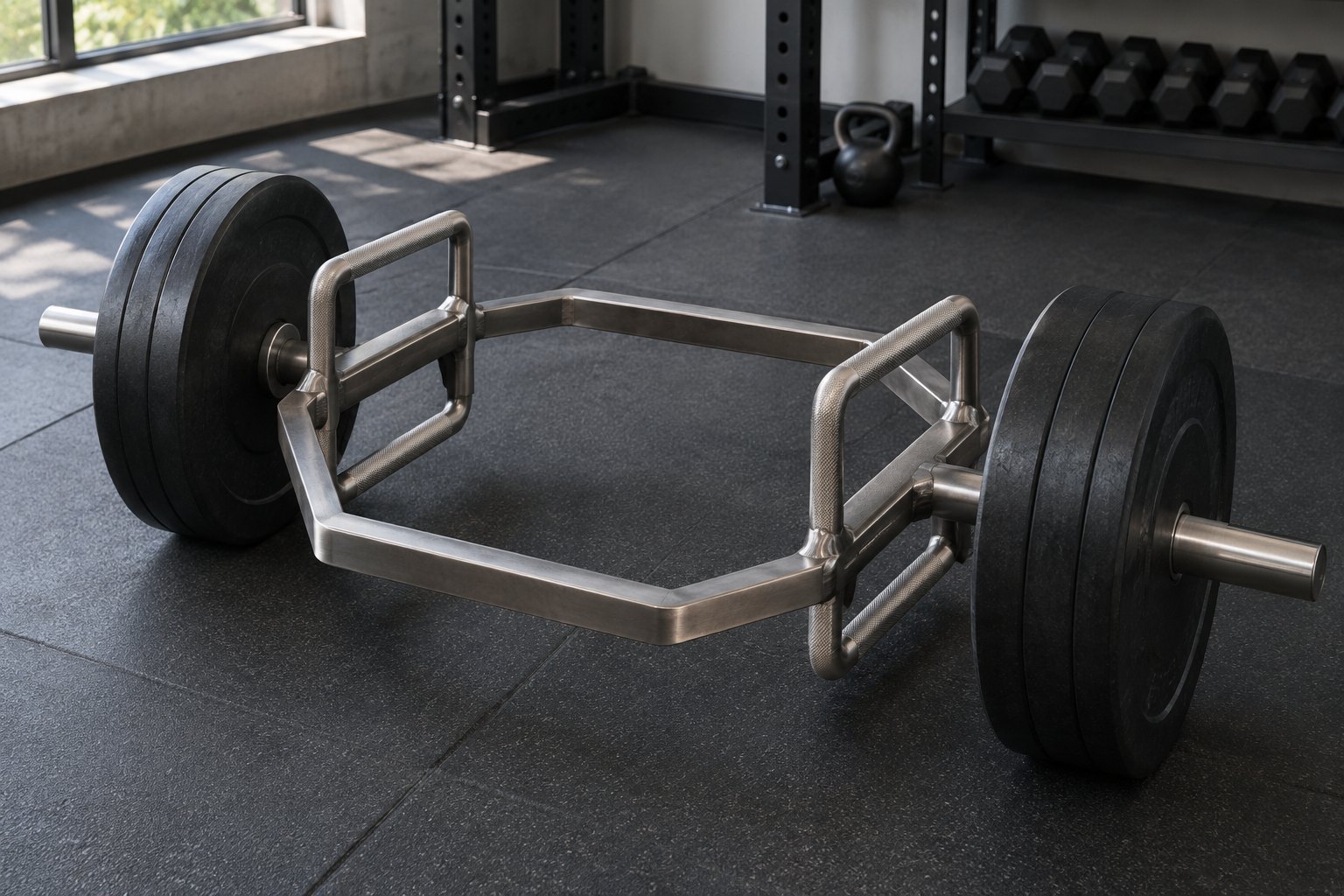
The trap bar deadlift is a strength exercise in which you stand inside a hexagonal or open-ended bar, hold handles beside your legs, and lift by extending your hips and knees. Start with a manageable load, brace your trunk, push through your whole feet, and finish standing tall. Lower the bar under control and reset before the next repetition.
Its side handles can make the setup feel more straightforward than a straight-bar deadlift, but the equipment does not do the technique for you. Handle height, foot placement, and the weight on the bar all affect the movement. This guide explains how to choose a setup, perform consistent repetitions, and build the lift into a realistic training week.
What does the trap bar deadlift work?
The quadriceps help straighten your knees, while the glutes and other hip extensors help bring you upright. Your trunk and back muscles work to maintain your position, and your hands and forearms hold the bar. The precise contribution of each muscle changes with your proportions, technique, handle height, and load.
Research supports treating the trap bar as its own exercise rather than assuming it is identical to a conventional deadlift. In a biomechanical study of 19 male powerlifters, the hexagonal bar changed joint demands, including a higher peak knee moment and lower peak hip and lumbar moments in that testing setup. These are measurements of mechanical demand, not proof that one version prevents injury.
A separate straight-bar and hex-bar comparison found differences in quadriceps, hamstring, and spinal-extensor electrical activity. Such short-term measurements help explain why the variations feel different. They do not establish which lift produces more muscle over months or which is right for a particular person’s back.
Think of the lift as a combined knee-and-hip extension exercise. You can train substantial lower-body strength without requiring the exact position used in conventional deadlifting. That makes it useful, but it does not make squats, single-leg work, or other hinges redundant.
Check the equipment before stepping inside
Trap bars vary considerably. Some have raised and low handles; some have rotating grips; others have an open frame or built-in loading stand. Check the manufacturer’s instructions or ask gym staff how that particular model is intended to be loaded and used. Do not assume every bar weighs the same.
- Check the frame, handles, sleeves, and collars for obvious damage or looseness.
- Load equal plates on both sides and secure them with appropriate collars.
- Use a flat, non-slip lifting surface with room around the ends of the bar.
- Keep bags, phones, benches, and other people clear of the lifting area.
- Use stable footwear rather than a soft, unstable platform under your feet.
- Keep fingers away from the space between plates and the floor when loading.
Plate diameter affects starting height. A small metal plate can put the handles much closer to the ground than a full-diameter bumper plate. If a light load leaves the bar too low, use suitable lifting blocks or full-diameter lightweight training plates where available. Do not create an unstable tower of loose objects.
An empty trap bar may already be too heavy for a new lifter. In that case, the kettlebell deadlift offers a simpler way to learn lifting from a raised or floor-level position with a smaller starting load. You do not have to earn the right to train by handling a heavy empty bar.
High handles or low handles?
Raised handles shorten the distance you must reach and the distance the load travels. They can be a useful starting point when low handles require a position you cannot control comfortably. Low handles increase the range of motion relative to the raised handles on the same bar, provided plate size and the lifting surface stay the same.
Neither setting is automatically better. Choose the version that matches your goal and lets you start without twisting, losing balance, or forcing a reach. A high-handle deadlift can remain your main lift indefinitely. Moving to low handles is an optional change, not a mandatory graduation test.
Record the setting in your training log. A heavier high-handle lift should not be compared directly with a lighter low-handle lift as if only strength changed. If you switch settings, reduce the load and establish a new baseline rather than carrying the old weight across automatically.
How to do the trap bar deadlift step by step
1. Center yourself inside the frame
Stand approximately hip-width apart, then make small adjustments for comfort. Point your toes in a natural direction and keep your knees tracking with them. Position yourself so the handles are beside you and you can grasp their centers without leaning forward or backward.
There should be enough clearance that the frame does not catch your shins or calves. A stance that works with one bar may not fit another. Check space before loading heavily, especially on narrower closed-frame models.
2. Reach down with both hips and knees
Move your hips back and bend your knees until you can reach the handles. Keep your arms long. Your hips will usually sit somewhere between a deep squat and a stiff-legged hinge, but there is no single correct hip height for every person.
Look at a point on the floor ahead of you that lets your neck follow the angle of your torso. Avoid craning your head up to stare at a mirror. Your starting position should feel balanced over your feet, not perched on your toes or tipped onto your heels.
3. Grip, brace, and take up tension
Wrap your fingers and thumbs securely around the middle of each handle. Brace your trunk as though preparing to resist a gentle push, keeping your ribs and pelvis organized rather than flaring your chest upward. Take the slack out of your arms and the equipment before beginning the lift.
For ordinary training, avoid a prolonged breath hold through multiple repetitions. Reset your breathing between reps and breathe in a way you can control. If you have been advised to avoid straining or breath holding, follow that advice and get individualized coaching before heavy lifting.
4. Push the floor away
Drive through your whole feet and stand up, allowing your knees and hips to extend together. Keep your elbows straight. The bar should rise smoothly rather than jerk off the floor after a sudden yank from your arms.
Your hips should not shoot upward while your chest stays down. If they do, the load may be too heavy or the starting position may be too low. Pause the set, reduce the weight if necessary, and rebuild the setup rather than trying to rescue each repetition with extra effort.
5. Finish tall without leaning back
At the top, stand comfortably upright with straight arms and the bar steady beside you. Finish extending your hips and knees without pushing your pelvis forward or bending your lower back to exaggerate the lockout. There is no need to shrug the bar upward.
A useful check is whether you could briefly hold the top position without rocking or changing your stance. If the bar tips noticeably, inspect your hand position, plate loading, and balance before continuing.
6. Lower, settle, and repeat
Move your hips back and bend your knees as the bar descends. Control the return to the floor while keeping the handles aligned beside your body. Once the plates settle, take a moment to reestablish your feet, grip, and brace.
Dead-stop repetitions make it easier to practice a repeatable starting position. Bouncing the plates can hide poor control and change the difficulty of the set. Your last rep should still have an organized descent rather than a drop you did not intend.
Warm up without spending your working sets early
Begin with a few minutes of easy movement if that helps you feel ready, then practice the movement itself. Bodyweight hinges and comfortable squats can help you check how your hips and knees feel. They are preparation, not a flexibility test you need to pass.
Follow with progressively heavier practice sets. For example, perform several easy repetitions with a light implement, then a smaller set with an intermediate load, then a brief set near your intended working weight. The exact number depends on how heavy you plan to train and how much preparation you need that day.
Warm-up sets should leave you better prepared, not tired. Avoid turning every step on the way to your working load into a hard set. If the final warm-up feels unexpectedly difficult, lower the day’s target rather than treating the plan as an obligation.
Choose a starting weight you can repeat
Start with a load that allows five controlled repetitions while leaving the clear sense that you could do several more. Repeat the same weight after resting. If the second set looks much worse, your initial estimate may have been too ambitious or your rest too short.
You do not need a one-repetition maximum to begin. A useful early goal is consistency: the same foot position, smooth lift, stable top, and controlled return on every repetition. Once those qualities are reliable, progressively heavier training becomes easier to interpret.
Keep the full load calculation in your notes. If the bar weighs 25 kilograms and you add two 10-kilogram plates, the total is 45 kilograms. If you cannot verify the bar’s weight, record the model and plates used instead of inventing a precise total. Consistent records are more useful than false accuracy.
Sets, reps, rest, and weekly frequency
For a beginner, two sets of five to eight repetitions once or twice a week can be a practical starting point. Leave roughly two or three technically sound repetitions in reserve. Add a third set only if the initial amount fits comfortably with the rest of your program and recovery.
Rest around two to three minutes between working sets, and longer if needed to regain normal breathing and concentrate on the next set. These are coaching starting points, not a uniquely proven trap-bar prescription. Your training background, load, and other exercises affect the appropriate amount.
The ACSM resistance-training guidance emphasizes regular training of major muscle groups and individualized programming. It also notes that training to failure is not consistently necessary for the average healthy adult. You can build a productive routine without taking a loaded deadlift to the point where technique breaks down.
Put trap bar deadlifts near the start of a strength workout after warming up, particularly when improving the lift is a priority. Pair them with a manageable upper-body push and pull, then optional accessories. Avoid exhausting your grip or trunk immediately before the lift if that limits your control.
A simple progression over your first several sessions
Use a rep range rather than increasing weight every workout. Suppose your target is two sets of five to eight. Begin with five smooth repetitions per set. Over later sessions, add a repetition where you can while preserving the same setup and leaving a little in reserve.
When you can complete both sets at eight with consistent technique on more than one occasion, add the smallest practical load increment. Return toward the lower end of the range and build again. If your gym’s smallest jump is too large, continue practicing at the existing load rather than forcing the increase.
Change one major variable at a time. Adding weight, lowering the handles, and adding a set in the same session makes it difficult to know why the workout suddenly became harder. A small, traceable change is easier to recover from and evaluate.
If performance drops for several sessions, look at sleep, recent training, total workload, and whether you are allowing enough rest. Reduce load or volume temporarily if needed. A difficult week does not require a complete program rewrite, and a missed workout does not need to be repaid with double the work.
Common mistakes and specific fixes
The bar rocks forward or backward
Check whether you are gripping the center of each handle and standing centrally in the frame. An uneven grip changes the balance of the bar. Reposition with a light load before concluding that you need stronger wrists or a more aggressive pull.
Your knees collapse inward
Reduce the load and choose a stance that lets your knees follow your toes. Keep pressure across your feet rather than rolling onto their inner edges. Do not force an extremely wide stance that the frame cannot accommodate.
Your shoulders rise before the bar moves
You may be shrugging or trying to curl the handles. Keep your arms long and use your legs and hips to stand. The hands connect you to the load; they should not perform a separate upper-body repetition during the pull.
You cannot reach the handles comfortably
Try the raised handles or an approved elevated setup. Reduce the load and check whether your stance is unnecessarily narrow or wide. If you still cannot find a comfortable, controlled position, choose a different lift and seek qualified instruction instead of forcing the floor-level version.
The last repetitions become rushed
End the set earlier. A target of eight does not mean all eight must happen regardless of quality. Rest, adjust the weight, or use a smaller rep target so that the next set resembles the first rather than becoming a test of improvisation.
How it compares with other lower-body exercises
A conventional deadlift places a straight bar in front of your legs and requires managing its path around your knees. The trap bar places the handles beside you. Both involve lifting from a start position, but their loading and technique are not interchangeable. Choose based on your goal, equipment, and ability to practice consistently.
A Romanian deadlift usually begins standing and emphasizes moving the hips back with less knee bending. The single-leg Romanian deadlift adds a balance and unilateral-control challenge. It can complement trap-bar work, but it should not be loaded as though it were the same exercise on one leg.
Squats generally involve more deliberate knee travel and a different load position. You can include squats and trap-bar deadlifts in the same week, but count the combined lower-body workload. Two challenging compound lifts do not automatically require a long list of additional leg exercises afterward.
For a simple full-body session, follow the deadlift with a press, a row, and a small amount of trunk work. A controlled reverse crunch is one option when you want abdominal work without holding another heavy implement. Choose exercises that serve a clear purpose rather than filling every available machine.
When to stop or choose another variation
Stop the set if you experience sharp pain, dizziness, numbness, or an unexpected loss of control. Do not use technique tips to push through symptoms. Persistent or recurring pain deserves assessment by a qualified healthcare professional; an online exercise guide cannot identify its cause.
If ordinary muscular fatigue is the issue, reduce the load, shorten the set, or rest longer. If the bar itself does not fit your body or the available space, use a different implement. Training should adapt to practical constraints rather than requiring a risky workaround.
Frequently asked questions
Is the trap bar deadlift good for beginners?
It can be, provided the starting load is manageable and the setup fits. Side handles and adjustable height may make practice convenient. Beginners still benefit from instruction, conservative loading, and enough space to lift safely.
Is it safer for your back than a regular deadlift?
No bar shape guarantees safety. Studies show differences in mechanical demands under particular conditions, not a universal reduction in injury risk. Technique, load, fatigue, training history, and individual circumstances all matter.
Should you use lifting straps?
Straps are optional. First learn to hold and control an appropriate load without them. If grip repeatedly limits otherwise suitable training, a coach can show you how to use straps correctly. They should not be used to justify a weight you cannot lower safely.
Do you need a lifting belt?
No. A belt is not required to learn the exercise, and wearing one does not replace bracing or sensible progression. If you later use a belt, practice with lighter loads and treat it as equipment to learn rather than permission to increase weight immediately.
Can you do high repetitions?
Yes, but longer sets can become limited by breathing, grip, or setup fatigue. Moderate sets are often easier to keep consistent while learning. Stop before repetition quality deteriorates, regardless of the number written in your plan.
How should you log the exercise?
Record total load, sets, repetitions, handle setting, and any elevation used. Add a short note about how much effort remained and whether the setup felt stable. Those details make future comparisons meaningful, especially if you train at different gyms.
Build a lift you can repeat
The most useful trap bar deadlift is one you can set up, perform, and progress reliably. Choose a comfortable handle height, start below your limit, and add difficulty only when the existing work is controlled. Consistent practice gives you more useful information than occasional all-out attempts.
Use Workit to plan your strength sessions and log the work you complete. Keep your handle setting and training notes alongside your sets and reps so your next workout starts with a clear, realistic target.