
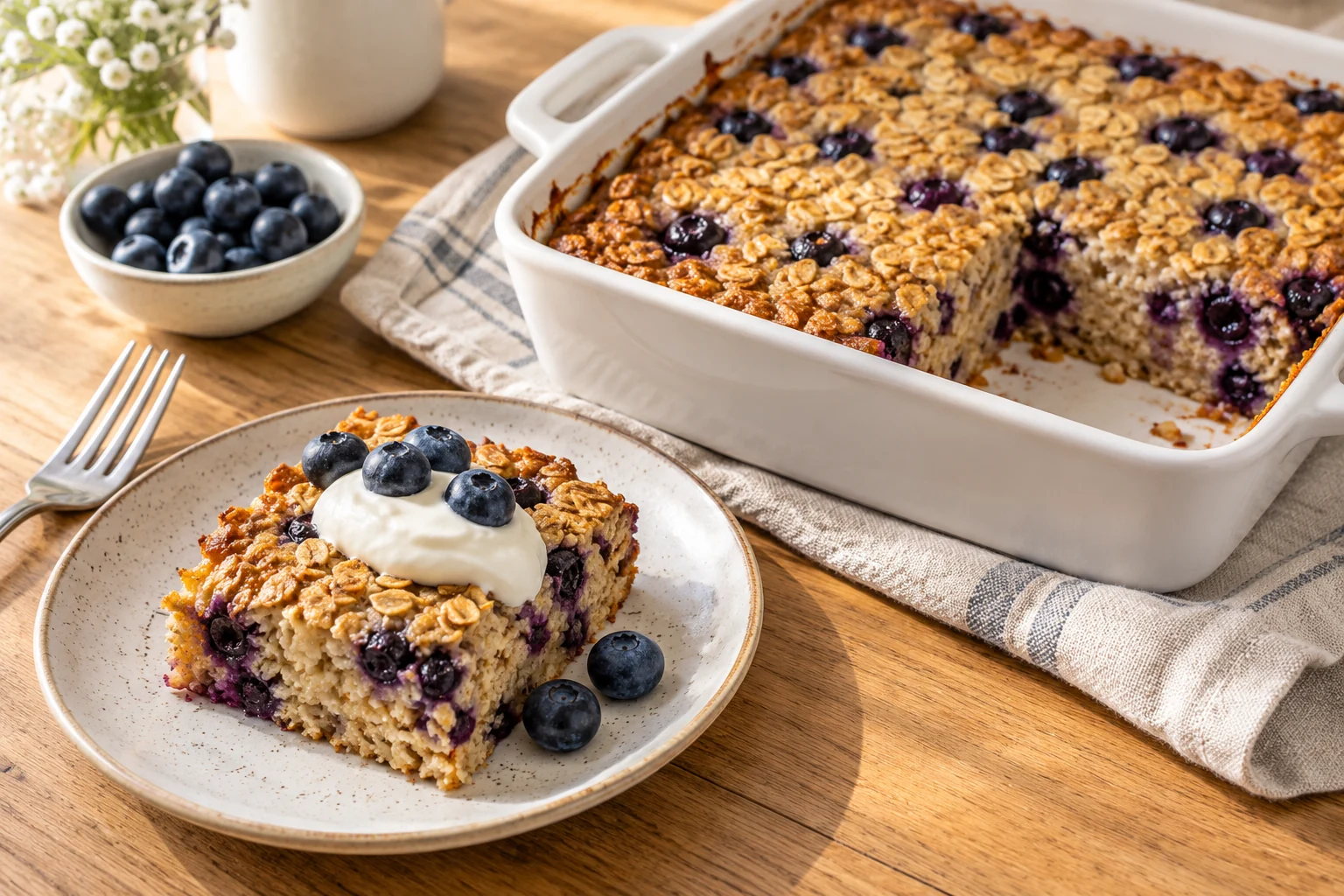
You can make high-protein baked oatmeal without protein powder by combining rolled oats, Greek yogurt, eggs, and milk. The recipe below uses a measured amount of each, makes four generous breakfast portions, and provides an estimated 22 grams of protein per portion using the clearly stated label assumptions.
This is a blueberry-and-cinnamon oat bake with visible oat texture, not a blended breakfast cake. It is designed to be portioned after baking and reheated for convenient breakfasts. The protein estimate applies to the base recipe; an optional yogurt topping can add more, but it is counted separately.
Published October 20, 2026. Nutrition estimates use manufacturer information available on this date. Baking times are estimates; use the doneness and food-temperature checks below.
High-protein baked oatmeal at a glance
- Yield: 4 generous breakfast portions, or 6 smaller portions with correspondingly less protein each.
- Equipment: a 9-inch square baking dish, mixing bowl, whisk, kitchen scale, and food thermometer.
- Oven: 350°F / 175°C, conventional setting.
- Timing: about 15 minutes preparation, 10 minutes hydration, approximately 40–50 minutes baking, and 10 minutes resting. Total approximately 75–85 minutes.
- Protein: approximately 22 grams per one-quarter of the pan, from the ingredient assumptions explained below.
- Allergens: contains milk and eggs. Check every ingredient for your needs.
The preparation is mostly mixing; the longer part is time in the oven. If you need a breakfast that avoids baking altogether, overnight oats with Greek yogurt offers a different make-ahead approach.
Ingredients for four portions
Use weights for the oats and yogurt where possible. Cup measures for oats differ between brands, and a tightly packed cup can change the moisture balance. A U.S. tablespoon is approximately 15 milliliters and a teaspoon approximately 5 milliliters.
- 200 g old-fashioned rolled oats, dry; weigh rather than relying on a universal cup conversion.
- 340 g plain nonfat Greek yogurt, approximately 1½ cups for the label example used here.
- 3 large eggs.
- 240 mL 2% dairy milk, approximately 1 cup.
- 150 g fresh blueberries, washed and drained well.
- 42 g pure maple syrup, approximately 2 tablespoons.
- 15 mL neutral oil, approximately 1 tablespoon, plus a small additional amount for greasing the dish.
- 5 mL vanilla extract, approximately 1 teaspoon.
- 8 g baking powder, approximately 2 teaspoons.
- 3 g ground cinnamon, approximately 1 teaspoon.
- 1.5 g fine salt, approximately ¼ teaspoon.
Optional topping, not included in the base estimate: 85 g plain nonfat Greek yogurt per portion. You can also serve with extra fruit. Add toppings after reheating so you can choose the texture and amount each day.
The formula contains no banana and no protein powder. Maple syrup supplies modest sweetness, but the result is intended as breakfast rather than a frosted dessert. If you prefer a sweeter serving, first taste the fully cooked oatmeal, then add a measured topping rather than guessing at sweetness by tasting raw batter.
How to make high-protein baked oatmeal
- Prepare the oven and dish. Heat the oven to 350°F / 175°C. Lightly grease a 9-inch square baking dish. Place it on a stable work surface while mixing; a deep loaf pan is not an equivalent substitute because the center would cook differently.
- Combine the dry ingredients. In a large bowl, stir together the oats, baking powder, cinnamon, and salt. Distribute the baking powder throughout rather than leaving it in one spot.
- Whisk the wet ingredients. In a second bowl, whisk the eggs until the whites and yolks are combined. Add the Greek yogurt, milk, maple syrup, oil, and vanilla. Whisk until the yogurt is evenly dispersed and no large lumps remain.
- Hydrate the oats. Stir the wet mixture into the dry ingredients. Let it stand for 10 minutes while the oven finishes heating. This brief rest allows the oats to begin absorbing liquid. Do not leave raw egg batter sitting out for an extended period.
- Add the blueberries. Fold in the drained berries gently, then transfer the mixture to the prepared dish. Spread it evenly, moving any dense clusters of berries away from the center.
- Bake and check the center. Bake for approximately 40–50 minutes, beginning checks around 35 minutes because ovens and dishes vary. The edges should be set and the center should no longer have a liquid wobble. A thermometer inserted into the center of the oat mixture, away from a berry, should register at least 160°F / 71°C. Continue baking if it has not reached that temperature.
- Rest before portioning. Let the baked oatmeal stand for about 10 minutes. Divide into four equal portions for the stated estimate. The bake remains moist; it is not intended to have the dry crumb of a granola bar.
The temperature requirement follows USDA guidance for dishes containing eggs: the center should reach 160°F. Its shell-egg safety guide also explains why raw egg mixtures require careful handling. A browned top alone does not establish that the middle is cooked.
Where the protein comes from
The recipe combines several ordinary ingredients rather than depending on a large amount of one supplement. Greek yogurt supplies the biggest share in this formula, with meaningful contributions from the oats, eggs, and milk. Blueberries, syrup, spices, and oil are not being used to inflate the protein estimate.
| Ingredient | Amount in recipe | Assumption used | Estimated batch protein |
|---|---|---|---|
| Rolled oats | 200 g | 6 g protein per 49 g dry oats | About 24.5 g |
| Plain nonfat Greek yogurt | 340 g | 18 g protein per 170 g | 36 g |
| Large eggs | 3 | 6 g protein each | 18 g |
| 2% milk | 240 mL | 8 g protein per 240 mL | 8 g |
The examples are drawn from Bob’s Red Mill regular rolled oats, FAGE Total 0%, the American Egg Board’s large-egg protein information, and Organic Valley 2% milk. These are reference labels, not required brands.
The arithmetic is approximately 24.5 + 36 + 18 + 8 = 86.5 grams for the pan. Dividing by four gives approximately 21.6 grams, rounded to 22 grams per portion. That figure is an ingredient-based estimate, not a laboratory result. Label rounding, egg size, and portioning introduce variation.
If you cut the pan into six portions instead, the same calculation gives about 14 grams each. The protein in the pan has not changed; you have made smaller servings. This is why a recipe’s serving size deserves as much attention as a large number in its title.
How to recalculate with your ingredients
For each ingredient, divide the amount used by the serving amount on its label, then multiply by the labeled protein. Add those figures and divide by the number of portions. Keep weights and units consistent: dry oat weights should be compared with dry oat labels.
For example, if your yogurt provides 15 grams of protein per 170 grams, 340 grams contributes 30 grams instead of 36. The batch estimate would be approximately 80.5 grams, or about 20 grams per quarter-pan portion. The recipe can still be useful without pretending every tub gives identical nutrition.
No exact calorie, carbohydrate, or fat total is claimed here. Those require the full labels and the amounts of any substitutions, greasing oil, and toppings. If you track those nutrients, enter your own ingredients as a batch recipe and use consistent portions.
Why these ingredients are used
Rolled oats provide the structure
Old-fashioned rolled oats retain recognizable flakes while absorbing the liquid mixture. They give this breakfast its oatmeal texture. Steel-cut oats, oat flour, and instant flavored packets behave differently and should not be substituted as if they were interchangeable.
There is no need to buy a special protein oat product for the stated estimate. The calculation uses ordinary rolled oats. If you do use a higher-protein variety, calculate from its label and watch the texture rather than assuming the same liquid absorption.
Greek yogurt adds protein and moisture
A thick, plain Greek yogurt contributes protein without adding a separate powder. It also changes the batter’s consistency, which is why switching to a thin drinking yogurt can affect the bake. Whisk it thoroughly with the wet ingredients so it does not remain in concentrated pockets.
Plain skyr may be a reasonable alternative when its thickness is similar, but the nutrition estimate will change with the label. Our skyr vs Greek yogurt guide explains why neither category automatically has more protein.
Eggs help the mixture set
Eggs contribute both protein and structure. They help turn a bowl of wet oats into a portionable bake. Simply removing them changes more than the protein count, so an egg-free version requires separate recipe development rather than a casual omission.
Whisking the eggs first makes them easier to distribute. Using large eggs also keeps the formula closer to the stated amounts. There is no reason to add extra eggs simply to chase a larger protein number if you prefer an oat-forward breakfast.
Milk supplies liquid and another protein contribution
Milk helps hydrate the oats and loosens the yogurt-egg mixture. The reference recipe uses dairy milk with 8 grams of protein per cup. Plant beverages differ widely, so replacing dairy milk with almond, oat, or soy beverage may change the batch protein.
Choose an unsweetened replacement if you want to keep sweetness close to the original. Check the carton rather than assuming all milk alternatives are nutritionally identical. A substitution can still be worthwhile for your preferences, but the estimate needs to follow the choice.
Getting the texture right
Expect a moist, spoon-friendly interior that becomes firmer as it rests or chills. Rolled oats will remain visible. If you want a smooth, cake-like baked oat dish, that is a different style of recipe involving blended oats and a different texture goal.
If the center is wet
First check temperature and whether the center contains liquid batter rather than juicy fruit. Continue baking if the oat mixture is undercooked. If the top is becoming too dark, cover it loosely with foil while the center finishes. Do not use resting time as a substitute for reaching the safe cooking temperature.
For the next batch, confirm the oat weight, pan size, and yogurt thickness. Extra milk, a smaller deeper pan, or large amounts of watery fruit can all make the center slower to set. Changing one variable at a time makes troubleshooting more useful.
If the oatmeal is dry
Check whether it was baked longer than necessary, whether the oven runs hot, or whether the oats were measured too generously by volume. A shallow oversized pan can also cook the mixture faster. Weighing the oats is an easy first correction.
For an already cooked portion, add a splash of milk when reheating and serve with yogurt. That can improve the eating texture, though it does not reverse overbaking. Avoid solving a dry result by automatically doubling the liquid in the next batch.
If it crumbles when sliced
Let it rest before portioning, and remember that this is baked oatmeal rather than a firm hand-held bar. A hot slice will be softer than a refrigerated one. Use a wide spatula or spoon and transfer it to a bowl if neat squares are not important to you.
If meal-prep portions need to travel, refrigerate them in individual containers after the initial cooling period. The container provides support and reduces the need to formulate a drier bake just so it can be carried by hand.
Variations and substitutions worth considering
Blueberry-lemon
Keep the base recipe unchanged and add 2 teaspoons finely grated lemon zest to the wet mixture. Use the outer yellow zest rather than the bitter white pith. This adds a different flavor without requiring a new liquid ratio.
Apple-cinnamon
Replace the blueberries with 150 grams of peeled, finely diced apple. Small pieces are preferable to thick chunks that may remain firm. Keep the cinnamon, and check both the oatmeal center and the apple texture before serving. This is a variation, so baking time may differ.
Frozen berries
Frozen blueberries can be convenient, but they can cool the batter and release more liquid as they thaw. Use the same 150-gram amount and expect that baking may take longer. Do not add the ice crystals accumulated at the bottom of a freezer bag. Temperature and center texture remain the deciding checks.
Using a different yogurt
A plain low-fat or whole-milk Greek yogurt can change richness and nutrition while keeping the general role of the ingredient. A flavored yogurt changes sweetness too. If using vanilla yogurt, consider reducing added vanilla and assessing sweetness after cooking rather than adding more syrup automatically.
Very thin yogurt, coconut yogurt, and other low-protein substitutes are not guaranteed equivalent swaps. They may work in an adapted recipe, but do not preserve this formula’s protein estimate or consistency by default.
Gluten-free needs
Use oats labeled gluten-free and verify the other ingredients when gluten avoidance is necessary. The FDA explains that oats carrying a gluten-free claim must meet its gluten standard, including less than 20 parts per million. See its gluten-free labeling questions and answers. If you have celiac disease, follow your own clinical guidance about oats.
Milk or egg allergy
This specific recipe is not suitable for someone who must avoid milk or eggs. Lactose-free dairy still contains milk protein. A dairy-free milk swap alone does not remove the Greek yogurt, and replacing eggs alone does not make the recipe vegan. Choose a recipe developed for the relevant allergy rather than assuming a single substitution solves it.
Meal prep, storage, freezing, and reheating
After the brief rest, divide leftovers into shallow containers and refrigerate promptly. Do not leave the entire pan on the counter until it is completely cold. Keep the refrigerator at 40°F / 4°C or below.
Use refrigerated portions within three to four days. Refrigerate perishable food within two hours, or within one hour if the room or outdoor temperature exceeds 90°F. Reheat leftovers to 165°F / 74°C. These recommendations follow USDA’s leftovers guidance.
For a four-breakfast plan, eat one portion on baking day and refrigerate the next three, or freeze any portions you will not use in that window. If your plans change, freeze promptly rather than waiting until a portion has been sitting in the refrigerator too long.
Wrap or seal cooled portions individually for the freezer, label the date, and thaw in the refrigerator. Texture can soften after freezing. For quality, plan to use frozen portions within roughly two to three months, consistent with USDA’s storage guidance for baked egg-containing dishes.
To microwave, put a portion in a microwave-safe bowl, add a small splash of milk if desired, cover loosely, and heat in intervals. Rotate or reposition it and check the temperature in the center, not just at a hot edge. Microwave strength and portion thickness vary, so a fixed number of seconds is not a safety guarantee.
Keep the yogurt topping separate until after reheating. If taking breakfast to work, use a cold pack when needed and refrigerate on arrival. Freezing a portion is useful for scheduling; it is not a way to make mishandled food safe again.
How to serve it as breakfast
A quarter of the pan is a generous starting portion, not a universal prescription. You may want less with another food or more on a hungrier morning. Adjust the serving first, then decide whether a topping is useful.
Using the reference Greek yogurt, an 85-gram topping contributes approximately 9 additional grams of protein. A quarter-pan portion plus that topping would therefore provide about 31 grams under the same assumptions. Count it only if you actually add the yogurt.
For variety, alternate fresh berries, pear slices, or a little chopped nut topping. Nuts add flavor and texture as well as nutrients, but their amount still matters when estimating the full meal. If you prefer a stovetop weekend breakfast, our high-protein pancake guide provides another option without requiring every breakfast to be oats.
Frequently asked questions
Can I make high-protein baked oatmeal without protein powder?
Yes. This formula uses Greek yogurt, eggs, milk, and the protein naturally present in oats. Its estimate is about 22 grams per quarter-pan portion with the stated ingredients.
Can I make the mixture the night before?
The simplest consistent approach is to bake it ahead and reheat portions. An overnight raw mixture will hydrate differently. If preparing egg-containing batter ahead, refrigerate it promptly and cook within 24 hours, following USDA egg-handling guidance.
Can I use quick oats?
They are likely to produce a softer, less distinct texture. This formula is written for old-fashioned rolled oats; use that type for the closest match. Steel-cut oats are not a direct substitute.
Can I blend the batter?
Blending changes the oats into a flour-like base and creates a different texture. This recipe is designed for visible flakes, so follow a separate blended-oats formula if you want a smooth breakfast cake.
Does the recipe need banana?
No. Yogurt, eggs, and milk provide the wet mixture, and maple syrup supplies sweetness. Adding mashed banana would change both flavor and moisture.
Is baking time the same in muffin cups?
No. Smaller portions cook differently, and the yield would change the protein per piece. Use a recipe designed for muffin cups rather than applying the full-pan timing unchanged.
A practical breakfast you can portion honestly
The useful part of high-protein baked oatmeal is a repeatable combination of familiar ingredients and clear serving sizes. Weigh the oats, use a thick plain yogurt, check the center properly, and store the finished portions safely. Then adjust flavor and serving size to your routine rather than chasing the biggest possible protein claim.
For the movement side of that routine, explore Workit on the App Store.