
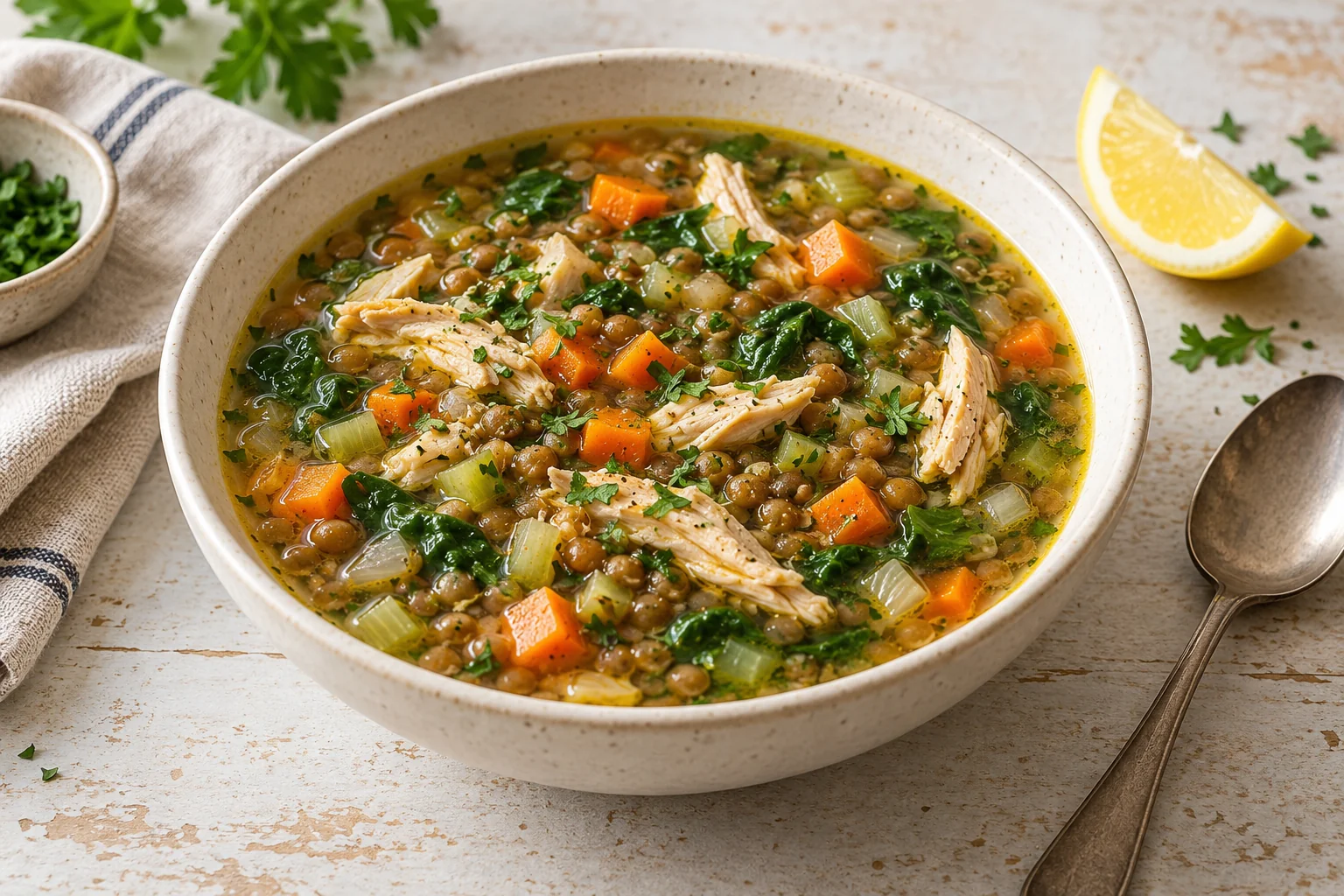
Chicken lentil soup works best when the lentils become tender without making the chicken stringy. This lemon-herb version gives whole brown or green lentils a short head start, poaches chicken breasts gently in the same pot, and adds spinach and lemon at the end. The result is a substantial, brothy soup with distinct vegetables, tender chicken, and enough flexibility for tomorrow’s lunch.
Published October 20, 2026.
The recipe makes six portions. Under the clearly stated ingredient assumptions below, each sixth of the batch provides approximately 31 grams of protein from the chicken and lentils alone. That is an estimate, not a tested nutrition panel, and it changes with the ingredients and portion size you use.
Chicken lentil soup at a glance
- Yield: six portions, each one-sixth of the finished batch.
- Preparation: approximately 20 minutes.
- Cooking: approximately 40–50 minutes, depending on the lentils and chicken thickness.
- Texture: brothy, with whole lentils and shredded chicken rather than a smooth purée.
- Equipment: a heavy 5–6-quart pot, fine-mesh strainer, knife, cutting board, tongs, and food thermometer.
- Chicken doneness: at least 165°F/74°C in the thickest part.
The times are planning estimates. A gentle simmer, tender lentils, and the chicken’s measured temperature are more useful endpoints than the clock alone. If you want several different soup styles rather than this specific recipe, explore our high-protein soup collection.
Ingredients for six portions
- 600 grams raw boneless, skinless chicken breast, fully thawed
- 200 grams dried whole brown or green lentils, approximately 1 cup
- 1 tablespoon olive oil
- 160 grams onion, diced into small pieces
- 200 grams carrots, cut into approximately ½-inch pieces
- 120 grams celery, cut into approximately ½-inch pieces
- 3 garlic cloves, finely chopped
- 1 teaspoon dried thyme
- ½ teaspoon ground cumin
- ¼ teaspoon ground black pepper, plus more to taste
- 1.6 liters lower-sodium chicken broth, plus water as needed
- 1 dried bay leaf
- 90 grams baby spinach, roughly chopped
- 2 tablespoons lemon juice, divided
- 2 tablespoons chopped fresh parsley
- Up to ½ teaspoon fine salt, added gradually to taste
Weights are the most repeatable measurements for the chicken, lentils, and vegetables. Tablespoons are 15 milliliters and teaspoons are 5 milliliters. The broth is approximately 6¾ US cups. Salt is intentionally adjustable because broth varies considerably; start without extra salt if your broth already tastes well seasoned.
Use plain chicken rather than a strongly seasoned or marinated product. Choose lentils labeled whole brown or green, not split red lentils, for the main recipe. Rinse the lentils in a strainer and pick out any debris before cooking. Keep the lemon and spinach aside until the final stage.
How to make chicken lentil soup
1. Prepare the vegetables before handling chicken
Chop the onion, carrots, celery, garlic, and parsley first. Keep the parsley away from the raw-poultry workspace because it will be added at the end. Set out a clean plate and two clean forks for the cooked chicken so you do not need to reuse the raw-chicken board.
If the chicken breasts are very large, cut them crosswise into two substantial pieces of similar thickness. Avoid tiny cubes: larger pieces are easier to lift out, measure, and shred. Do not rinse raw chicken. USDA advises against washing poultry because splashes can spread contamination; use clean handling and proper cooking instead. See its chicken handling guidance.
2. Soften the aromatic vegetables
Heat the oil in the pot over medium heat. Add the onion, carrots, and celery. Cook for 8–10 minutes, stirring occasionally, until the onion softens and the vegetables smell sweet. They do not need to brown deeply. If the bottom becomes dry or starts catching, add a tablespoon of water and scrape gently.
Stir in the garlic, thyme, cumin, and black pepper. Cook for about 30 seconds, just until fragrant. The cumin should sit in the background rather than turn this into a strongly spiced soup. Avoid letting the garlic darken while you search for the broth.
3. Give the lentils a head start
Add the rinsed lentils, broth, and bay leaf. Bring to a boil, then lower the heat to a steady, gentle simmer. Partially cover and cook for 10 minutes. Stir once or twice, reaching the bottom of the pot so lentils do not collect in a dry patch.
The liquid should move gently rather than churn vigorously. A hard boil encourages evaporation and makes the timing less predictable. Keep a kettle of water nearby; if the lentils stop moving freely in liquid, add enough water to restore a soup-like consistency.
4. Poach the chicken and check it separately
Lower the chicken pieces into the simmering soup so they are mostly submerged. Return to a gentle simmer and partially cover. Begin checking the chicken after approximately 15 minutes; substantial pieces may take 20–25 minutes or longer. Check each piece in its thickest part with a thermometer.
Remove each piece to the clean plate when it reaches at least 165°F/74°C. That minimum comes from USDA poultry temperature guidance. If the chicken is ready before the lentils, let the lentils continue simmering while the chicken rests briefly. Do not keep finished chicken boiling merely to synchronize the two ingredients.
5. Finish the texture and seasoning
When the chicken is manageable, shred it with the clean forks into short, bite-size pieces. Taste a few lentils only after the raw chicken has been removed fully cooked; they should be tender through the center, not chalky. Whole lentils can take longer than expected, so keep simmering and checking if needed.
Return the shredded chicken to the pot. Add the spinach and cook for 2–3 minutes, until wilted and the soup is hot throughout. Remove the bay leaf. Stir in 1 tablespoon lemon juice and the parsley, then taste. Add the remaining lemon juice and salt gradually. Thin with a little hot water if you want more broth.
Why these lentils suit this soup
Whole brown or green lentils provide small, distinct pieces that can share a spoon with shredded chicken and diced carrot. They also thicken the broth modestly as they cook. The target is tender lentils with some structure, not a perfectly clear consommé and not a completely smooth lentil base.
Lentils generally do not need soaking before cooking, as Iowa State University Extension explains. Still, read the package: size, variety, and storage age can change how quickly your particular lentils soften. A package timing range is a starting point, not a reason to serve a crunchy center.
Split red lentils are a different ingredient for texture purposes. They tend to break down much more readily and produce a thicker, less defined soup. You can make a pleasant chicken soup with them, but they should not silently replace the whole lentils while retaining the same timing and promised result.
French green or black lentils may retain a firmer shape and need a different cooking interval. If you prefer those, follow their package guidance and remove the chicken as soon as it is cooked. Our lentils versus chickpeas guide explains broader texture choices when you are planning meals around legumes.
Keep the chicken tender without undercooking it
The practical solution to dry chicken is not a lower safety target. It is controlling the simmer and removing individual pieces when they are done. A large breast and a small breast do not finish together just because they entered the pot at the same time.
Choose pieces with similar thickness where possible. If one is much thicker, divide that piece before cooking. Insert the thermometer into the center from the side when that gives a clearer reading. Avoid resting the probe against the hot pot or measuring only the surrounding broth.
Short shreds are easier to eat than very long strands. Pull the meat into pieces that fit a spoon, then cut any unusually long strands once or twice. A soup can feel stringy even when the chicken is not badly overcooked if every spoonful trails a long piece of breast.
If the lentils are taking significantly longer than expected, refrigerate cooked chicken promptly rather than leaving it out through an extended delay. When adding refrigerated cooked chicken back, reheat the soup thoroughly. Usually the difference is only a few minutes, but the plan should change if dinner gets interrupted.
Protein estimate with the ingredient assumptions shown
This recipe uses an illustrative calculation, not laboratory analysis or a promise about every chicken package. The assumptions are 23 grams of protein per 100 grams of raw boneless, skinless chicken breast and 24 grams per 100 grams of dried lentils. Replace those figures with your own labels when available.
- Chicken: 600 grams × 23 ÷ 100 = 138 grams protein for the batch.
- Dry lentils: 200 grams × 24 ÷ 100 = 48 grams protein for the batch.
- Counted subtotal: 138 + 48 = 186 grams.
- Six equal portions: 186 ÷ 6 = approximately 31 grams per portion.
The estimate excludes broth, vegetables, herbs, and any side dishes. Those can contribute nutrients, so this is deliberately a partial protein subtotal rather than a complete nutrition label. No calorie, fiber, or sodium total is claimed.
Match the measurement state. The chicken is weighed raw and the lentils dry. Applying a cooked-chicken value to the raw weight, or a cooked-lentil value to the dry weight, would give a misleading answer. The FDA’s label-reading guide explains why the serving amount must match the nutrient numbers you use.
Adding water changes the soup’s volume, not the counted batch protein. For consistent servings, distribute chicken and lentils evenly, then divide the broth. Four larger portions would have a different subtotal per bowl; eight smaller portions would as well.
Useful substitutions and what changes
Already-cooked chicken
Use approximately 450 grams cooked, shredded chicken in place of the 600 grams raw chicken, treating this as a practical ingredient substitution rather than an exact cooked-yield conversion. Cook the lentils and vegetables until tender without chicken, then stir in the cooked meat near the end and reheat thoroughly to 165°F/74°C.
Rotisserie chicken can bring more salt and seasoning, so taste before adding either. Use a cooked-chicken nutrition entry or the product label for its protein estimate. The raw-chicken calculation above no longer applies, and making soup does not restart the storage life of old leftovers.
Canned or ready-cooked lentils
Use 500 grams drained, fully cooked lentils as a starting substitution. Begin with 1.2 liters broth because cooked lentils will not absorb liquid like dry ones. Simmer the vegetables and raw chicken, remove the chicken when done, then add the lentils and shredded meat and heat through.
Add more broth or water if necessary. This version will have a somewhat different balance and yield. Use the drained cooked-lentil label for nutrition, not the dry-lentil assumption. Avoid simmering canned lentils for the full dry-lentil cooking period unless you want a much softer texture.
Boneless chicken thighs
Use 600 grams fully thawed boneless, skinless thighs. Open folded pieces before adding them so heat reaches them more evenly. They still need to reach at least 165°F/74°C; check their texture and the package directions rather than assuming breast timing is universal. Use a thigh-specific nutrition value.
Different greens or a stronger finish
Replace spinach with finely sliced kale, removing tough stems and allowing additional simmering time before returning the chicken. For a warmer finish, add a small pinch of chili flakes with the garlic. For a more lemon-forward bowl, add extra juice to individual servings rather than making the whole batch sharply acidic.
Troubleshooting chicken lentil soup
The lentils are still firm
Keep cooking them gently with sufficient liquid. Check whether they are whole lentils, a particularly firm variety, or an older package. Remove cooked chicken while you wait. Next time, allow more lentil cooking before adding the chicken rather than extending the chicken’s simmer automatically.
The soup is much thicker the next day
Add water or broth during reheating, a few tablespoons at a time, and stir well. Start with water if the original soup was already salty. Do not judge the final consistency while the soup is still cold and compact; warm it through before deciding how much extra liquid it needs.
The broth tastes flat
Check three things separately: seasoning, acidity, and concentration. Try a spoonful with a tiny pinch of salt, then another with a few drops of lemon. If both are bland because you added a lot of water, simmer briefly uncovered before adjusting again. More garlic is not the only solution.
The soup tastes too salty
Dilute with unsalted water and, if available, add separately cooked unsalted lentils or vegetables. This increases the batch and changes its portion math. A potato added to the pot is not a reliable way to selectively remove salt. Next time, hold back added salt until the broth has finished reducing.
The chicken is dry or stringy
Shred it into shorter pieces and distribute it through the broth rather than leaving large dry chunks. That improves eating texture but does not reverse overcooking. For the next batch, lower the heat, check smaller pieces sooner, and take finished pieces out independently.
The bottom catches
Lower the heat and stir more often as the lentils thicken the liquid. If a patch has burned, transfer the unburned soup to a clean pot without scraping up the scorched layer. Add liquid if needed. A heavy pot helps, but it cannot compensate for insufficient broth and excessive heat.
Serve it as a meal that fits your appetite
A bowl of this soup already contains chicken, lentils, and vegetables. Bread, rice, potatoes, or a simple side salad can round it out according to your appetite. There is no need to turn every serving into the same-sized meal or to remove starch because the soup contains lentils.
For a soup-and-salad lunch, dress the salad separately with Greek yogurt ranch dressing. Keep that cold dressing separate from the hot soup. It offers a different flavor and texture without requiring another cooked component.
If you are packing lunch, use a leakproof container with enough room to stir during reheating. Pack bread separately so it stays firm. Add parsley or a small lemon wedge at serving time when convenient; these are optional finishes, not requirements for the soup to be worthwhile.
Refrigerate, freeze, and reheat safely
Divide leftovers into shallow containers and refrigerate within two hours, or one hour above 90°F/32°C. Do not leave a large pot on the counter until completely cool. Keep refrigerated soup at 40°F/4°C or below and use within three to four days. USDA provides these cooling and storage principles in its leftover food safety guidance.
Freeze extra portions early in freezer-safe containers, leaving the headspace their manufacturer recommends. Label the contents and date. Aim to use frozen portions within three to four months for quality. Freezing does not rescue food that was handled unsafely beforehand.
Thaw in the refrigerator or reheat directly from frozen with enough liquid to prevent scorching. Bring reheated soup to a rolling boil and check that the food reaches 165°F/74°C throughout. Stir microwave portions thoroughly and check several spots. Reheat only what you intend to eat when practical.
Scale the recipe without creating a crowded pot
For three portions, halve the ingredients and use a smaller pot with enough depth to cover the chicken. Keep checking temperature: half a batch does not mean half the cooking time when the chicken pieces are the same thickness.
For twelve portions, two ordinary pots are often easier to manage than one very full pot. Divide ingredients evenly, check both batches, and prepare enough shallow containers before cooking. A doubled batch takes longer to heat, and its chicken pieces still need individual temperature checks.
Frequently asked questions
Can I put raw chicken directly into lentil soup?
Yes. In this recipe, raw chicken cooks in simmering broth after the lentils have had a head start. Handle the pot as containing raw-poultry juices until the chicken is fully cooked, and verify the thickest parts with a thermometer. Do not judge safety from the broth bubbling or the meat looking white.
Should I cook lentils separately first?
Not for the main recipe. Cooking dry lentils in the pot makes the method simpler and gives the broth body. Separate cooking is useful when you are substituting a variety with unfamiliar timing or want especially precise control over the finished lentil texture.
Can I use red lentils instead?
You can make a different, softer soup with red lentils, but this timing is designed for whole brown or green lentils. Follow the red-lentil package timing and monitor thickness. Expect them to break down, and check the chicken independently instead of waiting for both ingredients to finish together.
Is this chicken lentil soup dairy-free or gluten-free?
The listed core ingredients contain no intentional dairy or wheat ingredients, but check broth, seasonings, and packaged chicken for allergens and processing statements. A recipe description is not a guarantee for a particular product. Choose ingredients appropriate to your needs, including any requirements around cross-contact.
Does lemon juice make it keep longer?
No storage extension is assumed here. The lemon is a flavor finish, not a validated preservation process. Follow the same prompt cooling and short refrigerated storage window whether you use one tablespoon, two tablespoons, or omit it.
Can I make it in a slow cooker or pressure cooker?
This is a stovetop method. Those appliances change heat-up time, evaporation, and the relationship between chicken and lentil cooking. Use a recipe specifically developed for your appliance rather than transferring the listed timing unchanged. The thermometer check and careful leftover handling still matter.
The repeatable version
Start the lentils first, simmer gently, and remove chicken pieces when they reach the required temperature. Finish with lemon only after you know how the broth tastes. Those choices give you a soup that is easier to adjust than one that depends on a single fixed cooking time.
Looking for more from Workit? Explore Workit on the App Store.