
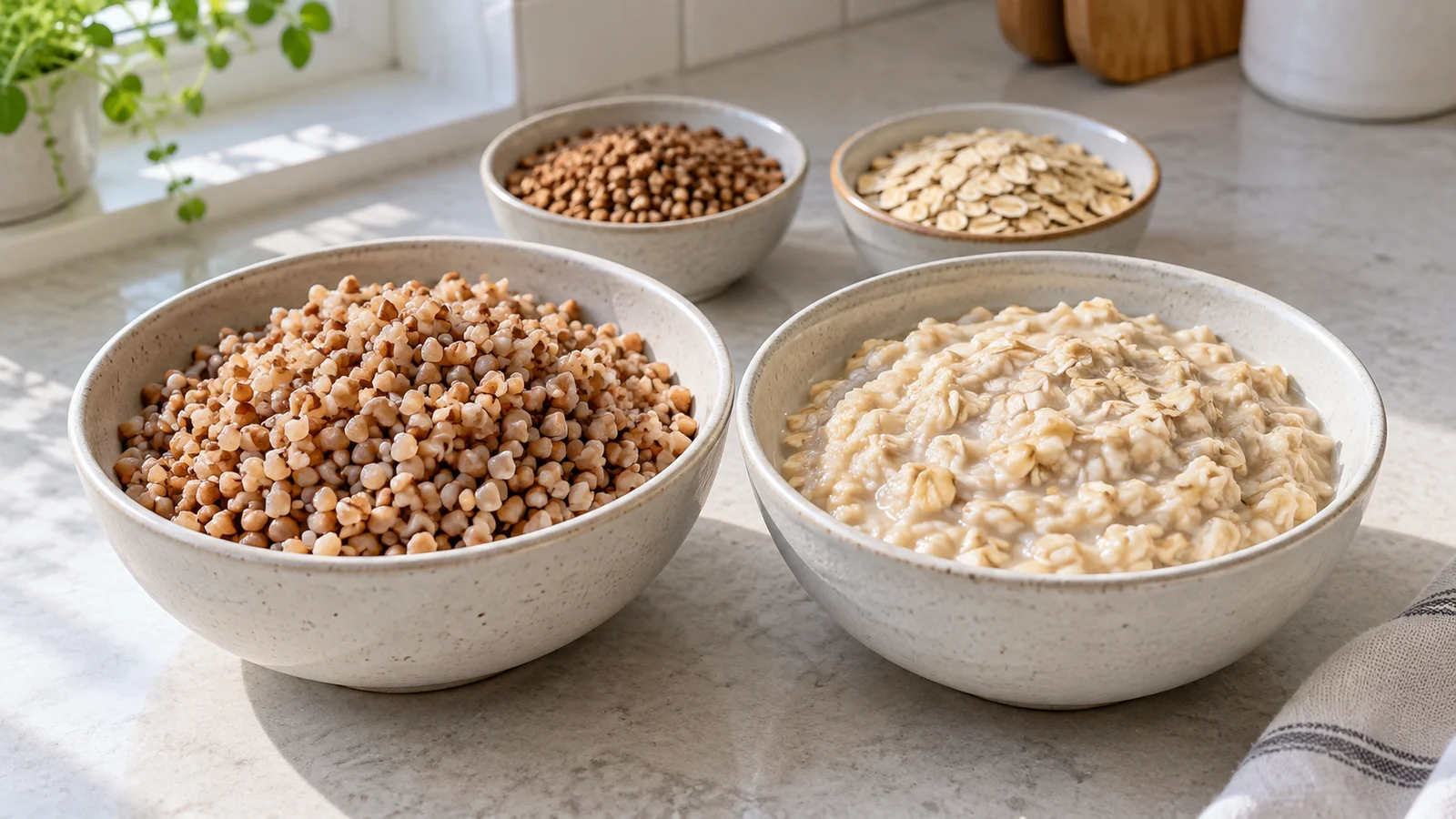
Choose oats for a creamy, quick breakfast; choose buckwheat groats when you want separate, slightly nutty grains for bowls and salads. Both can fit a balanced eating pattern. Their protein difference is small when you compare the same dry weight, and the toppings you add often matter more than switching the grain.
Published October 19, 2026.
The useful comparison starts with what is actually in the bag. This guide compares plain, uncooked buckwheat groats with plain old-fashioned rolled oats. Buckwheat flour, sweetened instant oatmeal, oat bran, and toasted kasha are different products with different cooking behavior. Below, you will find a dry-weight nutrition comparison, two dependable starting methods, and three original ways to turn either ingredient into a meal.
Buckwheat vs oats: the practical differences
- Texture: buckwheat groats can stay distinct and tender; rolled oats soften into a thick, spoonable mixture.
- Flavor: raw buckwheat groats have a mild, earthy nuttiness. Toasted buckwheat, often sold as kasha, tastes more pronounced. Plain oats are mild and work with sweet or savory ingredients.
- Cooking: rolled oats generally cook faster than whole buckwheat groats. Follow the specific package because processing and grain size change the timing.
- Best use: buckwheat makes a convenient alternative to rice in a chopped salad or warm bowl. Oats suit porridge, overnight oats, and mixtures that benefit from a soft binder.
- Nutrition comparison: measure the dry portion first. A cup of cooked porridge and a cup of cooked groats can contain very different amounts of water.
You do not need to select a permanent winner. Keep oats for mornings when a single saucepan and a spoon are appealing; use buckwheat when you want something you can toss with vegetables without turning the whole dish creamy.
What are buckwheat groats and rolled oats?
Despite its name, buckwheat is not wheat. The edible groats are seeds used much like cereal grains. Bob’s Red Mill describes its buckwheat groats as hulled seeds from a plant related to rhubarb. Buy intact groats for the methods in this guide, rather than flour or finely milled hot cereal.
Old-fashioned oats are flattened oat grains. Their thin shape helps them soften and release starch into the cooking liquid. Steel-cut oats are chopped rather than flattened and need a different cooking schedule; quick oats have a finer structure and soften sooner. Those distinctions are about processing and texture, not a reason to call one version automatically superior.
Look through the package window if there is one. Buckwheat groats should look like small, angular kernels. Rolled oats should look like flakes. A recipe written for flakes will not behave the same way if you add whole oat groats or buckwheat flour.
Compare nutrition on the same dry-weight basis
The following examples use manufacturer labels checked for this guide: Bob’s Red Mill Organic Buckwheat Groats and Quaker Old Fashioned Oats SmartLabel. Your package is the final reference if its formulation or serving size differs.
- Buckwheat, 45 grams dry: 160 calories, 6 grams protein, 33 grams carbohydrate, 2 grams fiber, and 1 gram fat.
- Rolled oats, 40 grams dry: 150 calories, 5 grams protein, 27 grams carbohydrate, 4 grams fiber, and 3 grams fat.
Those printed serving sizes are unequal. Scaling the buckwheat label to 40 grams gives approximately 142 calories, 5.3 grams protein, 29.3 grams carbohydrate, 1.8 grams fiber, and 0.9 gram fat. The calculation is each listed value multiplied by 40 and divided by 45. Oats remain at their printed 40-gram values.
This is a comparison of two specific labels, with normal label rounding. It is not proof that every buckwheat product has exactly these values. The important practical finding is that the protein difference at equal weight is modest. Neither plain grain supplies the same protein amount as a full serving of Greek yogurt, poultry, or another concentrated protein food.
Why cooked cups can give a misleading answer
Water changes weight and volume without adding calories. Suppose you cook 80 grams of oats with enough water to produce a thick breakfast for two. If you add extra water and make three smaller bowls instead, the pot still began with the same oats. Its total grain calories have not increased just because the finished pot weighs more.
The same issue affects buckwheat. A firmer batch and a softer, wetter batch can have different calories per 100 grams cooked because they retain different amounts of water. For consistent portions, weigh the dry grain, cook it, then divide the finished batch evenly. If you log a cooked database entry, check that it describes the cooked food and preparation you are actually eating.
Protein, fiber, and meal size: what to prioritize
Choose the texture you enjoy, then build the rest of the meal deliberately. If breakfast often leaves you looking for another meal shortly afterward, investigate the whole bowl: its size, protein component, fruit or vegetables, and whatever fats you add. A tiny grain serving with a few berries may simply be too small for your morning.
For a protein-containing breakfast, pair either grain with plain Greek yogurt, milk, eggs, or a suitable alternative whose label matches your needs. A spoonful of nuts can add crunch, but it is easy to assume a small garnish supplies more protein than it does. Measure the main protein component rather than relying on the word “protein” in a recipe title.
The two example labels also show different fiber amounts. That is useful information, but doubling the grain portion solely to chase fiber also changes the meal’s size and calories. Include other foods you tolerate and enjoy. If a larger portion causes discomfort, begin with a smaller serving rather than treating discomfort as evidence that the ingredient is working.
Gluten-free shopping needs a separate check
Buckwheat and oats do not belong to the wheat, rye, or barley group, but processing can introduce gluten through cross-contact. In the United States, FDA rules require foods labeled gluten-free to contain less than 20 parts per million gluten. An ingredient’s name alone is not the same as a gluten-free label.
If you need strict gluten avoidance, choose products labeled gluten-free and check every other ingredient in the meal. Soba noodles can contain wheat alongside buckwheat; granola can contain additional grains. For celiac disease or a known oat-related reaction, follow your clinician’s or dietitian’s advice about whether oats suit you. This comparison cannot determine individual tolerance.
How to cook buckwheat that stays separate
This small batch makes two grain portions. Use 90 grams dry raw buckwheat groats, 240 milliliters water, and a small pinch of salt if desired. Package directions take priority if they specify a different ratio for your product. Have a fine-mesh sieve and a small saucepan with a close-fitting lid ready.
- Check the groats for debris, rinse briefly in the sieve, and drain thoroughly.
- Bring the measured water to a boil. Add the groats and salt, stir once, then reduce the heat to a gentle simmer.
- Cover and begin checking after about 10 minutes. Many groats need roughly 12–15 minutes, but use tenderness rather than a rigid timer.
- If the kernels are still firm and the pan is dry, add a tablespoon or two of hot water, cover, and continue briefly.
- When tender, remove from the heat and rest covered for 5 minutes. Fluff gently with a fork. If excess water remains, drain it before resting.
Vigorous stirring and a hard boil encourage the kernels to break down. If your goal is a salad, handle the cooked grain gently. Spread it in a shallow container for prompt refrigeration rather than leaving a deep pot on the counter to become cold.
Raw groats and toasted kasha need different expectations
Toasted kasha can taste stronger and may soften differently from pale raw groats. Use its package instructions for the first batch. Do not assume that an extra-dark color means the grain needs more cooking; color can come from roasting before packaging.
If you bought a broken or fine-cut buckwheat cereal, embrace its porridge texture instead of trying to force it into separate kernels. That ingredient can still make breakfast, but it is a different starting point from the groats used here.
How to cook rolled oats without a gluey finish
For one bowl, begin with 40 grams old-fashioned rolled oats and 240 milliliters water. Add a pinch of salt if you like. These proportions align with the one-serving stovetop starting point on Quaker’s cooking instructions; other brands may recommend adjustments.
- Bring the water to a boil in a small saucepan, then stir in the oats.
- Lower the heat and cook for about 5 minutes, stirring occasionally rather than constantly.
- Stop when the flakes are tender and the mixture is slightly looser than you want to eat it.
- Rest for 1–2 minutes. Add a splash of water or milk if it thickens too far.
- Add yogurt, fruit, herbs, or other finishing ingredients after the main cooking stage.
Oats continue to thicken while they stand. Cooking until they already form a stiff mound can leave you with a dense bowl by the time you sit down. Milk can scorch more readily than water, so lower the heat and pay closer attention if using it as the cooking liquid.
Recipe one: warm cinnamon buckwheat with cool yogurt
Makes two bowls. The contrast here is between tender individual kernels and a cool, creamy topping. It is especially useful if you like breakfast grains but dislike the uniform softness of porridge.
- 90 grams dry buckwheat groats
- 240 milliliters water, plus a little more if needed
- Half a teaspoon ground cinnamon
- 340 grams plain nonfat Greek yogurt
- 150 grams diced apple or pear
- 20 grams chopped walnuts
- One teaspoon honey, optional, divided between the bowls
Cook the buckwheat using the method above. Stir the cinnamon into the finished grain and divide evenly between two bowls. Add half the yogurt, fruit, and walnuts to each. Drizzle with the optional honey. Leave the yogurt as a cool topping, or fold it in after the grain has stopped steaming vigorously.
For a clear protein illustration, FAGE Total 0% lists 18 grams protein per 170 grams. With that yogurt and the buckwheat label above, the grain-and-yogurt subtotal is 12 plus 36, or 48 grams per batch; divided by two, that is approximately 24 grams per bowl. This excludes the fruit and walnuts and is not a full calorie or macronutrient calculation.
For softer fruit, simmer the apple separately with a tablespoon of water and the cinnamon, then spoon it on top. Keeping that step separate avoids overcooking the buckwheat while waiting for large apple pieces to soften.
Recipe two: lemon-herb buckwheat and white bean bowl
Makes two substantial bowls. Use cooked, cooled buckwheat so the dressing coats the kernels rather than disappearing into a steaming pot. The beans are measured after draining; that is a recipe measurement, not a claim that a canned label uses the same basis.
- One full batch of cooked buckwheat made from 90 grams dry groats
- 240 grams cooked white beans, drained and rinsed
- 150 grams diced cucumber
- 150 grams halved cherry tomatoes
- Two tablespoons chopped parsley
- One tablespoon olive oil
- One tablespoon lemon juice, plus zest to taste
- Black pepper and salt to taste
Pat the rinsed beans dry enough that they are not dripping. Whisk oil, lemon juice, and seasoning in a large bowl. Fold in the buckwheat and beans, then the cucumber, tomatoes, and parsley. Divide evenly. Taste before adding more lemon: tomatoes contribute acidity too.
If you plan to eat the second bowl later, keep its cucumber and tomato separate until serving for a less watery result. Add a protein food of your choice if the meal needs one; the bean variety and portion will determine its contribution. For another grain that stays distinct in a bowl, compare the textures in our barley vs brown rice guide.
Recipe three: creamy oats with mushrooms and an egg
Makes one bowl. This version uses oats as a soft, savory base rather than trying to imitate rice. A separate skillet gives the mushrooms a chance to brown before they meet the moist porridge.
- 40 grams old-fashioned rolled oats
- 240 milliliters water
- 100 grams sliced mushrooms
- One teaspoon olive oil
- One large egg
- One tablespoon chopped scallion
- Black pepper and a small pinch of salt
Cook the oats in the water. Meanwhile, heat the oil in a small skillet and cook the mushrooms in a single layer, stirring only occasionally, until browned and tender. Move them to a plate. Cook the egg in the same pan until both white and yolk are firm, then place it over the oats with the mushrooms and scallion.
If the skillet becomes dry, add a small splash of water rather than letting the mushrooms burn. For more flavor combinations that keep the grain savory, see our savory oatmeal bowls. This recipe’s nutrition depends on your egg size and measured oil; no complete macro total is implied here.
Can you swap buckwheat for oats in a recipe?
In a grain bowl, often yes: cook each separately according to its own requirements, then use the amount you want. In porridge, the substitution changes the texture substantially. Whole buckwheat kernels will not become rolled-oat porridge merely because you use the same pan and liquid.
In baking, do not make a casual one-for-one swap between whole groats and oat flakes. They absorb liquid differently and have different shapes. The same caution applies to flour: a recipe designed around oat flour may need different hydration and binding when changed to buckwheat flour.
For overnight oats, use a recipe designed for oats rather than soaking raw buckwheat and assuming the result will be equivalent. Our overnight oats with Greek yogurt guide covers a familiar cold preparation. Cook buckwheat first when using it in a chilled bowl like the one above.
Troubleshooting common texture problems
The buckwheat turned mushy
Check whether you used raw groats, toasted kasha, or fine cereal. Next time, simmer more gently, begin checking earlier, and avoid repeated stirring. If this batch is already soft, serve it as a warm cereal. Adding more dry groats to a finished pot creates unevenly cooked pieces rather than restoring structure.
The oats became thick before the flakes were tender
The heat may be too high or the pan unusually wide. Add hot water a tablespoon at a time and continue gently. If milk has scorched at the bottom, transfer the unburned upper portion to a clean pan without scraping the burned layer into it.
The bowl tastes flat
Check seasoning before adding a large amount of sweetener. A small pinch of salt, lemon zest in a savory bowl, cinnamon with fruit, or toasted nuts can make the main ingredient more interesting. Add crunchy toppings at serving so they remain crisp.
Storage and reheating
Refrigerate cooked grains and finished perishable bowls within two hours, or within one hour when the surrounding temperature exceeds 90°F. Use shallow containers and keep the refrigerator at 40°F or below. Eat refrigerated leftovers within three to four days. These limits follow USDA leftover guidance; do not leave a pot out overnight and try to rescue it by reheating.
Reheat the grain portion to 165°F, adding a little water to loosen oats or gently steam buckwheat. Keep fresh yogurt and crunchy toppings separate until afterward. Freeze plain cooked portions if you will not use them within the refrigerator window; expect the texture to soften somewhat after thawing.
Compare cost per usable portion
Package prices are difficult to compare when one bag is much smaller. Divide the price by the package’s dry weight, then multiply by your usual dry portion. For example, a hypothetical $4 bag containing 400 grams costs $0.40 per 40-gram portion. A hypothetical $6 bag containing 600 grams costs the same amount per portion. These are arithmetic examples, not current store prices.
Also consider waste and how you actually cook. A cheaper large bag is less useful if you dislike its texture and leave it untouched. Start with a small package when trying buckwheat for the first time, and keep it tightly closed in a cool, dry cupboard according to its storage directions. Label a transferred container so whole groats do not get confused with flour or toasted kasha.
Adjust a portion without losing the recipe’s balance
If you want more grain in a bowl, increase the dry amount and its cooking water together, then check the final texture. Keep the yogurt, egg, or beans as a separate deliberate choice rather than automatically reducing that component to make room. If you want a smaller breakfast, reduce the grain portion and select a comfortable amount of toppings. The printed serving size is a reference for calculation, not a mandatory amount for every person.
When cooking for two people with different appetites, make one plain batch and divide it unevenly before adding toppings. That is easier than forcing everyone into identical bowls, and it keeps the cooking method consistent.
The bottom line
For a savory meal using cooked buckwheat as the grain base, pair it with yogurt-marinated chicken and a separately prepared cucumber-yogurt sauce. Cook and portion the grain separately so you can adjust the amount without changing the chicken recipe.
Oats are an easy choice for creamy breakfasts. Buckwheat offers a different chew and works particularly well when you want separate grains. Compare dry portions, check the product label, and build the rest of the meal around what you need and enjoy. A modest difference between grain labels matters less than a meal you can prepare well and eat consistently.
For the training side of your routine, Workit offers personalized workouts and a place to log weights, reps, and sets.
Comments
One response to “Buckwheat vs Oats: Nutrition, Texture, Cooking, and How to Choose”
[…] groats can provide a chewy grain base alongside this chicken and its clean yogurt sauce. Our buckwheat versus oats guide explains why whole groats suit a bowl with separate grains and how to avoid an overly soft […]