
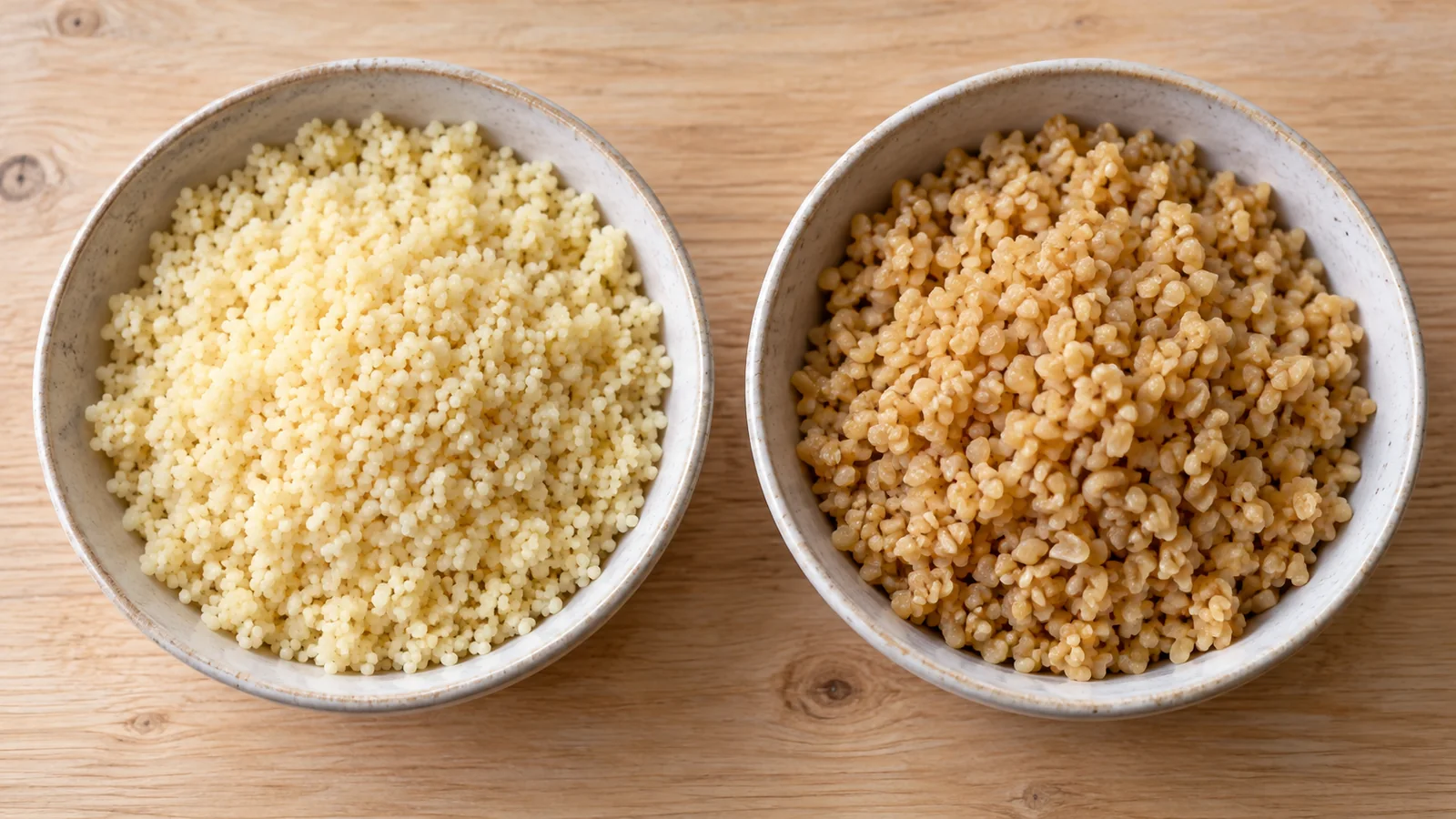
The practical difference between couscous and bulgur is simple: ordinary small-granule couscous is a wheat-based pasta that cooks into a light, mild base, while bulgur is precooked, dried, cracked wheat with a firmer bite. In the USDA plain-cooked reference entries, bulgur has substantially more fiber at the same weight, while couscous has slightly more protein. Neither ordinary wheat product is gluten-free.
Published October 16, 2026
Choose couscous when you want small, fluffy granules and a quick base for sauce. Choose bulgur when you want more chew in a salad or pilaf. For nutrition comparisons, make sure both portions are cooked or both are dry. Comparing dry bulgur with cooked couscous mostly compares a concentrated food with one that has absorbed water.
This guide separates the product types, puts the nutrition on equal serving bases, and shows how to use either food in two practical meals without pretending they are interchangeable in every cooking method.
Couscous and bulgur at a glance
- Basic ingredient: conventional couscous is made from wheat semolina; bulgur is made from wheat kernels that have been precooked, dried, and cracked.
- Typical texture: small couscous granules are soft and fluffy when prepared well; bulgur has more distinct chew, especially in coarser grades.
- Whole-grain status: look for whole-wheat couscous if that is what you want. Bulgur is commonly sold as a whole-grain wheat product; verify the ingredient list.
- Cooking method: many small-granule couscous products hydrate off the heat; bulgur preparation depends on the grind. Pearl couscous uses a different method.
- Gluten: ordinary versions of both contain wheat and are unsuitable for a gluten-free diet.
- Best practical choice: match the texture and preparation time to your meal, then compare the exact product’s label if a nutrient matters to you.
What is couscous?
Couscous can refer to the wheat product and to dishes made with it. In a typical supermarket box of conventional small couscous, the ingredient is semolina wheat formed into small granules. Although it is often placed beside rice and other grains, its manufacturing and cooking behavior make it useful to think of it as a small pasta.
For example, Near East Original Plain Couscous describes its product as small semolina-wheat pasta granules. Its directions call for adding couscous to boiling liquid, covering, removing from the heat, and allowing a five-minute standing period before fluffing.
That instruction applies to that type of product. It does not mean every food sold with the word couscous can be cooked by pouring hot water over it and waiting five minutes. Size, processing, and the package’s preparation method matter.
Small couscous, whole-wheat couscous, and pearl couscous
Small-granule couscous is useful when you want a light base that mingles easily with finely chopped vegetables or catches a spoonful of stew. Whole-wheat couscous offers another option, but its fiber and cooking directions should come from its own label rather than the conventional-couscous figures below.
Pearl couscous has much larger, rounded pieces and a springier pasta-like bite. It generally requires a simmering or boiling step rather than the short off-heat method used for many small-granule products. Near East’s pearled product instructions, for example, use several minutes of active cooking.
A seasoned box is another distinct product. It may contain oil instructions, salt, flavorings, and a seasoning packet. Decide whether you are comparing the dry contents or the meal “as prepared,” including the added fat. The product name alone cannot answer that.
What is bulgur?
Bulgur starts with wheat kernels that are precooked, dried, and broken into pieces. That precooking is one reason many bulgur products need less active cooking than an intact wheat berry. It is still important to read the grade and directions rather than assuming all bags hydrate identically.
Bob’s Red Mill Red Bulgur, for example, is a medium-grind whole-grain red wheat product. The manufacturer describes the wheat as parboiled, dried, and cracked. That is a different product from raw cracked wheat, which has been broken into pieces without necessarily receiving the same precooking treatment.
Fine bulgur is suited to dishes where small, tender pieces blend with herbs or other ingredients. Medium and coarse grades retain more visible texture and can work well in bowls and pilafs. The grade affects hydration time, so a recipe designed for fine bulgur may not work unchanged with a coarse bag.
Do not rely entirely on color. Red and golden wheat varieties can produce different-looking bulgur, while toasted or seasoned products can look darker for other reasons. The ingredient list tells you more about the product than a quick glance at the package window.
Nutrition comparison: the same cooked weight
The following figures use the USDA reference entries for plain cooked couscous and plain cooked bulgur in its Standard Reference cereal-grain report, entries 20029 and 20013. This is an archived reference dataset, not a new analysis of every product currently sold. Values describe the food, without added oil, butter, sauce, or toppings.
| Per 100 grams cooked | Couscous | Bulgur |
|---|---|---|
| Energy | 112 calories | 83 calories |
| Protein | 3.79 grams | 3.08 grams |
| Carbohydrate | 23.22 grams | 18.58 grams |
| Fiber | 1.4 grams | 4.5 grams |
On that equal cooked-weight basis, bulgur provides more fiber and fewer calories, while the protein difference is small. These figures do not establish that one complete meal is better than another. They also do not represent whole-wheat couscous, pearl couscous, or flavored mixes.
What happens at a 150-gram cooked portion?
Multiplying the reference figures by 1.5 gives approximately 168 calories, 5.7 grams protein, and 2.1 grams fiber for couscous; bulgur provides approximately 125 calories, 4.6 grams protein, and 6.8 grams fiber. Those are rounded grain-only estimates. A 150-gram serving is an illustrative comparison, not a universal portion recommendation.
The difference in protein is only about one gram at that amount. If you want a meal with a substantial protein contribution, the beans, tofu, eggs, fish, meat, or dairy you pair with the grain will usually be a more useful place to focus than this small difference between bases.
Why dry and cooked comparisons can mislead
Cooking adds water to both foods. The dry ingredient’s nutrients are then distributed through a heavier cooked batch. A dry 100-gram portion represents much more food than 100 grams after cooking, even though both entries may appear together in a food database.
The amount of water retained also varies with the product and method. A softer, wetter batch can have fewer calories per 100 grams than a drier batch made from the same starting amount. That does not mean the first batch lost its calories; the portion simply contains more water.
For your own cooking, choose one consistent approach. You can record the dry ingredient and divide the completed batch into equal portions, or you can weigh the cooked food and use a matching cooked reference. Avoid recording the dry amount and then adding a second cooked-grain entry for the same food.
Oil, butter, broth, and sauces need their own entries if you track them. A plain cooked-grain value will not include oil added to the pot or dressing added to a salad. Our raw versus cooked food weight guide walks through this distinction in more detail.
Why “one cup” is not always a fair comparison
Cups measure volume, not mass. Different grains, particle sizes, and hydration levels pack differently into the same cup. A tightly packed scoop and a loosely fluffed scoop can also contain different amounts.
If you want a clean side-by-side comparison, weigh equal cooked portions. If you are following a package’s cooking directions, use the specified measurement method. There is no need to replace every kitchen cup with a scale, but avoid mixing the two approaches without checking the conversion.
Which is better for your meal?
For a quick side with sauce
Small-granule couscous is a useful choice when the main dish is already cooked and you want a fast base. Fluff it gently, then spoon the sauce over it rather than stirring aggressively until the granules collapse into clumps.
For a herb-heavy salad
Bulgur is a good choice when you want distinct wheat texture among parsley, cucumber, tomato, and lemon. Choose the grade appropriate to the recipe. Fine bulgur behaves differently from a coarser product that needs longer cooking.
For more fiber from the grain itself
Bulgur has the clearer advantage in the plain cooked reference comparison. Whole-wheat couscous may also be worth comparing on its actual label. You can add beans and vegetables to either meal rather than expecting the grain to supply every nutrient you want.
For a specific protein target
Neither plain grain is a large protein serving on its own in the portions shown. Choose the texture you enjoy, then add a measured protein food. A small difference between grains is unlikely to compensate for accidentally dividing the main protein ingredient unevenly between containers.
For gluten-free eating
Ordinary wheat couscous and bulgur are both unsuitable. The FDA explains that gluten occurs in wheat, barley, and rye. If you choose a specialty alternative made from another ingredient, check its gluten-free labeling and use its own cooking directions and nutrition data.
Cooking each without making it mushy
For small couscous, measure the liquid carefully and follow the package’s resting time. Once covered, give it time to hydrate before inspecting repeatedly. Fluff with a fork, lifting and separating the granules rather than pressing them down with a heavy spoon.
If the couscous is still firm after the specified rest, add a small amount of hot water, cover again, and allow more time. If it is already very wet, stop adding liquid and let excess moisture escape gently. More stirring rarely turns a wet clump into fluffy individual grains.
For bulgur, confirm the grind first. The Bob’s Red Mill stovetop method uses one cup bulgur to two cups water and about 12 minutes of covered simmering, followed by draining excess liquid and fluffing. That is a product-specific example, not a universal rule for every bulgur grade.
For either food, cook vegetables with very different timing separately. Raw carrots need a different treatment from tender herbs, and watery zucchini can change the grain’s liquid balance. Combining already prepared components gives you more control than putting everything in the pot at once.
Recipe 1: Lemon chickpea grain salad
Makes two meal-sized portions or four smaller sides. Use either cooked grain, weighed after preparation. The flavor combination suits both, but bulgur will provide more chew and small couscous will make a lighter-textured salad.
Ingredients
- 300 grams plain cooked couscous or bulgur, safely cooled
- 240 grams canned chickpeas, drained and rinsed
- 160 grams cucumber, diced
- 160 grams tomato, diced
- 30 grams parsley, finely chopped
- 20 grams scallion, thinly sliced
- 25 grams lemon juice
- 15 grams olive oil
- 0.5 gram black pepper
Method
- Cook your selected grain according to its package. Cool promptly in a shallow container in the refrigerator, then weigh 300 grams for the salad.
- Drain the chickpeas well. If the tomatoes release a large pool of juice, keep some of that liquid out of the salad.
- Whisk the lemon juice, oil, and pepper in a large bowl.
- Add the grain, chickpeas, cucumber, tomato, parsley, and scallion. Fold gently until distributed.
- Taste and adjust seasoning to suit your ingredients. Divide into the intended number of portions and refrigerate until serving.
No complete recipe nutrition total is claimed here. The grain-only contribution per half-batch is the 150-gram comparison above; chickpeas, oil, and vegetables also contribute nutrients and need to be included in any full calculation. If you divide the salad into four sides, the grain contribution per serving is half as large.
Pack a little extra lemon separately if you like a brighter finish after refrigeration. Adding more oil automatically is not the only way to refresh a salad. For more guidance on choosing the legume, see lentils versus chickpeas.
Recipe 2: Warm mushroom and egg grain bowls
Makes two servings. This bowl demonstrates how a protein topping affects the meal more than the modest protein difference between the grains.
Ingredients
- 300 grams plain cooked couscous or bulgur
- 4 large eggs, approximately 200 grams total without shells
- 200 grams mushrooms, sliced
- 100 grams fresh spinach
- 60 grams onion, diced
- 10 grams olive oil
- 10 grams lemon juice
- 0.5 gram black pepper
- 5 grams chopped chives, optional
Method
- Heat half the oil in a skillet. Cook the mushrooms and onion over medium heat until tender and lightly browned, allowing released moisture to evaporate.
- Add the spinach and cook until wilted. Stir in lemon juice and black pepper, then transfer the vegetables to a plate.
- Beat the eggs and scramble them in the remaining oil until fully set.
- Warm the grain separately, adding a little water if needed. Reheat refrigerated leftovers to 165°F.
- Divide the grain, vegetables, and eggs equally between two bowls. Add chives if using.
The American Egg Board reference label lists 6 grams protein per large 50-gram egg, giving 12 grams from two eggs per serving. Add approximately 5.7 grams from 150 grams cooked couscous for a counted subtotal of 17.7 grams, or approximately 4.6 grams from bulgur for 16.6 grams. Vegetables and herbs are excluded, and these are rounded estimates.
Cook eggs fully; egg dishes should reach 160°F, according to USDA egg safety guidance. If you want a different warm grain-style breakfast, try our savory oatmeal recipes.
Meal prep, storage, and practical substitutions
Both foods can be prepared ahead, but keep the intended final texture in mind. Small couscous can clump when packed tightly; fluff it again before serving. Bulgur may hold a more distinct bite in a dressed salad. Neither benefits from sitting in a deep, warm pot while you finish the rest of the kitchen cleanup.
For safe storage, use shallow containers, refrigerate promptly at 40°F or below, and use cooked leftovers within three to four days. Reheat to 165°F. Keep perishables out no longer than two hours, or one hour above 90°F. See USDA leftover guidance.
In an assembled bowl, substituting equal cooked weights is an easy starting point. In a one-pot recipe, replacing the dry ingredient directly can alter liquid absorption and cooking time. Cook the replacement separately first unless you have directions designed for that product.
For cost, compare your actual store prices per dry weight and consider how much you will use. Do not assume a seasoned convenience box and a large bag of plain grain provide equivalent portions. The more useful purchase is often the one that fits several meals you already like.
A short shopping checklist
Before putting a bag or box in the cart, check four things: the ingredient, the form, the serving basis, and the preparation instructions. A package that says whole-wheat couscous answers a different question from one that says pearl couscous. The first describes the wheat ingredient; the second describes a larger shape. Neither word tells you the complete nutrition profile by itself.
Next, see whether the nutrition panel describes the dry product or includes ingredients added during cooking. If the directions call for butter or oil, check whether the displayed prepared values assume that addition. Use the numbers that match what you actually make.
Finally, plan a second use before buying a large package. Couscous can accompany a saucy dinner and become the base of a later salad; bulgur can go into a pilaf and another prepared bowl. Keep the dry product sealed and follow its storage instructions. Buying a grain for meals you already want is easier than inventing an entire new menu around an unfamiliar bag.
Frequently asked questions
Are couscous and bulgur the same thing?
No. Both conventional products come from wheat, but couscous is formed from semolina while bulgur consists of precooked, dried, cracked wheat kernels. The different forms explain much of the texture and preparation difference.
Is bulgur always better than couscous?
No single ranking covers every meal. Bulgur offers more fiber in the plain cooked comparison; couscous may provide the texture or quick preparation you prefer. Whole-wheat couscous and flavored products need separate comparisons.
Can I use pearl couscous in these recipes?
Yes, if you cook it using its own instructions before weighing the amount for assembly. Expect a larger, chewier pasta shape. Recalculate nutrition from its label instead of carrying over the small-couscous reference figures.
Which should I use instead of rice?
Either can work as a prepared bowl base. Choose couscous for smaller, softer granules or bulgur for more chew. For another comparison that separates cooking method from nutrition, see quinoa versus rice.
The useful decision
Choose the form you want to eat, compare equivalent portions, and build the rest of the meal around it. Bulgur’s fiber advantage is clear in the reference comparison; the protein difference is modest. Good preparation and a meal you enjoy are more useful than treating either ingredient as a universal winner.
If you track meals with Workit, record whether your grain was weighed dry or cooked and include the ingredients added during preparation. Review any AI-generated estimate against labels and portion information. A subscription is required.