
Published October 6, 2026
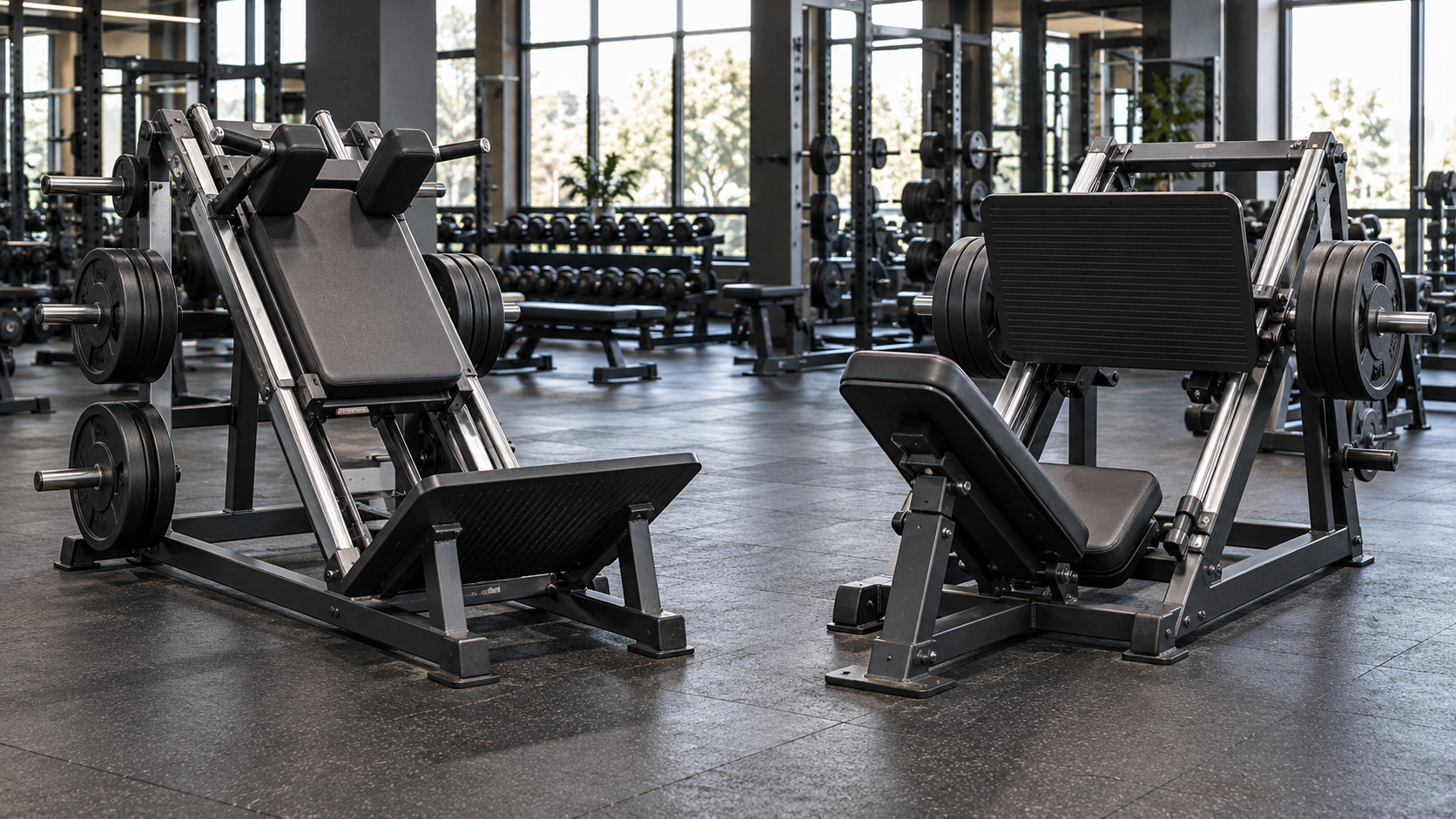
The main difference between a hack squat and a leg press is your position on the machine. In a conventional hack squat, you stand on a platform and move a shoulder-supported carriage. In a leg press, you sit or recline and push a platform away, although some designs move the seat instead. Both involve bending and straightening your knees and hips.
For a squat-style, quad-focused exercise, a well-fitting hack squat is a good choice. For supported leg training with a seated setup, the leg press is equally worth considering. Your best option is the machine that lets you train through a comfortable, repeatable range of motion and gradually improve your performance.
This hack squat vs leg press comparison covers the common back-supported hack squat and gym leg press. It does not cover the behind-the-body barbell hack squat. You will learn how the machines differ, which muscles they train, how to use them, and where they fit into a leg workout.
Hack squat vs leg press at a glance
| Feature | Hack squat | Leg press |
|---|---|---|
| Body position | Standing against a back pad, shoulders under pads | Seated or reclined against a backrest |
| Typical movement | Your body and carriage travel along the rails | You push a sled or lever; some machines move the seat |
| Main training role | Supported squat-style leg work | Supported lower-body pressing |
| Muscle emphasis | Quads, with hip extensor involvement | Quads and hip extensors, depending on setup |
| Important fit check | Shoulder-pad position, footplate and available depth | Seat angle, footplate and pelvic control |
| Best way to compare progress | Against your previous sessions on that machine | Against your previous sessions on that machine |
These are broad descriptions. A different machine model can change the feel enough to change your preference.
What is a hack squat?
A machine hack squat places your torso against a padded carriage, with pads over your shoulders and your feet on a fixed platform. You bend your knees and hips to lower the carriage, then push through your feet to return to the starting position.
The rails guide the movement, so you do not have to balance a barbell. That makes it easier to focus on producing force with your legs. You still need to brace and control your position against the pads.
Equipment details matter. For example, the Hammer Strength hack squat has an adjustable platform and range-of-motion stops. Other machines may have different angles, fixed platforms or a much lighter starting resistance. Read the instructions on your machine rather than copying somebody else’s setup.
The useful question is whether the machine fits you. Can you reach the handles, release and re-engage the catches, keep your feet planted and lower without being forced into an awkward position? If the answer is no, choose another exercise or ask gym staff to help with adjustments.
What is a leg press?
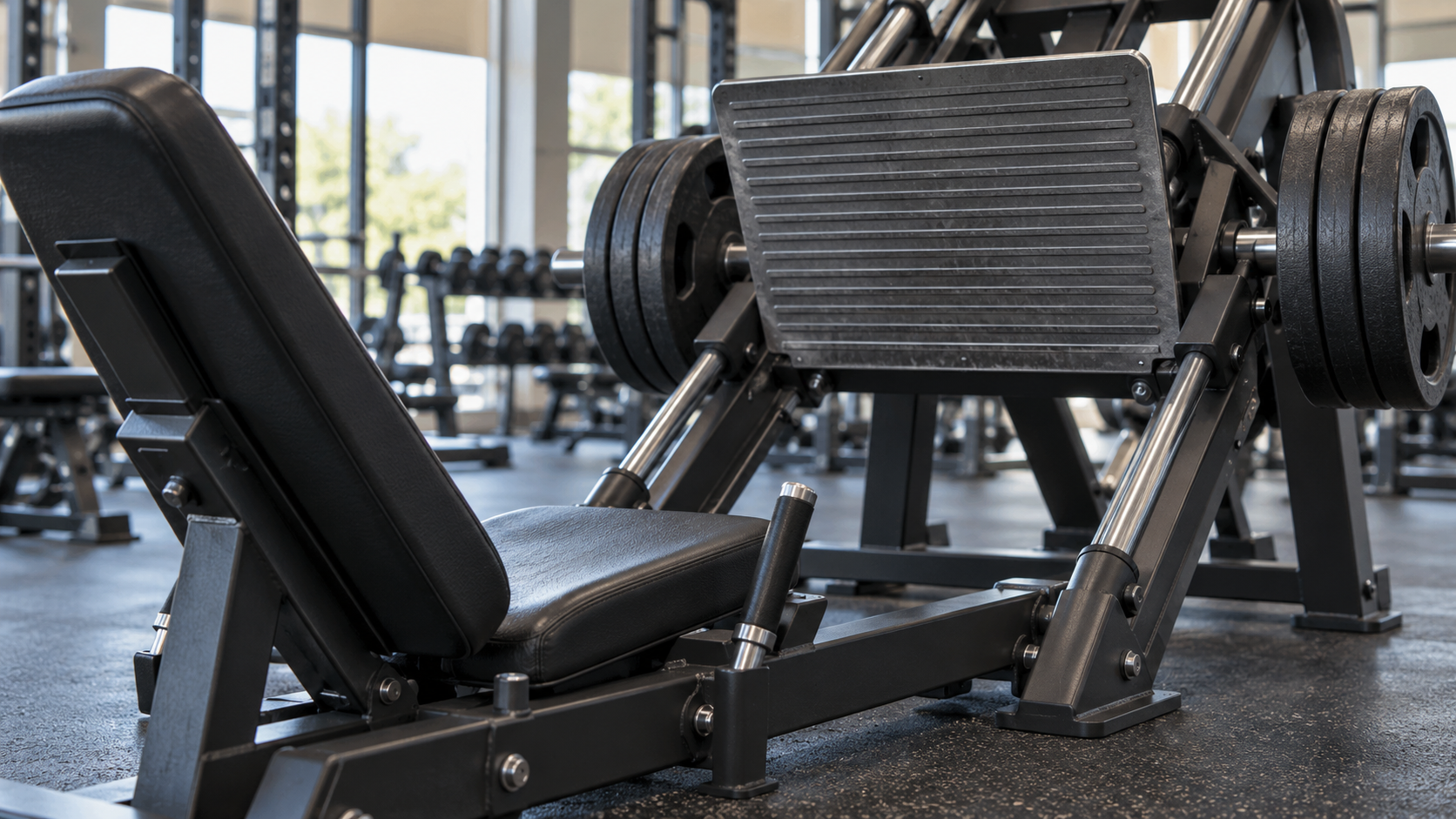
The leg press is another supported, multi-joint leg exercise. You press against a footplate while your torso rests on a seat or backrest. On a common 45-degree model, the weighted sled travels up angled rails. Horizontal and leverage machines use different arrangements.
Adjustability can make a significant difference. The Life Fitness linear leg press, for example, has an adjustable back pad and lists its own starting resistance. Those details help explain why an empty machine may already feel challenging and why the same plates can feel different elsewhere.
A seated setup is convenient, but it still takes practice. You need to find a position that allows useful knee and hip movement while keeping your pelvis supported. Being able to load many plates is less important than being able to repeat the same controlled movement.
Which muscles do hack squats and leg presses work?
Quadriceps
Your quadriceps straighten your knees, making them central to both exercises. A hack squat often suits people who want a stable squat pattern with substantial knee bend. A leg press can also provide demanding quad training when the setup allows it.
A useful nuance comes from a 2026 study comparing leg presses with knee extensions. Seventeen untrained adults trained for 12 weeks. Leg pressing increased overall quadriceps volume, but knee extensions produced greater growth in the rectus femoris, one of the four quadriceps muscles. This was not a hack-squat comparison. It does suggest that adding knee extensions can complement a leg-press-based quad routine.
Glutes and adductors
Both exercises involve hip extension as you push out of the bottom. Your glutes contribute to that movement, and the adductor magnus can contribute as a hip extensor. The same 2026 study measured growth in the gluteus maximus and adductor magnus following leg press training.
That finding supports the leg press as more than a quad exercise. It does not establish that every leg press setup builds more glute muscle than every hack squat. Your machine’s geometry and the hip motion you can comfortably use affect the exercise you actually perform.
Hamstrings and trunk
Do not assume either machine covers all your hamstring training. Muscle involvement during a movement does not automatically mean it provides a complete growth stimulus. For a balanced leg routine, consider a separate knee-flexion exercise, such as a leg curl, and a hip-hinge exercise appropriate to your experience.
Back support also changes trunk demands. A small study comparing hack squats with back squats found lower trunk muscle activation during hack squats in most measured conditions. It did not compare hack squats with leg presses. Avoid treating either supported machine as a complete replacement for every balance, bracing or movement skill trained elsewhere.
The differences that matter during your workout
1. The machine controls your path
On both exercises, the equipment guides the resistance. That support can be useful when you want to concentrate on your legs, but a fixed path also limits how you can adjust your movement.
Two lifters can reasonably prefer different machines. Someone with long thighs may find one leg press cramped and another comfortable. A hack squat’s shoulder pads may fit one person well and sit awkwardly on another. Test the actual equipment available before choosing your main lift.
2. More plates do not mean a better exercise
You may be able to leg press much more than you hack squat. The numbers are not directly comparable. Sled angle, carriage resistance, leverage, friction, body position and movement depth all influence the task.
Even two leg presses can differ substantially. Treat each machine as its own exercise in your training log. When you change machines, establish a fresh working weight through warm-up sets instead of assuming your previous load will transfer.
3. Foot placement changes your position
Moving your feet changes the relationship between your feet, knees and hips. It can alter the movement available to you, but simple claims that a particular stance isolates one muscle are often too confident.
In a study of inclined leg press variations, the tested stance-width and foot-rotation changes did not consistently change activation in the measured muscles. The study involved trained young adults and specific conditions, so it cannot answer every foot-placement question.
Start with a comfortable, roughly hip- to shoulder-width stance. Make small adjustments that help you keep your feet planted and move smoothly. Change one thing at a time so you can tell whether it helped.
4. Usable depth matters more than chasing an extreme
Choose a range you can control without pain or losing your supported position. On the leg press, that means avoiding extra depth obtained by letting your pelvis roll away from the pad. On the hack squat, keep your heels down and your torso supported as you descend.
More depth is not automatically better in every situation. A 2025 study in 23 resistance-trained participants found similar quadriceps growth after eight weeks of leg presses using approximately 100 degrees of knee flexion or a deeper individualized range. That does not prove all partial repetitions are equivalent. It shows why one universal depth rule is too simplistic.
Which should you choose for your goals?
For bigger quads
Either can serve as your main supported quad exercise. Give the hack squat a trial if you enjoy a squat-style movement and can achieve consistent knee bend. Choose the leg press if its seated position fits better or makes it easier to perform controlled, challenging sets.
Keep the choice stable long enough to learn it. Several weeks of repeatable training will tell you more about its practicality than switching after every workout. Assess whether you can add repetitions or load while preserving your technique.
For glute development
Look for comfortable hip movement and a setup that does not force your pelvis to shift. The leg press is a reasonable option, but moving your feet higher is not a guarantee of better glute growth.
You can also combine your chosen machine with another hip-extension exercise rather than trying to make one stance accomplish everything. The whole program matters more than assigning a winner to a single machine comparison.
For beginners
Start with the machine you can set up and control most confidently. A selectorized leg press may offer convenient weight changes, while a hack squat may feel more intuitive if you already enjoy squatting. Neither advantage applies to every model.
Ask for a demonstration of the release handles and safety stops. If the empty hack-squat carriage is already too heavy, choose equipment with a more manageable starting resistance. There is no benefit to forcing an exercise simply because it appears in a program.
For improving your barbell squat
Both can provide accessory leg work, but keep practicing the barbell squat if that specific lift is your goal. A machine cannot reproduce every part of balancing and moving a barbell. For a closer look at that distinction, read our hack squat vs squat comparison.
Research also cautions against assuming that strength transfers equally to every task. An eight-week study of back squats and leg presses found different improvements in jumping performance. It did not test hack squats, so it cannot establish a hack-squat advantage. Choose accessory work to support the activity you care about.
How to perform each exercise with control
Use the instructions for your specific machine and start light. The steps below describe common gym models; safety catches, seat adjustments and starting positions vary.
Hack squat technique
- Check the setup. Position the shoulder pads comfortably, place your back against the support and find the safety catches before starting.
- Set your feet. Use a comfortable stance with your whole foot on the platform. Hold the handles and brace your torso.
- Take the load. Extend your legs enough to release the catches as instructed by the machine manufacturer.
- Lower smoothly. Bend your knees and hips while maintaining contact with the pads and keeping your heels planted.
- Press back up. Push through your whole foot. Avoid bouncing out of the bottom or snapping your knees backward.
- Re-rack deliberately. Engage the catches and confirm the carriage is supported before stepping away.
PureGym’s hack squat demonstration illustrates the basic supported position and whole-foot drive. A trainer can help adapt the setup to the model in your gym.
Leg press technique
- Adjust the seat. Find a position where your back and pelvis feel supported and you can reach the handles.
- Plant your feet. Keep your whole foot on the platform, using a stance that lets your knees move comfortably.
- Release the sled if required. Know how to stop and re-rack before your first loaded set.
- Lower under control. Let your knees and hips bend without bouncing, shifting your hips or forcing extra depth.
- Press evenly. Extend your legs while keeping your feet planted. Finish under control rather than jamming your knees into hyperextension.
- Secure the machine. Re-engage its safety mechanism before relaxing or getting out.
The NASM leg press guide emphasizes back support, a controlled descent and avoiding excessive weight. Follow your machine’s instructions for its specific range and safety features.
When to stop or change the exercise
End the set if you cannot maintain your position or control the weight. Reduce the load if every repetition requires bouncing, shifting or shortening the movement.
Neither machine is automatically safe for every knee or back condition. Sharp pain, numbness, radiating symptoms or persistent discomfort deserve assessment rather than a heavier test set. If you have an injury or relevant medical condition, get individualized advice from a qualified clinician. This guide is general training information.
How to program hack squats and leg presses
You do not need both machines in every workout. Start by deciding how much leg work you already perform across the week, including squats, lunges and other demanding exercises. For a closer explanation of which sets count toward the plan, see warm-up sets versus working sets.
The ACSM’s 2026 resistance-training guidance emphasizes consistent training, individualization and matching workload to your goals. Its general hypertrophy guidance points toward higher weekly volume, around 10 sets per muscle group. Treat that as context rather than a requirement to immediately add 10 machine sets.
The following routines are illustrative starting points for healthy adults who know the exercises. Adjust them to your experience, existing workload and recovery. Warm-up sets are separate from the working sets listed.
Option 1: Choose one main machine
- Hack squat or leg press: 2–3 sets of 8–12 repetitions
- A familiar hip-hinge exercise: 2 sets of 8–12 repetitions
- Leg curl: 2 sets of 10–15 repetitions
- Optional calf work: 2 sets of 10–15 repetitions
This gives you a simple lower-body session without doubling up on similar presses. If you are new to training, begin at the lower end and prioritize learning the movements. You can adjust the routine once you know how you recover.
Option 2: Use both across the week
Put the hack squat in one lower-body session and the leg press in another, separated by recovery days. For example, perform 3 sets of 8–12 hack squats in the first session and 3 sets of 10–15 leg presses in the second. Add other exercises according to the rest of your plan.
Those rep ranges are practical examples, not a rule that each machine requires different repetitions. Splitting the exercises simply lets you practice both without making every session longer.
Option 3: Use both in one session
If you enjoy both and recover well, perform your priority exercise first. You could do 3 sets of hack squats followed by 2 sets of leg presses. Account for their overlap when planning the rest of your quad work.
If performance deteriorates or the second exercise becomes rushed, remove it or move it to another day. More exercises are useful only when the extra work fits your program.
Choose effort and rest you can repeat
A practical starting target is to finish working sets with about 1–3 good repetitions left in reserve. Beginners can leave more while learning. Rest around 2–3 minutes between demanding sets, extending that when needed to regain control and readiness.
You do not need to deliberately fail every set. A 2024 trial using leg presses and leg extensions found similar quadriceps growth over eight weeks when participants stopped close to failure or trained to failure. Failure training produced more acute fatigue. The takeaway is to train with meaningful effort while managing the cost of each set.
Track progress without chasing misleading numbers
Use a simple double-progression approach. Choose a range such as 8–12 repetitions. Keep the load stable while gradually improving your repetitions, then make a small increase when all planned sets reach the top of the range with comparable form and effort. The double progression guide includes a session-by-session log and clear rules for adding reps or weight.
For example, you might progress from 10, 9 and 8 repetitions to 12, 12 and 12 over several sessions. Increase the load only if your depth and control remain consistent. The next session may return to the lower end of the range.
Keep a record of:
- The machine model or location
- Seat, backrest and platform settings
- Load and how you count it, such as plates added
- Sets, repetitions and estimated repetitions in reserve
- Any meaningful change in depth, comfort or technique
If you add weight while cutting the movement in half, your log no longer describes the same task. Consistent setup makes small improvements easier to recognize and helps you make a fair decision about which machine belongs in your routine.
Frequently asked questions
Is the hack squat better than the leg press?
It depends on your goal and the equipment. A hack squat is useful for supported squat-style training; a leg press is useful for seated leg training. Choose the one that fits comfortably, allows controlled repetitions and supports consistent progress.
Can a leg press replace a hack squat?
Often, yes, when the purpose is general supported leg work. Establish a new working weight and range rather than transferring your hack-squat load. If your program has a specific reason for using the hack squat, discuss the substitution with whoever designed it.
Why does the hack squat feel harder with less weight?
The exercises use different body positions and mechanics. Starting resistance, machine geometry and depth change the challenge. A lighter plate total on a hack squat does not indicate weaker legs or a worse workout.
Which is better for bad knees?
There is no universal answer. The cause of your symptoms, load, range and machine setup all matter. Neither exercise should be selected as a treatment based on an online comparison. Get individual guidance when knee pain limits your training.
Build your next leg workout with Workit
The best choice in the hack squat vs leg press debate is one you can use well and progress consistently. Start with the machine that fits, keep your setup repeatable and judge the results over several weeks.
Ready to put a plan around your training? Workit offers personalized workout programs for home and the gym. Download Workit on the App Store to explore a program that fits your goals. Keep your machine choice manageable, record your sessions and give yourself time to improve.
Comments
3 responses to “Hack Squat vs Leg Press”
[…] machines fit different bodies. Our hack squat versus leg press guide explains the equipment choices if your gym has both. Keep whichever option you can perform […]
[…] push versus pull workout guide. If you’re choosing between lower-body machines, the hack squat versus leg press comparison covers a separate equipment […]
[…] you are deciding between different lower-body machines, our hack squat versus leg press comparison covers that choice. Here, the goal is narrower: make your next seated leg press session more […]