
Published October 27, 2026
A dumbbell front raise lifts a weight in front of your body to about shoulder height, primarily training the front of the shoulder. Use light dumbbells, keep a small consistent bend in your elbows, and raise them without swinging your torso or leaning backward. Lower with control. You do not need to lift overhead or use the same weight you use for a press.
Front raises are an optional accessory, not a compulsory ingredient in a shoulder workout. If you already perform plenty of chest and overhead pressing, your front shoulders may not need more work. This guide helps you decide whether to include the exercise, then explains setup, grip choices, loading, and practical ways to keep the movement consistent.
What muscles do dumbbell front raises work?
The main shoulder action is flexion: your upper arm moves forward and upward. The anterior deltoid, at the front of your shoulder, is a major contributor. Other muscles help move and stabilize the arm, while your trunk and legs keep your body steady. Calling it an isolation exercise does not mean only one muscle is active.
The direction distinguishes it from a dumbbell lateral raise, in which the arms move outward more toward the sides. Neither direction has to be perfectly geometric. Your arms should travel along a comfortable path rather than being forced into a position solely to match an illustration.
Front raises also differ from a shoulder press. A press combines shoulder movement with substantial elbow extension; a front raise keeps the elbow angle relatively steady. This is one reason the appropriate dumbbell load is usually much lighter. Trying to match your pressing weight is not a sensible test of whether you are strong enough.
You may notice effort around the front of the shoulders, but sensation is only one piece of feedback. A strong burning feeling is not proof of superior results, and a lack of burning is not a reason to keep adding repetitions until technique disappears.
Do you actually need front raises?
Start with your existing program. Chest presses, incline presses, push-ups, and overhead presses already involve the front of the shoulder. Adding front raises to every session can create more work without solving a clear training need.
ACE’s shoulder-exercise research report highlights this overlap: several movements can emphasize the anterior deltoid while other shoulder regions receive less attention. The study used muscle-activity measurements, so it should not be treated as a guarantee that one exercise produces the most growth over time. Its practical reminder is to look at the whole routine.
Consider including a small amount of front-raise work when you have a specific reason, the exercise feels comfortable, and your overall pressing volume is manageable. Consider leaving it out when you are short on time, already doing several pressing variations, or finding that shoulder fatigue affects your main exercises.
For example, a beginner doing a chest press and a comfortable overhead press twice weekly does not need to add front raises simply because a shoulder-day video includes them. Someone using a simpler routine with little direct front-shoulder work might choose one or two accessory sets. These are programming choices, not diagnoses of a weak or underdeveloped muscle.
If you prefer a pressing movement, the shoulder press machine guide explains seat position, grip, and a comfortable range. Presses already train the front of the shoulders, so adding front raises is optional rather than a requirement.
How to do a dumbbell front raise
The ACE front-raise exercise guide describes a controlled lift to shoulder level with a stable torso and neutral wrists. Use the following short setup as your starting point, then adapt the comfortable range and load to your own ability.
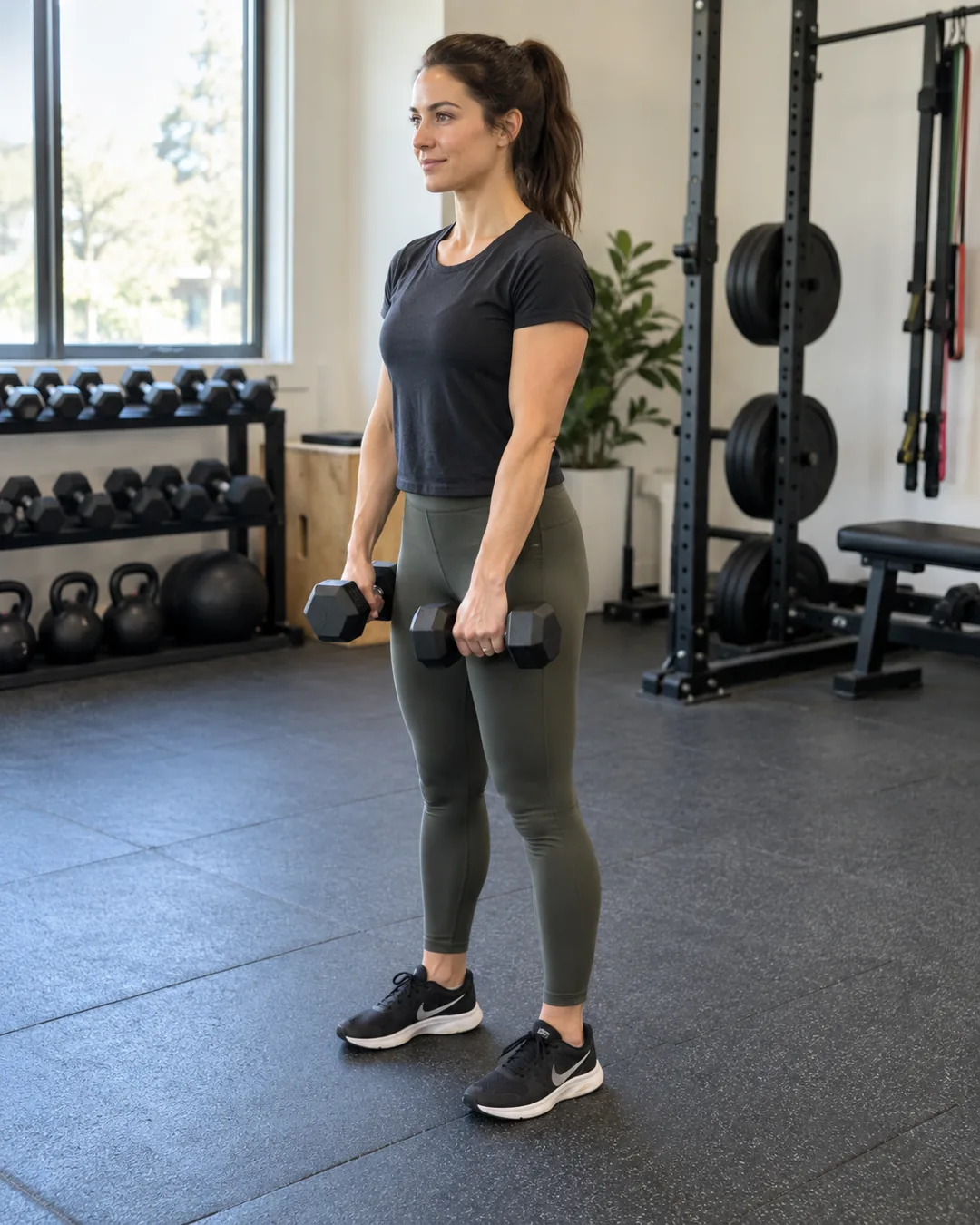
- Stand with a stable base. Hold a light dumbbell in each hand near the front or outer edge of your thighs. Keep your knees relaxed and your weight balanced through your feet.
- Set your trunk. Stand tall without pushing the ribs upward or exaggerating the lower-back arch. Keep your head comfortably aligned.
- Choose a comfortable grip. Palms can face toward the thighs at the start, or slightly inward if that feels better. Hold the handles securely with the thumbs around them.
- Lift smoothly. Raise the weights in front of you, keeping a small, consistent elbow bend. Let the arms move naturally rather than twisting the shoulders into a forced position.
- Stop around shoulder height. Use a lower endpoint if needed for comfort and control. Do not chase extra height by leaning backward.
- Lower deliberately. Return to the starting position without dropping the weights or bouncing them off your thighs.
Breathe throughout the set. A gentle exhale as the weights rise and inhale as they lower is an easy pattern to try. You should not need to hold your breath for several repetitions to finish a modest accessory exercise.
What a good repetition should look like
Imagine a side view. Your feet stay planted, the torso remains reasonably upright, and the dumbbells rise through a controlled arc. Your elbows do not suddenly bend much more halfway up. At the top, the shoulders are doing the work rather than the spine extending to place the weights higher.
Some natural shoulder-blade movement is expected when the arms lift. Do not pin the shoulder blades down so aggressively that the movement becomes uncomfortable. The aim is controlled arm movement, not freezing every part of the shoulder girdle.
At the bottom, give yourself a clear reset without using a bounce. You can pause briefly, but there is no compulsory count. At the top, a short controlled turnaround is enough; you do not need to hold the dumbbells at eye level until your arms shake.
A practical quality check is whether you could stop the weights briefly at a point during the lift. You do not have to pause every repetition, but if momentum is the only thing carrying the dumbbells upward, use less weight. Control should be visible even when the final repetitions feel demanding.
How high should you raise the dumbbells?
About shoulder height is a useful default for this version. That means the upper arms are roughly level with the floor, not that everyone must reach an identical position. Your shoulder comfort, body proportions, and chosen grip may change the endpoint slightly.
Lifting higher is a different choice, not automatic progress. If you want to train an overhead movement, use a suitable overhead exercise and learn its technique rather than extending front raises higher because a heavier-looking repetition seems more impressive.
A lower comfortable range is acceptable while learning, but write down what you are doing. Ten repetitions to chest height and ten repetitions to shoulder height are not directly interchangeable. If you gradually expand your comfortable range, consider that a meaningful change before adding load.
Do not force through a painful arc to meet a height target. If a lighter load and comfortable hand position do not resolve discomfort, stop that exercise and seek guidance when needed. A general fitness article cannot determine the cause of shoulder pain.
Palms down, neutral grip, or thumbs slightly up?
A palms-down position is common, but it is not mandatory to rotate the hands into a rigid orientation. Some people prefer palms facing slightly inward, with the thumbs a little higher. Choose a grip that lets the wrist stay in line with the forearm and the shoulder move comfortably.
Avoid the idea that deliberately tipping the thumbs downward makes the exercise more advanced. You do not need to imitate pouring water from a jug. Nor should a comfortable thumbs-up option be described as a guaranteed injury-prevention technique. Grip changes alter the movement, but they do not remove every possible source of discomfort.
Try variations with very light weights, one at a time. If one feels better, use it consistently for a few sessions before comparing performance. Do not switch the grip on every difficult repetition to squeeze out a few more.
For an original setup test, take two light repetitions with your palms mostly down, rest, then try two with the hands turned slightly inward. Ask which allows the smoother path without wrist bending or shoulder discomfort. If both feel fine, choose the simpler option. If neither feels fine, the answer may be to skip front raises rather than hunt for a special grip.
Both arms together or alternating?
Raising both dumbbells at once makes the set straightforward to count, but it can also tempt you to lean back as both weights move away from the body. Alternating allows you to focus on one arm, although the trunk must remain controlled rather than rotating with each lift.
Neither option is automatically superior. For a simultaneous version, count one repetition when both arms complete the lift and return. For an alternating version, decide whether the target is per arm and record it clearly. “Ten each side” is less ambiguous than “twenty,” especially when you review the session later.
If one side feels less coordinated, start with that side and match its clean repetition count on the other, using a manageable equal load unless a qualified professional has advised otherwise. Do not add extra heavy repetitions to a painful or unexpectedly weak side in an attempt to correct it yourself.
A single-arm version may make observation easier: you can keep your free arm relaxed and watch whether your ribs or hips turn. Avoid leaning on a movable object or grabbing equipment that is not intended as a support.
How to choose a starting weight
Use a load that feels almost too easy for the first practice set. Small muscles and long lever arms can make a modest dumbbell challenging. The number on the handle is not a score, and there is no required starting weight for men, women, or beginners.
Try a short practice set of five or six repetitions. If the final repetition requires a backward lean, a knee dip, or a sudden elbow bend, reduce the load before attempting a longer set. If you cannot control an available dumbbell, practicing the movement without external weight is a reasonable first step.
For a first working session, one or two sets of 10–15 controlled repetitions is an illustrative option. Finish with a few clean repetitions still possible. This range is not uniquely effective, and it is not a requirement to reach fifteen on the first day.
The guide to choosing dumbbell weight offers a broader decision process. For front raises, pay particular attention to the smallest available increment: going from a 2 kg dumbbell to a 3 kg dumbbell is a 50% increase, even though the absolute difference sounds small.
A simple progression without swinging
Choose a repetition range, grip, arm pattern, and endpoint you can repeat. Suppose you use two sets of 10–15 repetitions and finish before technique changes. Keep the weight steady until both sets reach the upper end with the intended control.
- First session: 12 and 10 repetitions, both stopped before leaning.
- Second session: 12 and 12 with the same range.
- Later session: 15 and 15, with a few clean repetitions still possible.
- Next decision: Try the smallest available increase, then reassess rather than assuming it will work.
If the next pair is too heavy, go back to the previous pair. There is no need to turn the exercise into a swing to justify a heavier dumbbell. You can continue practicing, use a gym with smaller increments, or decide that maintaining this accessory while progressing other exercises is enough.
A front raise does not need a weekly personal record. A stable, comfortable performance alongside improving main lifts can be a perfectly useful outcome. Do not add sets, reduce rest, increase load, and change grip all at once; you will not know which change caused the next session to feel different.
Common mistakes and what to change first
Leaning backward as the weights rise
Reduce the load and shorten the set. Think about keeping your ribs over your pelvis instead of chasing hand height. If you begin upright but finish every repetition with your chest pointing upward, the exercise has changed before the set is complete.
Using the legs to start each repetition
A small knee dip followed by a push can launch the weights. That may move a heavier pair, but it is not the controlled front raise described here. Reset, choose lighter dumbbells, and start each repetition without an intentional leg drive.
Bending the elbows more and more
A slight bend is fine. The problem is changing it dramatically as fatigue increases, shortening the lever to finish the lift. End the set when you can no longer maintain your chosen version. Do not count a bent-arm variation as identical to the earlier repetitions.
Letting the weights fall
Use a lighter pair or fewer repetitions so that the lowering remains deliberate. You do not need an extremely slow negative; simply avoid releasing control. Keep the dumbbells away from your knees and do not use your thighs as a rebound surface.
Turning every repetition into a shrug
The shoulder blades naturally move, but an abrupt shrug can become a way to start the lift when the weight is too demanding. Try a lighter load and a smooth beginning. Avoid forcing the shoulders downward as a countermeasure if that makes the movement stiff or uncomfortable.
Doing front raises despite painful pressing
A smaller-looking exercise is not automatically an appropriate substitute for a painful press. Front raises still load the shoulder. If symptoms persist, stop and seek individualized advice rather than assuming an isolation movement will solve the issue.
Where front raises belong in a session
If you choose to include them, front raises usually make sense after the main strength exercises. That lets you assess whether you still need accessory work and avoids pre-fatiguing the front shoulders before a press you want to prioritize.
An example upper-body session might include one press, one row, and a lateral or rear-shoulder exercise. Front raises could be an optional small addition, not an automatic fourth shoulder demand. If the session already includes multiple pressing movements, leaving them out may be the more useful choice.
If your goal is learning an overhead press, spend your limited practice time on an appropriate press progression. Workit’s dumbbell shoulder-press guide covers that separate skill. A front raise is not a replacement for every function of a press, just as a press does not require you to add front raises afterward.
The March 17, 2026 ACSM update supports a consistent, individualized approach to resistance training rather than assuming a complicated routine is better. It does not require this accessory or a particular shoulder-day sequence. Keep the program manageable enough to repeat.
Rest, recovery, and deciding when less is enough
Rest long enough to repeat the chosen movement. For modest accessory sets, roughly 60–120 seconds is a reasonable starting experiment; take more if breathing or local fatigue still changes your technique. Turning every set into a rushed circuit is optional, not an obligation.
Look beyond soreness when judging recovery. Can you raise your arms comfortably? Is your pressing performance stable? Are you maintaining the same range and control? A severe shoulder burn during the session is not more valuable than a small amount of work you recover from easily.
If front raises repeatedly leave your shoulders fatigued for the next planned pressing session, reduce or remove them before adding more recovery tricks. An optional exercise should earn its place. You do not have to keep it because you wrote it into a plan several weeks ago.
A useful front-raise log entry
Record the weight per dumbbell, repetitions per arm, whether the arms alternated or moved together, and one technique note. For example: “2 kg each, simultaneous, 13 and 12; shoulder-height finish, no lean.” This is an illustration of clear recording, not a recommended load.
If you change to alternating repetitions, mark that change. If you use a seated version, note the bench position. Otherwise, an apparent jump in repetitions may reflect a different variation rather than increased ability on the original one.
At the next session, read the note before picking up the weights. Your first decision might be to repeat the load, not increase it. If you cannot remember the last setup, use an easy practice set and establish a new baseline instead of guessing aggressively.
Frequently asked questions
Are front raises necessary for beginners?
No. A beginner can build a useful routine without them. They are one optional way to add shoulder work when the overall program, comfort, and available time support it.
Can I perform them seated?
Yes, if the seat is stable and allows a comfortable arm path. Sitting may make leg drive less tempting, but you can still lean or swing. Use the same control standards and treat it as a distinct variation when tracking performance.
Should I use a plate instead of dumbbells?
A plate changes your grip and constrains the hands to one object. It can be an option when held securely, but it is not inherently better. Dumbbells allow each arm to find a comfortable path and make small loads easier to select in many gyms.
What if I feel sharp pain or tingling?
Stop the exercise. Do not work through sharp pain, new tingling, or unexplained weakness. The Leeds Community Healthcare activity guidance identifies increasing pain and loss of movement or strength as reasons to stop and seek advice. Persistent symptoms deserve assessment rather than another grip experiment.
Keep the accessory useful
A good front raise is light enough to control, consistent enough to track, and optional enough to remove when it does not help the wider routine. Start with the program you already have, not with the assumption that every shoulder exercise needs a place in it. For help organizing a repeatable training routine, explore Workit’s personalized workout programs on the App Store.
Comments
One response to “Dumbbell Front Raise: Form, Weight, and When to Skip It”
[…] an extra shoulder exercise? Our dumbbell front raise guide explains a controlled isolation option. It overlaps the front-deltoid work in pressing, so first […]