
Published October 27, 2026
A cable crunch trains your abdominal muscles by curling your rib cage toward your pelvis against cable resistance. For the kneeling version, use a high pulley and rope attachment, keep your hands beside your head, and make the movement come from a controlled trunk curl rather than an arm pull or a big backward movement of your hips. Start light enough that your first and last repetitions look similar.
The useful question is not how much of the weight stack you can move. It is whether you can repeat the same comfortable curl, with the same setup, and gradually make it more challenging. This guide explains how to find that setup, choose a starting load, troubleshoot the common problems, and place cable crunches in a realistic workout.
What a cable crunch does, and what it does not do
The main action is trunk flexion: the front of your torso shortens as you curl. The rectus abdominis, the muscle running down the front of the abdomen, contributes to that movement. Other trunk muscles help control your position. Your hands connect you to the cable, but this is not meant to be a biceps curl, pulldown, or triceps exercise.
The appeal is adjustable resistance. A floor crunch uses your body as resistance; a cable lets you change the external load without holding a plate against your chest. That makes progression convenient, provided you keep the movement consistent. A heavier pin setting is not meaningful progress if the exercise turns into a kneeling bow.
Use cable crunches to practice and strengthen this particular movement, not as a promise to remove fat from your stomach. Abdominal training does not guarantee visible abs or a specific change in waist size. In a randomized study of abdominal exercise, the training improved abdominal endurance without reducing the measured abdominal fat outcomes. Your result depends on more than the choice of one exercise.
A cable crunch also does not cover every task your trunk performs. A Pallof press asks you to resist rotation; a crunch deliberately moves your trunk. Those are different training options rather than rival tests of which exercise is universally best.
Before you kneel: check the station
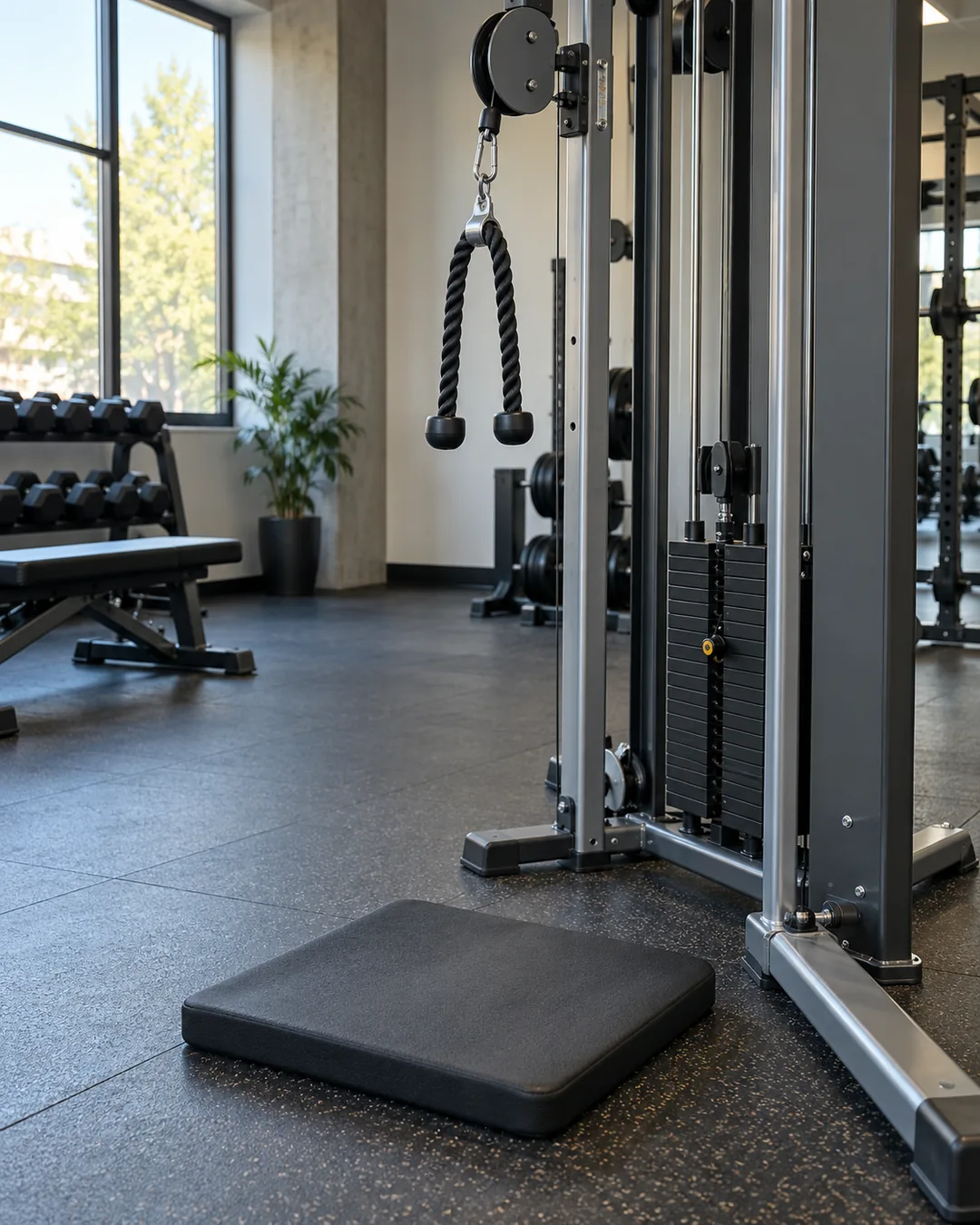
Choose a cable station designed for a high-pulley attachment. Read its instructions and ask gym staff if you are unsure how its adjustment system works. Different machines have different cable paths, attachment limits, and weight increments. Do not assume a setup copied from a video is appropriate for every station.
- Inspect the attachment. The rope and connector should be intact, and the connector should close properly. Report visible damage instead of using it.
- Set the pulley securely. Make adjustments while the cable is unloaded, then check that the locking mechanism is engaged.
- Choose a light pin setting. Put the selector pin fully into an allowed position. Do not improvise extra resistance by hanging loose weights on the stack.
- Clear your space. Leave enough room for your head, elbows, and torso to move without hitting the frame. Avoid blocking a walkway or another person’s cable path.
- Pad your knees. A firm exercise mat can make kneeling more comfortable. A thick, unstable pile of pads makes your setup harder to repeat.
If kneeling itself causes discomfort, there is no requirement to endure it. A seated abdominal machine or a suitable floor exercise may be easier to set up. The right alternative is one you can perform comfortably and control, not simply the option with the most equipment.
How to do a kneeling cable crunch
The following is a practical facing-the-machine variation. Equipment manufacturer ANCORE’s kneeling-crunch guide also illustrates the underlying distinction: abdominal curling against cable resistance, with controlled movement. Its specific facing-away setup is not a requirement for other machines; follow the directions for the station you use.
- Take the rope and lower into position carefully. Hold the rope ends securely and kneel on the mat. Do not let the selected load pull you off balance as you get down.
- Find a stable starting distance. Begin close enough to control the cable without reaching forward, but far enough from the frame that you can curl without contact. There is no universal distance measured in inches.
- Set your hands beside your temples or upper shoulders. Keep the rope clear of your neck. Your hands should travel with your upper body rather than pull independently.
- Choose a comfortable hip position. A slight bend at the hips is fine. Make a note of where you start, then avoid repeatedly sitting back onto your heels to move the load.
- Curl through your torso. Think about bringing the lower ribs toward the front of the pelvis. Your elbows move down because your torso curls, not because you yank the rope with your arms.
- Finish where you can still control the position. You do not have to touch your elbows to your thighs or your forehead to the floor. Stop the curl before you need a large hip movement or a painful forced bend.
- Return smoothly. Let your torso lengthen back to the chosen starting position without allowing the cable to snap you upward. Avoid deliberately arching into an exaggerated backward bend.
- Repeat, then exit under control. At the end of the set, return the resistance gently and stand up carefully. Keep your hands clear of moving parts.
Try an easy exhale during the curl and inhale as you return. You should not need a prolonged breath hold to complete a beginner set. If you cannot coordinate the breathing and movement, reduce the load and practice fewer repetitions.
The hip-hinge problem: how to tell whether you are crunching
A common version looks busy but changes little through the torso: the back stays almost the same shape while the entire upper body tips forward and the hips move backward. That is largely a bow at the hips. Some hip movement is normal, but it should not become the main way you move the stack.
Use a simple comparison before adding load. Without holding a cable, kneel comfortably and gently curl your ribs toward your pelvis. Notice the small change in torso shape. Then perform a light cable repetition and try to preserve that same movement. If the cable makes you abandon it immediately, the load or position needs changing.
A side-view recording can help if your gym permits filming and you can avoid capturing other people. Look for three things: a visible torso curl, hips that remain reasonably consistent, and hands that stay near the same place relative to your head. You are checking repeatability, not trying to make your body perfectly motionless.
For example, imagine the first five repetitions are controlled, but on repetition six you sit back sharply and pull the rope down with your arms. Record five clean repetitions. Counting the altered sixth repetition as progress makes the next session harder to interpret.
How much weight should you use?
There is no useful universal starting number. Cable machines use different pulley arrangements, friction, and stack labels. A setting that feels easy at one gym can feel very different at another. Your body position also changes the exercise. Treat the number as a reference for that specific station.
Start with an easy practice set. You should be able to move slowly, stop the curl without losing balance, and return without the cable pulling your arms away from your head. If you cannot, choose a lighter setting or a simpler exercise.
For a first working session, an illustrative target is one or two sets of 8–12 controlled repetitions, finishing while you believe you could perform another two or three with the same technique. That is a conservative example, not a rule that every person must follow. If eight repetitions already require strain and changing positions, the load is too demanding for that plan.
The reps-in-reserve guide explains this effort estimate. Be conservative while learning: your judgment of remaining repetitions will improve with practice, and technical failure often arrives before you have a useful reason to pursue muscular failure.
Do not choose a heavier load just because your arms can hold it. The question is whether your torso can control the exercise. It is entirely reasonable to use less resistance here than on a pulldown, row, or cable arm exercise.
A progression example that keeps the movement honest
Pick one machine, one attachment, one kneeling position, and a repeatable range. An example progression could use two sets with a target range of 10–15 repetitions. Keep approximately two controlled repetitions in reserve rather than chasing an all-out final repetition.
- Session one: 11 and 10 clean repetitions at your chosen setting.
- Session two: 12 and 11, with the same position and effort.
- Session three: 14 and 12. Keep the load unchanged.
- Session four: 15 and 15, both controlled. Consider the smallest permitted increase next time.
- After increasing: Return toward the lower end of the range. If you cannot reach it without bowing or pulling, go back down.
These numbers demonstrate a decision process, not a promised timeline. You might repeat the same performance for several sessions. You might also need to reduce the load after a break or after a demanding workout. Progress is not invalid because it is uneven.
If the smallest stack jump is large, stay at the current load longer. Do not attach a random plate or dumbbell to the machine. Use only manufacturer-approved increments. Workit’s double-progression explanation shows how repetitions and load can work together without changing everything at once.
Common mistakes and a useful first adjustment
Your arms are doing most of the work
If your elbows repeatedly bend and straighten while your torso hardly curls, reduce the resistance. Keep the hands in a comfortable fixed position relative to the head. You do not need to squeeze the rope so hard that your grip or forearms become the limiting factor, but maintain a secure hold.
Your hips move backward on every repetition
Use a lighter practice set and shorten the curl to the range you can control. Think of the torso shortening rather than your head travelling toward the floor. A smaller honest repetition is more useful for learning than a larger movement created mostly by shifting the hips.
The stack crashes between repetitions
Slow the return and check whether you have enough working cable travel. Do not step into an unsafe position merely to keep the stack suspended. Follow the station’s instructions; if the cable geometry cannot accommodate your setup, choose another station or exercise.
Your neck feels strained
Keep your head moving naturally with your upper torso rather than jamming your chin down or looking upward through the curl. Check that the rope is not pressing against the neck. Reduce the load, and stop if discomfort persists rather than treating neck strain as an abdominal training goal.
Your lower back hurts
Stop the set. Do not attempt to fix pain by forcing a deeper curl or adding more weight. A lighter or different movement may be appropriate, but persistent, sharp, or radiating symptoms warrant assessment. This guide is not a rehabilitation prescription for a spinal condition.
You feel little abdominal effort
A lack of burning does not automatically mean the exercise is ineffective. First check the movement, control, and effort. If you can complete many more clean repetitions than planned, a small load increase may eventually make sense. If your technique is inconsistent, adding weight is not the first solution.
How to fit cable crunches into a workout
For many recreational lifters, cable crunches fit near the end of a strength session, after exercises that need a fresh, stable trunk. This keeps the setup simple and avoids making abdominal fatigue an unnecessary obstacle to earlier lifts. It is a practical starting arrangement, not an absolute ordering law.
An example two-day plan could include two cable-crunch sets after the main exercises on one day, and a different trunk task on the other day. You might use a short dead-bug practice when learning to control the trunk while moving the limbs. There is no need to perform every abdominal exercise available at each session.
Allow enough rest that the next set resembles the first. About 60–120 seconds is a usable starting experiment for moderate sets; take longer if breathing, grip, or control has not recovered. Shortening rest is not automatically better, especially if it makes your repetitions progressively less consistent.
The ACSM resistance-training update published March 17, 2026 emphasizes consistent, individualized training and notes that routinely reaching failure is not necessary for the average healthy adult. It does not establish a unique ideal cable-crunch routine. Use its broad guidance without pretending that one exact rep range is mandatory.
Alternatives when the cable setup does not suit you
Floor crunch: useful when you want to practice a controlled curl without setting up a cable. It may be simpler to learn, although getting down to the floor must be comfortable.
Seated abdominal machine: can reduce the need to hold a rope and kneel. The machine still needs to fit you. Follow its adjustment instructions and avoid forcing a range because the machine permits it.
Reverse crunch: offers a different way to practice abdominal movement by controlling the pelvis. It is not a direct load-for-load substitute, so treat it as a separate exercise with its own learning process.
Anti-movement exercises: dead bugs, carries, and Pallof presses may suit a session where you want to resist motion rather than repeatedly curl. They are not automatically safer for every person, and they do not need to be added on top of an already adequate routine.
If an exercise is painful, changing equipment does not guarantee the problem is solved. Use a comfortable alternative only when it actually feels and moves better. If you are returning after injury or have been told to limit spinal flexion, ask the clinician managing your care before loading this movement.
What to record when something feels different
Suppose you return to the cable station and complete fewer repetitions than last week. Before calling it a strength loss, compare the conditions. Did you use the same pulley height, rope, kneeling distance, and rest period? Did you perform crunches after a different workout? Did you choose a slower return or a larger comfortable curl? Those changes can alter performance without showing that your training has failed.
Keep the comparison modest. Record one or two details that explain the session rather than turning every set into a technical report. “Different cable station; lighter baseline” is useful. “Two fewer reps after a longer session” may also explain why you should repeat the load instead of increasing it.
If your repetitions are becoming less controlled across several sessions, reduce the demand and review the wider routine. Adding another abdominal exercise is not the only response. You may simply need a more manageable number of sets, more rest between them, or a clearer starting position. If performance changes accompany pain or unexplained weakness, seek advice rather than trying to solve everything with programming.
A quick checklist for your next session
- Read the station instructions and secure the pulley, rope, and selector pin.
- Use enough room and comfortable knee padding.
- Choose a load you can control without pulling with your arms.
- Keep the hands near the head and the hips reasonably consistent.
- Curl the torso through a comfortable range and return smoothly.
- End the set before the movement changes substantially.
- Record the machine, setting, repetitions, and one useful technique note.
A useful note might say: “High pulley, rope, two sets of 12 and 11; last repetition still controlled.” That tells you more than “abs done.” If the gym changes the cable machine, begin with a new baseline rather than treating the old number as a target you must match.
Frequently asked questions
Should I face toward or away from the machine?
Both setups exist, but they change the cable path and your available space. Use the version intended for your equipment and the one you can control without the rope contacting your neck or the frame obstructing you. Do not switch direction halfway through a progression and compare the numbers as if nothing changed.
Should my elbows touch my knees?
No. Body proportions and setup affect where the elbows finish. Chasing contact can encourage excessive hip movement. Use a comfortable torso curl as your reference, not a compulsory elbow-to-knee target.
Can I do cable crunches every day?
You do not need to. Start with a manageable amount within your overall strength routine, then assess recovery and performance. More frequent practice is not useful if it leaves you sore, changes your technique, or crowds out the rest of your training.
Is a heavier cable crunch always better?
No. Added resistance is useful only when you can control the intended movement. A lighter set with repeatable repetitions is easier to assess than a heavy set dominated by momentum and changing positions.
When should I stop?
Stop for sharp or increasing pain, new numbness, weakness, dizziness, or a loss of control. The Leeds Community Healthcare return-to-activity guidance distinguishes normal reintroduction of activity from warning signs such as increasing pain and loss of movement. Seek appropriate care for concerning symptoms; do not use a workout guide to diagnose them.
Make the next set easier to repeat
The best starting cable crunch is a controlled one you can recognize and reproduce. Keep the setup steady, record clean repetitions, and change the load only when the current version is consistently manageable. To explore Workit’s current workout tools, visit Workit on the App Store. Choose a tracking method you will actually use, and let your notes guide the next session rather than the size of the stack.