
Published October 11, 2026
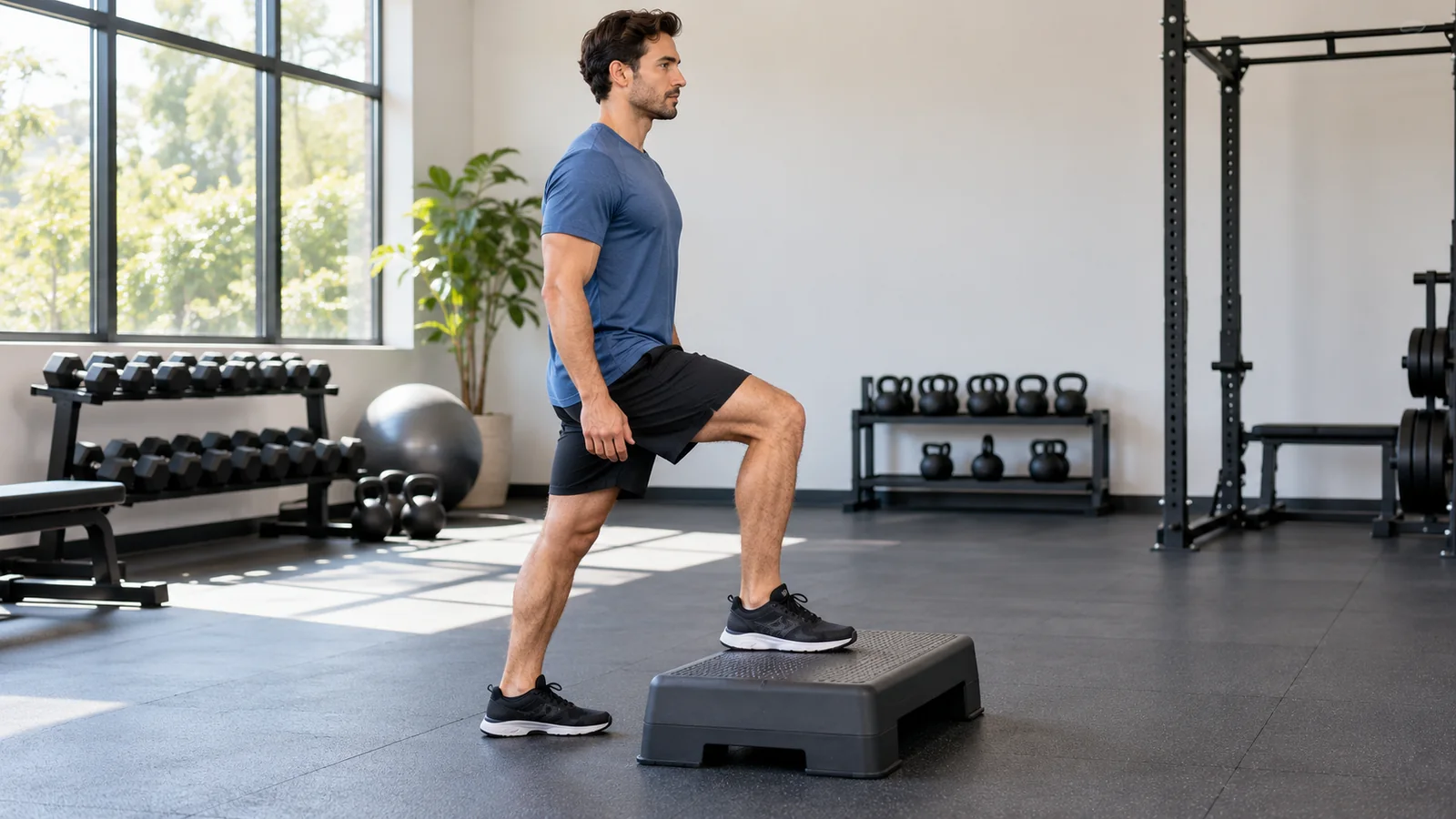
To do a step-up exercise, place one whole foot on a low, stable platform, push primarily through that lead leg, and stand up smoothly. Return the other foot to the floor under control, then repeat or switch sides. Start with bodyweight and a step low enough that you do not need to jump, twist, or pull yourself upward.
Step-ups train the legs while giving each side a clear job. Their usefulness depends less on finding the tallest box and more on choosing a height, load, and repetition style you can control. This guide covers technique, muscles worked, common mistakes, and practical programming for home or gym workouts.
What muscles do step-ups work?
The lead leg’s quadriceps help straighten the knee, while the glutes and other hip muscles contribute to lifting and controlling your body. The calf, foot, trunk, and muscles around the hip also help you stay balanced. The exact demands change with step height, added weight, speed, and assistance from the trailing leg.
The Mayo Clinic step-up demonstration describes the exercise as lower-body conditioning that involves the thighs and buttocks. Its practical priorities include full-foot contact and smooth movement, with form taking priority over platform height.
You may feel step-ups most strongly in your front thigh on one day and around your hip on another. Sensation alone cannot tell you exactly how much work a muscle is doing. Judge the exercise by your intended movement, a manageable challenge, and progress over time.
It is also possible for balance or breathlessness to end the set before your legs are meaningfully challenged. That is useful feedback when choosing a lower step, a hand support, or a different repetition arrangement.
Choose a platform you can trust
Use a purpose-built exercise step, a securely installed stair, or another load-rated platform suitable for stepping. The surface should be large enough for your entire foot, level, dry, and resistant to slipping or tipping.
A dining chair, rolling bench, soft ottoman, or stack of loose objects is not a reliable substitute. A surface can feel sturdy while you stand next to it yet shift when your weight lands near an edge. Check the setup before every session.
Leave space behind and beside you for the return to the floor. Remove bags, loose weights, pets, and anything that could catch your foot. If you use stairs, choose a clear bottom step rather than a position where losing balance would send you down a flight.
A secure rail or fixed support within easy reach can make early practice more manageable. Do not use a lightweight chair back or movable rack attachment as a handhold. If the setting does not allow a safe setup, choose another exercise.
How high should the step be?
Begin low enough that you can rise without a jump from the floor or a large shift of your body. For some people, an ordinary stair is already challenging. Others may need a lower exercise platform. There is no required starting height in inches that suits everyone.
Place one foot on the step and pause before moving. Can you keep the foot flat, bring your weight forward smoothly, and lift without excessive effort? Can you reverse the movement with the same control? If either direction feels unreliable, lower the platform.
A thigh positioned around horizontal is sometimes used as an assessment or training reference. It is not a minimum requirement for a beginner workout. Your leg length and current ability matter more than matching a photograph.
Increasing height changes your starting joint angles and the movement you must complete. Treat a taller step as a progression of its own. Do not simultaneously increase the height, add heavy dumbbells, and attempt more repetitions.
Step-up form: a complete repetition
- Start close to the platform. Stand with feet comfortably apart, facing the step. Keep any hand support within reach.
- Plant the lead foot. Place the whole foot on the surface, leaving enough room that neither the heel nor toes hang over an edge.
- Shift toward the lead leg. Let your body move slightly forward as needed. Keep your knee moving generally in the direction of your toes.
- Rise smoothly. Push primarily through the planted leg. Bring the trailing foot up to join it if using the two-feet-on-top version.
- Stand comfortably tall. Finish with control rather than leaning backward or snapping the knee.
- Lower the trailing foot. Bend the lead knee and hip as you return the other foot to the floor. Avoid simply dropping off the platform.
- Reset. Keep the lead foot planted for same-side repetitions, or step fully down before changing the lead leg.
The ACE step-up guide also emphasizes monitoring the foot and knee and controlling the descent. For your first few sessions, choose one repetition style and keep it consistent so you can judge the task accurately.
How much should the back leg help?
The trailing leg will often contribute some assistance as you leave the floor. You do not need to achieve a laboratory-perfect isolation of the lead leg. The practical goal is to avoid turning the exercise into repeated jumps from the rear foot.
Watch for a forceful ankle push, a bounce, or a quick hop immediately before your body rises. If those become the main way you reach the top, the step may be too high, the weight too heavy, or the set too long.
Try a brief pause with your lead foot planted before each repetition. Move your body toward that leg, then stand smoothly. If you cannot do this at all, lower the step instead of demanding that the trailing leg become completely passive.
A light touch on a secure support can reduce the balance challenge. Use it consistently and record the assistance. Pulling hard on a rail changes the exercise substantially, although assisted stepping can still be useful when it is intentionally chosen.
Control the step down as carefully as the step up
The return to the floor is part of the repetition. Keep enough control to place the trailing foot where you intend, then accept your weight smoothly. Your descent does not need to be extremely slow, but it should not feel like a fall you catch at the bottom.
A useful beginner cue is to make the landing quiet. This is a coordination target, not a claim that every audible footstep is harmful. If you repeatedly land heavily, reduce the height or repetitions and see whether control improves.
Do not reach the trailing foot far behind you just to avoid bending the lead knee. That changes your balance and may encourage twisting. Place the foot on a comfortable part of the floor near your starting position.
If the ascent is easy but the descent is difficult, choose the height based on the harder direction. Being able to climb onto a tall box does not establish that you can train it safely for repeated sets.
Should you alternate legs or finish one side first?
Both arrangements can work. Alternating legs gives each side a brief break between repetitions and resembles ordinary stair stepping. Same-side sets make it easier to focus on one movement pattern and notice when that leg begins to fatigue.
For same-side sets, keep the lead foot on the platform, return the trailing foot to the floor, and repeat. After completing the planned repetitions, step fully down and switch. Pause between sides if needed to restore balance and breathing.
Count clearly. Eight repetitions per leg means sixteen total step-ups. Two sets of eight per leg means thirty-two total repetitions across both sides. In your log, write “2 × 8 each side” rather than an ambiguous “16 reps.”
Start with the less confident side if that helps you select a manageable dose, then match that number on the other side. Do not automatically add extra sets to a side you consider weaker without understanding why it feels different.
Common mistakes and the simplest adjustments
The platform is too high
If you twist your pelvis, swing a leg dramatically, or hop from the floor, try a lower step. A taller box is not proof of a better workout. It may simply make your technique harder to repeat.
Only part of your foot fits on the step
Reposition before starting, or use a larger platform. Hanging your heel over the edge changes the support available to you. Do not try to correct an unstable foot placement halfway through a loaded repetition.
Your knee suddenly moves inward
Reduce the difficulty and check your foot placement. Aim for a controlled path that generally follows your toes. Small movement is not automatically dangerous, but a repeated loss of control is a reason to adjust the set.
You lean backward at the top
Finish standing rather than arching your back to show that you reached the top. Keep the load by your sides and your ribs roughly over your pelvis. A modest forward lean during the climb is different from an uncontrolled backward finish.
You rush to complete the count
End the set when you can no longer place your feet reliably. More repetitions are not useful if every one requires a new balance recovery. Reduce the target and build it back gradually.
Add dumbbells only after the bodyweight version is stable
Start with a light dumbbell in each hand, arms comfortably by your sides. Keep the weights clear of the platform and your legs. They should not swing forward to provide momentum as you rise.
If you still need a hand support, do not give it up just to hold two weights. Stay with bodyweight or ask a qualified coach to help choose an appropriate supported loading option. Safety and a useful leg challenge matter more than using a particular implement.
Use a load that preserves your step height, foot placement, and controlled return. Our guide to choosing dumbbell weight explains an effort-based approach. The dumbbells you use for squats or carries are not automatically suitable for step-ups.
A weighted vest changes the loading arrangement and must fit securely. A barbell adds further balance and setup demands. Neither is a necessary beginner progression, and an unstable backpack can be more distracting than helpful.
Beginner sets, repetitions, rest, and frequency
For a first session, try one or two sets of five to eight repetitions per side using a low step. Rest long enough that the next set begins with steady legs and comfortable breathing. One to two minutes is a reasonable starting window, with more rest when needed.
Once the movement feels familiar, two or three sets of six to twelve repetitions per side can provide a practical training range. These are general starting options rather than a step-up-specific research optimum. Finish while you still have control, especially when holding weights.
You could include step-ups on one or two days of a broader strength routine. Consider how much other leg training, hiking, running, or stair climbing you already do. A new exercise does not arrive without a recovery cost simply because it uses bodyweight.
The ACSM’s 2026 resistance-training summary encourages training major muscle groups regularly and building gradually. It does not require every workout to contain step-ups or prescribe one ideal platform height.
A progression example you can actually compare
Imagine that you comfortably perform two sets of six repetitions per leg on a 15-centimeter exercise step. You use bodyweight and a light touch on a fixed rail. These numbers illustrate a progression, not a required starting standard.
- Sessions one and two: Repeat the same setup. Concentrate on reliable foot placement and a smooth return.
- Sessions three and four: If control remains good, move toward eight repetitions per leg.
- Next progression: Choose one change: slightly less hand assistance, a small load, or a modest height increase.
- After the change: Return to fewer repetitions and reassess both directions of the movement.
Suppose you add two 3-kilogram dumbbells. Record “3 kg each hand,” not simply “3 kg,” because the latter is unclear. Keep the original step height while you learn the loaded version.
You might stay at the same height for months and still progress through better control, more repetitions, or additional load. Height is only one variable, and it is often the least convenient one to adjust in small increments.
What to record in your workout log
Step-ups are easy to miscompare because several details can change between sessions. Record the platform height or exact equipment, added load per hand, repetitions per side, number of sets, and whether you used support.
Also note whether you alternated sides or completed one side at a time. If your trailing foot joined the lead foot at the top last session but hovered this session, you changed the balance demand. Keep that distinction visible.
A useful entry might read: “Low black step, bodyweight, two sets of eight each side, same-side sets, rail fingertip support, controlled lowering.” The next session then has a clear reference.
Our workout log template can help you organize those details. You do not need to calculate a single volume score that combines height, bodyweight, and dumbbells. A clear description is often more useful than a complicated number.
Are step-ups good for glutes?
Step-ups involve the glutes, but a claim that they are universally the best glute exercise goes beyond the evidence. Study results depend on which version is tested, the loading, the participants, and the outcome measured.
For example, a small study of weight-bearing exercises recorded gluteal muscle activity during squats, step-ups, and step-downs. Another study in older adults comparing forward and lateral step-ups found differences in gluteus medius activity between directions.
These were muscle-activity studies, not long-term comparisons showing which exercise produced the most muscle growth. Their findings help describe exercise demands but do not justify a universal ranking.
For practical training, choose a version you can load and repeat comfortably. If balance consistently prevents meaningful leg effort, a supported variation or another exercise may suit your current goal better.
Step-ups versus squats, split squats, and lunges
A squat uses both feet on the floor throughout the repetition. It may be easier to standardize when you are learning to handle an external load. A goblet squat is one option when you have a dumbbell but no suitable step.
A split squat keeps you in a staggered stance, while a lunge usually includes stepping into or out of that position. These movements have different balance and space demands. Our split squat versus lunge comparison covers those choices.
A step-up adds an elevated surface and a deliberate climb. It can be a useful way to practice that task, but it does not automatically correct every left-right difference or replace all other leg exercises.
Choose based on the equipment you can use safely and the movement you want to improve. You can also rotate options across sessions without treating them as competitors for a single permanent place in your routine.
Variations worth considering after the basic version
Supported step-up
Use a secure handhold to reduce the balance demand. This is a legitimate training choice, especially when learning the movement. Be consistent about how much assistance you use so progress is easy to interpret.
Lateral step-up
Stand beside a low platform and step sideways onto it. Rehearse the foot placement without weight, and ensure the surface is wide enough. A direction change adds a new coordination task, so lower the difficulty initially.
Step-up with a pause
Pause briefly after placing the lead foot or at the top. Choose a version you can balance comfortably. A single-leg pause at the top is harder than bringing both feet together and is optional.
Conditioning step-ups
Light, rhythmic stepping can be used within a conditioning session. Choose a low platform and a pace that preserves foot placement. Avoid combining fatigue, heavy dumbbells, and rushed transitions when you are still learning.
When to change the exercise or get help
Stop if stepping causes sharp pain, repeated giving way, dizziness, or a feeling that you cannot place the foot safely. Lowering the height or removing weight may make an exercise more manageable, but it does not explain persistent symptoms.
If you are recovering from surgery or a recent injury, use the step height and assistance recommended by your clinician. General workout advice cannot replace a rehabilitation plan, and “functional” does not mean appropriate for every stage of recovery.
For a crowded gym, a missing platform, or a day when balance is unreliable, substitute a familiar floor-based leg movement. You can also do upper-body training and return to step-ups another day. There is no benefit in improvising a questionable surface to preserve the exercise name in your plan.
Frequently asked questions about step-up exercise
Can step-ups build muscle with bodyweight?
They can provide a meaningful challenge, especially when you are new to strength training. As they become easy, you may need additional repetitions, load, or another progression. A bodyweight exercise still needs sufficient challenge and consistency to keep producing adaptation.
Should my knee stay behind my toes?
Do not force a vertical shin at the cost of an awkward movement. Some forward knee travel may occur naturally. Prioritize stable foot contact, controlled movement, and a comfortable range; follow individual clinical guidance when relevant.
Can I do step-ups and carries in one workout?
Yes, if the total workload is manageable. Complete controlled step-ups before your balance or grip becomes heavily fatigued. A short farmer’s carry can fit later in the session when you still have a clear path and steady walking.
Start with the step you can control
Pick a stable, low platform and practice a few repetitions on each side. Build the habit of full-foot placement, a smooth climb, and a controlled return. Record the setup before progressing one variable at a time. If you would like to look at the app, explore Workit.