
Published October 11, 2026
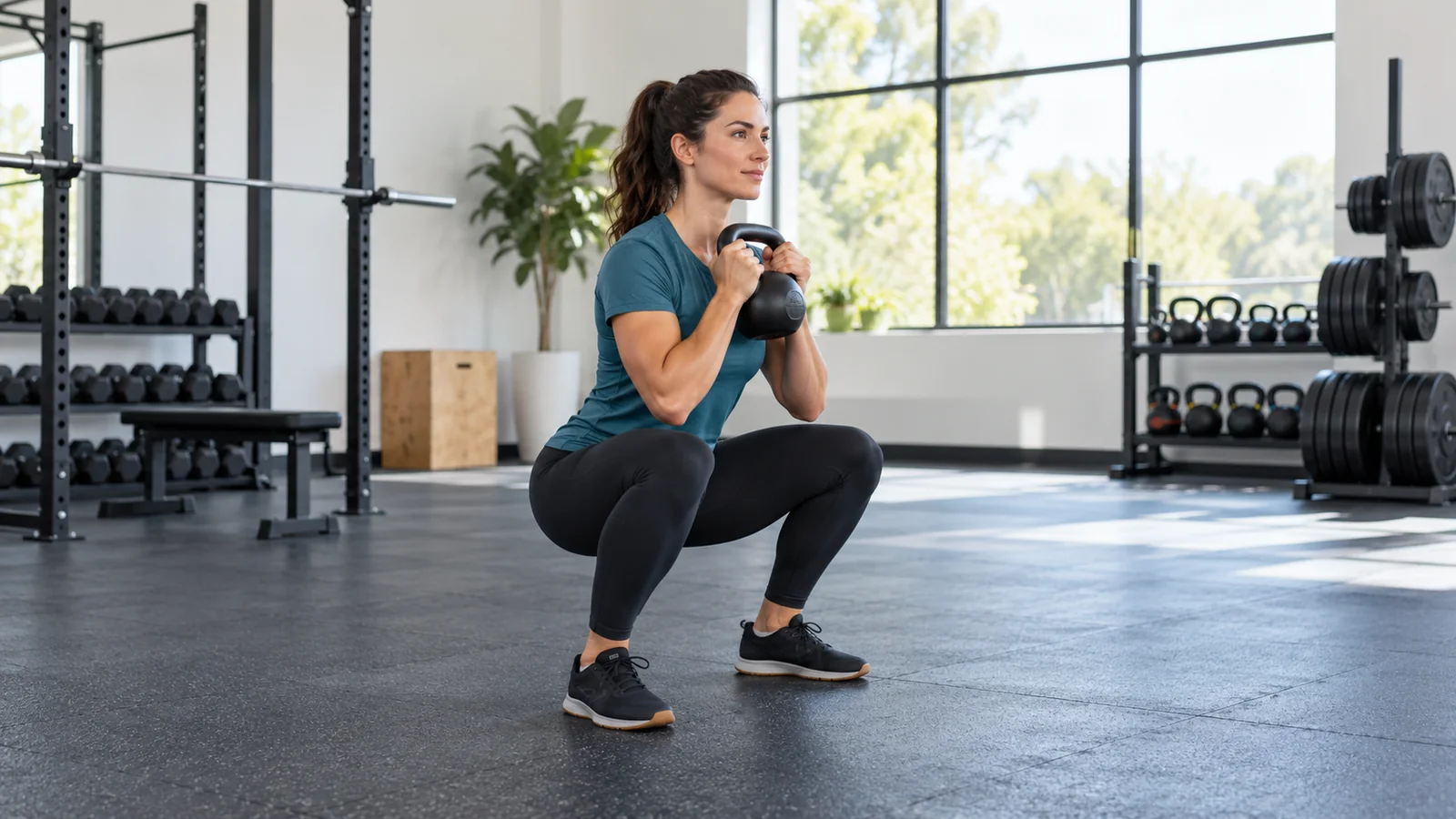
Good goblet squat form starts with a weight held close to your chest, feet planted firmly, and a controlled bend at your hips and knees. Lower as far as you can comfortably control, let your knees move in the same general direction as your toes, then stand without letting the weight pull you forward. Begin light enough that your grip, balance, and breathing stay manageable.
The goblet squat is useful when you want a straightforward lower-body exercise with one dumbbell or kettlebell. The details that matter most are choosing a workable stance, finding your current depth, and repeating that movement as the set gets harder. This guide explains those decisions and gives you a practical way to progress.
What is a goblet squat, and which muscles does it work?
A goblet squat is a squat performed while holding one weight in front of your chest. With a dumbbell, you usually support the underside of its upper head. With a kettlebell, you can hold the sides of its handle. Your elbows point generally downward, and the load stays close rather than hanging at arm’s length.
Your quadriceps straighten your knees as you stand. Your glutes and other hip extensors contribute at the hips, while your trunk and upper body help support the weight. Your arms can become the limiting factor before your legs do, especially as the dumbbell becomes larger.
The NASM goblet squat guide describes the movement as a front-loaded lower-body exercise emphasizing the quadriceps and glutes. That basic description is useful; claims that one position automatically fixes everyone’s squat deserve more caution.
A study comparing goblet and landmine squats found differences in muscle activity and forces under its specific test conditions. It measured an exercise session, not months of muscle growth. It therefore does not establish a universally superior squat or a guaranteed result for your body.
Set up your equipment before lifting
Choose a level, nonslip surface with enough room to squat and set the weight down. Avoid a busy walkway. Wear footwear that feels stable under load; a very soft, unstable sole can make balance harder to judge. You do not need special lifting shoes to begin.
Inspect the dumbbell or kettlebell. Its handle should be dry, and adjustable equipment must be fully secured according to its instructions. Do not support a loose plate, removable collar, or uncertain attachment beneath your chin.
Getting the weight into position is part of the exercise. For a light dumbbell, bring it close with both hands using a controlled pickup. If you need to swing, heave, or awkwardly curl it into place, choose a lighter implement or ask a qualified trainer to show an appropriate setup.
Plan the finish too. Leave enough space to lower the weight with both hands after the last repetition. A set is too ambitious if you can complete the squat but cannot safely put the load away.
How to do a goblet squat: six clear steps
- Find a comfortable stance. Start around shoulder width, with a modest toe turnout if that feels natural. Make small adjustments rather than forcing both feet perfectly straight.
- Bring the weight close. Hold it securely near your upper chest. Keep your wrists comfortable and your elbows beneath or slightly beside the weight.
- Prepare your trunk. Take a comfortable breath and gently tighten your midsection. Keep your ribs roughly over your pelvis instead of lifting your chest into a large back arch.
- Lower under control. Bend your hips and knees together. Keep your whole foot in contact with the floor and allow your torso to incline naturally.
- Stop at your controlled depth. Reverse before you lose balance, develop pain, or need a sudden change in body position to get lower.
- Stand and reset. Push the floor away, straighten your hips and knees, and finish tall without leaning backward. Take the next breath and repeat.
For an initial practice set, use three to five easy repetitions. Notice whether your last repetition looks and feels similar to the first. You can make a small stance adjustment between sets rather than experimenting while holding a challenging load.
Choose your stance by what you can repeat
There is no single foot width that makes every person’s goblet squat correct. Limb proportions, available joint motion, and the shape of the implement all affect what feels workable. Your aim is a stable, comfortable movement you can reproduce.
Try a simple comparison without weight. Perform three squats at a comfortable stance, then move each foot slightly outward and repeat. Finally, make a small toe-angle adjustment. Keep the option that lets you lower and stand smoothly while maintaining foot contact.
Do not keep widening your stance just to chase depth. An extremely wide position can create a new restriction. Similarly, aggressively twisting your feet into the floor can turn a helpful stability cue into unnecessary tension.
Research examining squat stance widths and foot angles found that setup changes alter movement and loading. It supports taking stance seriously, but it does not supply one ideal angle for every lifter. Individual trial, symptom response, and coaching remain useful.
How deep should a goblet squat be?
Use the deepest range you can currently control comfortably with your feet stable and the weight secure. Thighs around parallel can be a practical reference, but parallel is neither a required starting point nor a reason to push through a painful position.
Depth should emerge from the movement you can perform. If your heels lift or you lose your position well above parallel, shorten the range and investigate the cause. If you can comfortably descend farther while staying balanced, there is no need to stop simply because you reached an imaginary line.
A stable box or bench behind you can give you a repeatable target. Lightly touch it, then stand. Choose a height that suits your current movement, and avoid collapsing onto the surface or rocking backward to create momentum.
When comparing sessions, keep your depth consistent. Ten deeper, controlled repetitions and ten shallow repetitions at the same weight are different tasks. Increasing depth can be genuine progress, even before you add load.
Can your knees go past your toes?
Your knees may move beyond your toes during a comfortable squat, depending on your proportions, stance, and depth. The toe line is not a universal safety boundary. Try to maintain stable feet and a controlled knee path instead of forcing your shins to remain vertical.
A small study of barbell squats found that restricting forward knee movement changed how load was distributed between the knees and hips. It involved seven trained men and a barbell, so it cannot diagnose your squat or establish injury risk. Its useful lesson is that changing one joint position redistributes demands elsewhere.
If forward knee travel is painful, reduce the load or depth and seek individualized advice when necessary. Do not use a general technique statement to override symptoms or a clinician’s specific rehabilitation instructions.
Breathing and bracing without overcomplicating the rep
For light to moderate practice, take a breath before lowering, maintain comfortable abdominal tension, and exhale as you stand. Reset between repetitions as needed. You should not need to hold your breath through an entire set.
Think of making your middle steady enough to support the load. Excessively sucking your stomach inward, flaring your ribs, or squeezing every muscle as hard as possible can make a simple set harder to coordinate.
Some experienced lifters use different breathing strategies for heavy efforts. A beginner does not need to copy those strategies to learn a goblet squat. If you have been advised to avoid straining or breath holding because of a medical condition, follow that advice and discuss appropriate loading with your clinician.
Stop and put the weight down if you feel dizzy, faint, or unusually short of breath. Breathing is part of keeping control, not another challenge to win.
Common goblet squat problems and useful first adjustments
Your heels lift
Try a lighter weight, slightly different stance, and a shallower range. Pay attention to pressure across your heel and the bases of your big and little toes. Avoid intentionally lifting your toes and balancing entirely on your heels.
A stable squat wedge or appropriate lifting shoe can change the setup, but an improvised stack of slippery objects is a poor substitute. Heel elevation also changes the exercise; record it so future sets are comparable.
The weight drifts away from your chest
Bring the load closer before the next repetition. If your arms cannot maintain that position, end the set. A lighter weight often lets your legs receive more useful work because you can complete the intended range without fighting the implement.
Your knees move inward as the set gets harder
Small movement is not automatically an injury, but a sudden loss of control is a reason to reduce difficulty. Shorten the set, lower the load, and check whether your feet and knees move together comfortably. Avoid forcing your knees outward as far as possible.
Your chest drops sharply
Some forward torso inclination is normal. A large, sudden change late in the set may indicate fatigue or an unsuitable load. Repeat with less weight and compare your first and final repetitions before deciding that you need a mobility routine.
You feel pinching or sharp pain
Stop that repetition rather than pushing deeper. Adjusting stance or range may help some people, but recurring pain, swelling, instability, or symptoms that affect daily activities warrant assessment. An online checklist cannot tell you which tissue is involved.
How heavy should your goblet squat be?
Choose a load that allows the target repetitions with stable technique and several controlled repetitions still available. For a new lifter, the first session may use a very light dumbbell or no external weight at all.
Test the load with six easy repetitions. Ask three questions: Could I repeat the same depth? Could I hold the weight securely? Could I complete another few repetitions without changing the movement? If any answer is no, reduce the weight.
A bodyweight percentage or someone else’s dumbbell number can be misleading. Two people of the same size may have very different experience, mobility, grip, and confidence. Our guide to choosing dumbbell weight explains how to use performance rather than guesswork.
If your legs feel capable but your wrists or arms consistently end the set, the goblet position may be reaching its practical limit. You can use another squat variation, a suitable machine, or a single-leg exercise rather than forcing increasingly awkward pickups.
Sets, repetitions, rest, and weekly frequency
A practical starting prescription is two sets of six to ten repetitions, with enough rest to regain comfortable breathing and repeat your technique. Around one to two minutes may work for easy sets; harder work may need longer. These are starting options, not a tested optimum for every person.
After a few successful sessions, you might use two or three sets of eight to twelve repetitions. Keep a couple of controlled repetitions in reserve instead of routinely continuing until you cannot stand. The reps-in-reserve guide explains how to judge that margin without pretending it is perfectly precise.
The 2026 ACSM resistance-training position stand supports progressive training across major muscle groups and does not identify momentary failure as consistently necessary. It is broad resistance-training guidance, rather than a goblet-squat-specific prescription.
Two lower-body training opportunities per week can be a manageable arrangement. Count your other squats, lunges, and leg exercises when deciding how much to add. Start with less if you are returning after a break.
A four-week example that keeps progression simple
Consider a hypothetical beginner who can perform two sets of eight controlled repetitions with one 8-kilogram dumbbell. The number is an example, not a recommended starting weight.
- Week one: Practice two sets of eight twice during the week. Keep the same stance, depth, and load.
- Week two: If both sessions felt manageable, try two sets of nine. Repeat eight when recovery or technique is less reliable.
- Week three: Aim for two sets of ten without losing the original movement quality.
- Week four: If ten repetitions remain controlled with a useful reserve, try the next manageable load and return to six to eight repetitions.
The calendar does not require an increase. You can repeat any week. If the next dumbbell is a large jump, continue building repetitions within your chosen range or use a modest pause with the current weight before changing exercises.
Progression should leave a clear explanation in your training record. Our double-progression guide covers increasing repetitions before load in more detail.
Useful variations and when to choose them
Goblet squat to a box
Use a stable surface as a depth target when consistency or confidence is the main challenge. Set it before picking up the weight. Touch down gently, or use a deliberate sit-to-stand version if that is your intended exercise. Record which version you used.
Paused goblet squat
Pause briefly at a comfortable bottom position, then stand without bouncing. This makes momentum easier to notice. Reduce the load or repetitions first, because adding a pause changes the difficulty even when the dumbbell stays the same.
Heel-elevated goblet squat
A secure heel wedge may make a certain range more accessible. Start with a small elevation and a light load. It is an equipment choice rather than proof that your ankles are defective, and it is optional when the flat-footed version already works.
Another lower-body movement
If holding a weight at your chest is uncomfortable, a step-up can provide a different lower-body challenge using a low, stable platform. It introduces its own balance and setup demands, so begin with bodyweight instead of transferring your squat load automatically.
Fit goblet squats into a complete workout
A simple full-body session might include goblet squats, a row, a press, a hip-hinge exercise, and an optional carry. Put the movement you most want to practice early enough that fatigue does not dominate your technique.
For example, perform two sets of goblet squats, two sets of a supported row, and two sets of an incline push-up. Add a familiar hinge if you have the time and recovery capacity. Finish with a short farmer’s carry only if your grip and walking remain steady.
This is a session structure, not a requirement to learn several unfamiliar exercises at once. If squatting is new, you can keep the rest of the workout familiar and introduce one skill at a time.
Long, breathless circuits can make it difficult to tell whether your squat load is appropriate. When form is the priority, ordinary sets with deliberate rest often make feedback clearer.
Adjust the session when you are tired or sore
Your planned weight is a starting point for the day. After a few minutes of comfortable general movement, try several bodyweight squats and a light practice set. Compare them with your usual movement before deciding what to load.
If yesterday’s hike has left your legs tired but movement is comfortable, repeat the previous load or remove one work set. If your warm-up already feels unusually difficult, use a lighter session. You do not need to compensate by adding extra repetitions at the end.
Distinguish ordinary muscle soreness from a movement that causes sharp or worsening pain. A squat session should not become a repeated test of whether a painful spot will finally settle. Stop the aggravating exercise and get appropriate advice if the problem persists.
One easier session does not erase progress. A useful training record includes the reason for the adjustment, such as poor sleep, a demanding previous workout, or a different dumbbell. That context makes your next decision more accurate than judging the number alone.
A quick self-check before adding weight
If filming is allowed and you are comfortable doing it, record a short set from the side or a front diagonal. Place the phone safely outside the movement area. Review broad patterns rather than trying to diagnose joint angles from a single camera view.
- Does the weight remain close and secure?
- Do your feet stay planted throughout the repetition?
- Is your depth reasonably consistent?
- Can you stand without a sudden shift or backward lean?
- Do the last repetitions resemble the first?
Pick one improvement for the next set. Trying to control ten cues at once can make a straightforward movement feel unnecessarily complicated. A qualified coach can help when you cannot tell which adjustment matters.
Frequently asked questions about goblet squat form
Should I feel goblet squats in my arms?
Some arm and upper-back effort is expected because you are supporting a weight. If that effort stops every set before your legs receive a useful challenge, reduce the load for practice or choose a squat variation with a different loading position.
Are goblet squats only for beginners?
No. Experienced lifters can use them for warm-ups, moderate-load training, or a convenient home workout. Their main limitation is often how much weight you can comfortably hold and position, rather than whether the movement is advanced enough.
Do my elbows have to touch my knees?
No. That contact may occur for some people, but it is not a depth standard. Keep enough space that your arms do not force your knees into an uncomfortable position. Judge the squat by control and a repeatable range.
Can I do goblet squats every day?
Daily easy practice and daily challenging training are different. Begin with a schedule that allows recovery, especially when the movement is new. Persistent soreness, worsening performance, or joint symptoms are reasons to reduce the workload and reassess.
Your next session
Choose a manageable load, perform a brief practice set, and find a depth you can repeat. Complete two controlled work sets, noting the weight, repetitions, and any setup detail that helped. Build from those observations instead of rushing toward a heavier dumbbell. If you would like to look at the app, explore Workit.