
Published October 28, 2026
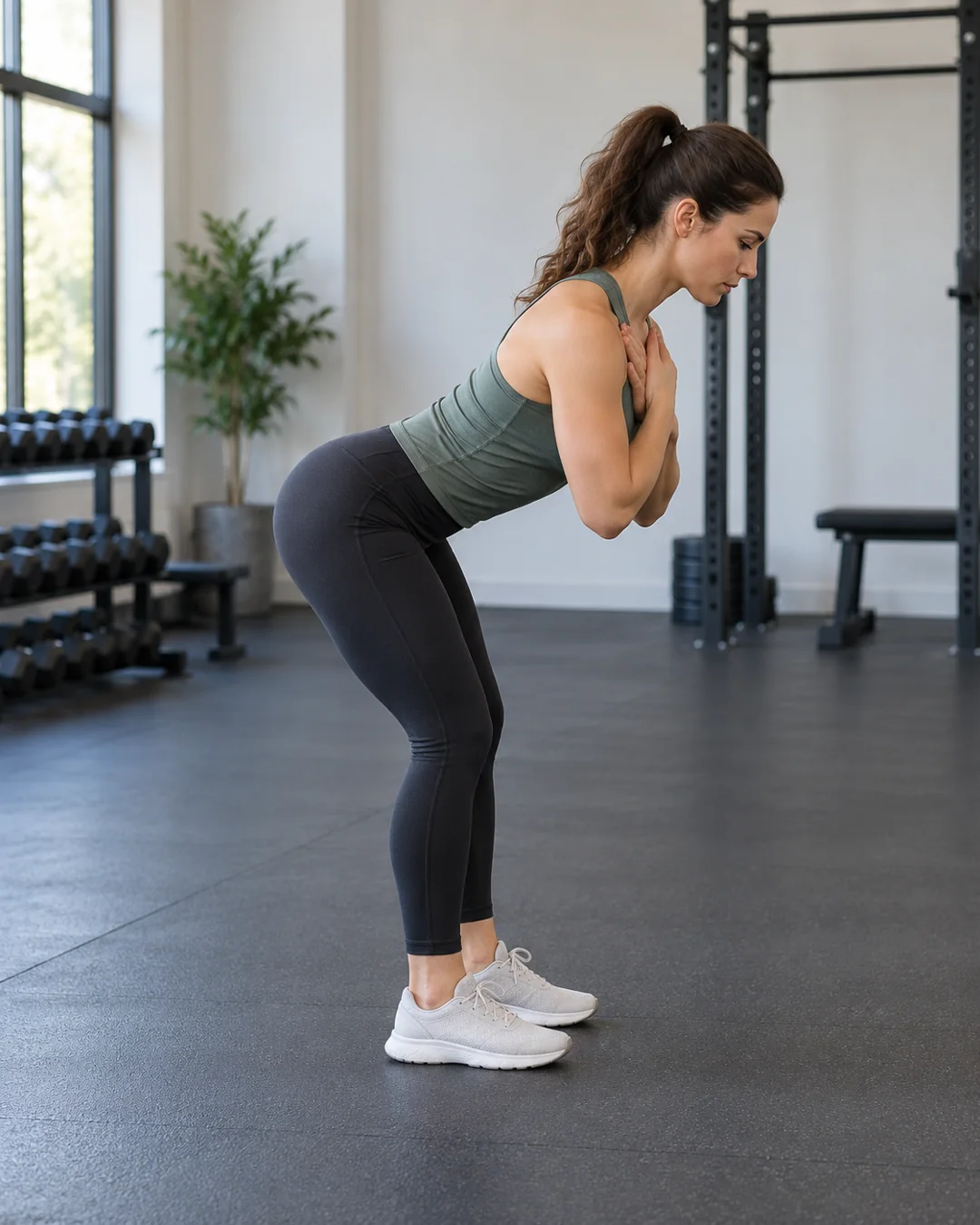
The good morning exercise is a controlled hip hinge: soften your knees, move your hips backward, and incline your torso while keeping your trunk organized. Stand back up without leaning behind your heels. Learn the pattern unloaded before considering a barbell across the upper back. Your range ends where you can still control the movement—not where your torso reaches an arbitrary angle.
A loaded good morning is not a compulsory beginner exercise. It places the weight on your upper back rather than in your hands, making setup and control particularly important. This guide explains the movement, how to rehearse it, when another hinge is a better choice, and how to avoid turning progression into a contest of depth or weight.
What makes a good morning different?
In a good morning, the hips travel backward as the torso inclines, then return you toward standing. The knees bend modestly and remain relatively consistent instead of moving through the larger bend of a squat. The exercise challenges the back of the thighs and hips while the trunk manages the changing position of the load.
The NASM good morning exercise entry identifies the barbell version as a challenging option for intermediate to advanced exercisers. It describes a hip-driven movement with a secure upper-back bar position and emphasizes controlling load and spinal position. That is a reason to approach loading deliberately, not a reason to assume everyone must eventually perform it.
The central difference from a Romanian deadlift is where you hold the weight. An RDL places the load in your hands; a barbell good morning supports it across the upper back. That changes the setup, leverage, and ways an unsuccessful repetition can become difficult. The weights you use are not interchangeable.
If your main question is which deadlift variation to choose, read the Romanian deadlift versus conventional deadlift comparison. Here, the focus is specifically the good morning: its rehearsal, upper-back loading, range decisions, and practical limits.
Who should start with an unloaded hinge?
Anyone unfamiliar with the movement should first practice without a training load. Being comfortable with a squat does not prove that a barbell good morning is suitable. Nor does a strong deadlift automatically provide the shoulder comfort, bar control, and rack experience needed for this variation.
Stand in an open area and rehearse a small hinge with your hands resting on your hips or crossed comfortably over your chest. Keep your feet planted. If the movement is painful, confusing, or difficult to balance, do not add a bar to make the exercise feel more official.
A qualified trainer can help you decide whether the loaded version belongs in your program. Ask them to assess the actual movement, show the rack setup, and explain the finish before you try working sets. A tutorial cannot assess your symptoms, mobility, prior injury, or equipment.
If you have current back pain, a recent injury, unexplained weakness, or medical advice limiting loaded bending, seek individual guidance. This article is a general exercise tutorial for healthy exercisers, not a treatment plan. Do not use the absence of pain during one repetition as proof that a particular load is appropriate.
Rehearse the movement in five steps
- Stand with your feet in a comfortable, stable position, approximately hip-width apart as a starting experiment. Keep pressure through the whole foot.
- Soften the knees rather than locking them. Arrange your ribs over your pelvis and take a comfortable preparatory breath.
- Move your hips backward. Let your torso incline as part of that movement rather than deliberately curling your upper body down.
- Stop before you lose control, shift onto your toes, or need to force more range. A modest hinge is enough for a first rehearsal.
- Return to standing smoothly. Finish upright without squeezing into a backward lean or throwing your chest upward.
Try a few repetitions with a pause between them. This gives you time to notice whether your feet, knee bend, and balance change. There is no need to create a large hamstring stretch on the first attempt.
Think of learning a reproducible movement rather than passing a flexibility test. Two people can use visibly different torso angles while both stay within a controlled range. Limb proportions, stance, experience, and individual tolerance affect what that range looks like.
How much knee bend is appropriate?
Use enough knee bend to make the hinge comfortable, then keep it reasonably consistent. Rigidly straight knees can make you reach your available range earlier. Repeatedly bending the knees much farther as you descend can turn the task into a squat-like movement.
A useful check is whether the hips are moving mainly backward or mainly downward. If your hips drop while your torso remains relatively upright, you are no longer practicing the same hinge. Stop and rehearse with less range instead of forcing yourself into a position that looks more dramatic.
Do not interpret “soft knees” as an exact angle you must measure. It is a practical cue for avoiding locked knees while keeping the movement hip-dominant. A trainer may adjust your stance or bend based on how you move rather than using a universal number.
If the back of the knee feels uncomfortable, do not solve it by pushing harder into the stretch. Reduce the range and reassess. Persistent discomfort deserves individual advice, not another repetition with a stronger stretch.
Choose your range from control, not a photograph
Your torso does not have to reach parallel to the floor. The useful endpoint is the deepest position you can enter and leave smoothly while maintaining a consistent hinge, secure load, and comfortable movement. For some people, that endpoint is visibly higher than the demonstrations they have seen online.
Lowering farther is not automatically progress. If an extra few centimeters come from losing your trunk position, shifting your feet, or changing your knee bend substantially, the task has changed. Compare like with like when you record your training.
Do not bounce out of the bottom to prove that you can reach it. Pause the learning process at a manageable depth and use a smooth reversal. You should not need momentum to escape a position you deliberately entered.
Use a natural head position that follows your torso. Looking up aggressively can make your neck uncomfortable; dropping your head toward your knees is not a useful depth cue either. If you need to check a mirror, do so between repetitions rather than turning under load.
Before placing a barbell on your back
Unloaded practice and barbell practice are different stages. A standard empty bar may already be too heavy for learning this exercise. A lighter training bar or dowel can help a coach teach the position, but even a dowel should not be used to force your shoulders into an uncomfortable grip.
Use a suitable rack, not a setup that requires you to clean, press, or swing the bar overhead to get it onto your back. Set the supports so you can unrack with a small controlled rise and rerack without reaching on tiptoe. Ask gym staff or your trainer to demonstrate adjustments you do not understand.
Set appropriate safety supports with professional guidance before loading. They need to suit your intended range and the equipment’s design. Do not improvise a failed-repetition escape plan while the bar is already on your shoulders. If you cannot establish a safe setup, choose another exercise.
Place the bar securely across the muscular upper-back area as instructed, not directly on the neck. Use a grip that maintains control without painful shoulder or wrist strain. Padding is not a solution to an unsuitable bar position, excessive load, or an uncomfortable setup.
A controlled loaded repetition
After appropriate instruction, unrack and take only the steps needed to establish a stable stance. Settle before beginning. Avoid walking a long distance with the bar or adjusting your feet repeatedly once you are already hinging.
Brace your trunk before the descent and maintain a controlled breathing strategy. Do not hold your breath through an entire long set. If you have been told to avoid breath-holding or straining, follow that advice and discuss the exercise with your clinician or trainer.
Move the hips backward while the bar remains securely supported. Lower smoothly into your practiced range, then reverse without a bounce. Return to a balanced upright position. Do not finish by leaning backward, snapping the knees, or shrugging the bar.
Between repetitions, decide whether the next one can resemble the last. End the set if the bar shifts, your stance changes, the movement becomes abrupt, or you lose confidence in the return. Rerack deliberately while you still have control rather than waiting for an unsuccessful repetition.
Choosing a working weight without borrowing deadlift numbers
Start much more conservatively than your strongest related lift might suggest. A percentage of your squat or deadlift is not a reliable universal starting prescription. The load’s location and your experience with the movement matter more than what you can lift in another exercise.
A suitable first practice load allows you to repeat the same range without rushing, bending your knees progressively more, or shifting pressure toward the front of your feet. You should finish with substantial control available, not with the feeling that the final repetition was barely rescued.
If the lightest available bar is too demanding, use an unloaded version or choose a different hinge. There is no requirement to make the available equipment fit the plan by changing your technique. Equipment limitations are a valid reason to select another exercise.
Do not test a one-repetition maximum as part of learning. A small load that you can manage confidently provides more useful information than a heavy attempt with a changing range. The goal is to establish a baseline you can recognize next time.
A modest practice plan
For someone who has already received appropriate instruction, one possible starting session is two easy sets of six controlled repetitions. This is an illustrative practice structure, not a rule from a clinical trial or a prescription for every reader.
- Prepare with general movement and several unloaded hinges.
- Rehearse the setup with the lightest appropriate implement.
- Perform a short set, stopping before technique changes.
- Rest until breathing and concentration are ready for another consistent set.
- Repeat only if the first set was comfortable and controlled.
Two sets of six gives twelve repetitions. If your sixth repetition looks different from your first, the useful number may be five rather than six. Completing a written total is not more important than maintaining the task you intended to practice.
Use the warm-up and working-set guide to separate preparation from demanding work. Adding more warm-up repetitions indefinitely can become fatigue rather than preparation, especially when the exercise is still unfamiliar.
Progress one variable at a time
First make your setup, knee bend, and range repeatable. Then consider a small increase in repetitions while keeping the load unchanged. For example, two sets of six might become seven and six, then two sets of seven across later sessions if the movement remains consistent.
That sequence is a decision example, not a promised weekly timeline. You might repeat the same performance for several visits. You might also choose to maintain the exercise rather than continually add work because other lifts already supply enough training demand.
When a modest increase in weight is appropriate, reduce repetitions if needed and reassess the whole movement. Do not increase the load and deepen the hinge simultaneously. You would be changing two demands while losing a clear comparison with your previous session.
General resistance-training guidance from ACSM’s 2026 update favors individualized, sustainable training and notes that reaching muscular failure is not routinely necessary for average healthy adults. It does not require good mornings, establish an ideal depth, or justify turning a controlled hinge into a maximal test.
Troubleshooting without adding more weight
You keep sinking into a squat
Reduce the range and rehearse the backward hip movement without a load. Check whether you are trying to make the bar travel downward rather than letting the torso incline through a hinge. A squat is not a bad movement, but changing into one makes your good-morning repetitions difficult to compare.
The bar feels unstable
Stop and rerack. Review bar position, grip, support height, and whether the implement is suitable. Do not keep moving your hands while bent over or assume that extra padding will make an insecure setup reliable.
Your shoulders or wrists hurt in the setup
Do not force the grip. A different hinge that holds the load in your hands may suit you better, but it still needs to be comfortable. There is no benefit in tolerating an unsuitable shoulder position merely to include this particular exercise.
You feel your lower back working
The trunk muscles have a role in managing the position, but sensation alone cannot tell you whether technique or loading is appropriate. Fatigue is not proof of good form. If the sensation becomes painful, sharp, radiating, or progressively worse, stop rather than trying to push through.
You feel little hamstring stretch
Do not chase a stronger stretch by locking the knees or forcing depth. Check the overall hinge and load with a trainer. A dramatic stretch sensation is not required to make a controlled repetition useful, and more sensation does not automatically mean more benefit.
How it fits alongside other exercises
A good morning adds another hip-hinge demand. Consider what your routine already includes before adding it after deadlifts, RDLs, and back extensions. More similar exercises do not automatically make a session better balanced.
If you are learning the movement, place practice where you can concentrate rather than after exhausting your trunk and legs. For broader scheduling decisions, the exercise-order guide explains how priorities affect session structure.
You can also choose not to include good mornings. A controlled kettlebell deadlift offers a different setup with a floor reset. An RDL holds the weight in the hands. Neither alternative is automatically suitable for an injury, but either may be more practical for your equipment or learning stage.
Allow recovery and watch the next session, not just the current one. If repeated lower-back fatigue interferes with your other lifts or daily activities, reduce the workload and reassess. Adding another exercise is not the only response to a plateau.
A two-hand kettlebell swing is a different hip-hinge skill that introduces momentum and a moving bell. Do not treat it as simply a faster good morning or the next compulsory progression; its start, timing, and finish need separate instruction.
Use a brief log to keep comparisons honest
Record the implement, load, sets, repetitions, and one range or setup note. “Training bar; two sets of six; controlled shallow hinge; repeat” is more useful than “posterior chain.” Include whether the exercise was coached if that explains a change in technique.
Suppose you lift more next week but bend the knees much farther and use a shorter hinge. The larger number does not show that the same exercise improved. It shows that the task changed. Restore a comparable version before deciding whether to increase again.
Likewise, a lighter session after a break is not a failed workout. It can re-establish control without treating an old performance as an obligation. Progress should be something you can repeat, not a number you achieved once under uncertain conditions.
Three decisions before your next session
If the rack is unavailable: choose another exercise or wait. Do not move the bar into position with a technique you have not learned simply to keep the written plan unchanged. The setup is part of the movement, and replacing it with an improvised lift changes the risk and skill demands.
If yesterday’s training left you unusually fatigued: keep the session lighter, use unloaded rehearsal, or omit the good morning. You do not need to prove that you can reproduce your best performance on every day. If fatigue is persistent or comes with unexplained symptoms, seek advice rather than continually changing sets and repetitions.
If a coach changes your technique: establish a new baseline. A smaller load with a more controlled range may represent better practice even though the number has fallen. Write down the adjustment and give yourself time to learn it before resuming progression. Do not compare a newly coached hinge directly with an older version that used a different knee bend or depth.
Frequently asked questions
Can beginners do good mornings?
Beginners can learn an unloaded hip hinge. That is not the same as recommending loaded barbell good mornings to every beginner. Choose loading and equipment with appropriate instruction, and use a simpler alternative when needed.
Should my torso become parallel to the floor?
No fixed depth is compulsory. Stop within a range you can control comfortably, and do not force additional depth to match another person’s demonstration.
Are good mornings better than RDLs?
Not universally. They use different load positions and setups. The better choice depends on your goals, equipment, experience, and tolerance—not on which exercise looks more advanced.
When should I stop and seek advice?
Stop for sharp or increasing pain, new numbness, significant weakness, or loss of control. The Leeds Community Healthcare return-to-activity guidance identifies worsening pain, swelling, and loss of movement or strength as warning signs. Persistent symptoms deserve assessment rather than self-diagnosis from a workout article.
Keep the hinge controlled and optional
The most useful good morning is one you can set up, perform, and finish consistently. Learn unloaded, choose a conservative range, and treat the loaded version as an option rather than a requirement. For help organizing your wider routine and logging sets, repetitions, and weights, explore Workit on the App Store. Review its current subscription details and keep your training plan manageable enough to repeat.