
Published October 23, 2026
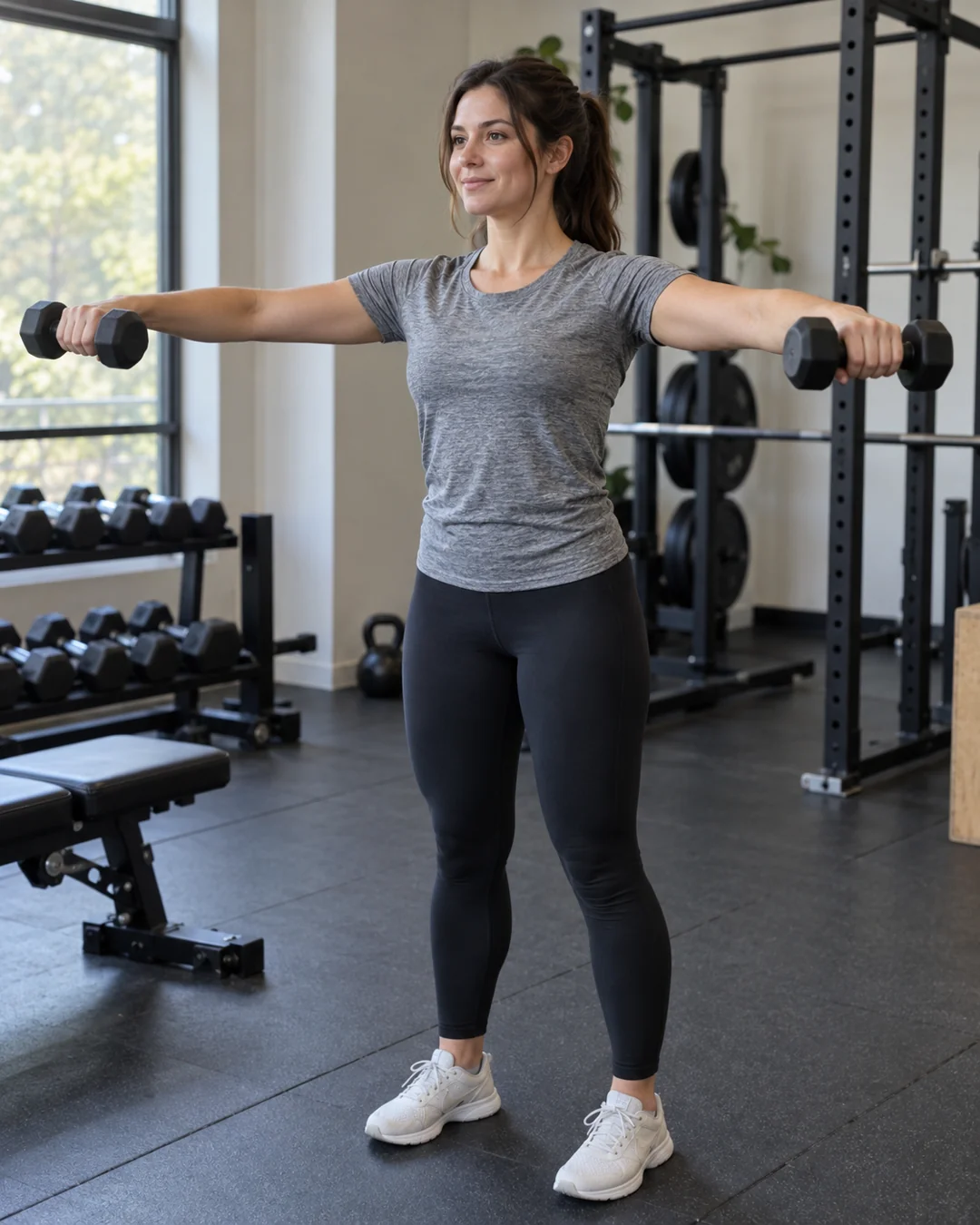
To do a dumbbell lateral raise, hold light weights beside your body, keep a small bend in your elbows, and lift your arms outward through a comfortable arc toward shoulder height. Lower without swinging or dropping the weights. Start with two sets of 10–15 controlled repetitions, using a load that leaves a few good repetitions available.
The exercise provides direct shoulder work without an overhead press. Its simplicity is useful at home or in a busy gym, but the long arm position makes small weights feel surprisingly demanding. Good technique is less about lifting the heaviest dumbbells and more about repeating the same arm path as fatigue builds.
What muscles does a dumbbell lateral raise work?
The lateral, or middle, portion of the deltoid is a main contributor to raising the upper arm outward. Other shoulder muscles and the muscles that move the shoulder blade help coordinate the action. Your trunk stabilizes you while you hold the weights away from the body.
“Isolation exercise” is a programming label, not a claim that only one muscle is active. Your shoulder blades should be able to move naturally as your arms rise. Trying to pin them rigidly down throughout every repetition can make the movement feel artificial. Aim for control rather than eliminating all movement outside the deltoid.
The lateral raise is an accessory exercise. It can complement presses and rows, but it does not replace the rest of an upper-body program. It also does not diagnose a shoulder problem or guarantee pain-free overhead activity. People differ in the arm path and range they find comfortable.
Start with a stable, uncluttered setup
Pick dumbbells you can lift off the rack and return without strain. Clear enough space on both sides that you will not hit a wall, another person, or the end of a bench. In a crowded gym, wait for a clear area rather than squeezing a long-arm movement into a narrow gap.
Stand with your feet in a comfortable stance, usually around hip-width apart. A small stagger is fine if it helps you balance. Let your knees stay soft and keep your ribs comfortably above your pelvis. You should not need to lean backward to make room for the weights.
Hold the handles with your thumbs wrapped around them. Keep your wrists approximately in line with your forearms. The weights can begin beside your thighs or slightly in front of them, depending on your proportions. Avoid resting the dumbbells against your legs and bouncing them outward to start each repetition.
How to do a dumbbell lateral raise
- Stand tall with light dumbbells at your sides and a gentle bend in your elbows.
- Raise your upper arms outward, allowing them to travel slightly forward of directly sideways if that feels more natural.
- Keep the elbow bend approximately constant. Let your hands and elbows travel together rather than curling the dumbbells toward your shoulders.
- Approach shoulder height only while the motion remains comfortable and controlled. A lower endpoint is acceptable.
- Lower smoothly to the starting position without dropping the dumbbells or using a rebound.
- Repeat with the same stance and range. Finish the set before you need a pronounced body swing or develop pain.
The American Council on Exercise lateral-raise guide also describes a light dumbbell setup, controlled raising and lowering, and neutral wrists. Its shoulder-height endpoint is a useful general reference, not a reason to force an uncomfortable range. Use your own controlled movement rather than copying every angle in a photograph.
Elbows: soft, not constantly changing
A small elbow bend shortens the lever slightly and avoids an unnecessarily rigid arm. Keep that bend similar throughout the repetition. If the elbows fold more and more as the weights rise, you are changing the mechanical challenge just when the exercise becomes difficult.
You do not need to measure an exact angle. A side mirror or short video can help you see whether the shape of the arm stays consistent. Think of moving the whole arm in an arc, with the hand following the elbow, rather than turning the movement into a curl followed by a shrug.
Hands: avoid the deliberate thumbs-down pour
There is no need to tip the little-finger side sharply upward as though pouring out a jug. Keep a comfortable hand orientation, with the thumbs roughly level or slightly higher if that suits you. Do not wrench the shoulders into a position simply because a cue sounds technical.
The wrist should not be the moving joint that gets the weight higher. If you bend it at the top, reduce the load and reset. A dumbbell that rotates a little in your hand may also indicate that your grip is poorly placed or that the handle is too slippery to control safely.
Shoulders: natural movement without a dramatic shrug
Your shoulder blades move as your arms rise, so a perfectly motionless shoulder girdle is not the objective. However, if every repetition begins with a large upward shrug and almost no arm movement, the load or fatigue level is probably obscuring the exercise you intended.
Try an easy unloaded repetition. Notice the smooth path your arms naturally take. Then reproduce that path with a light weight. If a cue such as “shoulders down” makes you stiff or uncomfortable, replace it with “long neck, smooth arms” rather than forcing the joints into a rigid position.
Why light dumbbells can feel heavy
As your arm lifts away from your body, the dumbbell is farther horizontally from the shoulder. Gravity creates a greater turning demand than when the weight hangs close beneath the joint. That is why the top of a standard dumbbell raise often feels much harder than the bottom.
This is also why comparing lateral-raise weights with curl or press weights is unhelpful. The exercises have different lever arms and muscle contributions. Someone who presses a substantial dumbbell can still benefit from a much lighter lateral raise. The weight label is not a score for the size or importance of the exercise.
In a cable variation, the direction of the pull depends on the station and setup. If you want that option, see the separate cable lateral raise guide. This article focuses on free weights, including how to handle the relatively easy bottom and more demanding upper part of the arc.
Choose your first working weight
Begin with several unloaded repetitions, followed by an easy practice set. Then try ten controlled repetitions with a light pair of dumbbells. If you could have done another two or three without changing the range, stance, or elbow bend, the weight is a reasonable starting choice.
If you have to throw the weights upward by the sixth repetition, move down. If the entire set is very easy, increase cautiously rather than making a large jump. Your first session is a calibration session. You do not need to discover your maximum lateral-raise weight to train effectively.
Use the dumbbell weight-selection guide for a broader decision process. For this movement, pay particular attention to the smallest available increment. Moving from 2 kg to 3 kg per hand is a 50% increase, which explains why the next pair can feel dramatically different.
A simple beginner plan
Try two working sets of 10–15 repetitions after your main upper-body exercises. Rest approximately 60–120 seconds, or longer if necessary to reproduce the movement. Begin once or twice per week according to your existing schedule. Stop each set with roughly two or three controlled repetitions still available.
This is a practical example, not a universal prescription or a research-proven optimum for every shoulder. The ACSM’s 2026 guidance emphasizes consistency and individualization in resistance training. An accessory exercise should fit your broader routine rather than turn a manageable workout into a volume challenge.
If you already do cable raises, substantial shoulder pressing, and other shoulder accessories, replace some existing work before adding more. There is no requirement to perform every available variation in the same week. A small amount of repeatable work gives you clearer feedback than several exercises introduced at once.
Example: adding raises to two weekly sessions
On one day, perform your main press and row, then two lateral-raise sets. On the other day, repeat the same arrangement or use a different accessory that addresses a different movement. Keep the first few weeks simple enough that you can tell whether you recover comfortably between sessions.
For example, one person might pair lateral raises with a horizontal press and row on Monday, then train a different full-body session on Thursday. Another might use raises only on Saturday because their other sessions already include substantial shoulder work. Both arrangements can be sensible; neither calendar is mandatory.
How to progress when the next dumbbell is too heavy
Use a repetition range before increasing weight. If you complete 10 and 9 clean repetitions today, work toward 15 and 15 with the same dumbbells over future sessions. Increase only when the top of the range is controlled and still leaves a little room to spare.
When the next pair is a large jump, try a few repetitions with it during a later session only if you can maintain the intended movement. If the quality deteriorates immediately, return to the lighter pair. Progress does not require accepting a completely different technique just to use a new number.
Other options include smaller-increment adjustable dumbbells, a planned slightly higher repetition range, or simply repeating the current prescription until it becomes more consistent. Do not attach improvised objects to a dumbbell in a way that could slip. Equipment must remain secure through the whole arc.
You can also improve the consistency of the descent, but record that change. Ten repetitions with a deliberate pause are not directly comparable with ten fast repetitions. Keep one or two variables stable so your log helps you make decisions instead of producing numbers with no common meaning.
Common technique problems
Using a leg drive
If your knees dip before every raise, reduce the load and begin each repetition from stillness. A soft knee is different from using the legs to launch the dumbbells. You can try a seated version to remove some of that temptation, although sitting does not automatically eliminate torso swinging.
Leaning backward
Check whether you are trying to raise the dumbbells too high or choosing a load you cannot control. Keep the ribs stacked comfortably over the pelvis and shorten the endpoint if needed. A smaller controlled arc is more useful for learning than a high finish created by arching your back.
Turning it into a front raise
A slightly forward arm path can be comfortable. Bringing the hands almost entirely in front of you changes the movement more substantially. If that happens only near the end of a set, fatigue may be the cause. Stop, rest, and reduce the load rather than chasing the original repetition target at any cost.
Dropping the weights from the top
Choose a lighter pair and focus on a quiet return. You should control the dumbbells until they reach the bottom, not only during the lifting phase. If your hands accelerate toward your thighs and the weights bounce outward again, pause between repetitions to remove the rebound.
Different arm heights
Use a comfortable range on both sides rather than forcing the less capable shoulder to match a photograph. One-arm practice with light support from the other hand can make the difference easier to observe. Persistent asymmetry accompanied by pain, sudden weakness, or loss of function deserves individualized assessment.
Standing, seated, or one arm at a time?
The standing version needs only dumbbells and clear space. It is efficient and easy to add after another exercise. Its main practical challenge is resisting the urge to use the legs or lean. A small staggered stance can help without turning the exercise into a balance drill.
The seated version uses a stable bench or chair, with both feet supported. Sit tall enough that the dumbbells can travel without striking the seat. It may reduce leg drive, but you can still swing the torso. Choose it because the setup helps you, not because sitting automatically makes the exercise strict.
For a one-arm version, use your free hand lightly on a stable support intended to bear load. Do not grab a moving machine component. Keep your torso upright rather than leaning dramatically away to increase the range. Complete the same planned repetitions on both sides, starting with the less capable side if useful.
Record which version you used. Seated and standing numbers may differ, especially when fatigue or balance has previously affected performance. Switching versions is fine, but treating them as identical log entries can make apparent progress misleading.
Lateral raises versus shoulder presses
A shoulder press involves pushing a load upward with several joints contributing. A lateral raise primarily asks you to lift the arms outward against resistance. They are different tasks with different loading possibilities. You can include both, but you do not need to choose a winner.
If your session already has substantial pressing, a few controlled raises can provide another kind of shoulder work without adding another heavy press. If pressing is uncomfortable, substituting raises does not automatically solve the underlying issue. Choose comfortable exercises and seek advice when symptoms persist.
Rows and rear-shoulder movements also contribute to a varied upper-body routine. The goal is not to build an enormous list of shoulder exercises, but to cover useful movement patterns with a workload you can recover from. Keep the lateral raise in proportion to that larger plan.
For a different compound pushing option, see the assisted dip machine guide. Dips are optional, require a comfortable shoulder range, and are not a direct substitute for a lateral raise.
How to judge a set without chasing a burn
A burning sensation can occur during a long set, but it is not a direct measure of muscle growth. Similarly, soreness the next day is not required for a useful workout. Judge the session by controlled effort, repeatable technique, and whether you can continue training consistently.
For effort tracking, use an approximate reps-in-reserve estimate. Ask how many more repetitions you could perform to the same standard, not how many you could throw upward with a body swing. If you are unsure, write “a few left” rather than inventing precision.
A helpful entry might be: “Standing lateral raise, 3 kg each, 12/11, controlled shoulder-height range, 90 seconds rest.” If you shorten the range or change the version, note it. That makes a later comparison useful without turning every workout into an examination.
Frequently asked questions
Should I raise above shoulder height?
You do not need to do so for the basic version in this guide. Start with a comfortable range at or below shoulder height. Higher-arm variations exist, but they change the movement and are not an automatic progression everyone must earn. Do not force extra height through discomfort.
Should I lock my elbows?
A gentle bend is a practical starting point. The important detail is keeping it reasonably consistent rather than repeatedly bending and straightening during the raise. Avoid aggressively locking the elbows or treating a perfectly straight arm as a requirement for an effective repetition.
Can I do raises at home?
Yes, if you have appropriate weights and clear space. Secure adjustable dumbbells carefully, use a stable floor, and keep children and pets out of the lifting area. If your only weights are too heavy, do not use momentum to make them fit the exercise. Obtain suitable equipment or choose another movement.
What if I feel shoulder pain?
Stop the painful version. Do not assume that pain means the exercise is working or that a specific hand angle will fix it. Persistent pain, recent injury, numbness, or unusual weakness warrants advice from a qualified clinician. This is general exercise guidance, not a rehabilitation plan.
Make the next session easy to repeat
Choose a light pair, a comfortable arm path, and two manageable sets. Keep the setup and range consistent long enough to learn what progress looks like for you. Add repetitions gradually, and treat the next weight increase as an option rather than a deadline.
If you want to explore a fitness app alongside your routine, visit Workit on the App Store. The useful habit is showing up with a clear plan, performing it honestly, and making the next small adjustment from what you learned.
Comments
One response to “Dumbbell Lateral Raise: Form, Weight, and Beginner Progression”
[…] your upper-body plan also includes a shoulder accessory, our dumbbell lateral raise guide offers a separate light-weight movement. Place each exercise where it fits your priorities; you do […]