
Published October 15, 2026
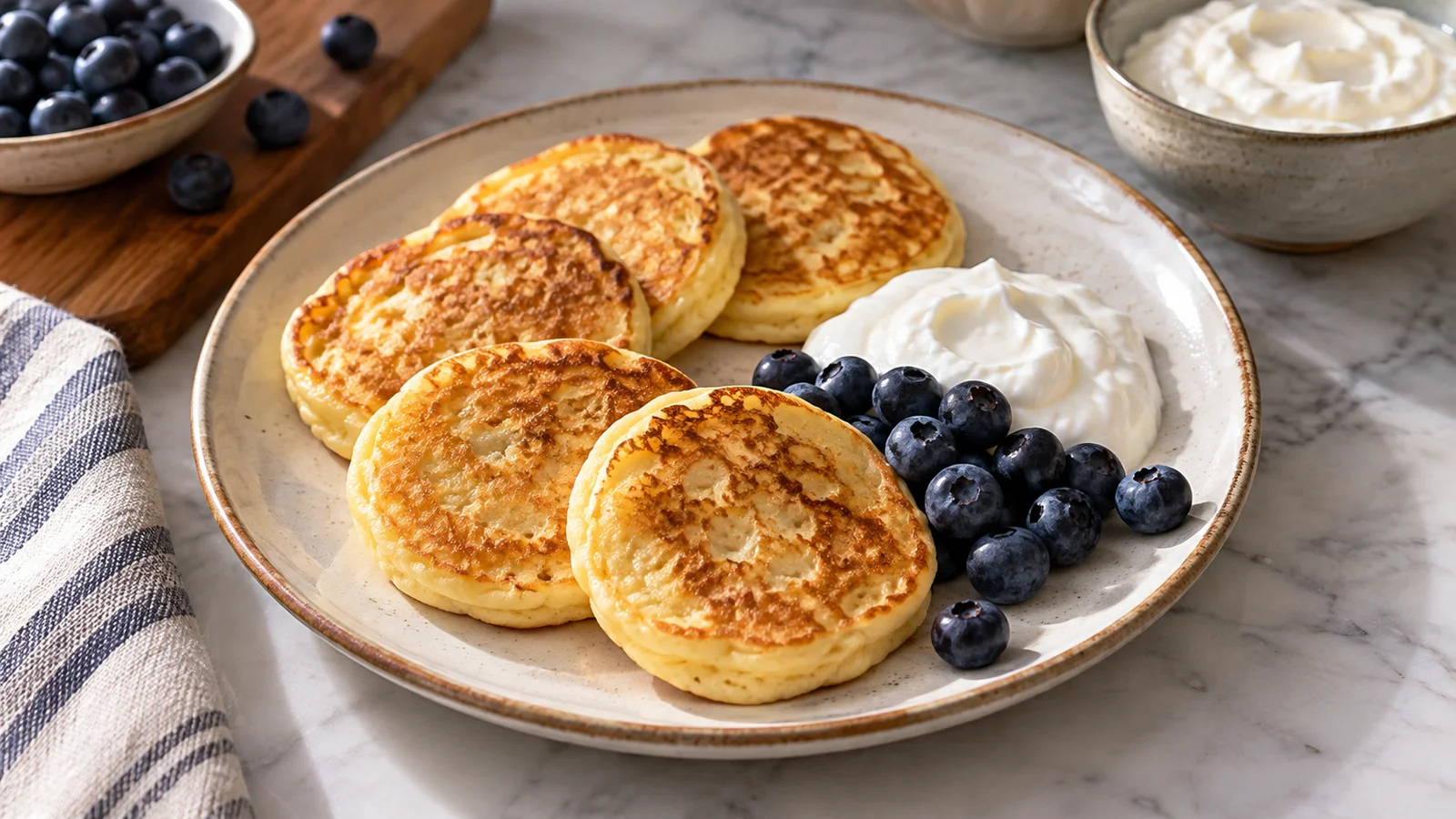
For high-protein pancakes that still behave like pancakes, use Greek yogurt and eggs for protein, keep enough flour for structure, and cook small portions over moderate heat. The base recipe below makes two servings with approximately 23 grams of protein per serving from its flour, yogurt, and eggs, before toppings. No protein powder is required.
The practical challenge is balancing tenderness with a center that actually cooks. A towering pancake can brown long before the middle sets; an extra scoop of powder can make yesterday’s successful batter dry today. Start with the measured base, make one small test pancake, and use its behavior to adjust the remaining batch.
This guide focuses on pan temperature, batter consistency, three specific flavor variations, and portions you can reproduce. For a different savory breakfast format, see Workit’s high-protein egg muffins.
The base recipe at a glance
- Yield: about 10 small pancakes, divided into two equal servings.
- Preparation: about 10 minutes, including a short batter rest.
- Cooking: roughly 12–18 minutes in batches; pan size and stove output change the timing.
- Equipment: kitchen scale, two bowls, whisk, flexible spatula, nonstick or well-seasoned skillet, and a thin-tip food thermometer.
- Texture: tender and slightly tangy, with a finer, more moist crumb than a traditional milk-only pancake.
These are recipe-development quantities, not a claim that every stove, yogurt, or flour has been kitchen-tested. The consistency cues matter more than a promised exact cooking time. Weights also make troubleshooting easier: a firmly scooped cup of flour can change this relatively small batch considerably.
Ingredients for two servings
- 120 g all-purpose flour, weighed dry
- 170 g plain nonfat Greek yogurt
- 2 large eggs, about 100 g without shells
- 60 ml water, plus up to 30 ml more if needed
- 8 g double-acting baking powder, approximately 2 level teaspoons; check your brand’s teaspoon weight
- 10 g granulated sugar
- 1 teaspoon vanilla extract
- ¼ teaspoon fine salt
- 2 teaspoons neutral oil, divided, for the pan; use only what your pan needs
Use ordinary all-purpose flour rather than self-rising flour, which already contains leavening and salt. Choose a thick, spoonable Greek yogurt rather than a drinkable yogurt. Water keeps the base’s protein calculation straightforward; replacing it with milk is fine, but it changes the nutrition and can change browning.
The small amount of sugar balances yogurt’s acidity and encourages color. It is not a requirement to make a sweet breakfast, and syrup remains optional. Omitting it gives a more tangy pancake and somewhat lighter browning; avoid turning up the burner just to force a darker surface.
Method
- Prepare the dry mixture. Whisk the flour, baking powder, sugar, and salt thoroughly in one bowl. Break up visible baking-powder clumps before any liquid goes in.
- Prepare the wet mixture. In a second bowl, whisk the yogurt, eggs, 60 ml water, and vanilla until the yogurt is dispersed. Small yogurt streaks are harmless, but large lumps make consistency difficult to judge.
- Combine gently. Pour the wet mixture into the dry mixture and fold just until no pockets of dry flour remain. A few small lumps are fine. Do not beat until perfectly smooth.
- Rest for five minutes. Meanwhile, warm the skillet over medium-low heat. The batter should fall from a spoon in a thick ribbon and settle slowly, rather than remain in a stiff mound.
- Adjust only if necessary. If the rested batter will not spread, fold in water 15 ml at a time, using up to 30 ml extra. Stop as soon as it becomes scoopable and slowly spreading. Do not thin it to a crepe batter.
- Cook one test pancake. Brush the pan with a little oil. Add about 45 g batter and gently spread to approximately 9 cm across. Leave space around it. Start checking after about two minutes; the edges should look set and the underside should release cleanly when ready to turn.
- Flip once and finish. Turn with a broad spatula, then cook the second side until the center is set. Typical timing is two to three minutes on the first side and one to two on the second, but thickness and heat can extend this.
- Check the center. Insert a thin probe from the side into a thick pancake’s center; aim for at least 160°F/71°C for this egg-containing batter, with no wet raw-flour center. If the surface is already dark, lower the heat and cook longer rather than serving an underdone pancake.
- Repeat and portion. Lightly oil as needed, stir the batter only enough to keep it even, and cook the remaining portions. Divide the finished batch equally between two plates. An extra tiny pancake belongs to the batch, not an extra full serving.
Wash your hands and equipment after handling raw eggs and flour. The FDA explains that flour is a raw food and batter should not be tasted uncooked. A browned surface alone does not tell you what happened in the center.
How the protein calculation works
The example uses three specific label references: FAGE Total 0% yogurt at 18 g protein per 170 g; King Arthur all-purpose flour at 4 g per 30 g; and Eggland’s Best large eggs at 6 g each. Brands are calculation examples, not required purchases.
- Yogurt: 170 ÷ 170 × 18 = 18 g protein.
- Flour: 120 ÷ 30 × 4 = 16 g protein.
- Eggs: 2 × 6 = 12 g protein.
- Batch subtotal: 18 + 16 + 12 = 46 g protein.
- One of two equal portions: 46 ÷ 2 = approximately 23 g protein.
This is a rounded main-ingredient protein estimate, not a laboratory analysis or a complete nutrition panel. Small contributions from vanilla and other minor ingredients are not counted. Toppings, substitutions, and additions are excluded. Label values are rounded, so an apparently precise decimal would imply more certainty than the ingredients support.
If your yogurt supplies 15 g rather than 18 g for 170 g, the same batch becomes about 43 g, or 21.5 g per portion, before toppings. If your flour label lists 3 g per 30 g, it contributes 12 g rather than 16 g. Make both substitutions and the estimate becomes 39 g per batch, or 19.5 g each. The recipe can still work; the printed protein number simply needs to change.
Counting pancakes is convenient only when their sizes are similar. If one person gets the thick, oversized first three and another gets five small ones, the protein will not divide evenly. For a closer split, weigh the cooked batch and serve half to each person. Water loss affects cooked weight but does not create extra protein.
Three flavors that preserve the base
1. Lemon-blueberry pancakes
Make the base recipe with the finely grated zest of one washed lemon added to the wet ingredients. Use 80 g fresh blueberries, washed and dried. After portioning each pancake into the skillet, press a few berries into its surface before flipping. Distributing berries in the pan keeps the final pancake from receiving most of the fruit.
Avoid adding a large squeeze of lemon juice to the batter as well. Zest provides citrus aroma without making the mixture more liquid. Large blueberries can create thick wet pockets; choose smaller berries or halve unusually large ones. Frozen berries release more water and can stain the whole batter, so keep them for a separate heated topping if texture is your priority.
Serve each portion with half the remaining berries if any were left over and, optionally, 50 g extra yogurt. With the reference yogurt, that topping adds about 5.3 g protein to each plate. The pancake base still contributes about 23 g per serving; fruit is not included in that subtotal. Keep added syrup separate so each person can choose the sweetness.
2. Cinnamon-banana pancakes with peanut drizzle
Make the base recipe with ½ teaspoon ground cinnamon mixed into the flour. Slice 100 g peeled banana thinly and reserve it for serving rather than blending it into the batter. This preserves the base’s water balance and prevents banana-heavy centers that stay soft after the surface looks cooked.
For the drizzle, whisk 30 g smooth peanut butter with 15 ml warm water. Add another teaspoon of water only if needed. Spoon half over each serving, then divide the banana between them. If your peanut butter label shows 7 g protein per 32 g, 15 g would contribute approximately 3.3 g; use your own jar’s numbers rather than assuming all nut butters match.
Peanut butter is an optional flavor and fat addition, not a necessary ingredient. For a peanut allergy, omit it and use a safe topping suited to the person eating. Do not describe another nut butter as automatically safe. The base contains egg, milk, and wheat regardless of what goes on top.
3. Savory chive pancakes with lemon yogurt
Omit the vanilla and sugar. Fold 10 g finely chopped chives into the combined batter. Keep the rest of the base unchanged, including the flour and baking powder. Cook the same small pancakes, remembering that the lower sugar content can produce a paler surface even when the centers are done.
For the topping, stir 100 g plain Greek yogurt with 1 teaspoon lemon juice and black pepper, then divide between the two servings. Add sliced cucumber or tomatoes on the side. Pat watery vegetables dry and keep them out of the pancake batter: a cucumber pancake would require a different recipe balance.
The extra yogurt adds about 5.3 g protein per serving using the reference label, taking the main-ingredient subtotal to approximately 28 g. This version is useful when you like pancakes’ soft texture but want a savory plate. If you add smoked fish, cheese, or another topping, count it separately and follow its storage directions.
Why the batter behaves this way
Flour provides the framework that holds the pancake together. Eggs contribute protein and help the batter set. Yogurt brings moisture, tang, and additional protein. Baking powder supplies lift. These ingredients work together; maximizing any one of them does not necessarily improve the finished pancake.
Replacing much of the flour with protein powder changes that framework. Whey, casein, and plant-protein blends absorb moisture differently and may contain gums, sweeteners, or other ingredients. A scoop is also a volume measure with no universal weight. Adding an unspecified scoop to this recipe would make both the texture and its protein arithmetic unreliable.
If you want to use powder, choose a recipe developed for the specific type and measure it in grams. Another low-risk option is to keep these pancakes unchanged and use a small amount in a separate yogurt topping, following the product’s directions. Then a topping you dislike does not spoil the entire cooked batch.
Whole-wheat flour can make the pancake more robust, but a full replacement may need different hydration. For a first trial, replace 30 g of the all-purpose flour with 30 g whole-wheat flour, rest the batter, and evaluate it before adding water. This is a texture variation, not a promise of identical nutrition.
Troubleshooting the first pancake
Dark outside, wet center
Lower the heat, reduce the batter portion, and spread it a little wider. This is usually a heat-transfer problem rather than a need for more baking powder. Thick yogurt batter needs time for the middle to cook. Wipe away browned oil between batches if it is smoking or leaving burnt flecks.
Pancakes spread into thin puddles
Confirm that you used thick yogurt and measured the flour before adding more liquid. Rest the batter for the full five minutes. If you accidentally poured in substantially more water, a small flour adjustment can help, but it changes the recipe. Add 10 g, fold gently, rest again, and recalculate if you track the protein closely.
Rubbery or tough pancakes
A batter beaten vigorously after the flour goes in can become tougher. Long cooking after the center is already done also dries the crumb. Whisk the wet ingredients first, fold gently at the end, and remove finished pancakes promptly. Pressing pancakes down with a spatula does not help them rise or become more tender.
Little lift
Check that the baking powder is in date and that you used baking powder rather than plain baking soda. Check the pan temperature too: a cold skillet lets batter sit and spread. If the first pancake is weak but later ones improve, inadequate preheating may be the main issue. Do not keep adding leavening to compensate.
They break when flipped
Give the first side longer to set and slide the spatula fully underneath before lifting. A small pancake is easier to turn than a large one. Make sure the pan has a thin coating of oil and is suitable for pancakes. An intact cooked edge matters more than waiting for a precise number of bubbles.
Make-ahead cooking without a soggy stack
For two future breakfasts, cook the full batch rather than holding the raw batter overnight. The leavening has already started reacting, and an overnight batter can behave differently. Place cooked pancakes in a single layer briefly so steam can escape, then refrigerate promptly in shallow containers. Do not leave them on a rack for hours waiting until completely cold.
USDA leftover guidance recommends refrigeration within two hours, or one hour above 90°F/32°C, and use within three to four days at 40°F/4°C or below. Freeze portions you will not use in that window. Separate pancakes with parchment so you can remove one serving without thawing the entire batch.
Reheat leftovers to 165°F/74°C. A covered microwave-safe plate helps retain moisture; turn or rearrange the pancakes as needed and check the center. A skillet can restore a drier surface after heating, but simply toasting the outside is not proof that the middle is hot enough. Add cold yogurt, fruit, and nut toppings afterward.
Pack toppings separately when taking pancakes out. A refrigerator or insulated bag with enough ice packs is needed for perishable pancakes and yogurt; a lunch bag without cooling does not make them shelf-stable. If freezer packaging is your main question, use Workit’s broader meal-prep guides alongside these cooking instructions.
Scaling the recipe sensibly
For one serving, halve every ingredient: 60 g flour, 85 g yogurt, one large egg, 30 ml initial water, 4 g baking powder, and half the seasonings. This is more reproducible than using a whole egg while halving everything else. Keep the same pancake diameter and cooking cues.
For four servings, double the ingredients but avoid crowding the skillet. Crowding makes flipping awkward and changes how quickly the pan recovers heat. If cooking for several people, a second suitable pan is usually more useful than making each pancake twice as large. Use separate clean utensils for raw batter and ready-to-eat toppings.
Choose the serving size that fits your meal rather than forcing a particular protein number. Half of the two-serving batch is a defined recipe portion, not a universal breakfast prescription. Add fruit, a drink, or another side according to appetite and preference. There is no need to turn the plate into a contest for the most protein possible.
Frequently asked questions
Can I use regular yogurt?
Not as an exact swap. Regular yogurt is usually thinner and may provide less protein per gram. It can require less added water and a different calculation. For the most predictable first batch, use a thick plain Greek yogurt and then experiment with one change at a time.
Can I make these gluten-free?
The base contains wheat. A gluten-free flour blend is not automatically an equal-performance substitute, and different blends contain different gums and starches. Use a pancake recipe designed for your chosen gluten-free blend if avoiding gluten is necessary. Check every ingredient and prevent cross-contact.
Can I omit the eggs?
Removing them changes both structure and protein. A flax or chia mixture is not a nutritionally identical replacement and may make this batter heavier. Choose an egg-free formula rather than expecting a simple omission to work. The same caution applies to replacing dairy yogurt with a low-protein plant alternative.
Do I need a blender?
No. Two bowls and a whisk are enough. A blender can overwork flour once everything is combined, and its blades do not solve an incorrect liquid ratio. If you use one for convenience, blend only the wet ingredients, then fold them into the dry mixture by hand.
Your next batch
Make the plain version once, note how much extra water your yogurt needs, and choose one flavor for the next batch. That small record is more useful than changing the flour, yogurt, powder, and pan temperature at the same time. Consistent portions and a properly cooked center make this a breakfast you can repeat.
For the movement side of your routine, explore Workit and choose an approach that fits alongside meals you enjoy.
For a no-cook breakfast using the same type of yogurt, try the high-protein yogurt bowl guide. It explains how to adjust portions and calculate protein from your own label.