
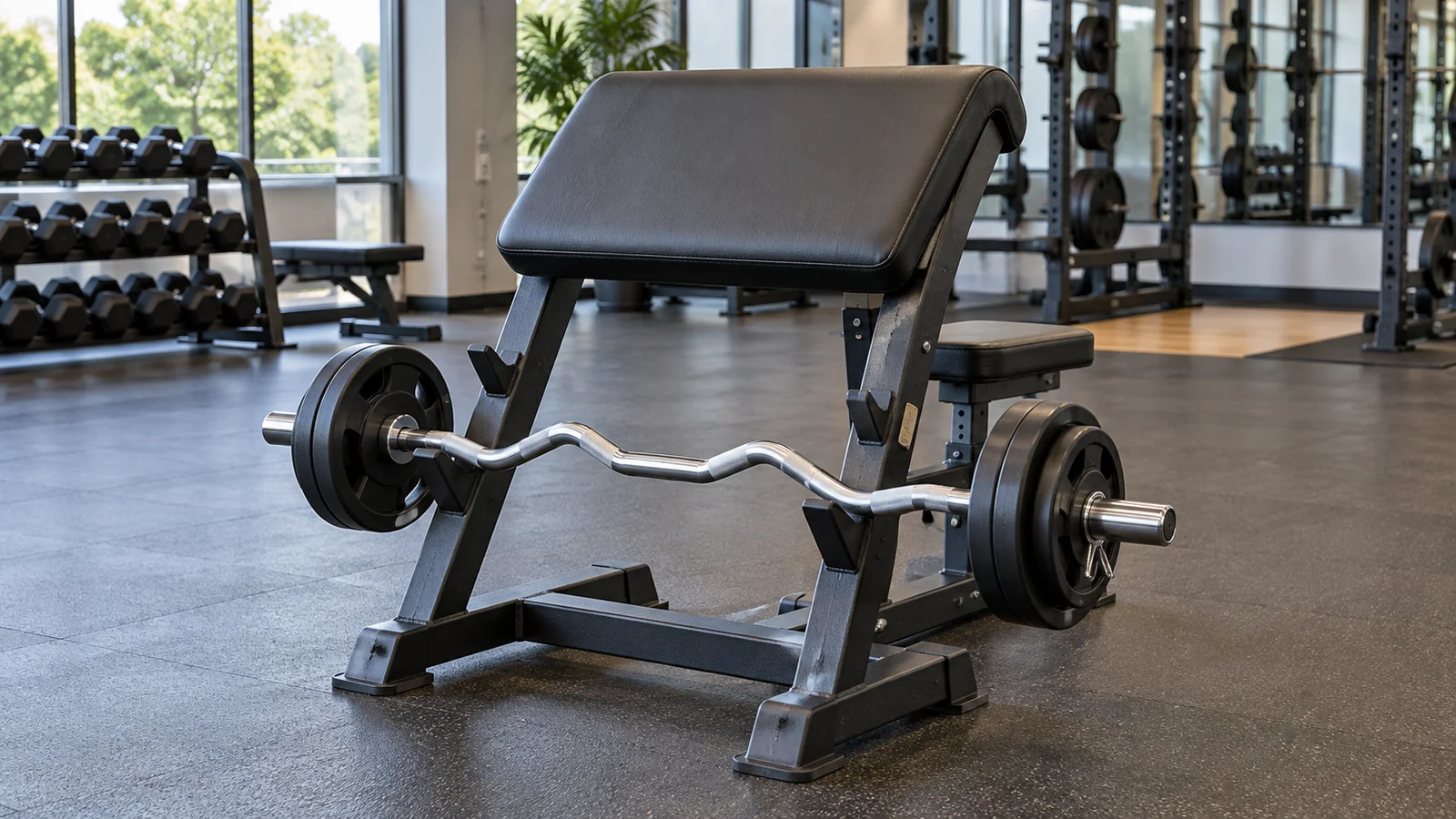
A preacher curl trains your elbow flexors with your upper arms supported on an angled pad. Adjust the seat so the pad supports your upper arms without pushing your shoulders upward, curl a manageable weight, and lower it under control. Keep your arms in contact with the pad and avoid bouncing out of the bottom position.
Published October 15, 2026
The support makes this curl easier to standardize, but it does not make any weight safe or eliminate the need to learn the movement. A good first session is mostly about fitting the bench, finding a comfortable grip, and finishing every repetition with control. You do not need to prove how much you can lift on a new station.
This guide covers dumbbell, EZ-bar, and machine versions, including how to choose between them. The training examples are starting options for generally healthy adults, not injury rehabilitation or a requirement to add more arm work to an already full program.
What muscles does the preacher curl work?
The main action is elbow flexion: bending your elbow to bring the load toward your upper arm. The biceps brachii contributes, alongside the brachialis and brachioradialis. Your forearm muscles also maintain your grip. Calling the exercise a biceps isolation movement describes its emphasis; it does not mean only one muscle works.
With a palms-up grip, the biceps also helps maintain the forearm position. An angled bar changes the grip slightly, and a dumbbell gives each hand more freedom. These differences can affect comfort without turning the exercise into an entirely different category of training.
The pad places your upper arms in front of your torso. That is the defining difference from a standing curl with your elbows near your sides or an incline curl with your upper arms behind your torso. You should not have to squeeze your armpits painfully against the pad to achieve that position.
A preacher curl is useful when you want an arm exercise with less opportunity to swing your torso. It can also make a working set easier to compare with the previous session. However, a poorly adjusted seat can make a supported movement feel less comfortable than a simple standing curl.
Choose the version that fits your equipment and body
Single-arm dumbbell preacher curl
This version lets each arm choose a comfortable hand position. It is also convenient when a bar feels awkward at your wrists. Use a proper preacher bench or a stable adjustable exercise bench that can safely support the setup. Do not improvise with a rolling chair, loose cushion, or furniture that can tip.
Working one arm at a time takes longer, but it makes it easier to notice whether one shoulder rises or one wrist bends back. Start with the side that feels less coordinated and use a manageable repetition target for both. Differences do not justify forcing the weaker side through extra painful repetitions.
EZ-bar preacher curl
An EZ bar has angled grip sections that may feel more comfortable than a fully straight bar. Use a roughly shoulder-width grip that allows your wrists to stay in line with your forearms. The exact hand spacing depends on the bar and your build; the outermost or innermost grip is not automatically better.
Check the bar’s actual weight rather than assuming every curl bar weighs the same. Load the two sides evenly and use collars where appropriate for the equipment. Before your working set, confirm that you can safely remove the bar from its support and return it without reaching beyond your control.
Preacher curl machine
A machine may be the simplest choice when the seat, pad, and handles fit you well. Adjust it according to its instructions. If the machine has a visible elbow pivot reference, use that as a setup guide and ask staff if the alignment is unclear.
Machines differ in handle path, resistance, and seat adjustment. A number on one weight stack cannot be treated as an equivalent load on another. Record the station and settings, not just the number. A machine that forces an uncomfortable wrist or elbow path is a reason to choose another exercise.
Set up the bench before picking a working weight
- Check stability. The bench should sit firmly on the floor, with adjustable parts fully locked. Clear bags, bottles, and spare weights from the area.
- Set the seat height. Sit with your feet supported and your upper arms resting along the pad. Your shoulders should not be shrugged toward your ears or dragged forward by the equipment.
- Position your torso. Let your chest approach the upper edge without crushing yourself into it. Keep a comfortable, steady trunk position.
- Check arm support. The pad should support the upper arms rather than leave your elbows hanging precariously over a hard edge. Avoid a position that creates concentrated pressure or tingling.
- Rehearse the range. Bend and straighten the elbows with no load or a very light load. Make sure the weight, handles, and rack have clearance.
- Plan the finish. Know where the bar or dumbbell will go before fatigue makes returning it more difficult.
If you cannot find a comfortable seat setting, do not compensate by balancing on your toes or lifting your body off the seat. Try a different station or curl variation. Equipment is not equally adjustable for every height and arm length.
For a dumbbell version over an adjustable bench, the bench must be locked and stable, with room for the weight to move freely. Stand or sit as appropriate for that bench while keeping the supported arm comfortably positioned. If arranging the setup is confusing, have gym staff demonstrate it before adding load.
How to do a preacher curl, step by step
1. Establish a comfortable starting position
Hold the weight securely and let your elbow open through a range you can control. Keep your wrist approximately straight instead of allowing the dumbbell or bar to fold it backward. Your shoulder stays settled while the upper arm rests on the pad.
You do not need to force your elbow into a hard end position. Equally, you do not need to avoid every degree near straightness simply because the exercise has a reputation for being demanding at the bottom. Use a comfortable range, light enough resistance, and a controlled reversal.
2. Curl by bending the elbow
Bring the weight upward smoothly. Think about moving the forearm around the elbow while the upper arm remains supported. Avoid pushing your chest into the pad, lifting your hips, or sliding the upper arm upward to help the weight move.
Finish where you can still keep the movement controlled. Pulling the bar all the way toward your face is unnecessary if it requires your elbows to lift or your wrists to fold. On some equipment, resistance changes noticeably near the top; do not turn that into a long resting pause.
3. Lower without dropping
Let the elbow open gradually, keeping the same arm and wrist position. The lowering phase should be deliberate enough that you could stop the movement if needed. Avoid releasing tension abruptly as the arm approaches the bottom.
A simple practice rhythm is a smooth lift followed by a slightly slower return. You do not need to count exact seconds forever. What matters is that a heavier weight does not cause the final third of the lowering movement to become an uncontrolled drop.
4. Reverse smoothly and keep breathing
Begin the next repetition without rebounding off the bottom position. Exhale comfortably as you lift and inhale as you lower, or use another natural breathing rhythm that avoids prolonged breath-holding. If maintaining breathing requires reducing the load, reduce it.
The Catalyst Athletics preacher curl demonstration shows the basic supported-arm movement. Use a demonstration to understand the task, then adjust the equipment to your own proportions rather than copying someone else’s seat setting.
How low should you lower the weight?
There is no useful rule that every person must stop at one exact elbow angle. Aim for a repeatable, comfortable range that you can control without the shoulder moving, the wrist collapsing, or the weight pulling your arm abruptly downward.
With free weights, the resistance you feel changes as the forearm changes position relative to gravity. The bottom and lower-middle portion can feel demanding. A machine or cable arrangement may have a different resistance profile, so a technique that felt easy on one station can feel unfamiliar on another.
Begin conservatively while learning. As the movement becomes familiar, you can explore a slightly larger comfortable range with light resistance. Do not simultaneously increase weight and force extra depth. A stretching sensation around working muscles is not permission to push through elbow pain.
If a particular portion consistently hurts, stop that version. You can try a different grip or exercise only if it is comfortable. Persistent pain, new weakness, swelling, numbness, or symptoms after an injury deserve individual assessment rather than repeated experiments with heavier weights.
Common preacher curl mistakes and practical fixes
Your shoulders rise or your chest lifts
First check the seat. An awkward height can make you shrug before the repetition even begins. If the unloaded position is comfortable but the movement changes during the set, reduce the weight or stop a few repetitions earlier. The pad should help you hold a position, not become something to wrestle against.
The weight drops at the bottom
Use less resistance and pay attention to the final part of the return. If you can lift a weight only by swinging it and cannot lower it steadily, it is too heavy for the version you are practicing. Avoid having a partner force extra repetitions after control has already gone.
Your wrists do most of the moving
Keep the handle secure, but do not repeatedly curl the wrists to bring the bar closer. Try a lighter dumbbell or a more comfortable EZ-bar angle. A straight bar is optional; there is no prize for tolerating a grip that makes your wrists hurt.
The pad presses painfully into your arms
Reposition before continuing. Check seat height, how far forward you sit, and whether your upper arms have enough contact with the pad. A towel does not fix an unsuitable bench geometry. Tingling or numbness is a stop signal, not normal muscle effort.
You can do many partial reps but few controlled ones
Choose one movement standard and reduce the weight until you can repeat it. Intentionally programmed partial repetitions are a separate technique; accidentally shortening every repetition as fatigue builds makes a beginner log difficult to interpret. Record the controlled repetitions you actually completed.
Your forearms fatigue before your upper arms
Some grip work is expected. Check that you are not squeezing far harder than needed or bending the wrist unnecessarily. Also consider earlier pulling exercises. Your grip may already be tired. Rest, use a manageable load, and avoid assuming that a stronger burning sensation is the only sign of a productive set.
A cautious beginner prescription
For an initial trial, use one easy practice set followed by one or two working sets of 10–15 repetitions. Choose a load that lets you finish with roughly two or three more controlled repetitions available. This is a practical teaching example, not a special range that uniquely builds biceps.
Rest around 60–120 seconds between working sets, taking longer when needed to recover your grip and control. If the second set becomes dramatically shorter, ask whether the first set was too close to your limit or the rest was rushed before adding more exercises.
Try the exercise once or twice weekly within your existing plan, with recovery time between demanding arm sessions. Rows, pulldowns, and other curls already contribute to elbow-flexor workload. Two preacher-curl sets are additional work, not the only work your arms have done.
The ACSM’s 2026 resistance-training summary emphasizes training major muscle groups regularly and building gradually. It also notes that reaching momentary muscle failure does not consistently improve outcomes for the average healthy adult. That supports starting with manageable sets rather than treating the preacher bench as a maximal-effort test.
Choose weight by performance, not a universal number
No single dumbbell weight is right for every beginner. Previous training, bar weight, pad angle, and equipment design all matter. Start with a clearly light option, perform several smooth repetitions, and assess whether the intended range and steady upper-arm position remain easy to maintain.
If the practice load already requires body movement, go lighter. If it feels very easy, you can make a small increase before a working set. Avoid turning load selection into several exhausting trial sets; that changes the exercise before you have established a baseline.
Keep the same weight while you build repetitions. For example, a first session might produce 11 and 10 controlled repetitions. A later session might reach 12 and 11, then eventually 15 and 15. Those are illustrative results, not an expected timetable. A lower-performance day can simply be a day to repeat the load.
After both sets reach the top of your chosen range at the intended effort, try the smallest manageable increase. If that increase forces you below the lower end or changes your technique, return to the previous load. Our double progression guide explains how to keep this decision consistent.
Where preacher curls fit in a workout
For a general upper-body session, a press and a row can come before optional arm work. Preacher curls then add a small amount of direct elbow-flexor training without taking energy away from the movements you intended to prioritize.
A simple sequence is your usual warm-up, a familiar chest press, a supported row, another planned movement, and one or two preacher-curl sets. This is an ordering example rather than a complete prescription. If the session is already long or recovery is poor, leaving out the extra curls is reasonable.
If improving the preacher curl itself is a priority, you may place it earlier. Just expect later pulling exercises to feel different when your elbow flexors are already tired. The exercise order guide helps you decide which movement deserves your freshest effort.
Avoid adding preacher curls, hammer curls, several cable curls, and extra chin-ups all at once. Introduce a modest change, keep the rest of the program recognizable, and see whether you recover well before adding more.
Preacher curls versus other curls
Versus hammer curls: hammer curls use a neutral grip, with palms facing each other, and are commonly performed without a preacher pad. They offer a different hand position and may suit someone who dislikes a fixed palms-up bar. See our hammer curl form guide for that distinct variation.
Versus incline curls: incline curls position the upper arms behind the torso, while preacher curls support them in front. These are different setups rather than a simple good-versus-bad choice. Comfort, equipment, and the rest of your program matter.
A 2025 randomized trial comparing preacher and incline curls found regional differences in elbow-flexor muscle-thickness changes, with strength improvements favoring the exercise practiced. It studied young women over eight weeks. That does not establish one universal winner or show that a beginner needs both exercises in every workout.
Versus cable preacher curls: a cable can change where the movement feels hardest. A training study comparing cable and barbell preacher curls found similar muscle-thickness gains with some angle-specific strength differences. The practical conclusion is modest: more than one resistance arrangement can be useful, and stack numbers are not a direct comparison.
What to record so progress means something
Write down the version, bench or machine, seat setting, load, repetitions for each set, and a short note about effort. For a bar, include the bar weight in the total. For a dumbbell, make clear that the load is per hand.
A useful entry could read: “Single-arm preacher curl, bench seat 3, same dumbbell, 12/11 each side, about two clean reps left, no shoulder lift.” You do not need a complicated spreadsheet to make the next decision.
If you change the bench, grip, or range substantially, note the change and establish a new baseline. A larger number after switching to a different machine is not automatically a strength gain. Use our workout log template if you want a simple structure.
Frequently asked questions
Are preacher curls suitable for beginners?
They can be, when the equipment fits and the load is manageable. A machine or light single-arm version may be easier to learn than a bar that is already heavy when empty. Beginners do not need preacher curls specifically; another comfortable curl can fill the same general role.
Should I fully straighten my elbows?
Use your comfortable controlled range without snapping into the bottom or forcing the joint. Do not sacrifice control to meet an arbitrary depth rule. If straightening under load repeatedly hurts, stop and seek individual advice rather than treating pain as a normal part of the exercise.
Can preacher curls build a higher biceps peak?
They can contribute to arm-muscle development, but no curl lets you choose a completely new muscle shape. Avoid promises that a particular grip will create a specific peak. Consistent, recoverable training is a more useful focus than chasing anatomy claims.
Do I need to feel sore afterward?
No. Soreness is not a target or a reliable score for a workout. Pay attention to repeatable technique, gradual improvements, and whether you can return to training comfortably. Persistent joint symptoms call for a different response than ordinary short-lived muscle fatigue.
Your first-session checklist
Choose a stable bench that fits. Rehearse the movement with light resistance. Keep your upper arms supported, wrists comfortable, and lowering phase controlled. Finish before you need to swing or drop the weight, then return the equipment safely.
Record the setup and actual repetitions so you know what to repeat next time. You can log sets, reps, and weights in Workit; a subscription is required. The useful first goal is a curl you can perform consistently, not the heaviest weight on the rack.