
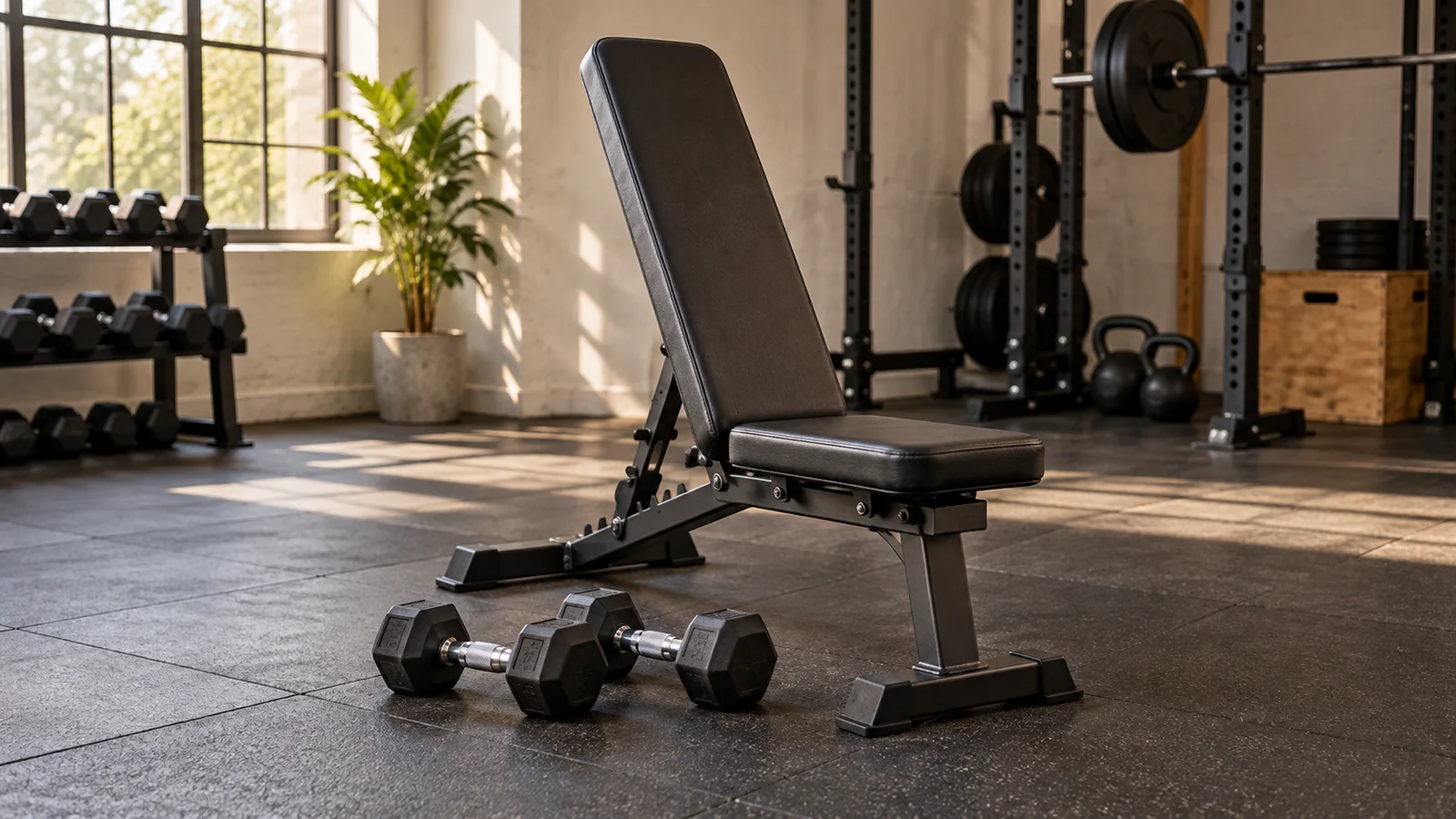
The dumbbell shoulder press trains your shoulders and triceps by moving two weights from around shoulder height to overhead. Start with light dumbbells, keep your wrists above your elbows, and press through a comfortable range without turning the movement into a back bend. A seated version with a stable backrest is a useful place to learn.
Published October 14, 2026
For a first practice session, try one or two easy sets of 8–12 controlled repetitions. Finish while you could still do several clean reps, then judge the session by your control and comfort rather than the size of the dumbbells. Those numbers are a practical starting example, not a shoulder-press prescription proven best for everyone.
This guide covers setup, grip, seated versus standing options, weight selection, and a progression you can actually record. If reaching overhead already causes pain, or you have a recent shoulder injury or operation, get individualized guidance before loading the movement.
What muscles does the dumbbell shoulder press work?
The press combines movement at the shoulders and elbows. The deltoids lift the upper arms, with the front portion strongly involved. The triceps straighten the elbows. Muscles around the shoulder blades help coordinate the overhead reach, while your trunk helps maintain your position.
That makes the exercise a useful overhead pushing movement, but it does not cover every job your shoulders perform. A press and a rear-shoulder exercise are different training choices. If you want a more rounded upper-body session, include pulling work and choose any extra shoulder isolation work according to your goals and available time.
An ACE-sponsored shoulder exercise study found substantial front-deltoid activation during the dumbbell shoulder press. That was a short-term muscle-activity comparison, not proof that one exercise produces the most long-term growth or is best for every shoulder.
For a different shoulder movement, the cable lateral raise raises the arm out to the side with a much lighter load. You do not need to compare its weight with your pressing weight. The lever and task are different.
Set up the bench, dumbbells, and space first
Choose a stable seat
Use a purpose-built exercise bench that does not rock or slide. Check that the adjustment mechanism is fully engaged. A nearly upright backrest, perhaps one comfortable notch below vertical, is a reasonable starting position. Bench markings differ, so record the notch as well as any printed angle.
A deep recline changes the task toward an incline chest press. You do not need to force yourself against a perfectly vertical pad, but you should be able to sit tall rather than lying far back and chasing the weights with your chest.
Place both feet securely on the floor. If the bench is too high for that, find a more suitable bench or ask gym staff about an appropriate stable foot support. Avoid balancing on the tips of your toes while you learn to manage overhead weights.
Leave room to start and finish
Check above you and to both sides. Low ceilings, hanging fixtures, nearby lifters, and closely placed benches can interrupt the path. Keep the floor around your feet clear so you can put the weights down deliberately.
Select dumbbells you can bring into position under control. Start with them resting near your thighs, then bring them to shoulder height without a violent swing. If simply getting the weights ready is a maximal effort, choose lighter ones or use an appropriate machine instead. Ask a qualified trainer to teach the setup if it feels awkward.
How to do a seated dumbbell shoulder press
Use these steps as a repeatable checklist. Practicing with very light weights lets you learn the path before effort makes it harder to notice small changes.
- Sit tall and settle your feet. Keep your pelvis and upper back comfortably supported. A natural small low-back curve is fine; avoid deliberately lifting your ribs to create a large arch.
- Bring the dumbbells to the start. Hold the handles firmly with thumbs wrapped around them. Keep the wrists fairly straight rather than folding them far backward.
- Set your elbows slightly forward. Find an arm position that feels natural rather than forcing your elbows straight out to the sides. From the front, the weights should generally sit over the forearms.
- Brace gently and keep breathing. Create enough trunk tension to remain steady. An easy pattern is to breathe out while pressing and breathe in on the return.
- Press up smoothly. Let the weights travel overhead without pushing your head forward or lifting your chest to meet them. The dumbbells can move slightly inward, but they do not need to touch.
- Finish comfortably. Reach a controlled overhead position with the elbows comfortably straight. Do not snap them into position or force extra range.
- Lower with control. Return toward shoulder height along a comfortable path. End the descent before you lose your position or feel joint discomfort.
- Finish the set deliberately. Lower the weights to a manageable resting position, then return them safely to the rack. Do not drop them beside an occupied bench.
The ACE seated overhead press demonstration supports a stable base, neutral wrists, controlled lowering, and avoiding excessive low-back arching. A trainer can help adapt the movement if the written cues do not translate easily to your body.
Let your shoulder blades move
Overhead movement includes motion of the shoulder blades. Avoid interpreting “stable shoulders” as a command to pin them forcibly down throughout every inch of the press. You want a controlled reach with comfortable motion, not a rigid squeeze that stops the arms from rising.
ACE’s shoulder mechanics overview describes upward rotation of the shoulder blade as part of raising the arm overhead. The useful takeaway is simple: keep your trunk steady while allowing the shoulder complex to move.
Neutral grip or palms forward?
A neutral grip means the palms face each other. A palms-forward grip turns them toward the space in front of you. You can also use a position between those two. Dumbbells give each hand some freedom to find a comfortable path.
For a beginner, try the neutral or partly turned grip with very light weights first. If it feels smooth, there is no requirement to rotate farther just to match a photograph. If palms forward feels equally comfortable, that is another option.
Keep the comparison fair: use the same light load and similar effort. A new grip may feel unfamiliar without being better or worse. Choose one, record it, and keep it consistent long enough to assess your technique.
Do not use a grip adjustment as a way to push through persistent pain. A change that makes a movement feel briefly tolerable does not diagnose the cause of the discomfort.
Seated versus standing dumbbell shoulder press
Seated with a backrest
The supported version gives you fewer positioning tasks to manage at once. It is often convenient when the goal is learning the arm path or doing controlled shoulder work after lower-body exercises. The backrest still does not do the lifting for you, and it does not make an oversized load appropriate.
Standing
Stand with feet about hip- to shoulder-width apart and knees comfortable rather than locked rigidly. Keep the rib cage reasonably stacked over the pelvis. Press without leaning backward or using a knee dip to launch the dumbbells.
The standing version asks more of your balance and whole-body positioning. Begin lighter than you expect, even if you already use the seated version. If your legs drive the weights upward, you have changed from a strict shoulder press into a different exercise.
Which should you choose?
Pick the variation you can set up, control, and repeat comfortably. Neither is mandatory. A person training in a low-ceiling room may need a seated option; someone without a bench may prefer standing with lighter weights. Track them as separate variations rather than assuming the same load will suit both.
How to choose your starting weight
Start with the lightest pair that gives you useful feedback. Perform five easy practice reps. If those are comfortable, try a set of eight. Ask whether you could do another three or four with the same path, range, and breathing.
If the answer is clearly yes, the load is suitable for learning. If the last reps require back extension, a kick from the legs, or a shortened range, reduce it. You can make the next session harder after you have established a repeatable baseline.
Always record the weight per dumbbell. “8 kg each” means 16 kg total external load, while “8 kg total” means a different pair. Clear notation prevents accidental jumps when you return to the gym or switch between tracking systems.
The guide to choosing dumbbell weight gives a broader method for exercises where your usable loads differ substantially. A comfortable row weight may be far too heavy for a shoulder press.
Warm up without spending your working sets
Do a few minutes of easy general movement, then rehearse the press without weights and with a light pair. A beginner using light working weights may only need one easy rehearsal set. Someone pressing heavier dumbbells may need several gradual steps.
A warm-up set should leave you more prepared, not tired. For example, before two sets with 8 kg per hand, you might do six smooth reps with 4 kg and three with 6 kg if those weights are available. The numbers illustrate the idea; they are not a requirement or a test you must pass.
Sets, reps, rest, and weekly frequency
A practical learning plan is one or two working sets of 8–12 reps, once or twice in a week, with comfortable recovery between pressing sessions. Rest about 90–150 seconds, taking longer if your breathing or control has not recovered. You can begin with one set if two would make the session hard to sustain.
These are coaching examples rather than findings from a trial of this exact routine. The 2026 ACSM guidance emphasizes regular resistance training, individualization, and training major muscle groups at least twice weekly. It also reports that routinely reaching momentary muscle failure is not essential for the average healthy adult.
The broader weekly plan matters. Chest presses, push-ups, and overhead presses share some working muscles. Adding shoulder presses to an already crowded push day can increase fatigue even if you call them a different exercise.
Place the shoulder press earlier when improving it is a priority. Place it later, with an appropriately smaller load, when it is supporting work. The exercise-order guide explains how to choose a sequence around the movement that matters most to you.
A two-day example with manageable pressing volume
Here is a sample upper-body portion of two full-body sessions. Add suitable lower-body work elsewhere in each session. The goal is to show how overhead pressing fits rather than build a complete individualized program.
- Session A: seated dumbbell shoulder press, two sets of 8–12; a supported row, two sets of 8–12; then any planned lower-body work and an easy trunk exercise.
- Session B, several days later: a comfortable chest press, two sets of 8–12; a row or pulldown, two sets; optional light shoulder press practice, one set of eight.
If Session B leaves your shoulders tired before the practice press, omit that extra set. Repeating a movement is useful only when the repeat is manageable. You can also put the overhead press first on both days and reduce other pressing if that is your main goal.
A Pallof press can supply a separate trunk-control exercise, but its forward hand movement should not be counted as another shoulder-press set. It serves a different purpose.
Progress with reps before making a large weight jump
Choose a rep range and keep the setup stable. For example, use two working sets of 8–12 with about two or three clean reps left at the end. The following is an imaginary training log, not a forecast:
- First session: 6 kg each, 9 reps and 8 reps, comfortable path.
- Next session: 6 kg each, 10 and 9, similar effort.
- Later session: 6 kg each, 12 and 12, with control and some reps still available.
- After repeating that comfortably: try the next suitable increment and return toward the lower end of the range.
There is no deadline for moving down that list. Sleep, other training, unfamiliar equipment, and ordinary day-to-day variation can affect the number of reps you complete.
Dumbbell jumps can be proportionally large. Moving from 6 kg to 8 kg per hand is a 33% increase. If that jump is too much, use a pair with a smaller increment, stay at the current weight longer, or ask about a machine that allows finer loading. Do not attach improvised objects to dumbbells.
The double-progression method explains this reps-then-load approach in more detail. Keep the grip, bench setting, and rest time in your log so apparent progress is not just a different exercise.
Common mistakes and practical fixes
Your back arches more with every repetition
End the set before the next rep demands a larger lean. Lower the weight, check your seat position, and consider doing fewer reps. A small natural spinal curve is normal; a progressively changing torso position is the useful warning sign.
The dumbbells drift far forward
Check that the weights begin over your forearms and that you are not staring down at your lap. Reduce the load and rehearse a smooth overhead path. Avoid forcing the weights behind your head to overcorrect.
You slam the dumbbells together
Finish with a comfortable gap. Contact between the weights is not necessary to complete the press, and a collision can disturb both wrists. Think about reaching upward rather than squeezing metal together.
One side finishes much earlier
Use a load that the less-controlled side can handle. Let it determine the end of the set rather than adding extra hurried reps with the other arm. Sudden or pronounced weakness, especially with pain or numbness, deserves professional assessment rather than an improvised correction routine.
You change three things at once
A heavier load, slower lowering, and extra set can each add challenge. Introduce one change at a time. That makes the next workout easier to interpret and gives you a clear adjustment if recovery becomes difficult.
When another exercise makes more sense
If the main problem is handling loose weights, a well-fitted shoulder-press machine may simplify the setup. Ask gym staff how to adjust the seat, handles, and range for that particular model.
If overhead work is uncomfortable, choose a comfortable alternative within your existing plan rather than repeatedly testing the painful movement. A chest press changes the direction of the task and is not a direct overhead substitute. Likewise, lateral raises may train the shoulders without practicing the same pressing skill.
Equipment preference is enough reason to choose a different movement. You do not need a medical explanation to decide that a particular exercise is inconvenient or difficult to learn. Persistent symptoms, however, need a more specific assessment than an exercise swap.
When to stop a set or get advice
Stop for sharp pain, pinching, numbness, dizziness, or a sudden loss of strength or control. Put the weights down safely. Do not try to finish a rep target by forcing the same movement again.
Mayo Clinic’s weight-training guidance recommends stopping exercises that cause pain and prioritizing sound technique. A qualified clinician can help with persistent or recurring symptoms; a trainer can help with an otherwise comfortable exercise setup.
Normal effort and muscle fatigue are different from pain inside a joint. You do not have to perfectly categorize a sensation while holding dumbbells overhead. When unsure, finish the set and reassess without the load.
Frequently asked questions
Should the dumbbells reach my shoulders at the bottom?
They often return near shoulder height, but there is no universal touch point. Arm proportions, grip, and comfortable range differ. Use a repeatable descent you can control without pain or a forward collapse.
Do I have to lock out my elbows?
You can finish with comfortably straight arms. Avoid aggressively snapping the elbows or forcing a position beyond your usual range. The goal is a controlled finish, not a dramatic impact at the top.
Is a heavier seated press cheating?
No. Seated and standing versions have different positioning demands. Record the variation accurately and compare progress within it. A supported exercise remains a legitimate training choice.
Can beginners use the shoulder press?
Many can learn it with light weights and appropriate guidance. Begin with a setup you can manage, keep several reps available, and adjust if overhead movement is uncomfortable. Being a beginner does not create a requirement to use any one lift.
Your next shoulder-press session
Choose a stable setup, an easy pair of dumbbells, and one clear rep target. Record the weight per hand, bench setting, grip, reps, and any discomfort. Repeat before adding complexity. Progress is most useful when the movement remains recognizably the same.
Explore Workit on the App Store.
Comments
One response to “Dumbbell Shoulder Press: Form, Grip, Sets, and Beginner Progression”
[…] you also use a dumbbell shoulder press, remember that the front of the shoulders has already participated in chest exercises. Start with […]