
Published October 11, 2026
A practical elliptical workout for beginners is 20 minutes: five minutes of easy movement, ten minutes at a comfortable, steady effort, and five minutes easing down. Start with low resistance and a familiar, smooth stride. You should finish feeling that you could have continued a little longer, rather than needing to recover from an all-out effort.
If twenty minutes sounds unrealistic, begin with the shorter option below. Your first goal is to learn the machine and find a repeatable amount of exercise. Resistance numbers, distance totals, and the person moving quickly beside you can wait.
This guide explains how to set up a standing elliptical, choose your effort without guessing at a universal resistance level, and progress through your first month. The workouts are adjustable examples for generally healthy adults, not a rehabilitation prescription or a requirement to advance every week.
Is an elliptical a good choice for a beginner?
An elliptical keeps your feet supported by moving pedals while you follow a continuous stepping motion. Mayo Clinic describes elliptical exercise as low impact, with some machines offering moving handles for simultaneous arm and leg movement. That can make the machine an appealing way to try aerobic exercise without repeated running foot strikes.
Low impact does not mean effortless, pain-free for everyone, or automatically suitable after an injury. A machine can feel surprisingly demanding when its resistance is high, its stride does not suit you, or your body is unfamiliar with the movement. The useful question is whether you can move comfortably and control the effort.
An elliptical may suit you if you like indoor exercise, want a predictable route through a workout, and feel steady standing on moving pedals. If the pedal path consistently feels awkward, another machine may fit better. You do not need to adapt your body to one particular elliptical to get worthwhile exercise.
If you prefer a walking pattern, the beginner incline walking workout offers another starting point. Compare comfort and repeatability before comparing the numbers on either console.
Set up the elliptical before starting your timer
Check the machine and learn its controls
Choose a stable machine with intact pedals and handles. At a gym, ask staff to demonstrate getting on, changing resistance, and stopping. At home, follow the owner’s manual, including its clearance, footwear, user-weight, and maintenance instructions. Different designs can move differently when you put weight on a pedal.
Find the manual or quick-start option, resistance controls, ramp controls if present, and the stop or pause function. Manual mode is useful because it avoids an unfamiliar program changing the workload before you expect it. You can explore the built-in workouts after you know what their settings feel like.
Use the fixed support handles to mount and dismount as your machine’s instructions direct. Keep your fingers, clothing, and belongings clear of moving parts. Do not step onto a moving pedal casually or assume pressing stop immediately locks the pedals.
Find a comfortable foot and body position
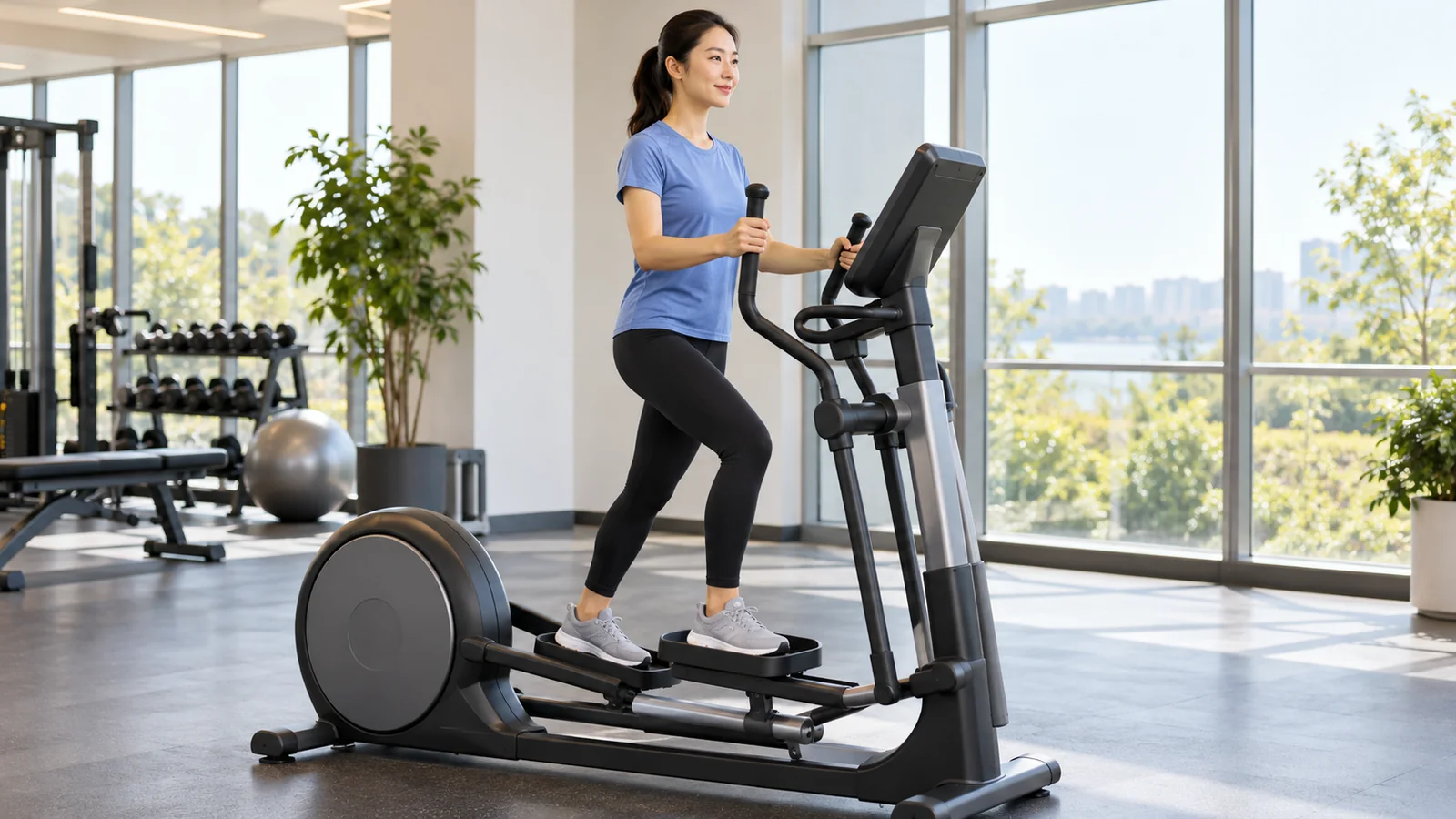
Place your feet securely within the pedals, facing generally forward. Stand tall enough to look ahead without craning your neck. Keep your shoulders relaxed and your knees moving in the same general direction as your toes. Avoid forcing an exaggerated stride or holding a deep squat.
Start with the fixed handles if coordinating the moving arms feels distracting. Hold securely without hanging your body weight from the rails. When you feel steady, try the moving handles with a gentle push and pull. You should not need to twist your torso or reach so far that your shoulders pull forward.
Your heels may move somewhat with the pedal path; there is no need to pin them down rigidly. Aim for comfortable foot contact and avoid spending the whole session pushing only through your toes. If the motion feels cramped or overlong, ask about adjustable stride settings or try a different model.
Keep the first setup simple
Wear secure athletic shoes with tied laces and clothes that cannot catch in the mechanism. Put water within easy reach. Set a timer or use the console clock before you begin. Save complicated playlists, messages, and unfamiliar entertainment controls for afterward so your attention stays on learning the movement.
Choose effort first, resistance second
There is no single beginner resistance level that works across elliptical machines. Level three on one model may feel very different from level three on another. Ramp height, stride design, and your speed also change the experience. Start near the low end and adjust according to breathing, control, and comfort.
The CDC’s talk test is a useful guide: moderate activity allows conversation, although singing becomes difficult; vigorous activity leaves you able to say only a few words before taking a breath. For these beginner sessions, stay easy to moderate. You do not need a breathless segment.
Use these plain-language effort descriptions throughout the plans:
- Easy: You can speak comfortably and concentrate on your stride. The movement feels controlled and sustainable.
- Steady: Your breathing is more noticeable, but you can still hold a conversation. There is no need to strain.
- Slightly brisker: You make one small increase while preserving conversational breathing and a smooth movement.
If you use a zero-to-ten effort score, the CDC describes moderate intensity as approximately five or six and vigorous intensity as seven or eight. Treat these as subjective guides, not a target you must force yourself to reach. An easy introductory session is still a valid place to begin.
Adjust one control at a time
Resistance makes each stride harder to push. Cadence describes how quickly you move. Ramp adjustments, where available, change the pedal path. For your first sessions, keep the ramp at a comfortable low setting and use small changes in resistance or pace, rather than changing everything together.
After a small adjustment, give yourself time to notice how breathing and movement respond. If your legs start grinding, your shoulders tense, or you cannot speak comfortably, undo the change. A useful setting is one you can sustain with good control, even when it looks modest on the display.
The 20-minute elliptical workout for beginners
Use this workout once you can move comfortably on the machine. The ten-minute middle block can remain easy if that is what you need. Finishing the planned time is optional; stopping early because your movement or symptoms require it is sensible.
- Minutes 0–5: Warm up. Begin slowly with low resistance. Let the first couple of minutes be an orientation period. Gradually settle into a smooth rhythm without chasing a speed number.
- Minutes 5–10: Find your steady setting. If comfortable, increase your pace slightly or add a small amount of resistance. Keep your breathing conversational. Leave the ramp alone.
- Minutes 10–15: Hold the effort. Continue at the same manageable workload. Check that your hands are not carrying your weight and your shoulders remain relaxed. Reduce the setting if the effort keeps climbing.
- Minutes 15–20: Cool down. Lower the resistance and gradually slow your movement. Let breathing become easier before following the machine’s stopping and dismounting instructions.
The timing is five minutes warming up, ten minutes working steadily, and five minutes cooling down: twenty minutes total. The American Heart Association recommends gradual warm-ups and cool-downs, generally lasting five to ten minutes each. Allow longer if you need a slower transition.
During the middle block, ask three questions: Can I speak comfortably? Can I move without rocking or pulling myself forward? Does the motion feel comfortable in my feet, knees, hips, and back? Those answers are more useful than matching a resistance number from somebody else’s workout.
If you finish and feel ready to do much more, keep that information for the next session. There is no need to turn the first successful workout into an unplanned endurance test. Repeating a manageable session gives you a clearer starting point.
Shorter options when twenty minutes is too much
A 15-minute introductory workout
Use five minutes of easy warming up, five minutes of easy-to-steady movement, and five minutes easing down. That is fifteen minutes total. Keep the middle block gentle enough that you can pay attention to the machine rather than simply waiting for the timer to end.
Repeat this version until it feels familiar. To work toward twenty minutes, extend the middle block by one or two minutes on a later visit while leaving the warm-up and cool-down intact. You can spend several sessions at the same duration.
A 10-minute familiarization visit
If even fifteen minutes feels like a lot, make the whole visit easy: five minutes gradually finding your rhythm, followed by five minutes gradually easing down. There is no separate challenging block. This is practice using the equipment and testing a comfortable amount of movement.
You can stop sooner if needed. If you cannot find a comfortable, controlled stride at the easiest practical setting, ask for help with the machine or choose another activity. Do not force ten minutes simply because it appears on a plan.
A shorter session is particularly useful when the main obstacle is unfamiliarity. Learning to mount safely, recognize the controls, and leave feeling comfortable creates something concrete to build on next time.
A four-week plan you can repeat or slow down
The following schedule is an example, not a deadline. It assumes the fifteen-minute session feels manageable. Start with the familiarization version instead if needed. Place an easier day or a day away from the elliptical between early sessions, such as training Monday, Wednesday, and Saturday.
- Week 1: Three fifteen-minute sessions. Keep all three easy and focus on learning a repeatable setup. Total machine time: forty-five minutes.
- Week 2: One fifteen-minute session and two twenty-minute sessions, only if week one felt comfortable. Total machine time: fifty-five minutes.
- Week 3: Three twenty-minute sessions at easy-to-steady effort. Use the same basic settings rather than adding a harder challenge. Total machine time: sixty minutes.
- Week 4: Two twenty-minute sessions and one twenty-five-minute session. For the longer session, use five minutes warming up, fifteen steady minutes, and five minutes cooling down. Total machine time: sixty-five minutes.
Advance when you can complete the current version with controlled movement, manageable breathing, and no concerning symptoms during or afterward. Also consider how you feel the next day. If the sessions leave you unusually drained or interfere with ordinary activities, repeat or reduce the workload instead of advancing.
You can keep the same week for a month. You can also use only two sessions if that fits your current capacity and schedule. The purpose is to establish a pattern that you can return to, not to collect perfect weekly totals.
The CDC’s adult activity guidance recommends at least 150 minutes of moderate-intensity aerobic activity weekly, plus muscle-strengthening activity on two or more days. That is a longer-term reference, not an entry requirement. Some activity is better than none, and it can be accumulated in smaller amounts.
Importantly, total machine time is not automatically moderate-intensity time. Easy warm-ups, easy recovery, and cool-downs may fall below that intensity. Record them as part of your workout, while counting only the appropriate portions toward a moderate-activity target.
Try gentle intervals after steady sessions feel familiar
Intervals simply alternate different efforts. They do not have to involve sprinting or high-intensity training. Once repeated steady sessions feel comfortable, this optional twenty-five-minute version offers variety without a maximal effort.
- Warm up for five minutes with low resistance and easy movement.
- Complete five rounds of one minute slightly brisker followed by two minutes easy. Each round lasts three minutes, so the interval block totals fifteen minutes.
- Cool down for five minutes by gradually returning to very easy movement.
For the brisker minute, increase either your pace a little or the resistance by a small step. Keep the other setting unchanged. Your breathing should remain conversational, and the easy minutes should genuinely feel easier. There is no requirement to reach a specific speed.
If you are still struggling to recover when the next brisker minute arrives, skip it and continue easily. Next time, return to the steady workout or make the brisker segments smaller. Do not add this interval session at the same time you increase your weekly frequency and duration.
Fix the common problems that make ellipticals feel harder
Your legs tire before your breathing changes much
Try reducing the resistance rather than pushing through a heavy, slow grind. Keep the ramp comfortable and seek a smoother movement. If that makes the session easier, stay there. You can build familiarity before asking your legs to handle more resistance.
You are bouncing or leaning heavily on the handles
Ease the pace and check whether you are trying to move faster than you can control. Bring your attention back to staying tall and moving smoothly. If you need the handles to support much of your weight, the current setup or workload may not suit you.
Your feet feel numb or tingly
Stop and safely step off rather than trying to ignore the sensation. Check whether your shoes are too tight and whether the pedal position is comfortable. Do not assume persistent or recurring numbness is just a normal part of elliptical exercise; seek professional advice before continuing to provoke it.
Your knees or hips hurt
End the painful movement. Low impact is not a promise that every stride path will suit every joint. A different ramp, machine, or activity may feel better, but persistent pain deserves assessment rather than repeated experiments at higher settings.
The display makes you feel behind
Use elapsed time as your main console number for now. Speed, distance, and calorie estimates are secondary information, particularly when switching machines. Your first month’s useful comparisons are whether the same session feels more controlled and whether you can repeat it comfortably.
You get bored before you get tired
Break the steady block into short attention checks without changing the workload. Spend one minute noticing relaxed shoulders, another checking your breathing, and another keeping the stride smooth. A short audio program can help once you can operate the machine confidently and remain aware of your surroundings.
Track the details that help your next workout
A good elliptical log only needs a few entries: date, machine or model, total minutes, resistance and ramp settings, and how the session felt. Add a note about discomfort or unusual fatigue if relevant. Recording the machine matters because settings are most useful when compared on the same equipment.
For example: “Monday, gym elliptical beside the window, fifteen minutes, low ramp, resistance two, easy conversation, comfortable afterward.” On the next visit, your first goal can simply be to repeat that session. You have a starting point instead of guessing again.
Use the workout log template as a place to organize your training, adding these cardio details alongside any strength work. Keep the record brief enough that you will actually fill it in. If you also need a simple home strength option, our beginner resistance-band routine provides a separate session to adapt around your cardio days.
Look for progress beyond bigger numbers: less hesitation getting started, smoother coordination, a familiar effort feeling easier, or finishing with enough energy for the rest of your day. These observations help you decide whether to extend the next session or keep practicing the current one.
Safety checks before you increase the workload
If you have a chronic condition, an injury affecting movement, or uncertainty about exercise restrictions, get individualized guidance. NHLBI advises discussing appropriate activity with a clinician when you have conditions such as heart disease, diabetes, or high blood pressure, and seeking advice about symptoms such as chest pain or dizziness with activity.
Stop exercising for chest pain, faintness, unusual severe breathlessness, or other concerning symptoms. If you think you may be having a heart attack, call emergency services immediately. Do not keep pedaling to complete a cool-down or reach the planned minutes.
For ordinary sessions without warning symptoms, ease down gradually and follow the machine’s safe dismounting instructions. Wait until the pedals are stopped and stable before stepping off. At home, keep children and pets away from moving equipment.
Frequently asked questions
How long should a beginner use an elliptical?
Start with a duration you can manage comfortably, often ten to twenty minutes including easy transitions. The twenty-minute plan is a useful option, not a minimum. If five easy minutes is your current starting point, use that information to plan the next visit.
How often should beginners do elliptical workouts?
Two or three manageable sessions per week is a practical starting schedule for this guide. Your other exercise, recovery, and health needs matter too. Build a comfortable pattern before adding more days, and avoid making every session harder than the previous one.
Should I use the moving handles?
Use them if they feel comfortable and you can coordinate them without twisting or reaching. Fixed handles are useful while learning. Neither choice requires hanging onto the machine or using your arms to compensate for a resistance level that is too demanding.
Should beginners pedal backward?
You do not need backward pedaling to start. Learn a controlled forward stride first. If you later want to try another direction, check that your machine permits it and follow its instructions, rather than reversing abruptly while moving quickly.
Is twenty minutes enough?
Twenty minutes can be a worthwhile session and a repeatable step toward a more active routine. Its contribution depends partly on intensity, and no single workout guarantees a fitness or weight outcome. Consistency and a suitable overall routine matter more than making each visit long.
Make your next session easy to repeat
Choose the shorter or twenty-minute plan, identify one comfortable setup, and record how it felt. Repeat before increasing the challenge. Your best beginner elliptical workout is one you can control, recover from, and return to without dreading it.
For another place to start exploring your fitness routine, explore Workit.