
Published October 11, 2026
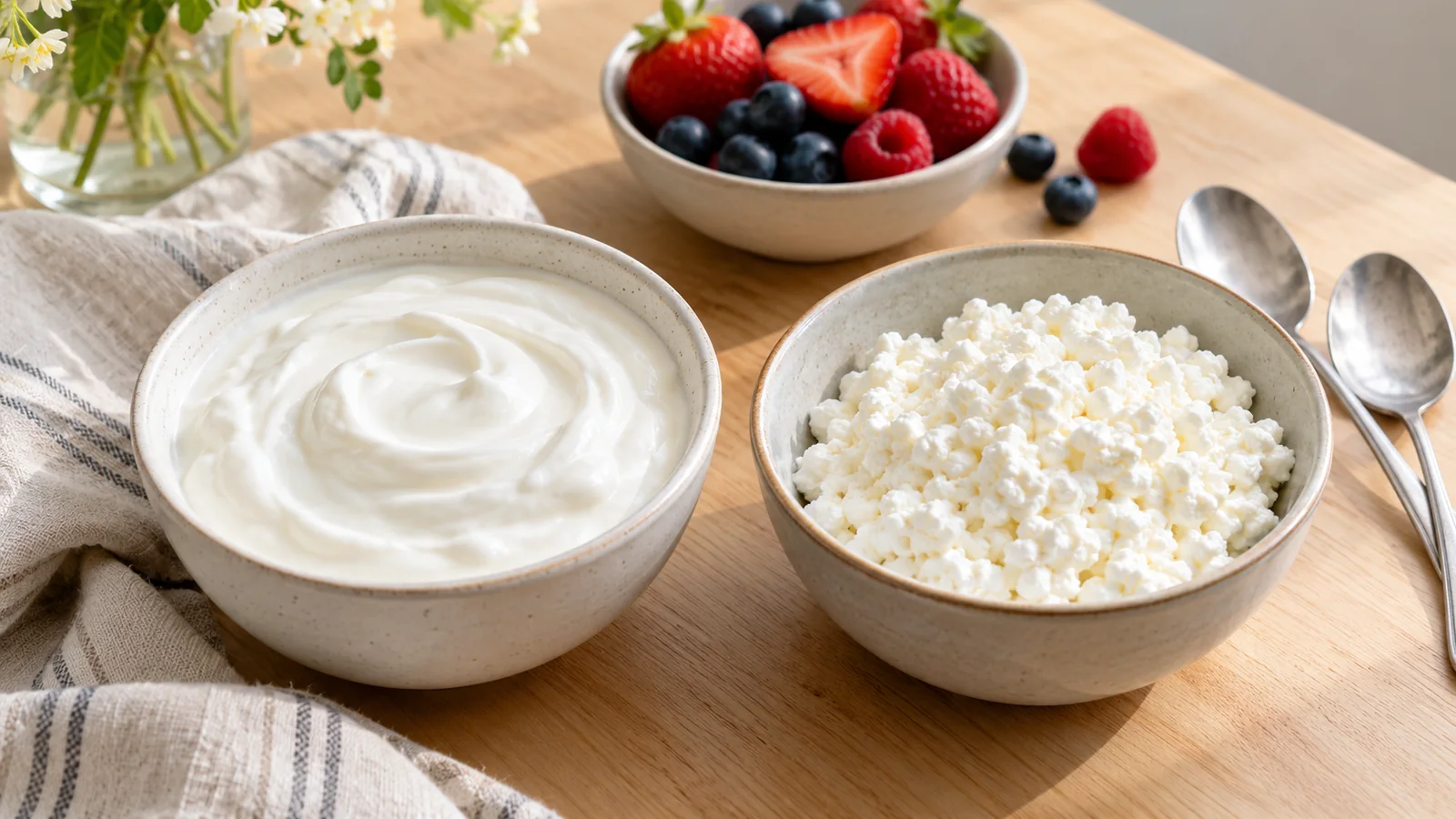
Greek yogurt and cottage cheese can both be convenient protein foods. Choose Greek yogurt when you want a smooth, tangy base for oats, fruit, or sauces; choose cottage cheese when you prefer mild, salty curds or a spread you can blend. For nutrition, compare the actual labels at the same weight. Protein, sodium, fat, and added sugar vary by product, and a larger listed serving can make one food look more impressive than it is.
This guide explains how to make that comparison, build useful meals with either food, and avoid paying more for a tub that does not fit your routine. There is no universal winner. The most useful choice depends on your preferred flavor, dietary needs, budget, and what you plan to eat alongside it.
Greek yogurt vs. cottage cheese: the short answer
- For smooth breakfasts: Greek yogurt is easy to stir into oats or spoon under fruit.
- For a savory bowl: cottage cheese works with tomatoes, cucumber, herbs, and toast.
- For protein: compare grams per equal food weight, then consider the portion you actually enjoy.
- For sodium: inspect the label carefully. The two example products below have a substantial difference.
- For lactose concerns: neither ordinary product should automatically be treated as lactose-free.
- For a milk allergy: both dairy versions contain milk, including lactose-free versions.
A food can work well in one meal and poorly in another. A smooth yogurt you enjoy every morning may be more useful than a slightly higher-protein cottage cheese you rarely finish. Conversely, a savory cottage-cheese lunch can be a welcome alternative when you are tired of sweet breakfasts.
Start with a fair comparison
The biggest comparison mistake is putting one manufacturer’s serving beside another manufacturer’s serving and assuming they represent equal amounts. A yogurt label might use 170 grams, while a cottage-cheese label uses 110 grams. Both numbers describe legitimate servings for labeling, but they answer different questions.
First ask what you are comparing: protein in the portion you plan to eat, protein per 100 grams, or cost for a useful serving. These are separate measurements. None tells you everything about the food.
Two real label examples
The following values were checked on manufacturer pages for this article. FAGE Total 0% lists 18 grams of protein and 65 milligrams of sodium per 170 grams. Good Culture Organic 2% Low-Fat Classic lists 14 grams of protein and 380 milligrams of sodium per 110 grams. These specific products have different fat levels and are examples, not a controlled comparison of all yogurts and cottage cheeses. Packaging can change; your current container takes priority.
At an equal 100-gram weight, the protein calculations are:
- Yogurt: 18 ÷ 170 × 100 = approximately 10.6 grams.
- Cottage cheese: 14 ÷ 110 × 100 = approximately 12.7 grams.
On these labels, cottage cheese provides about 2.1 grams more protein per 100 grams. At the manufacturers’ different serving sizes, yogurt appears ahead, 18 versus 14. Both observations are mathematically correct. They simply use different denominators.
You do not need to perform this calculation every time you eat. It is a shopping tool that helps you understand a label before settling into an ordinary routine. For a step-by-step label walkthrough, see how to read nutrition labels for protein.
Compare the amount that fits your meal
Suppose your usual yogurt bowl contains 170 grams. Using the example yogurt, that is 18 grams of protein before toppings. If your preferred cottage-cheese portion is 165 grams, the example cottage cheese supplies 14 × 165 ÷ 110 = 21 grams.
That three-gram difference may matter less to you than texture, price, or sodium. It also does not establish an ideal serving for everyone. You might want a smaller snack, a larger breakfast, or either food as a condiment within a meal that contains other protein sources.
Use the comparison to make a practical choice, rather than turning each meal into a competition. The rest of your eating pattern matters more than winning a narrow comparison between two tubs.
What differs beyond protein?
Sodium deserves its own check
Cottage cheese can contribute appreciable sodium, and the amount differs among brands and varieties. In the two examples above, sodium is about 38 milligrams per 100 grams of yogurt and 345 milligrams per 100 grams of cottage cheese. Those values come from the same equal-weight calculation.
Consider the whole meal. Cottage cheese with salty crackers, olives, and heavily seasoned deli meat will have a different sodium total from cottage cheese with fresh cucumber and unsalted toast. Greek yogurt used as a dip can also become salty once you add seasoning packets, cheese, or prepared sauces.
If a clinician has given you an individualized sodium limit, use that guidance and the actual label. Do not assume a food fits simply because it has protein, is organic, or is marketed for fitness.
Plain and flavored products answer different needs
Plain dairy contains naturally occurring milk sugar. A number on the total-sugars line does not automatically mean sugar was added. The FDA’s Nutrition Facts guide distinguishes total sugars from added sugars and explains that serving size is not a recommendation for how much to eat.
A flavored yogurt can be a convenient food you genuinely like. A plain yogurt allows more control over sweetness and seasoning. Compare products in the form you will actually eat: plain yogurt plus honey is no longer the same meal as plain yogurt alone.
The same applies to cottage cheese sold with a fruit compartment. Check whether the nutrition panel includes both parts and whether the package contains one serving or more. Small packaging details can change the comparison more than the food category does.
Fat level changes the experience
Nonfat, reduced-fat, and whole-milk versions differ in flavor and richness. A higher-fat option may suit a sauce or bowl you find too sharp when made with nonfat yogurt. A lower-fat option may fit another meal perfectly. Either can be part of an ordinary eating pattern.
Avoid assuming that two foods are equivalent because both say “2%.” Look at serving weight, total fat, saturated fat, and protein directly. Also distinguish what you prefer from what someone else recommends online. The version that works in your kitchen is the relevant one.
Calcium and fortification vary
Check calcium and vitamin D on the package instead of assuming all dairy products provide identical amounts. Serving size and formulation affect the listed quantities. Plant-based alternatives vary even more, so a similar-looking tub may provide a different combination of protein and added nutrients.
If you are replacing a food you regularly rely on, compare its broader nutritional role. You might choose a product for flavor and get particular nutrients elsewhere. A single substitution does not need to perform every job in your diet.
Texture and cooking: where each food fits
Use Greek yogurt when smoothness matters
Greek yogurt is convenient for a spoonable breakfast, a tangy dressing, or a cool topping. Stir it with lemon, garlic, and herbs for vegetables or grain bowls. Add milk gradually when you want it pourable, because yogurt thickness varies.
For warm sauces, begin with a small amount off the heat and loosen it with warm cooking liquid. Intense heat can produce a grainy or separated texture. That texture change is a cooking-quality issue; it is not a reliable safety test. Follow safe handling and reheating practices regardless of how smooth the sauce looks.
If the goal is an easy make-ahead breakfast, our overnight oats with Greek yogurt guide provides a measured base, variations, and storage considerations.
Use cottage cheese when mildness or structure helps
Cottage cheese works well spooned onto toast, paired with roasted vegetables, or blended into a dip. Small-curd and large-curd varieties feel different, and some tubs contain more loose liquid than others. Those differences influence a recipe even when the protein numbers are similar.
Blend a small portion first if curds are the main thing stopping you from enjoying it. Add liquid sparingly; it is easy to make a dip thinner but harder to restore its original thickness. A blended cottage-cheese sauce may still taste noticeably salty, so season after blending.
For baking, avoid assuming cottage cheese can replace Greek yogurt in every recipe at equal volume. Acidity, moisture, texture, and salt can affect the result. Follow a recipe designed for the ingredient when the structure of the finished food matters.
Try a small substitution before changing a whole batch
If a meal-prep recipe calls for a large tub of yogurt, test cottage cheese in one serving before changing the entire recipe. Blend it if needed, taste it with the other ingredients, and check the consistency after refrigeration.
This small trial answers a more useful question than an internet ranking: will you want to eat this meal again? Record the amount of liquid or seasoning you added so the next batch is repeatable. You do not need a perfect substitution to discover a combination you enjoy.
Four practical meals with transparent protein math
The following are illustrative meal builds, not laboratory-analyzed recipes. Dairy figures use the two manufacturer examples above. Other protein values are explicit hypothetical label assumptions so you can substitute your own packaging. Fruit, vegetables, spices, and optional extras are not included in the stated protein subtotals.
1. Yogurt, oats, and berries
Combine 170 grams of the example Greek yogurt with 40 grams of oats suitable for your chosen preparation and berries. If the oats label lists 5 grams of protein per 40 grams, the yogurt-and-oats subtotal is 18 + 5 = 23 grams.
Prepare the oats according to their package, whether cooked or used in a manufacturer-supported refrigerated preparation. Add milk or water to achieve the texture you like. Nuts, fruit, or a drizzle of sweetener can make the bowl more enjoyable, but their nutrition belongs in any complete meal calculation.
This meal is useful when you want a breakfast with contrasting textures. It is also easy to scale: a smaller bowl is valid, and a larger appetite can be met by adding more food rather than treating the example as a limit.
2. Cottage cheese on savory toast
Spread 165 grams of the example cottage cheese over two slices of toast. Add sliced tomatoes, black pepper, and herbs. If the bread label provides 4 grams of protein per slice, the dairy-and-bread subtotal is 21 + 8 = 29 grams.
The bread is part of the calculation, not an invisible vehicle. Its sodium and other nutrients also contribute. Choose a texture you enjoy and an amount that makes the meal satisfying. A little olive oil, avocado, or an additional side can change the eating experience without requiring a different central ingredient.
3. A shared yogurt dip
Mix 340 grams of the example yogurt with grated cucumber, lemon juice, dill, and garlic. The yogurt supplies 36 grams of protein to the entire dip. Divide it evenly among four people, and each portion receives 9 grams from the yogurt.
This is a useful reminder that a high-protein ingredient does not make every small spoonful a large protein serving. Enjoy the dip with a meal, and count the portion you actually eat if you are doing nutrition arithmetic. Keep a clean serving utensil with the bowl.
4. Cottage-cheese pasta sauce for two
Blend 220 grams of the example cottage cheese with roasted peppers and a little warm pasta water. Divide between two portions of cooked pasta. The cottage cheese contributes 28 grams to the batch, or 14 grams per serving.
If each portion starts with a dry pasta serving labeled 12 grams of protein, the cottage-cheese-and-pasta subtotal is 26 grams per person. Use the dry weight specified by that pasta label. Cooked pasta weighs more after absorbing water; the extra weight does not create extra protein.
Serve promptly after combining, and include other ingredients when calculating a full recipe. These examples intentionally show the arithmetic instead of presenting a precise-looking total that hides the assumptions.
Which is better around a workout?
Either food can fit before or after training if you tolerate it and like the meal. The practical questions are how soon you are exercising, whether you want a full meal or a snack, and what else you have eaten that day.
Some people prefer a smaller, smoother yogurt snack before movement. Others would rather eat cottage cheese as part of a later lunch. Test familiar foods during ordinary sessions instead of trying a new large dairy meal before an important event.
Neither food automatically creates muscle gain, guarantees recovery, or needs to be eaten at a special minute. Training, adequate overall food, sleep, and consistency all belong in the wider picture. Our guide to protein per meal can help you think about meal structure without making this comparison carry the entire plan.
If eating or tracking food is becoming stressful, there is no requirement to optimize the protein difference between two dairy products. A simple meal you enjoy is a reasonable outcome.
Lactose intolerance and milk allergy are different
People vary in how much lactose they tolerate. The National Institute of Diabetes and Digestive and Kidney Diseases notes that some people tolerate yogurt more easily and that lactose-free products can be useful. That does not mean every Greek yogurt or cottage cheese is suitable for every person with lactose intolerance.
Check for a lactose-free label when that is what you need. Try changes in a way that fits your own clinical advice, especially if symptoms are persistent or their cause is unclear. Do not diagnose a milk allergy from digestive discomfort alone.
A milk allergy concerns milk proteins. Removing lactose does not remove those proteins. The FDA’s food-allergy guidance identifies milk as a major allergen. Read ingredient and allergen statements and follow your allergy care plan.
For a dairy-free alternative, compare protein and fortification explicitly. A coconut-based yogurt, soy-based yogurt, and almond-based yogurt may serve very different nutritional roles. Choose according to your needs and preferences rather than assuming the word “yogurt” guarantees a particular protein amount.
Food safety and meal-prep storage
Choose dairy made with pasteurized milk. The FDA explains why raw milk carries avoidable infection risks; fermentation is not a reason to ignore pasteurization.
Keep opened dairy and prepared bowls refrigerated at 40°F or below; setting the refrigerator at 4°C or colder meets that limit. Follow package instructions and use clean utensils. Discard perishable food left out longer than two hours, or one hour above 90°F/32°C. Refrigerated cooked leftovers generally have a three-to-four-day window under USDA guidance; a mixed dish should also respect any shorter ingredient or product limit.
Plan around when you opened the tub and when the other ingredients were prepared. Adding fresh yogurt to older cooked pasta does not reset the pasta’s storage clock. For travel, use an insulated bag with ice packs and refrigerate the food when you arrive.
How to compare price without wasting food
Unit price by weight is a useful starting point. Cost per amount of protein can help too, provided you do not mistake it for a complete measure of food quality. The cheapest protein on paper is poor value if half the tub goes uneaten.
Here is a fictional store example. A 680-gram yogurt tub costs $4.80 and supplies 18 grams of protein per 170 grams. It contains four such portions, totaling 72 grams of protein. Its cost per 20 grams of protein is $4.80 ÷ 72 × 20, or about $1.33.
A fictional 440-gram cottage-cheese tub costs $4.40 and supplies 14 grams per 110 grams. Its 56 grams of total protein cost $4.40 ÷ 56 × 20, or about $1.57 per 20 grams. These are arithmetic examples, not current prices or buying recommendations.
Now consider convenience. Individual cups may cost more per gram but suit a small household or a workday without measuring equipment. Larger tubs may suit someone who already uses the ingredient in several meals. Compare the amount you will realistically finish.
Frequently asked questions
Does cottage cheese always have more protein?
No. Protein depends on the product and comparison basis. One may provide more per 100 grams while the other provides more in its larger labeled serving. Read both serving weights before deciding.
Can Greek yogurt replace cottage cheese?
Often in a simple bowl or dip, but flavor and texture will change. For baking or recipes that depend on curds, moisture, or acidity, use a suitable recipe or test a small batch first.
Are live cultures a reason to choose one automatically?
No. Culture information differs among products, and a label mention alone does not establish a specific health outcome for you. Buy a food you tolerate and enjoy; avoid treating it as a treatment for digestive symptoms.
Should I buy both?
Only if both have a clear use. For example, yogurt can cover breakfast and a dressing, while cottage cheese covers savory lunches. If you regularly discard one, simplify your shopping rather than forcing variety.
What if I dislike both plain?
Try one small change before buying another large tub. Add ripe fruit and cinnamon to yogurt, or herbs and crunchy vegetables to cottage cheese. You can also combine a plain product with a flavored version you already enjoy. There is no requirement to like either food. Beans, eggs, tofu, fish, and other familiar ingredients can fill similar meal-planning roles, depending on your needs and preferences.
The practical takeaway
Choose Greek yogurt or cottage cheese by matching the food to the meal, comparing labels at equal weights, and checking the features that matter to you. Protein is useful information, but flavor, sodium, tolerance, price, and safe storage also influence whether the choice works.
Start with one breakfast or lunch you genuinely want to repeat. If you are building a broader movement routine alongside everyday meals, you can explore Workit on the App Store.