
Published October 7, 2026
A 2 day full body workout can be a practical way to start strength training. Train on two nonconsecutive days, include lower-body work, a push, a pull and a trunk exercise in each session, and repeat the same movements long enough to learn them. Start with one or two working sets rather than making your first week a test of endurance.
The gym plan below uses two sessions, A and B, with clear rep ranges, rest periods and equipment alternatives. It is designed for generally healthy adults beginning resistance training or returning after a break. Allow roughly 40–60 minutes once you are doing the full two-set version; equipment availability and learning time will affect that estimate.
This is a general starting template, not an individualized rehabilitation program. If an injury, medical condition, pregnancy or recent operation affects your exercise choices, get appropriate guidance before using it.
Your twice-weekly schedule
Choose two appointments you can usually keep. Monday and Thursday work well, as do Tuesday and Friday or Wednesday and Saturday. The nonlifting days give you room for walking, other aerobic activity and recovery.
- Monday: Workout A
- Tuesday: Walking or another manageable aerobic activity
- Wednesday: Normal daily activity; no required lifting
- Thursday: Workout B
- Friday through Sunday: Aerobic activity, recreation and rest according to your schedule
The letters describe a sequence, not fixed weekdays. If Monday becomes Tuesday, keep A as your next session. Avoid replacing a missed workout with twice as many sets at your next visit.
The 2-day full-body workout plan
A rep is one complete repetition of an exercise. A set is a group of consecutive reps before a rest. The numbers below are working sets; easy practice and warm-up sets are additional. The CDC explains sets and repetitions and recognizes weights, bands and bodyweight exercises as strengthening options.
For your first week, perform one working set of each listed exercise. Move to two sets when you can maintain comfortable technique and recover between sessions. The routine is a practical beginner template, not a claim that this exact exercise combination has been tested as a package.
Workout A
- Leg press: 2 sets of 8–12 reps; rest 2 minutes
- Machine chest press: 2 sets of 8–12 reps; rest 90–120 seconds
- Seated cable row: 2 sets of 8–12 reps; rest 90–120 seconds
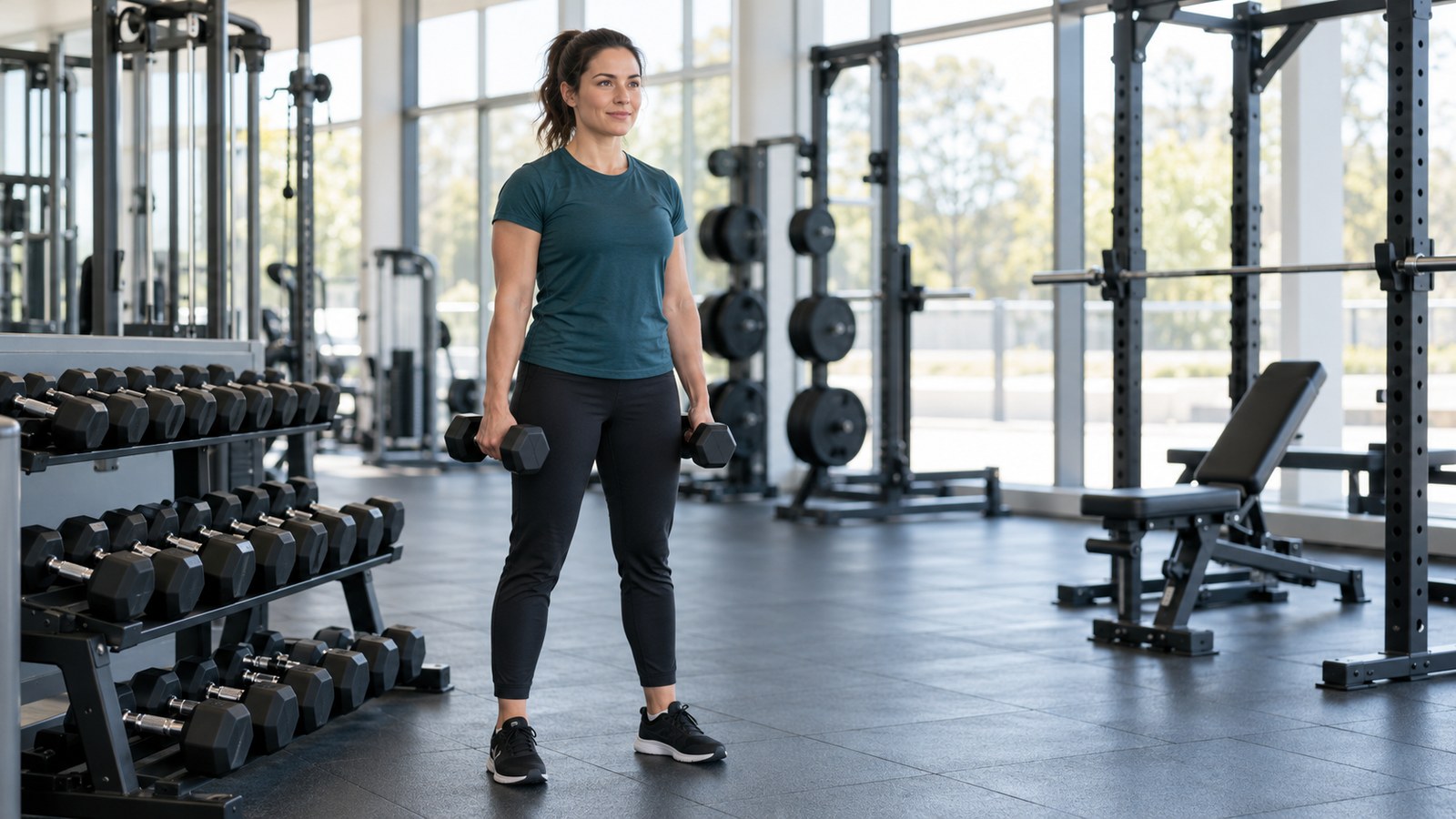
- Dumbbell Romanian deadlift: 2 sets of 8–10 reps; rest 2 minutes
- Standing calf raise: 2 sets of 10–15 reps; rest 60–90 seconds
- Dead bug: 2 sets of 5–8 controlled reps per side; rest 60 seconds
Use a calf machine or start with bodyweight while lightly holding a fixed support. Dead bugs need no external weight. If the Romanian deadlift is unfamiliar, ask a qualified trainer to check your setup or use the bridge-and-leg-curl alternative described below.
Workout B
- Goblet squat: 2 sets of 8–12 reps; rest 2 minutes
- Lat pulldown: 2 sets of 8–12 reps; rest 90–120 seconds
- Machine chest press: 2 sets of 8–12 reps; rest 90–120 seconds
- Floor glute bridge: 2 sets of 10–15 reps; rest 60–90 seconds
- Seated or lying leg curl: 2 sets of 10–15 reps; rest 60–90 seconds
- Side plank from bent knees: 2 sets of 10–20 seconds per side; rest 60 seconds
Start the bridge with bodyweight. Use the leg press instead of the goblet squat if holding a dumbbell is awkward. Repeating the chest press is deliberate: you get another chance to practice the same setup instead of learning a new pressing exercise every visit.
These sessions include shoulder and arm work through the presses and pulls. Direct shoulder presses, curls and triceps exercises can wait. After several consistent weeks, you may add one or two sets of a comfortable accessory if you have time and a specific reason.
Warm up without using up the workout
Spend about five minutes walking, cycling or using another easy machine. The goal is to feel ready to move, not to complete a hard cardio session first. Then rehearse the exercises you are about to perform. Our guide to warm-up sets versus working sets includes machine, dumbbell, and barbell examples.
- Do a light set of the first lower-body exercise for about 6–10 reps.
- Increase the load gradually if needed, using another easy practice set.
- Before your first press and pull, do a light set to check the seat, handles and movement.
- Rehearse the hip hinge without weights before picking up dumbbells.
Warm-up sets should leave plenty of energy. You do not need to turn every small exercise into a lengthy sequence of preparation sets. If you are unsure how to adjust a machine, ask gym staff before loading it.
How to perform the main exercises
Leg press and goblet squat
For the leg press, adjust the seat so you can lower the platform through a comfortable range while keeping your back and pelvis supported. Place your feet securely on the platform, lower under control and press smoothly. Do not bounce at the bottom or force extra depth by curling your pelvis away from the pad.
For the goblet squat, hold one dumbbell close to your chest and choose a stance that lets your feet stay planted. Bend your knees and hips together, descend only as far as you can control, and stand back up. A light bodyweight squat can be your first learning step.
Different machines fit different bodies. Our hack squat versus leg press guide explains the equipment choices if your gym has both. Keep whichever option you can perform comfortably and set up consistently.
Chest press
Adjust the machine so the handles begin around chest height and the starting position does not force your shoulders far behind your body. Keep your feet supported and press without lifting your back away from the pad. Return slowly enough to control the handles.
Use the same machine and seat setting when practical. A weight stack number is not a universal measure: 40 on one machine may feel very different from 40 on another.
Cable row and lat pulldown
During a seated row, sit tall enough to maintain a comfortable trunk position. Pull the handle toward your lower ribs, let your elbows travel back, then reach forward under control. Avoid turning every repetition into a large backward lean.
For pulldowns, secure the thigh pad and pull the bar or handles down in front of you toward the upper chest. Choose a grip that feels comfortable. Do not pull behind your neck or use a forceful swing to start each rep. If the bar never approaches the intended finish without leaning dramatically, reduce the load.
Romanian deadlift
Hold dumbbells near the front of your thighs. With a small bend in your knees, move your hips backward while keeping the weights close to your legs. Lower until you reach a controlled limit, then drive through your feet and return to standing.
The weights do not need to reach the floor. End the descent before you have to round your back or turn the movement into a squat. If you cannot find a comfortable hinge, use bodyweight glute bridges plus a light leg curl while you learn with qualified help.
Bridge, leg curl and calf raise
For the bridge, lie on your back with knees bent and feet planted. Lift your hips by pushing through your feet, stopping before you overarch your lower back. Lower smoothly. Adjust foot position until the movement feels controlled.
Set a leg-curl machine according to its instructions, including the knee alignment and pad position. Bend your knees against resistance without jerking your hips. For calf raises, rise onto the balls of your feet, pause briefly and lower under control. Use a stable support for balance rather than adding a wobbling challenge.
Dead bug and side plank
In the dead bug, lie on your back, raise your arms and bend your hips and knees. Slowly extend one leg and the opposite arm only as far as you can without losing trunk control. Return, switch sides and breathe throughout. Shorter reaches are a valid starting point.
For a modified side plank, support yourself on a forearm with knees bent. Lift your hips into a comfortable straight line from shoulders to knees. End the hold before your position collapses. Start with shorter holds if needed; longer is useful only while the position stays controlled.
Choose starting weights without a maximum test
You do not need to find your one-rep maximum to start this routine. Choose a light load, perform the bottom of the rep range and assess your control.
- Clearly too light: Every repetition feels easy and you could do many more. Make a small increase for the next set or visit.
- Useful starting load: The final reps require attention, but you could probably do another two or three with the same technique.
- Too heavy today: You cannot reach the minimum reps without swinging, rushing or shortening the movement. Reduce the load.
Estimating spare reps is imperfect, especially at the beginning. Treat it as a rough guardrail. In your learning sessions, err on the lighter side and finish before a repetition becomes a struggle you cannot control.
Rest longer if your breathing or grip is preventing a good next set. The listed rests are starting points, not deadlines. If you repeatedly need far longer, check whether the load or number of exercises is currently too demanding.
Your first four weeks
The double progression guide expands on how to build reps before increasing weight.
Week 1: learn the route
Complete A and B with one working set per exercise. Find the equipment, record seat settings and identify substitutions. Keep loads comfortably manageable. Finishing with energy left is appropriate.
Week 2: repeat the setup
If the first week went well, use two sets. Keep the weights similar while you learn how the second set feels. If soreness still interferes with ordinary movement, stay at one set or reduce the loads. There is no deadline for earning the two-set version.
Week 3: add a little performance
Where both sets feel controlled, try one additional rep while staying within the range. For example, change chest press results from 9 and 8 to 10 and 8. You do not need every exercise to improve on the same day.
Week 4: review before adding more
Look at attendance, technique and your training log. If you reach the top of a rep range on both sets with a couple of comfortable reps left, try the smallest available weight increase next time. Expect repetitions to fall toward the bottom of the range.
If the next machine increment is too large, keep the current load and repeat it. You can also ask whether the machine permits a manufacturer-approved small increment. Never balance loose plates on a weight stack or improvise a loading attachment.
Do not add weight, extra sets and several new exercises simultaneously. Change one thing so you can tell whether it helped. The ACSM’s 2026 resistance-training guidance emphasizes individualization and sustainable participation. The goal of this introductory month is a repeatable routine, not the highest possible weekly workload.
Keep a log that makes the next session easier
Write down the exercise, machine setting, load and reps for each set. Add one short note if something affected the result, such as poor sleep, a different machine or a rushed warm-up.
For example: “Chest press, seat 4, 20 kg, 10/9 reps, controlled.” At the next session, that is enough information to repeat the setup and aim for another good repetition. Record dumbbell loads as weight per hand so you do not confuse them with a combined total.
Judge trends over repeated visits. One weaker workout after a difficult day does not require a new program. Repeatedly declining performance, persistent soreness or a schedule you cannot maintain is a reason to reduce the workload and reassess.
What to do in a busy gym
Save one backup for each main movement before you arrive. That keeps a crowded room from turning your workout into random exercises.
- Leg press occupied: Use a light goblet squat, or a hack squat machine after learning its setup.
- Chest press occupied: Use wall or incline push-ups against a fixed, secure support. Choose a height that permits controlled reps.
- Cable row occupied: Use a chest-supported row machine.
- Pulldown occupied: Use a row machine for that day. It changes the pulling direction but preserves back work.
- Dumbbells unavailable: Replace Romanian deadlifts with one or two sets each of bridges and leg curls; allow extra time or omit optional work.
- Floor area unavailable: Use a light cable anti-rotation press for 1–2 sets of 8–12 controlled reps per side after learning the setup.
A substitution is a different exercise, so select its weight independently. Do not transfer the same number from a cable stack to a machine and assume the difficulty matches. For the movement categories behind these choices, see push versus pull workouts.
You may swap the order of the press and pull when necessary. If you change a major exercise’s position in the session, note that in the log: fatigue can affect how many reps you perform.
Missed days, short sessions and consecutive days
If you only train once this week
Do the next workout in your sequence. Resume with the other session next time. A single disrupted week does not need to be repaired by doubling your volume. If one day becomes your usual availability, plan honestly around it while looking for a realistic second opportunity.
If you have only 25 minutes
Warm up, then do the first four exercises of A for one or two sets each. For B, prioritize the squat, press, pulldown and bridge; keep the leg curl if time allows. This is an occasional shortened session, not a claim that accessory and trunk work never matter. Return to the complete plan at the next visit.
If your only openings are consecutive days
First check whether moving one session by a day is possible. If it is not, do not assume that two hard sessions are required. Keep the first session modest and make the second a lighter technique session if you are sore or tired. Avoid pushing both days toward failure.
There is no universal recovery clock that fits every person and exercise. If a consecutive-day schedule is your permanent reality, a trainer can help divide the work more comfortably. Persistent pain or declining control calls for changing the plan, not forcing the calendar.
Where cardio and recovery fit
Two strength sessions cover one part of an active week. For general adult health, the CDC recommends at least two strengthening days plus 150 minutes of moderate aerobic activity, 75 minutes of vigorous activity, or an equivalent combination. Build toward those amounts gradually if you are currently inactive.
For example, you might walk briskly for 30 minutes on five days, including after a lifting session if convenient. Shorter bouts can also fit your day. The schedule should reflect your starting fitness, available time and any medical guidance.
Keep meals regular, include protein-containing foods and protect your sleep as best you can. You do not need to overhaul every habit before your first workout. Start with manageable changes that support showing up again.
Mild muscle soreness can occur after unfamiliar training, but soreness is not a score to maximize. Stop an exercise for sharp or worsening pain. Chest discomfort, fainting or severe unusual breathlessness warrants prompt medical attention rather than a workout modification.
Frequently asked questions
Is a 2-day full-body workout enough to build muscle?
It can support muscle and strength gains, particularly for beginners, when the training is sufficiently challenging and progresses over time. In a 12-week randomized trial in previously untrained women, twice-weekly full-body training and a four-day upper/lower split produced similar measured improvements when weekly exercises, sets and reps were matched. That finding does not prove that every two-day program equals every four-day program.
Should beginners use machines or free weights?
Either can fit. Machines may simplify balance and setup; free weights offer useful flexibility. Choose equipment that fits you and that you can use with control. The best starting mix depends on access, comfort and instruction rather than a rule that one category is always superior.
Should I train to failure?
You do not need to make failure the target of this beginner plan. Finish most working sets with a few controlled reps probably available. This leaves room to learn the movements and repeat the second set. Avoid testing your limit simply to prove that a session counted.
When should I add a third day?
Consider it when two days are consistent, recovery is manageable and an extra session serves your goals. You can also remain on two days and gradually adjust the work. More calendar days create opportunities; they do not automatically improve the quality of the training.
How do I stay consistent after the first month?
Keep your two appointments, prepare backups and review your log weekly. If a small challenge helps, choose an attendance or technique goal from these fitness challenge ideas. Avoid a challenge that forces extra hard sessions when you need recovery.
Make the next workout easy to start
Choose your two days, save A and B, and begin with manageable loads. Your next useful step is a completed session with a clear record of what you did. If you want help organizing training, explore the workout-planning options in Workit on the App Store.
Comments
2 responses to “2-Day Full-Body Workout: A Beginner Gym Plan You Can Repeat”
[…] two-day full-body routine offers one way to begin with a smaller schedule. It can still be adjusted when needed, but it does […]
[…] With two available days, a full-body routine is often the simplest arrangement. Put a push, a pull, and lower-body exercises in each session, with rest days between them. For a complete example, use our two-day full-body workout plan. […]