
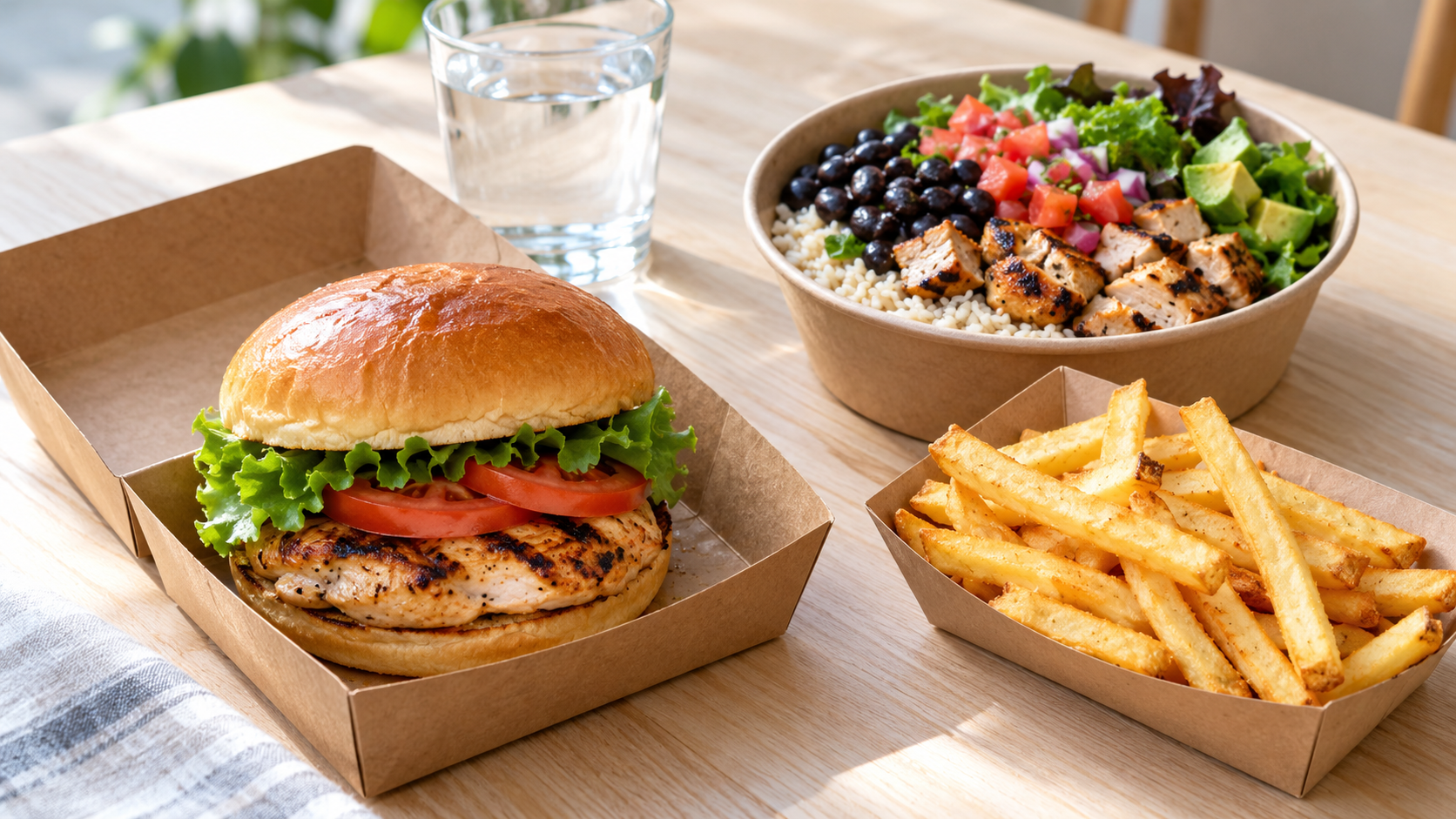
Fast food can fit into a muscle-building diet because it can provide calories, protein, and a convenient meal when time is tight. Whether it is good for bulking depends on the order, how often you rely on it, and what the rest of your eating and training look like.
A burger after lifting will not undo your progress. Equally, ordering the biggest meal available does not guarantee more muscle. The useful question is whether a meal helps you meet your needs while leaving room for variety, comfortable digestion, and a routine you can maintain.
This guide explains the benefits and trade-offs, how to build a practical order, and when an easy meal at home might serve you better.
Is fast food good for bulking? The quick answer
It can be useful as one option in your routine. It becomes less useful when “bulking” turns into a reason to ignore meal quality or eat past comfort every day.
| What you need | How fast food can help | What to check |
|---|---|---|
| Enough energy | A convenient, substantial meal | Whether the portion suits your needs |
| Protein | Meat, fish, eggs, beans, or other protein ingredients | The amount in your actual order |
| Variety | Customizable bowls, sandwiches, and sides | Vegetables, fruit, whole grains, and fiber across the day |
| Consistency | An option during travel or busy workdays | Cost, convenience, enjoyment, and how you feel afterward |
There is no universally best fast-food restaurant for muscle gain. A useful order at one location might be unavailable at another, and recipes differ between countries. Judge the meal in front of you rather than relying on a chain’s reputation.
What a muscle-building diet actually needs
A suitable amount of energy
Bulking usually means deliberately eating more energy than you use while following resistance training, with the aim of gaining muscle. The appropriate surplus is individual. Your training experience, activity, appetite, and starting circumstances all matter.
A small eight-week study of trained lifters compared maintenance intake with intended energy surpluses of 5% and 15%. Faster weight gain was more clearly associated with increased skinfold thickness than with additional muscle growth. Some outcomes differed, and only 17 participants completed the study, so it does not establish one perfect surplus for everyone.
The practical implication is to begin conservatively and adjust to your response. Automatically adding a large fast-food combination to an already adequate day may overshoot what you intended. The study did not compare fast food with home cooking; it examined energy intake.
Enough protein across the day
The International Society of Sports Nutrition’s protein position stand gives a general range of 1.4–2.0 grams per kilogram of body weight daily for most healthy exercising adults. For a 75-kilogram adult, that works out to approximately 105–150 grams, as an illustration rather than a personal prescription.
A fast-food meal can contribute toward that total. However, a large calorie count does not automatically mean a large protein serving. Check the protein in the sandwich, bowl, or main dish instead of assuming that any substantial-looking meal covers it.
Include protein at several meals rather than leaving the entire day’s intake to dinner. Beans, tofu, eggs, fish, poultry, dairy, and other foods can all have a place, depending on your preferences and needs.
Training that gives your body a reason to adapt
Food supports training; ordering more food cannot replace it. The American College of Sports Medicine’s 2026 guidance emphasizes regular resistance training, working the major muscle groups at least twice weekly, and building gradually.
Choose an achievable program, practice the exercises, and record your progress. A sustainable eating routine should make it easier to show up for those sessions.
Why fast food can be useful during a bulk
It solves a real convenience problem
Not everyone has a kitchen, meal-prep time, or predictable breaks. After a late shift or during a journey, a familiar restaurant may be the most realistic way to get dinner. A plan that only works when your schedule is perfect is difficult to follow.
Keep a few reliable meal ideas in mind before you need them. That reduces the pressure to analyze an unfamiliar menu when you are hungry and tired.
It offers flexibility and foods you enjoy
You can share meals with friends and still pursue strength goals. A flexible approach makes room for preferences, cultural foods, and social occasions without treating every restaurant visit as a problem to correct.
Fast food also covers more than burgers and fries. Depending on what is available, you might choose a bean burrito, chicken sandwich, rice bowl, breakfast sandwich, or falafel wrap. Each deserves consideration on its own ingredients and portion.
Some orders make substantial meals easy
A main dish plus a suitable side can be useful when a rushed day would otherwise leave you without a proper meal. The benefit is practical: you have something accessible that you will eat. You do not need to seek out the highest-calorie option to make that convenience count.
The trade-offs of relying on fast food
Sodium can add up across a full order
Bread, seasoned meat, cheese, sauces, and sides can each contribute sodium. Looking only at the main dish may miss much of the meal’s total. The World Health Organization’s healthy-diet guidance recommends adults consume less than 2,000 milligrams of sodium daily, equivalent to less than 5 grams of salt.
Your clinician may recommend an individual limit. Sweating during a workout is not, by itself, a reason to disregard sodium intake. Compare the full order and consider whether several salty components are being combined.
Fiber and food variety can get crowded out
If repeated meals contain little fruit, vegetables, pulses, or whole grains, meeting your needs becomes harder. WHO recommends at least 25 grams of naturally occurring fiber daily for adults. A small garnish does not offer the same variety as regularly including those foods.
Add what is convenient: beans in a bowl, vegetables in a sandwich, or fruit alongside breakfast. The goal is a varied overall pattern, rather than making every individual meal nutritionally complete.
The type of fat still matters
Bulking does not remove the importance of cardiovascular health. The American Heart Association explains that excess saturated fat can raise LDL cholesterol and recommends replacing some saturated-fat sources with unsaturated fats.
That can mean rotating your choices and including foods such as nuts, seeds, fish, avocado, and olive oil elsewhere in your routine. Grilled and plant-based labels are not guarantees of a particular nutrient profile, so check the actual ingredients and nutrition information.
The routine can become expensive or uncomfortable
Delivery charges, drinks, and frequent add-ons may cost more than you expect. Large meals may also leave you feeling too full for the rest of your day. If a particular order consistently feels uncomfortable before training, try a different portion or meal timing.
These are reasons to adapt your routine, not evidence that you have failed at bulking.
How to build a fast-food meal for bulking
1. Choose the main protein ingredient first
Start with a dish containing an identifiable protein source: chicken, fish, beef, eggs, beans, tofu, or another option you enjoy. Then look at its listed protein amount if that information is available.
Extra protein can be useful when the standard serving is small, but it is not automatically necessary. Compare the price and the whole meal before ordering double portions by default.
2. Include a carbohydrate you want to eat
Rice, bread, potatoes, noodles, and tortillas can all form part of a substantial meal. You do not have to replace the carbohydrate with salad simply because you are trying to make a thoughtful choice.
Choose a portion that fits your appetite and the rest of your day. Where available, whole-grain options add another way to vary your food choices.
3. Look for a straightforward addition
Consider vegetables, beans, or a fruit side. If the restaurant has few options, you can include them at another meal. You can also combine a purchased main with food from home, such as a sandwich with a piece of fruit you packed.
A useful order does not have to come entirely from one menu.
4. Decide on sides, sauces, and drinks individually
A meal deal bundles decisions together. Pause long enough to ask whether you want each part. You can have fries because you enjoy them without assuming that a larger size is necessary for muscle gain.
Choose drinks and toppings intentionally too. Water is a simple default; other drinks can fit according to your preferences and needs. There is no requirement to remove every sauce or make the meal taste bland.
5. Check the restaurant’s own information
In the United States, FDA menu-labeling requirements apply to qualifying chains with 20 or more locations. Covered businesses must provide additional nutrition information on request, including protein, fiber, sodium, and saturated fat.
Use the restaurant’s current local menu or calculator when possible. Check the serving size and whether the numbers include sauces, cheese, dressings, sides, and drinks. An old social-media graphic may describe a different recipe or market.
What if nutrition information is unavailable?
You can still make a reasonable choice. Look at the main ingredients, order a portion that usually leaves you satisfied, and include a recognizable protein source. Ask about ingredients if you need to manage an allergy or dietary restriction.
A missing nutrition panel does not mean you must skip the meal or invent a precise calorie estimate. If you regularly eat at the same independent restaurant, learn which orders work well for your appetite, budget, and training schedule. Familiarity can make the decision simpler without turning lunch into a calculation.
Practical meal ideas without a rigid meal plan
These are adaptable examples, not prescribed portions or verified nutrition totals for a particular chain. Use the menu available to you, account for allergies, and adjust to your appetite.
A customizable rice bowl
Start with rice and chicken, tofu, or another protein option. Add beans and vegetables if you enjoy them, then choose toppings for taste and the overall meal. A bowl gives you a clear view of the different components.
If you are still hungry, consider which part you actually want more of. More rice, another protein serving, or a side may each solve a different need. “Double everything” does not have to be the default.
A burger meal
A burger can fit. Consider the burger’s size and ingredients, then choose a side separately. You might have fries, a side salad, fruit, or something from home, depending on availability and preference.
Adding several patties, bacon, cheese, and a large dessert changes both the cost and nutritional profile. Make those choices because they suit you, rather than because a bulk supposedly requires the largest possible order.
A sandwich or wrap
Choose a filling such as chicken, tuna, eggs, tofu, or beans where available. Add vegetables and a dressing you like. Bread type and size are flexible choices rather than tests of how serious you are about fitness.
Check the actual protein if the meal relies mainly on vegetables or a small amount of filling. A larger wrap can simply contain more tortilla, so appearance alone is not a reliable guide.
A quick breakfast
An egg sandwich or breakfast wrap can be a convenient starting point. Fruit, yogurt, or milk may be available alongside it. Alternatively, bring one part from home and buy the rest.
Before choosing a combination automatically, compare what you need that morning. A long commute, your next meal break, and personal appetite may matter more than copying another lifter’s breakfast order.
A plant-based order
Look for a meaningful serving of beans, lentils, tofu, or another protein ingredient, rather than assuming every vegetarian item is protein-rich. A bean burrito or tofu bowl offers a different starting point from a vegetable-only side.
Plant-based burgers and sauces also vary. Check nutrition and allergen information where relevant, and build the rest of the meal using the same approach as any other order.
How often can you eat fast food while bulking?
There is no universal number of fast-food meals per week that determines whether a bulk is successful. The meals themselves, your total diet, health needs, and practical circumstances all matter.
Consider two routines. One person occasionally orders a large takeaway but otherwise eats varied meals. Another often buys a customizable bowl with beans and vegetables. Counting restaurant visits alone would miss important differences between their diets.
Ask a few broader questions:
- Am I regularly eating a range of foods, including produce and fiber sources?
- Do my meals provide enough protein without making eating unnecessarily complicated?
- Does the routine fit my budget and leave me comfortable enough to train?
- Am I choosing meals I enjoy, or forcing myself to eat because I think bulking requires it?
If fast food is your main option, improve what is feasible. One workable change, such as adding beans or keeping fruit available, is more useful than an unrealistic plan to cook every meal immediately.
Make room for a takeaway without rearranging the whole day
Imagine an evening when you finish work late and meet a friend for food before heading home. You do not need to skip lunch to “save up” for dinner or add another workout afterward. Keep your usual meals, then choose a dinner that fits your hunger and the options available.
If you know the restaurant has little produce, packing fruit earlier in the day is an easy practical step. If its main dishes offer modest protein servings, you might choose a protein-containing snack at another time. The point is to keep the day workable, without making one meal responsible for every nutritional goal.
Afterward, return to your normal routine. A useful plan can accommodate changing circumstances without requiring a new set of rules each time you eat out.
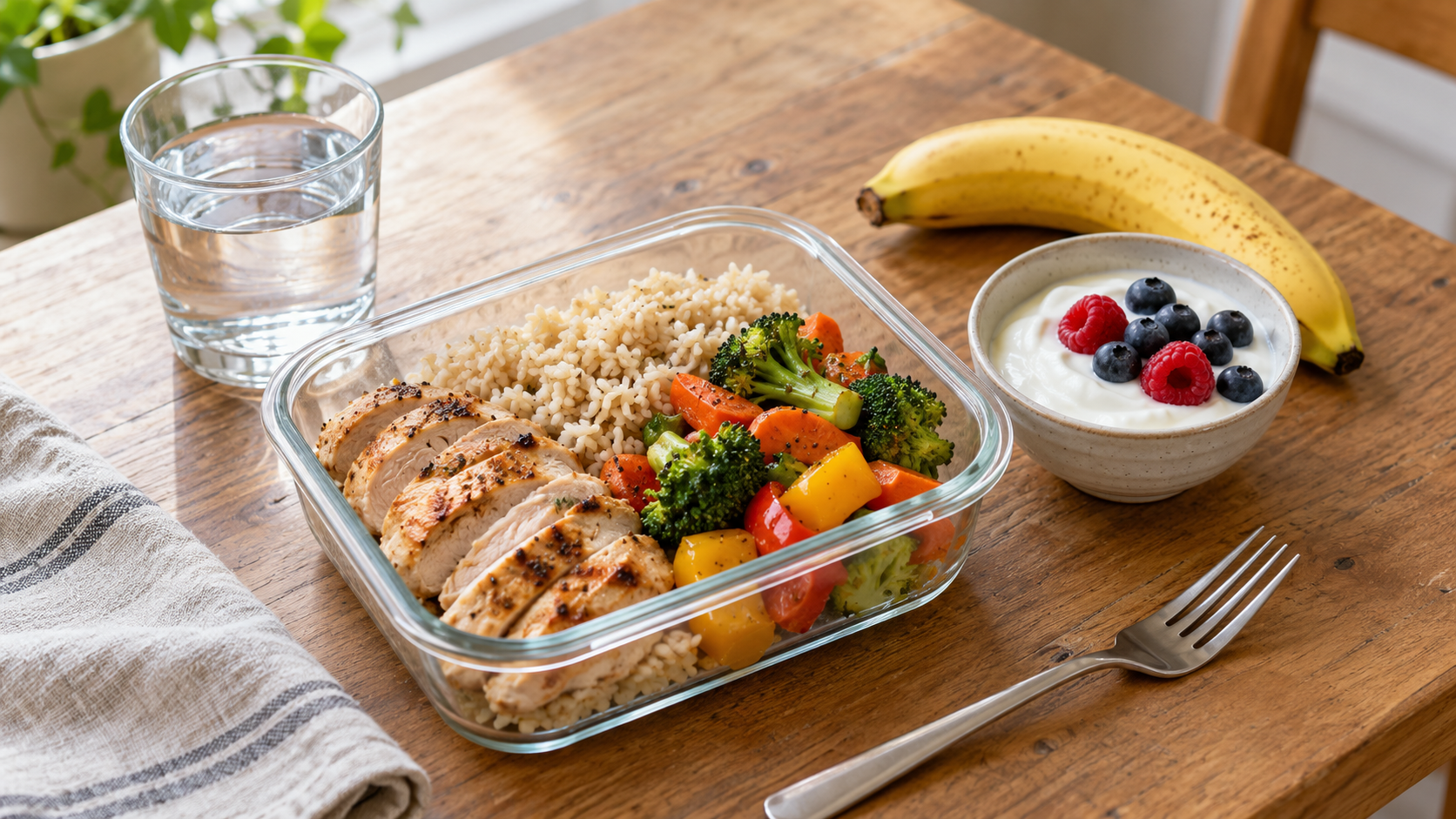
Fast food versus quick food at home
The realistic alternative to takeaway is often a five-minute meal, not an elaborate meal-prep session. Compare convenience options by the time, equipment, cost, and effort they actually require.
Useful combinations might include microwave rice with canned beans and frozen vegetables; eggs with toast and tomatoes; yogurt with oats, fruit, and nuts; or a ready-cooked protein with bread and a bagged salad.
The NHS’s general advice on gradual weight gain includes smaller, more frequent meals, easy snacks, and adding foods such as nuts and seeds. These can offer alternatives when eating a very large meal feels difficult. That guidance is not a personalized bodybuilding prescription.
For budgeting, compare the complete order with the groceries you would actually use. Include delivery fees and the possibility of wasted ingredients. Cooking is not automatically cheaper if you buy food you cannot store or realistically prepare.
A practical compromise is to keep two easy meals available and use fast food when it genuinely saves time. Repeatable options reduce decision-making without demanding that every week looks identical.
How to tell whether your approach is working
Review your training, energy, appetite, digestion, and ability to keep the routine going. Are you completing planned sessions? Are your exercises progressing over time? Do you feel adequately fed without regularly eating to discomfort?
If you choose to monitor body weight, interpret the longer-term pattern rather than treating one reading as a verdict. Scale weight alone cannot tell you how much muscle you have gained. Detailed tracking is optional, and it is reasonable to avoid it if it makes eating stressful.
When something is not working, change one practical part of the routine and review it over time. That might mean a more reliable lunch, a different pre-workout meal, or a training program you can follow more consistently.
Your next step should reflect your progress and circumstances rather than a deadline borrowed from someone else.
Frequently asked questions
Can you build muscle while eating fast food?
Yes, fast food can be part of a diet that supports muscle gain. It can contribute energy and protein, but the rest of your nutrition and resistance training still matter. No individual meal guarantees results, and a restaurant meal does not automatically prevent them.
Is fast food good for bulking after a workout?
It can be a practical meal afterward, particularly when it includes a protein source and carbohydrate. Choose something that suits your appetite and schedule. You do not need to rush to a drive-through to make the workout count; protein intake across the day matters too.
Does a “dirty bulk” build muscle faster?
The label usually describes eating with little attention to food quality or the size of the surplus. It is not a standardized nutrition strategy. More food does not guarantee proportionally more muscle, and deliberately ignoring comfort or overall nutrition is unnecessary.
Do I need to count every calorie?
No. Some people find occasional nutrition checks useful, while others prefer consistent meal patterns and attention to training progress and appetite. Precision is not a requirement for every meal. If you need a more individualized approach, a registered dietitian can help you choose an appropriate level of structure.
When should I get individual advice?
This guide is for generally healthy adults. Seek individualized guidance if you have a medical condition, prescribed dietary restrictions, unexplained weight loss, or a history of disordered eating. For example, NIDDK advises people with chronic kidney disease to work with a professional on protein and other nutrient needs. Children and teenagers need age-appropriate advice rather than adult bulking targets.
Build a routine you can repeat with Workit
Fast food can fit into bulking when the meal serves your needs and complements a varied diet. Start with a protein source, choose portions deliberately, and keep your training consistent. Convenience and thoughtful choices can exist in the same routine.
Workit offers personalized workout programs and nutrition plans to help you organize your fitness routine. If you want a starting point for bringing your training and eating plans together, download Workit and explore the options available in the app.