
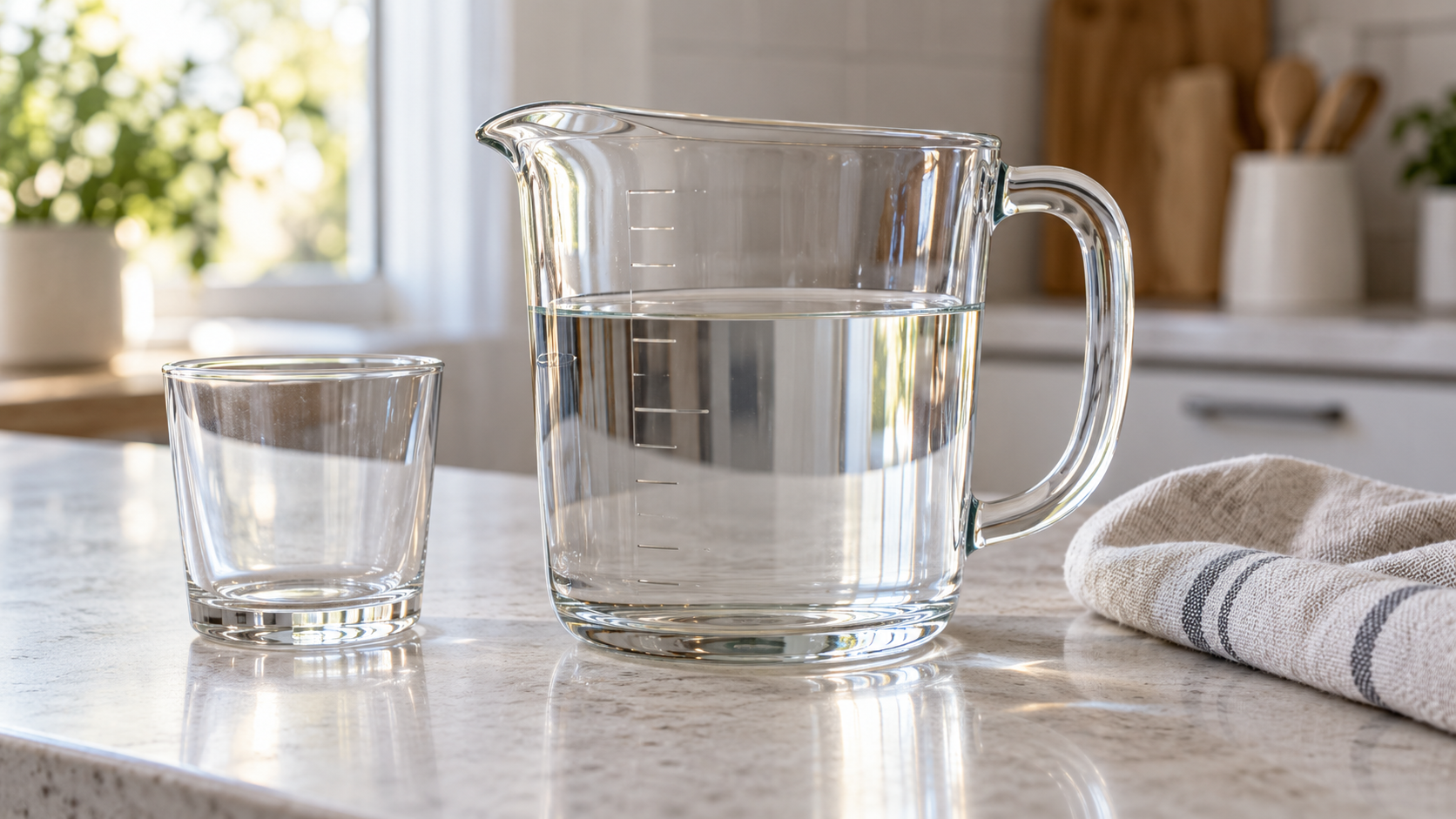
A pound is easy to read on a label and surprisingly difficult to picture inside a human body. The short answer to “what does 1lb of fat look like?” is roughly the volume of a small, half-liter container. For a pound of adipose tissue, about 470–500 milliliters, or around two US cups, is a useful illustration rather than an exact measurement for every person.
That comparison answers a question about volume. It cannot show what gaining or losing a pound would look like on you. Body fat is distributed across different areas, and a scale measures much more than fat. A photograph, clothing size, or single weight reading cannot establish your health or whether you need to change your weight.
Here’s how to understand the comparison, where common illustrations go wrong, and what this information can reasonably tell you. This guide provides general education for adults, not an individualized medical or weight-management plan.
The quick answer in everyday terms
Think of the internal capacity of a container labeled 500 mL. A pound of adipose tissue would occupy approximately that amount of space. The container’s outside dimensions are less useful because its walls, lid, and empty space also take up room.
A second reference is a measuring jug filled to about the two-cup mark. Specify US cups, because measuring-cup sizes differ internationally. These examples give a sense of scale without pretending that the human body stores fat in neat, detachable portions.
The arithmetic behind the estimate uses one pound, approximately 454 grams, divided by tissue density. A study comparing MRI and DXA measurements used an assumed adipose tissue density of 0.92 grams per milliliter. At that density, a pound occupies about 493 mL. The authors also noted that density can vary between people and tissue locations.
The useful takeaway is “roughly half a liter.” Extra decimal places would create more confidence than the biology supports.
Why there is no single exact size or shape
A pound describes mass
Mass and volume answer different questions. A pound tells you how much something weighs in everyday terms. Volume tells you how much space it occupies. Materials with different densities can have the same mass and occupy different amounts of space.
Shape adds another variable. Imagine the same amount of modeling clay formed into a ball, a broad sheet, or several small pieces. Its mass stays the same, but its outline changes. This is a geometry example, not an anatomical model, and it explains why a single silhouette cannot represent every arrangement of the same amount of tissue.
An image that shows a dramatic lump answers only one possible version of the question. It says little about how that volume would be distributed in a living person.
Adipose tissue varies in composition
The 470–500 mL illustration also reflects a distinction between fat molecules and fat-containing tissue. In a small anatomical study of six adult male cadavers, average whole-body adipose tissue densities ranged from 0.925 to 0.970 grams per milliliter. Those values correspond to roughly 468–490 mL per pound.
That small study does not define a universal range for all bodies. Alongside the commonly used 0.92 estimate, it supports rounding to approximately half a liter rather than advertising one supposedly exact size.
Body fat is living tissue with useful jobs
In everyday conversation, “fat” often means adipose tissue. This tissue contains fat-storing cells along with water and other components. A pound of adipose tissue therefore differs from a pound of chemically pure lipid. Research reports and body-composition devices may use more specific definitions, so context matters when comparing their numbers.
Body fat also has essential functions. The NIH’s National Center for Advancing Translational Sciences describes its roles in energy storage, temperature insulation, and substances involved in hormone and immune function. Treating all fat as useless material misses that biology.
Most familiar discussions concern white adipose tissue, which stores energy. Brown adipose tissue has a different role in heat production. The NIH explains these different kinds of fat, including why the amount of fat alone does not capture its full relationship with metabolism.
You do not need to memorize the cell types to understand the original question. The important point is that a simple volume analogy describes one property of a complex tissue. It is neither a health verdict nor a recommendation to remove that amount.
Why one pound has no predictable appearance on a body
Location changes the picture
Adipose tissue exists in several locations. Subcutaneous fat lies beneath the skin, while visceral fat is located deeper in the abdomen around internal organs. A surface image cannot separate those compartments or tell you precisely what each contains.
The same total volume can also be spread over a large area or divided across several areas. Picture a small quantity of material spread across a wide surface instead of gathered in one place. The volume has not changed, but the visible outline has. Applying that principle to a body still requires caution because living anatomy is much more complicated than a flat surface.
There is no dependable conversion from “one pound” to a particular change in waist size, facial appearance, or clothing fit. Claims such as “one pound always equals this many inches” leave out too much information.
People store tissue differently
People differ in body structure and fat distribution. Biology plays a role: NIH-supported genetics research has investigated genes associated with the locations of fat deposits. Someone else’s distribution pattern cannot serve as a template for yours.
This makes side-by-side body comparisons a poor way to answer a measurement question. Even people with the same height and weight can have different proportions and body composition. Their appearance does not tell you which person is healthier, stronger, or better nourished.
A photo cannot isolate a pound of fat
Lighting, posture, camera distance, clothing, and the moment an image captures can all change what you see. A photo also cannot establish whether any actual weight change came from fluid, muscle, fat, or another component.
If an online comparison claims to show exactly one pound of fat gained or lost, ask how that conclusion was established. A number in a caption is not the same as a validated measurement. You do not need to reproduce the photos or scrutinize your body to test the claim.
How a pound of fat compares with a pound of muscle
A pound of fat and a pound of muscle have the same mass. Muscle tissue is denser, so an equal mass generally occupies less volume. The familiar phrase “muscle weighs more than fat” only makes sense when comparing equal volumes rather than equal weights.
For example, an MRI study of muscle and adipose tissue used assumed densities of 1.04 kilograms per liter for skeletal muscle and 0.92 for adipose tissue. These are modeling assumptions, not exact specifications for every sample of human tissue.
Those assumptions imply a modest volume difference between equal weights. They do not support illustrations in which a pound of fat appears several times larger than a pound of muscle. Such images may communicate a real density difference using misleading proportions.
Muscle and fat are also different tissues with different roles. A change in strength is not proof that a particular amount of fat has disappeared. If your interest is exercise, the ability to move comfortably or handle a task more easily can be meaningful on its own.
Why a one-pound scale change does not identify fat change
A scale measures total body weight at that moment. Its reading includes organs, bone, muscle, body fluids, and the contents of your digestive system. The scale does not independently label which component changed.
Food and drinks have mass before your body finishes processing them. Changes in fluid balance can affect the reading too. Neither a higher number after a meal nor a lower number after sweating can tell you that the corresponding amount of fat has changed.
Stored carbohydrate, called glycogen, is associated with water. Changes in those stores can therefore contribute to short-term weight differences. The technical model behind NIH body-weight research explicitly includes glycogen and fluid changes rather than treating every change in weight as fat.
This is why “I am a pound heavier” and “I have gained a pound of fat” are different conclusions. The first describes a reading. The second claims to know its cause, which requires more information.
You do not need to respond to every fluctuation with a food restriction or extra workout. If monitoring weight is part of your medical care, follow the plan your clinician gives you, including any instructions about changes that require contact. Otherwise, a single reading rarely answers a useful health question by itself.
Can a smart scale tell you exactly how much fat changed?
Many smart scales display body-fat estimates in addition to weight. The extra number can look precise, especially when the app shows decimal places. Precision on a screen does not automatically mean equivalent accuracy in the body.
A 2021 study comparing three smart scales with DXA found that weight measurements were reasonably accurate, while body-composition estimates were not. That finding concerns the devices and participants studied; it does not evaluate every product available today.
The broader lesson is to understand what a device actually measures and what it estimates. Do not assume that a small change in a displayed fat-mass value proves a real, equally small biological change. Algorithm-derived categories also need context before they can guide care.
Clinical body-composition tests can answer particular questions, but they are not required to settle everyday curiosity about a pound of fat. If a test is being considered, useful questions include why it is needed, what its limitations are, and whether the result would change a care decision. More data is worthwhile when it serves a clear purpose.
Does the 3,500-calorie rule explain a pound of fat?
You may have encountered the claim that 3,500 calories always equals one pound of weight change. It is a simplified rule, not a reliable personal timetable. It also shifts the subject from what tissue occupies to how body weight changes over time.
Research by NIH scientist Kevin Hall and colleagues modeled adaptations in energy expenditure and body composition. Their work shows why predictions need to account for a changing biological system rather than assume a fixed, linear response indefinitely.
The practical limitation is important: a generic calorie calculation cannot tell you that a particular pound has been gained or lost by a specific day. Nor can a workout’s estimated calorie count establish the amount of fat used or predict a visible result.
If you have a medical reason to discuss weight management, a qualified clinician or registered dietitian can help put the question in context. A household-object analogy is not a suitable foundation for choosing a restrictive eating plan or setting a deadline for your body.
Can you choose where that pound comes from?
An exercise can emphasize particular muscles, but that does not give it precise control over an adjacent quantity of fat. Abdominal exercises, for example, can be used to train the trunk without offering a dependable way to remove one pound from the abdomen.
In a small randomized study of abdominal exercise, six weeks of the tested program improved abdominal muscular endurance without significantly changing the measured abdominal-fat outcomes. A later 2023 trial involving 16 men reported regional differences with a specialized endurance protocol. These small studies used different methods; neither establishes a reliable way for an individual to select exactly where one pound will come from.
Choose movement for the skills, strength, enjoyment, or daily function you want to support. A good description of a workout should explain what you will do and how it can be adapted, rather than promise to reshape one area by an exact amount.
Pain, illness, or fatigue may mean a session needs changing or postponing. Completing a body-change target is never a reason to push through a concerning symptom.
Better questions to ask about fitness progress
If the original search came from starting an exercise routine, you may be looking for evidence that your effort matters. Appearance is only one possible interest, and it is often a noisy way to judge what training is doing.
The CDC describes immediate and longer-term benefits of physical activity, including sleep, reduced feelings of anxiety, and support for bone health and balance. These benefits do not require a visible one-pound difference before they become worthwhile.
Consider questions connected to your own life:
- Is a familiar everyday task becoming more comfortable?
- Am I learning an exercise technique or movement skill?
- Does this activity fit my time, access needs, and preferences?
- Can I adjust the session when my energy or circumstances change?
- Is my routine leaving room for recovery and other things I value?
You can answer these without creating another set of rigid scores. For example, carrying shopping, joining a walk with a friend, or feeling more confident with an exercise can give a routine a practical purpose.
If keeping notes helps, a brief record of the activity and how it felt may be enough. Tracking is optional. It should support your decisions rather than pressure you to add more exercise or interpret every day as a test you passed or failed.
A sustainable routine also has ordinary interruptions. Travel, work, caregiving, and recovery can change what is realistic. Adjusting the plan is part of using it well. You do not need to compensate for a missed session by trying to erase a guessed amount of body fat.
How to read a fat-volume illustration critically
A clear illustration should explain the idea without making you feel that your body needs correcting. Before accepting a graphic as evidence, check what it actually claims:
- Is the mass stated? “Fat model” without a weight or scale gives you little information.
- Is there a volume reference? A labeled container is easier to interpret than an object photographed from an unknown angle.
- Is the material defined? Pure lipid, adipose tissue, and a plastic teaching model are different things.
- Are the limits explicit? A standalone object cannot predict someone’s appearance or health.
- Does the caption jump to a promise? A size analogy cannot establish results from a product, supplement, or workout.
An image can be visually striking while being scientifically weak. Transparent assumptions and plain labels usually teach more than dramatic proportions or unsettling colors.
You can also stop at the simple answer. Understanding the rough volume does not require watching repeated transformation videos, examining body parts, or buying a measuring device. The information has served its purpose once it resolves the original curiosity.
When to get individualized support
If your concern is a change in health, start with the symptom or question rather than an appearance judgment. A clinician can consider your medical history, medications, daily function, and relevant examinations or tests. NIDDK notes that even BMI has limitations, including that it does not directly measure body fat.
Seek medical advice about substantial or unexplained weight changes. Rapid gain with swelling or shortness of breath warrants prompt attention because fluid retention can have medical causes, as MedlinePlus explains.
If thoughts about fat, weight, or appearance are becoming persistent, distressing, or disruptive to eating and exercise, that is also a valid reason to ask for help. The National Institute of Mental Health explains that eating disorders can affect people across body weights. You do not have to look a particular way to deserve assessment and support.
Frequently asked questions
Is one pound of fat about two cups?
For a rough adipose-tissue volume comparison, yes: approximately two US cups is reasonable. Cup sizes differ by country, and tissue density varies. Think of this as an explanatory analogy, not a way to measure your body or identify a precise amount of change.
Can you see a one-pound difference in the mirror?
There is no dependable visual test. Distribution, anatomy, fluid shifts, and viewing conditions complicate the comparison. Looking harder will not turn a mirror into a body-composition instrument, and a visible difference is not required for movement to have value.
Does losing one pound mean losing one pound of fat?
No. A change in total weight does not identify the material responsible. Water, digestive contents, and other tissues contribute to body weight. The same limitation applies to a gain: the number alone cannot tell you its composition or cause.
Can you convert a pound of fat into inches?
There is no universal conversion. Pounds describe mass and inches describe length. You would need information about volume, shape, location, and surrounding anatomy to connect them. A simple chart claiming a fixed inches-per-pound result is leaving out those variables.
Is a one-pound fat model useful?
It can help explain approximate volume if the model’s assumptions are clear and its proportions are appropriate. It cannot show how that tissue sits in your body, measure your health, or establish a need for weight loss. Treat it as a teaching aid with a narrow purpose.
Make movement fit your life with Workit
If you’d like structure for an exercise routine, explore Workit on the App Store. Workit’s current listing includes personalized workout programs and a workout journal, which can help you organize sessions around a practical goal such as building strength or learning a routine.
Choose features that feel useful and leave any tracking that creates pressure aside. No app can guarantee a particular body shape or turn a volume comparison into an individualized health assessment. Consistent, adaptable movement can be worthwhile without making appearance the main result.
The bottom line
A pound of adipose tissue occupies roughly half a liter, with about 470–500 mL serving as a qualified illustration. Its appearance in a living body has no single template. Keep the volume comparison in its proper place, interpret weight readings cautiously, and let your health needs and everyday goals guide what you do next.