
Published October 23, 2026
A reverse curl is an elbow curl performed with your palms facing down rather than up. Hold a light bar or pair of dumbbells, keep your wrists aligned with your forearms, bend your elbows without swinging, and lower the weight under control. A practical first session is two sets of 10–15 comfortable repetitions after your main pulling exercises.
The overhand grip makes this a different task from a conventional biceps curl. It challenges the elbow flexors and the muscles that maintain your grip and wrist position. It is useful as a small accessory exercise, not a mandatory test of toughness, a cure for elbow pain, or a replacement for a balanced strength program.
What a reverse curl is, and what it is not
During a reverse curl, your elbows bend while your forearms remain approximately palm-down. With a straight bar, the grip is pronated. An angled EZ-bar gives you a less extreme hand position. Dumbbells allow each hand to find its own comfortable angle. These versions are related, but their weights are not interchangeable measurements of performance.
A reverse wrist curl is a different exercise: the forearm stays relatively still while the wrist extends. In the reverse curl described here, the elbow supplies the visible movement and the wrist stays quiet. If your hands flap backward and forward while the elbows barely move, you are no longer performing the intended exercise.
Nor is a reverse curl a Zottman curl. In that variation you change hand position between the upward and downward phases. For this guide, choose one overhand grip and maintain it. Keeping the task simple makes it easier to see whether you are improving instead of accidentally changing the exercise every few repetitions.
Which muscles work?
The brachialis, brachioradialis, and biceps brachii contribute to bending the elbow. The muscles around the wrist and hand also work to maintain the grip. The brachioradialis runs along the thumb-side of the forearm and is often the reason people include this exercise in an arm session. That does not mean the biceps switch off.
A primary electromyography study of brachioradialis function reported substantial activity during elbow-flexion tasks across forearm positions. This supports its role in the movement, but does not prove that one grip produces the greatest long-term muscle growth. Muscle-activity measurements are not a percentage breakdown of how much each muscle grows.
The practical distinction is how the grip changes the lift. You will often need less weight than you use for a palms-up curl. Accept that difference instead of treating it as a weakness to overcome with momentum. The target is a repeatable movement you can load gradually, not matching a number from another exercise.
Choose the equipment before choosing the weight
Dumbbells: independent hand positions
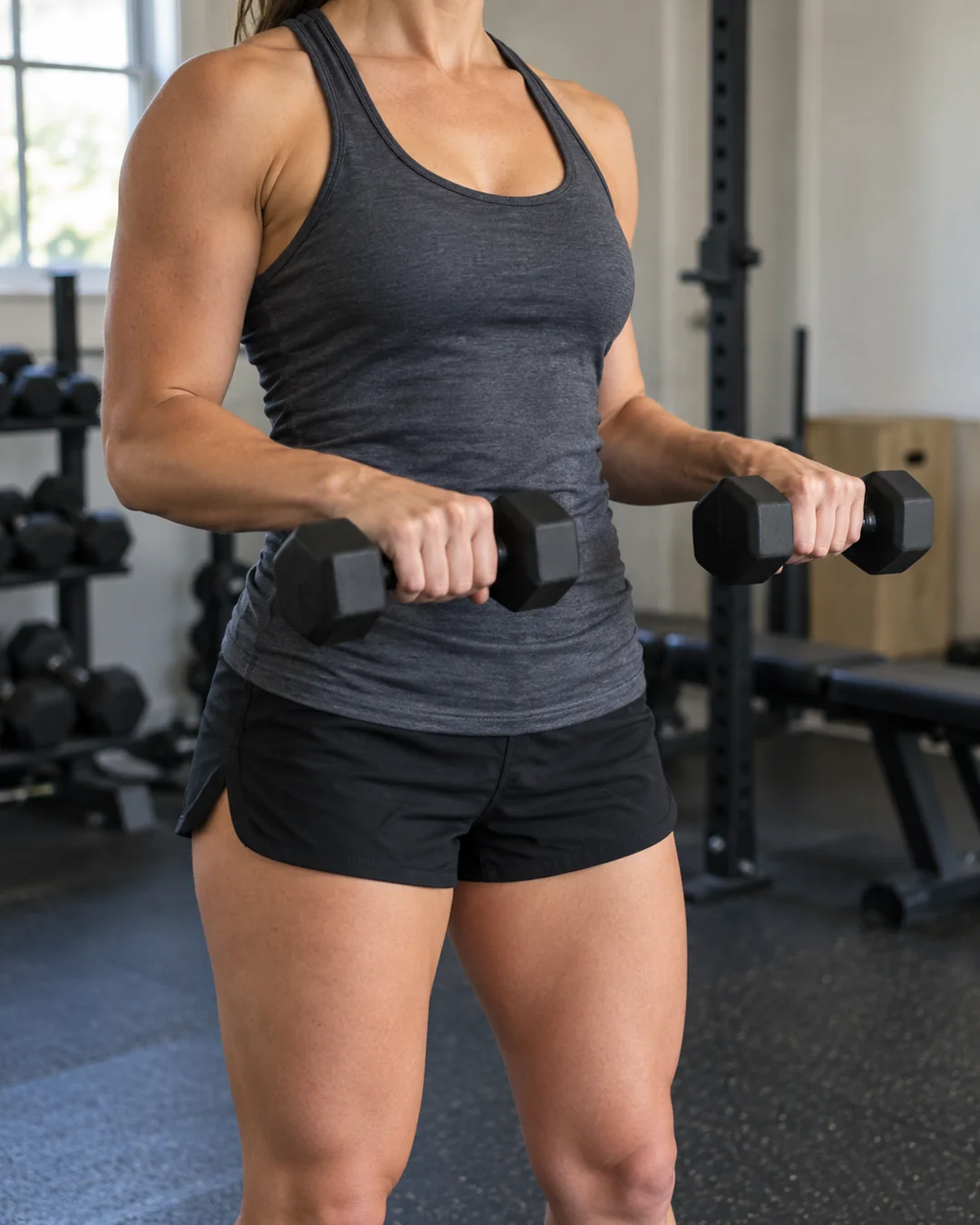
Dumbbells are a straightforward first option when a fixed straight-bar grip feels awkward. Stand with one weight in each hand and let the palms face toward the floor as your elbows bend. You can use both arms together, alternate, or train one side at a time. The version you can control and repeat is the useful version.
Check that the dumbbell heads do not hit your thighs or each other. Let the arms hang slightly forward if needed, without rounding your upper body around the weights. Adjustable dumbbells must be fully secured before use. A loose plate is an equipment problem, not something to solve by gripping harder.
EZ-bar: an angled compromise
An EZ-bar may let your wrists sit at a more comfortable angle than a straight bar. Use matching bends on each side, and make sure the grip is still predominantly overhand. Do not force the wrist into a straight line with a bar angle that does not fit you. Try the unloaded implement first.
Count the bar in the total load. A bar that looks light can already exceed your appropriate starting weight. If the empty bar is too heavy for controlled practice, use lighter dumbbells instead. Secure plate-loaded bars with the appropriate collars, and load each side evenly.
Straight bar: fixed and symmetrical
A straight bar gives both hands a consistent position but allows less freedom. Start around shoulder width and see whether you can maintain relaxed, aligned wrists. There is no requirement to make your grip extremely narrow. If the position causes discomfort even with a very light load, another implement is a reasonable choice.
Keep the area clear enough to lift and return the bar without threading it between benches or people. Put it down on the intended rack or a stable surface, not balanced on the edge of a bench. A safe setup includes how the set ends, especially when your hands are tired.
How to do a reverse curl step by step
- Stand comfortably with your feet about hip-width apart. Hold the weights in front of your thighs with an overhand grip and your thumbs wrapped around the handles.
- Let your elbows settle near your sides. Keep your torso upright, your knees soft, and your wrists in line with your forearms.
- Bend your elbows to raise the weight. Move at a speed you can control without a leg drive, backward lean, or sudden shoulder shrug.
- Finish when further lifting would require the elbows to travel markedly forward or the wrists to bend. You do not need to touch the bar to your chest.
- Lower smoothly until the elbows are comfortably extended. Avoid snapping the elbows straight or dropping into the bottom.
- Reset your balance and repeat. End the set if your technique changes substantially or you develop pain, tingling, or numbness.
Think of the hands as handles attached to the forearms. Their job is to hold the load, not to flick it toward the shoulders. A useful repetition has a visible elbow bend, a controlled return, and a grip that remains secure from beginning to end.
How high should the weight travel?
Your anatomy and equipment determine the endpoint. A large dumbbell head may meet the upper arm before your elbow reaches its maximum bend. A bar may finish below the collarbone without anything being wrong. Choose a comfortable endpoint and repeat it rather than chasing an arbitrary landmark.
Use a side view to distinguish elbow flexion from shoulder movement. A little natural upper-arm motion is not automatically a failed repetition, but a large forward sweep changes the task. If the last half of every curl becomes a front raise, the load is probably too demanding for the version you intended.
How quickly should you move?
Start with an unhurried lift and a slightly slower return. You do not need a stopwatch for every rep. The important check is whether you can change direction without bouncing and lower the weight without losing your grip. A speed that looks smooth for the first rep should remain recognizable at the end.
Deliberately making a set extremely slow can make light weight feel harder, but it also changes what you are comparing. If you add long pauses, note that in your log. Otherwise a lower repetition count next week may simply reflect a different tempo, not a loss of strength.
Find a sensible starting weight
Choose your reverse-curl weight independently from your other curls. After several unloaded practice repetitions, try a light set of ten. Stop and ask whether you could have completed two or three more repetitions with the same wrist position, torso position, and range. That is a useful starting level of effort.
If the tenth repetition looks identical to the first and you could easily continue for many more, increase modestly next time. If you cannot complete the set without rocking backward, reduce the load immediately. There is no universal kilogram recommendation based on sex, body weight, or how long you have owned a gym membership.
For broader guidance, use how to choose dumbbell weight. The key point here is that your grip or wrist control may be the limiting factor before your upper arms feel tired. That is a reason to choose an appropriate weight, not a reason to ignore the limitation.
A beginner prescription you can actually repeat
Try two working sets of 10–15 repetitions once or twice per week, after your larger pulling movements. Rest about 60–120 seconds, extending the break if your hands or breathing have not recovered enough to repeat the movement. Leave approximately two or three controlled repetitions available rather than forcing a final awkward curl.
This is an original practical starting example, not a claim that research has identified a perfect reverse-curl dose. The ACSM’s 2026 resistance-training update emphasizes regular participation and individualized programming; complex methods and training to failure are not necessary for every healthy adult. Your overall program matters more than maximizing one accessory exercise.
If you already perform several curl variations and heavy rows, replace some existing arm work rather than adding reverse curls on top of everything. Two manageable sets that fit your recovery are more useful than five extra sets that make your next pulling session uncomfortable. Start small enough to learn what the exercise costs you.
A simple two-session example
On the first upper-body day, complete your main row and pulldown work, then perform two reverse-curl sets. On the second upper-body day, use a conventional or neutral-grip curl instead. This gives you variety without turning both sessions into long arm circuits. Keep the exercise order consistent for the first few weeks.
If you prefer one weekly arm session, place reverse curls after the movements you most want to improve. Doing them before heavy pulling can fatigue your grip and affect those exercises. That may be intentional in a specialist program, but it is usually unnecessary when you are learning basic technique.
If your upper-body plan also includes a shoulder accessory, our dumbbell lateral raise guide offers a separate light-weight movement. Place each exercise where it fits your priorities; you do not need to superset them or add both to every session.
Progress with repetitions before load
Keep a load until you can reach the upper end of your repetition range on both sets without losing the standard you chose. Then use the smallest practical increase and let the repetition count fall back toward the lower end. This is a simple double-progression approach rather than an obligation to add weight every week.
For example, a hypothetical lifter records 12 and 11 repetitions with the same dumbbells, then 13 and 12, and later 15 and 15. If the final set still ends with a little room to spare, the next small increase is reasonable. The actual numbers are illustrative; they are not strength standards or a promised timeline.
A large dumbbell jump can be substantial in percentage terms. Moving from 4 kg to 5 kg per hand is a 25% increase. If that is too much, stay at 4 kg and improve control or add a few repetitions within a planned range. Do not turn a sensible loading problem into a swing-assisted test.
When progression stalls, review the conditions. Did you perform more rows beforehand? Did you shorten the rest? Are you using a different bar? Were you tired from work or another sport? A single lower score is information, not evidence that the exercise has stopped working.
Common problems and practical corrections
Your wrists bend backward
Lower the weight and reset the handle across the palm. The hand should remain an extension of the forearm, not hinge backward to balance the load. Try dumbbells or an EZ-bar if the fixed straight-bar grip feels awkward. Do not compensate by gripping so hard that your hand cramps.
Your torso rocks with every repetition
Reduce the load, adopt a small staggered stance, and begin each rep from stillness. If you need a hip push before the weight moves, you are practicing a different lift. Seated dumbbell reverse curls can also reduce the temptation to use your legs, provided the seat is stable and your feet are supported.
Your elbows move far forward
Stop the curl a little earlier and see whether that preserves control. You may be chasing a finish position your proportions do not allow. If the entire upper arm swings forward from the start, use a lighter weight. Filming a short side-view set can reveal the change more clearly than a front mirror.
Your grip fails before your arms feel worked
That can happen with an overhand curl. Reduce the load or choose fewer high-quality repetitions, and check whether earlier pulling exercises have already exhausted your hands. Do not continue with fingertips barely hooked around a bar. Put the implement down safely before the grip becomes unreliable.
One arm takes over
Dumbbells make the difference easier to observe. Begin with the less capable side when training one arm at a time, and match its controlled repetition count with the other side. Avoid forcing extra repetitions on the weaker side merely to make both arms equally tired. A sudden or painful change deserves professional assessment.
Reverse curls versus hammer curls
Reverse curls use a predominantly palms-down grip; hammer curls keep the palms facing inward. Both involve elbow flexion, and both can fit an arm program. The choice can be based on comfort, available equipment, and the grip you want to practice rather than declaring one universally superior.
If reverse curls feel awkward, a neutral grip may be easier to manage. If you already enjoy hammer curls, you do not have to replace them. You could use reverse curls for a short training block, then compare how reliably you performed them and how they affected the rest of your workout.
Keep comparisons fair. Ten repetitions with 8 kg in one grip and ten with 5 kg in another do not establish which exercise is better. The leverage and constraints differ. Compare progress within the same version over time, using the same range and effort target.
What to record in your workout log
Write the implement, total bar weight or weight per dumbbell, repetitions for each set, and whether the set ended because of arm fatigue, grip fatigue, or technique. Add a short note if you changed the range or felt discomfort. These details make the next session easier to plan.
An example entry could read: “Dumbbell reverse curl, 4 kg each, 13/12 reps, 90 seconds rest, wrists steady, about two reps left.” Another could read: “EZ-bar reverse curl, total 12 kg, 10/10, grip limited; repeat load.” Both are more informative than simply writing “forearms done.”
If judging effort is unfamiliar, the reps-in-reserve guide explains how to estimate it without treating the number as precise. You do not need to test failure to make a useful note. “Several good reps left” is better than a confidently invented score.
Frequently asked questions
Should I do reverse curls every day?
You generally do not need daily reverse curls to make them useful. Begin with one or two weekly exposures and consider all the gripping, pulling, and arm work you already perform. If soreness or joint discomfort affects later sessions, reduce the amount rather than trying to build tolerance by adding more.
Are they mainly a biceps or forearm exercise?
They involve elbow flexors in the upper arm and forearm, with additional work to hold the wrist and grip. Treating them as an arm accessory is more accurate than assigning an exact percentage to either region. The muscles that feel most tired can vary with equipment and previous exercise.
Can I use a cable?
A low cable with a suitable bar attachment is another option, provided the clip and pin are secure and the cable can travel freely. Keep the same overhand-grip concept, but record cable work separately. Stack labels, pulley ratios, and friction mean the number is not directly comparable with a free-weight bar.
Do reverse curls prevent elbow injuries?
No exercise can guarantee injury prevention. This guide is for general training, not rehabilitation. If you have ongoing elbow or wrist pain, numbness, recent injury, or a clinician’s restrictions, get individualized advice rather than assuming an overhand curl will fix the problem.
Your next session
Choose one comfortable implement, practice the movement lightly, and complete two controlled sets. Keep the wrists quiet and the torso steady. Record enough detail to repeat the same task next time, then give your arms time to recover alongside the rest of your training.
For a simple place to start building a fitness routine, explore Workit on the App Store. Whatever tool you use, consistency starts with a manageable plan and an honest record of what you did.