
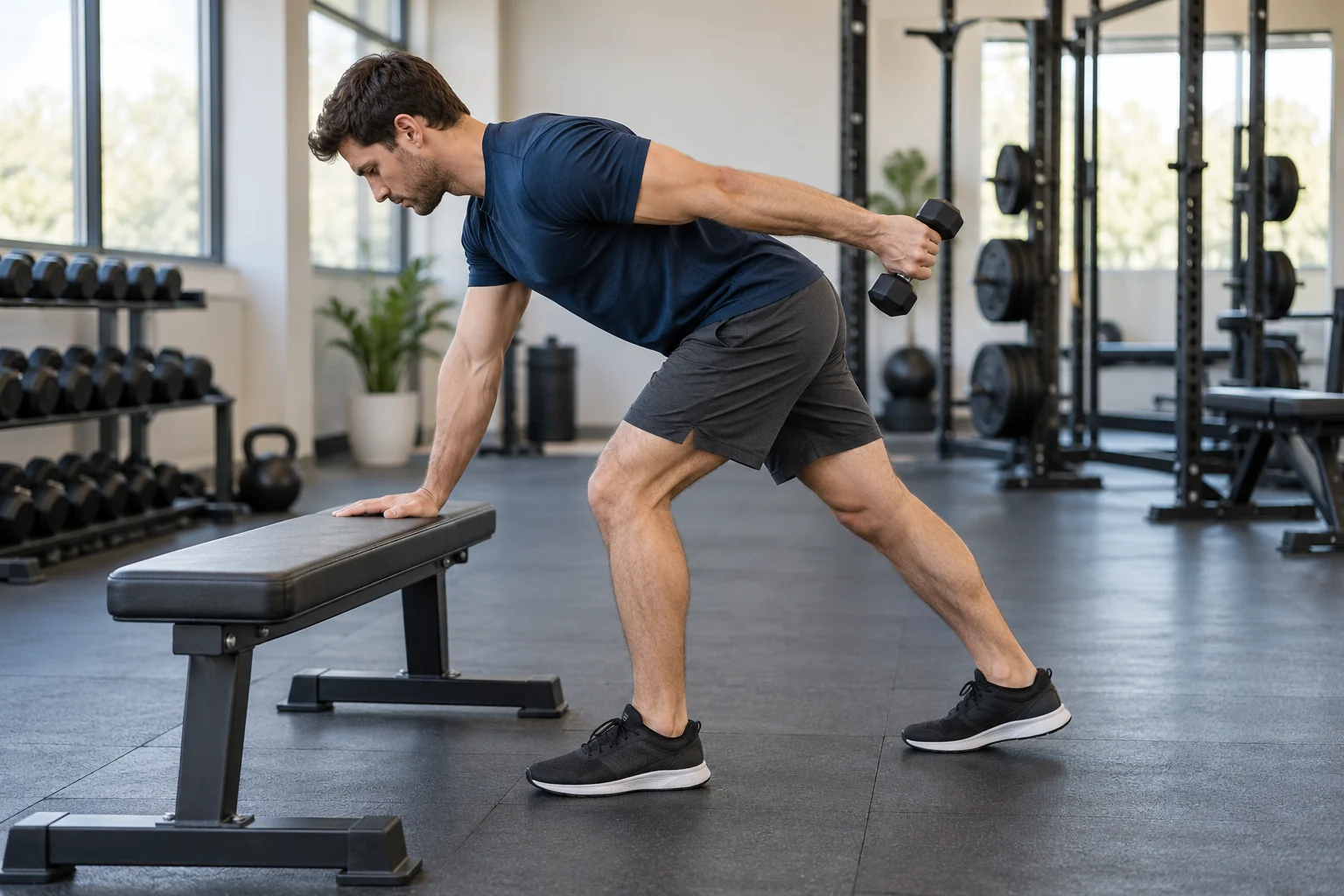
The dumbbell triceps kickback trains the back of your upper arm by straightening the elbow while your upper arm stays beside your torso. Hinge forward, support yourself with your free hand, position the working upper arm close to horizontal, and extend the elbow without swinging. Use a light weight that you can control near the straight-arm finish.
Published October 20, 2026.
The defining challenge is not getting the dumbbell moving. It is keeping your body and upper arm quiet as the forearm extends. When the weight is too heavy, the movement often turns into a small row followed by a swing. That can make a set look impressive without making it a better kickback.
This guide covers a supported one-arm setup, what the resistance feels like through the repetition, practical ways to progress, and when a cable or overhead extension may be a better fit.
What is a dumbbell triceps kickback?
A kickback is an elbow-extension exercise. You begin with the elbow bent and move the forearm backward until the arm is nearly straight, while the upper arm stays relatively still. The triceps creates the elbow movement. Muscles around your shoulder and torso help maintain the position.
It is usually an accessory exercise rather than a heavy strength lift. A modest dumbbell can feel demanding near the finish because of its leverage relative to the elbow. There is no need to use the same weight you row, press, or curl.
- Equipment: one dumbbell and a sturdy weight bench or other suitable stable support.
- Grip: neutral, with the palm facing inward and wrist straight.
- Starting version: one arm at a time, free hand supported, both feet on the floor.
- Suggested first dose: 2 sets of 12–15 repetitions per arm, with 2–3 controlled repetitions left in reserve.
- Main technique cue: keep the upper arm quiet while the forearm moves.
How to set up a supported kickback
Choose support that does not move
A solid gym bench is a convenient option. Check that it does not slide or rock under your hand. If you train at home, avoid lightweight chairs, folding furniture, or anything that tips when you lean on it. Supporting your hand on your own thigh is another option if you can maintain the position comfortably.
Set the dumbbell within easy reach before leaning forward. Leave enough space behind you to extend the arm without hitting a wall, another person, or equipment. A kickback needs more rear clearance than a curl.
Find a stable hinge
Put your free hand on the bench and use a comfortable split stance. Push your hips back and incline your torso, keeping your neck aligned with your back. Your knees can remain slightly bent. Adjust the distance between your feet and the bench until you feel balanced rather than stretched out.
You do not need a perfectly horizontal torso. However, standing almost upright makes it difficult to position the upper arm well for a dumbbell kickback. Choose a hinge you can hold without rounding, twisting, or repeatedly changing height.
Position the working arm before the first repetition
Bring the working upper arm alongside your torso, approximately parallel to the floor when comfortable. Bend the elbow so the forearm hangs roughly downward. Keep the shoulder away from your ear without aggressively forcing it down and back.
This setup should feel like something you can hold still. If simply maintaining it is difficult, use less weight, adjust your support, or choose a different triceps exercise. Do not solve an awkward position by jerking through the repetitions.
How to do a dumbbell triceps kickback
- Brace and settle. Hold your hinge, support yourself with the free hand, and establish the working upper-arm position.
- Straighten the elbow. Move the dumbbell backward by extending the forearm. Keep the upper arm close to its starting location.
- Finish under control. Approach a straight elbow without snapping or forcing it beyond your comfortable range. Keep the wrist aligned with the forearm.
- Own the return. Bend the elbow to lower the dumbbell, stopping around the position where the forearm hangs down.
- Reset if needed. If your shoulder or torso moves, pause and restore the setup rather than carrying the drift into another repetition.
- Change sides carefully. Stand up, reposition your support and feet, then repeat on the other arm.
The American Council on Exercise’s kickback instructions similarly emphasize maintaining the upper-arm position and avoiding torso movement. The important visual check is the relationship between your elbow and body: your hand should travel much farther than your elbow.
Exhale as you extend if that feels natural and inhale as you return. Keep breathing rather than bracing with a long, unnecessary breath hold. A steady rhythm helps you notice when a repetition turns into a whole-body effort.
Why the top feels hard and the bottom feels easy
With a dumbbell, gravity acts straight downward. At the start, the forearm and weight hang nearly below the elbow. The horizontal distance between the dumbbell and elbow is relatively small, so the external turning demand at the elbow is relatively small.
As you straighten the elbow and move the dumbbell behind you, that horizontal distance grows. When the forearm approaches horizontal, the dumbbell has a larger lever arm. That is why the last part of a strict kickback can be challenging even when the first part feels easy.
This resistance pattern is not a flaw you can eliminate by squeezing harder. It is a feature of the exercise. Use it to choose the weight: the correct load must allow a controlled finish, not merely a quick start.
Do not confuse “behind me” with elbow extension
You can move a dumbbell backward by moving your shoulder and upper arm, even if the elbow barely straightens. That is not the movement you are trying to practice. In a kickback, the angle at the elbow should visibly open while the upper arm stays mostly stationary.
A useful check is to imagine your elbow resting on a small shelf beside your torso. Your forearm rotates around that point. The shelf is only a cue; do not force your arm into a painful position or expect absolute immobility.
Which triceps muscles does the kickback work?
The triceps brachii has three heads that contribute to straightening the elbow. The long head also crosses the shoulder, so shoulder position changes its length. In a kickback, the upper arm is near or behind the torso, rather than overhead.
That makes the exercise different from an overhead extension, but it does not justify claims that kickbacks exclusively train the “outer triceps,” completely miss a head, or reshape a specific patch of the arm. Exercise selection can change the task without giving you precise control over how your arm will look.
Are kickbacks actually effective?
They can be a useful way to train elbow extension when you use sufficient effort and maintain the intended movement. Whether they are the best choice depends on comfort, available equipment, and how easily you can progress them.
An ACE-sponsored comparison of common triceps exercises reported high muscle activity during kickbacks. That supports treating them as a legitimate exercise, not dismissing them because the dumbbells are light. It does not establish that they produce more long-term growth than every alternative: acute muscle activity and a months-long training outcome are different measurements.
A training study comparing overhead and neutral-arm cable extensions found greater triceps growth in the overhead condition. It did not directly test dumbbell kickbacks. The useful inference is that shoulder position deserves consideration when designing a routine, not that one study proves kickbacks useless.
Eight technique errors that make kickbacks harder to judge
1. Starting with a row
Repeatedly pulling the elbow backward and then extending the arm adds a second movement. Set the upper arm once, then perform the elbow action. If you cannot maintain the position, the dumbbell may be too heavy or the set may already be finished.
2. Dropping the elbow as the arm straightens
The dumbbell can descend even while the elbow appears to extend. Watch the upper arm, not just the hand. Use a lighter weight and shorten the set if necessary so the final repetitions preserve the same basic geometry.
3. Swinging out of the bottom
Momentum can carry the dumbbell through the hardest portion. Try a smooth start with no sudden acceleration. If removing the swing makes the finish impossible, reduce the weight rather than trying to generate an even bigger swing.
4. Throwing the hand upward
A kickback is not a contest to lift the dumbbell as high as possible behind you. Finish by extending the elbow, not by raising the whole arm. Excessive shoulder motion makes it harder to compare repetitions and may put you in an uncomfortable position.
5. Snapping into lockout
Approaching a straight elbow is different from forcefully jamming it straight. Move smoothly through the finish. A brief pause can help you verify control, but you do not need to force the joint farther to get a stronger contraction.
6. Twisting toward the mirror
Looking sideways throughout the set often changes the neck and torso position. If you want feedback, record a short side-view set in a safe location or ask a qualified trainer to observe. Do not compromise the movement simply to watch it.
7. Turning the wrist to chase a different muscle
Keep a comfortable grip and let the elbow do the work. Aggressively rotating or bending the wrist is not necessary to reach a hidden part of the triceps. A secure neutral grip is a straightforward default.
8. Continuing after the support position fails
A fatigued back or supporting arm can end the set before the working triceps does. That is information about the setup, not a reason to ignore it. Rest, improve the support, or use a variation that removes the limiting position.
How much weight should you use?
Begin with a dumbbell you expect to feel almost too light. Perform several practice repetitions and briefly stop near the straight-arm position. If you can do that without changing your torso or elbow location, continue into a controlled set.
A suitable working load lets you reach your chosen repetition range while leaving a little room before technique fails. For a first session, 12–15 repetitions with 2–3 repetitions in reserve is a reasonable experiment. There is no standard weight everyone should use, and a smaller number than your other exercises is normal.
A simple selection process is:
- If 12 repetitions are smooth and you could do many more, try the next small increase on a later set.
- If the last few repetitions require a swing or a dropping elbow, reduce the weight.
- If you cannot tell whether the elbow is moving, slow the set down and check a side view before increasing anything.
Do not test a one-repetition maximum to find your kickback weight. A light-load trial provides the information you need with less complexity. The target is a stable accessory movement, not a record lift.
A beginner-friendly progression method
Start with 2 working sets per arm once or twice per week as part of your overall routine. Rest long enough to repeat the setup comfortably, often about 60–120 seconds after both arms. Switching sides is not automatically enough recovery for the next round.
Keep the same support height, torso angle, and range of motion while you add repetitions. Once you can perform both sets at the top of your range with clean finishes and some reserve, try the smallest available weight increase.
For example, your first session might produce 13 and 12 repetitions per arm. Several sessions later, you reach 15 and 15. With the next dumbbell, you might return to 12 and 11. That is fine if the movement remains controlled; it is not fine if the extra load turns every rep into a row.
If your dumbbells jump too much, use the lighter pair for a slightly broader range, such as 12–20 repetitions, or choose equipment with smaller increments. A repeatable one-second pause near the finish can also make control easier to assess. Record the pause rather than silently adding and removing it between workouts.
The ACSM’s 2026 resistance-training guidance emphasizes tailoring training to the person and sustaining regular participation. You do not need advanced intensity techniques or all-out failure sets to make a beginner routine worthwhile. These kickback examples are starting options, not a requirement to do more arm work regardless of the rest of your program.
How to handle different strength between arms
Start with the side that feels less capable and use its clean repetition count as the target for the other side. Keep the load and setup comparable. Small differences are common, but a sudden or unexplained change, especially with pain, is a reason to stop and seek appropriate guidance rather than adding extra work blindly.
Where kickbacks belong in your workout
For most general upper-body sessions, perform your main presses and pulls first, then use kickbacks as a small accessory. Presses already involve the triceps, so consider that work before adding several isolation exercises.
A simple arm pairing is 2 sets of incline dumbbell curls and 2 sets of supported kickbacks. You can alternate exercises if time is limited, but rest enough that the second exercise is not rushed. Alternating movements does not require turning the session into a nonstop circuit.
If you already have a demanding press workout and direct triceps work, replacing an accessory may be more sensible than adding kickbacks on top. The value comes from work you can recover from and repeat, not from including every exercise you know.
Check progress across several comparable sessions. A single weak day after poor sleep or an unusually hard pressing session does not prove that your program has stopped working. Conversely, repeatedly worsening technique or persistent discomfort is a reason to reduce the load or volume and reassess.
Variations and alternatives
Two-arm dumbbell kickback
Hold a dumbbell in each hand and hinge forward without hand support. This saves switching sides, but it adds a greater demand on maintaining the torso position. Use it only if you can keep the same quality of elbow movement. Two arms at once is not automatically a progression from the supported version.
Chest-supported kickback
Lying face down on a suitable incline bench can reduce the need to hold a free-standing hinge. Adjust the bench so your arms have room to move without hitting the frame. The position must be comfortable and stable; do not balance on the edge of the pad to manufacture clearance.
Cable kickback
A cable changes the direction of resistance according to the pulley and your position. It can make the start of the motion feel different and may offer smaller load increments. It is not the same resistance profile as a dumbbell, so select the weight again rather than copying the number.
Triceps pushdown
A triceps pushdown lets you work with the upper arms nearer your sides in a more upright position. It is a practical alternative when the bent-over setup is the limiting factor or you prefer a cable stack for progression.
Overhead triceps extension
An overhead triceps extension uses a different shoulder position and lengthens the long head more than a neutral-arm position. It can complement kickbacks, but only if the overhead setup is comfortable. You do not have to force it into a routine that already provides adequate, tolerable triceps work.
Frequently asked questions
Are dumbbell kickbacks good for beginners?
They can be, especially with one hand supported and a light weight. The main learning task is separating elbow movement from shoulder movement. If the hinge or upper-arm hold is too difficult to maintain, a pushdown may be simpler.
Should my upper arm be parallel to the floor?
Approximately horizontal is a useful target for the dumbbell version, provided it is comfortable. It places the forearm near horizontal as you extend. Avoid standing upright with the arm hanging down and expecting the same resistance pattern.
Do I need to squeeze at the top?
A short pause can help confirm that you control the finish. It is optional, not a special growth mechanism. You should not need to shrug, lift the entire arm, or hyperextend the elbow to create a stronger sensation.
Why do I feel the back of my shoulder?
Your shoulder muscles help hold the upper arm in position. If they tire first, check the weight, support, and arm height. Do not interpret pain as normal muscle work. Stop a painful set and seek qualified advice if symptoms persist or recur.
Can kickbacks reduce fat on the back of my arms?
They train muscle; they are not a reliable way to choose where your body loses fat. Avoid judging their usefulness by promises to remove fat from one specific area. Evaluate them by comfort, consistent technique, and progress in the exercise.
Are high repetitions better than low repetitions?
Moderate-to-higher repetitions are often practical because a strict kickback uses relatively light loads and small weight jumps matter. That does not make one repetition range magical. Choose a range that lets you train with control and sufficient effort.
What if my elbow hurts?
Stop the painful set rather than forcing the joint straight. Try another movement only if it is comfortable, and have persistent or recurring symptoms assessed by a qualified healthcare professional. This article cannot determine the cause of your pain.
The bottom line
Use dumbbell triceps kickbacks when you want a simple, light-load elbow-extension accessory and can maintain a stable setup. Choose the weight by your ability to control the finish, keep the upper arm quiet, and progress in small steps. If support or loading becomes awkward, a pushdown or another comfortable extension is a sensible alternative.
Explore Workit on the App Store.
Sources and evidence notes
- ACE-sponsored research and kickback technique instructions: used for movement cross-checking, not a guarantee of growth.
- ACE’s summary of its triceps exercise comparison: acute muscle-activity findings have limited relevance to long-term rankings.
- Overhead versus neutral-arm cable extension training study: a direct comparison of those cable conditions, not of dumbbell kickbacks.
- ACSM’s updated resistance-training guidance: context for consistent, individualized training.
This article provides general exercise education. Programming examples are illustrative and are not individualized medical or rehabilitation advice.