
Published October 15, 2026
A good stair climber workout for beginners starts with a short, controlled climb at a pace you can manage while speaking in sentences. Learn the stop controls first, use the handrails for balance, and finish before your steps become rushed. For your first visit, try three minutes of easy walking on level ground, two to four minutes of comfortable climbing, and three minutes of easy walking afterward.
That gives you an eight- to ten-minute movement session, plus machine setup and transitions. You do not need to complete a continuous 20-minute climb on day one. Once a short exposure feels predictable, you can build toward the longer examples below without chasing someone else’s machine level.
Know which stair machine you are using
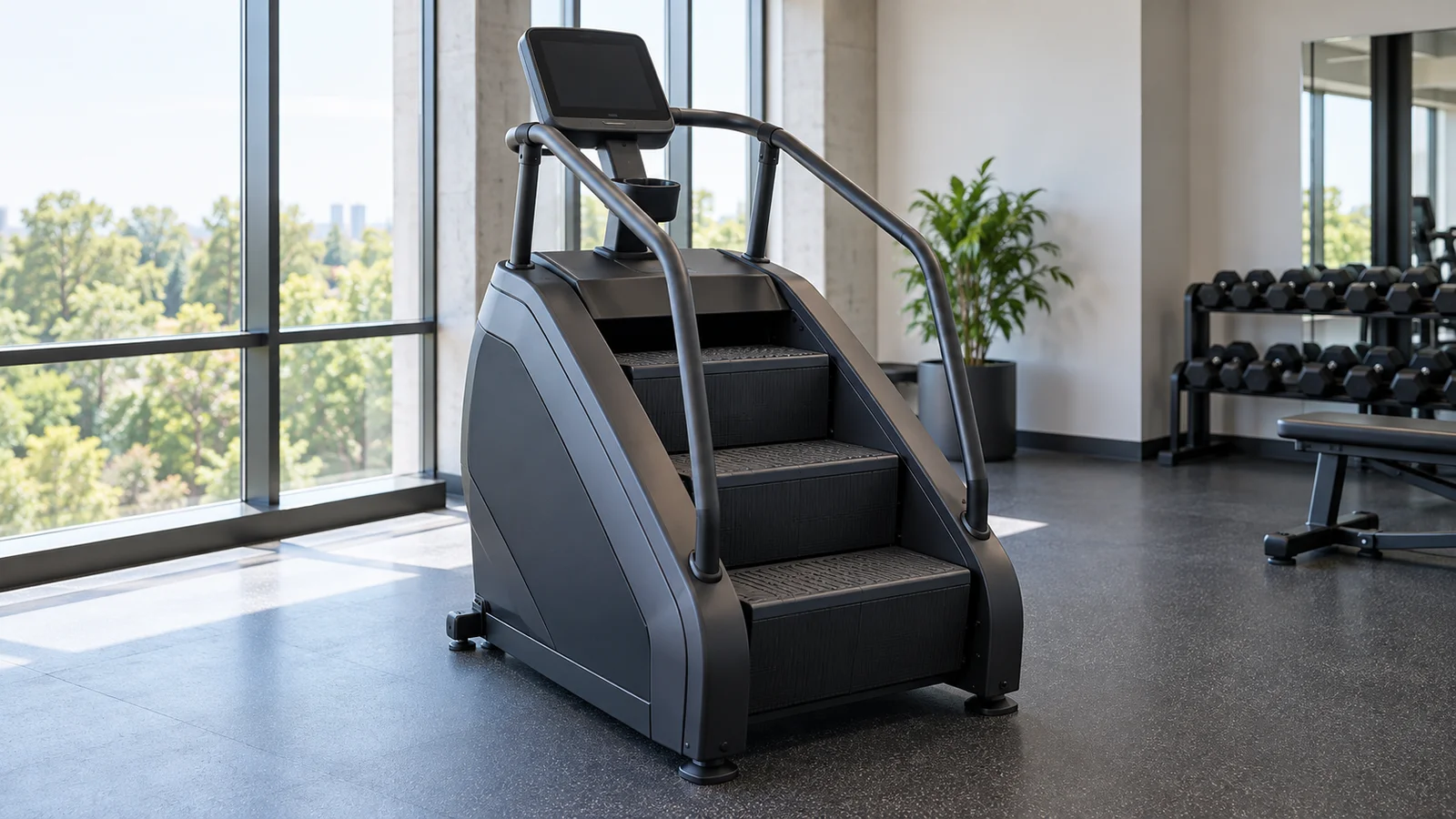
This guide primarily describes a rotating-stair machine, often called a stepmill. You step onto actual moving treads that cycle downward as you climb. StairMaster is a brand name, though people often use it casually for several types of stair equipment.
A pedal-style stair stepper works differently: your feet remain on two pedals rather than repeatedly transferring onto rotating steps. The movement, mounting procedure, and controls can differ substantially. Read the placard on your machine and ask staff for a demonstration rather than applying stepmill instructions to every device.
Even among rotating stair machines, level numbers are not standardized. Level three on one model may not feel like level three on another. Step height, speed ranges, starting behavior, and stop systems also vary. Your own foot placement and effort are better guides than a number borrowed from a video.
If you are still choosing between machines, our StairMaster versus treadmill comparison addresses that decision. The purpose here is to make your actual first stair-climber sessions manageable and repeatable.
What does a stair climber workout train?
Repeated stepping challenges your cardiovascular system and the muscles that help lift and support your body, including the thighs, hips, and calves. How demanding it feels depends on your fitness, body size, step dimensions, speed, and how you use the rails.
You may find your legs tiring before you feel comfortable sustaining the breathing effort. That is useful information. It means your current limiting factor may be local muscular endurance or simply unfamiliarity with the stepping pattern.
The machine is not a substitute for every kind of training. It does not provide a full upper-body strength routine, and it does not guarantee a particular change in your glutes or body fat. Treat it as one cardio option that may fit alongside strength work and other movement you enjoy.
Unlike running, a stepmill does not require repeated airborne landing phases. That does not make it stress-free for the knees, hips, or ankles. The repeated step height and effort can still be demanding, especially when you are new or returning after a break.
Learn the controls before the stairs move
Find the ordinary stop button, emergency or safety stop, speed controls, and any required safety attachment. Ask staff to show you the mounting and dismounting sequence for that model. Do this before selecting a workout, not after the stairs have already accelerated.
The manufacturer’s StairMaster 8Gx safety instructions, reproduced in its owner’s manual, emphasize reading the machine warnings and operating instructions. Its control layout is an example, not a substitute for the instructions on another brand or console.
Use the intended access steps and rails. Keep the area behind and around the machine clear. Avoid equipment with damaged steps, loose rails, unusual movement, or an out-of-service notice. Do not attempt to troubleshoot a mechanical problem while standing on moving stairs.
Wear shoes that stay securely on your feet and tie loose laces. Keep towels, clothing, and headphone cords away from moving parts. Put your phone away before beginning, and place a drink only in the intended holder if one is available.
For an ordinary finish, slow the machine as instructed, use the rails, and wait for the steps to stop before dismounting by the intended route. Do not jump from moving stairs or assume that the display ending means the treads have stopped.
How to stand and step
Face forward and keep your position comfortable
Look mainly ahead, with brief downward checks when necessary to place your feet. Stand comfortably upright with a small natural inclination if needed for the movement. Avoid folding your chest over the console or forcing an exaggerated backward lean.
Stay in the area recommended for the machine rather than drifting toward the bottom edge. If you repeatedly feel close to being carried off the back, slow down immediately and stop if you cannot regain a controlled position.
Use the rails for balance
Light rail contact is appropriate, especially while learning. There is no need to prove you can climb hands-free. If you must support much of your body weight through straight arms or hang over the rails to maintain the pace, the speed is probably too high for the intended workout.
Keep a secure hold whenever balance requires it. The goal is not to remove support at the expense of safety. Instead, choose a pace where the rails help you feel stable without becoming the main way you hold yourself up.
Place each foot securely
Aim for a stable amount of your foot on each tread within the machine’s design, rather than balancing only on your toes at the edge. Step with control and let your knees move comfortably in the direction of your feet. Do not force an unnatural foot angle.
If the tread depth, step height, or machine geometry does not accommodate you comfortably, choose another piece of equipment. No technique cue can make every machine fit every person.
Keep the first version simple
Face forward and take one step at a time. Skip backward climbing, sideways crossovers, double-step patterns, kickbacks, and added weights. Those changes make balance and timing more complicated without being necessary for a useful beginner cardio session.
How hard should beginners work?
Use your breathing and ability to talk as the main guides. The CDC’s intensity guidance describes moderate activity as a level where you can talk but cannot sing comfortably. During vigorous activity, speaking more than a few words becomes difficult without a breath.
Early familiarization can be easier than moderate. You are learning the machine, and there is no requirement to make every second challenging. For the working portions of the examples below, aim for manageable effort that still allows sentences.
If you use a zero-to-ten effort scale, the CDC places relative moderate intensity around five or six, with vigorous effort beginning around seven or eight. Those descriptions are reference points, not a command to push to six when you are still struggling with your footing.
Some beginners find even the lowest rotating-stair speed too demanding. In that case, shorten the exposure, stop safely, or choose a more adjustable activity. Hanging on the rails to survive a prescribed duration is not a necessary stepping stone to fitness.
Your first stair-climber session: eight to ten minutes of movement
Use this as a first exposure for a generally healthy adult, not an obligation or a medical exercise prescription. If you have a condition that affects balance, exercise tolerance, or safe stepping, get individualized guidance before using a moving stair machine.
- Walk easily on level ground for three minutes. Let your breathing increase gradually and check that you feel comfortable.
- Learn the controls and mount safely. Take the time you need; this setup is not included in the movement total.
- Climb for two to four minutes at a manageable pace. Start at the lowest appropriate setting. You may finish earlier if your footing or breathing becomes difficult.
- Stop and dismount as instructed. Wait until the stairs have stopped.
- Walk easily for three minutes. Let your effort settle gradually rather than immediately rushing to another hard exercise.
The arithmetic is three minutes plus two to four minutes plus three minutes: eight to ten movement minutes. Setup, mounting, stopping, and transitions make the actual gym visit longer.
If you complete only one comfortable minute on the machine, that is still useful information for planning the next visit. You do not need to repeat attempts until you reach the published total. Finish with an easier activity if you want more movement that day.
A 12-minute beginner climbing session
Try this only after you can manage short climbing exposures with reliable foot placement and comfortable recovery. The full session contains 12 minutes of movement, of which six are on the stair climber.
- Minutes 0–3: easy walking on level ground.
- Six-minute stair block: repeat one minute of comfortable climbing followed by one minute of easier climbing, three times.
- Final three minutes: easy walking on level ground after safely stopping and dismounting.
Three rounds of one minute plus one minute equal six climbing minutes. Add the three-minute walk before and after for 12 movement minutes. Allow additional time for setup and transitions.
The easier minute is not a pause while standing on moving steps. You continue stepping at a lower manageable pace. If your machine’s minimum speed does not allow recovery, stop safely instead of trying to force the interval format.
Likewise, the comfortable minute is not a sprint. The difference may be small, or you may use the same easy pace throughout your first attempt. The pattern is simply a way to check in regularly, not an excuse to repeatedly accelerate beyond your control.
A later 20-minute option
Once the shorter version feels repeatable, a 20-minute session can provide a longer practice window. This example contains 12 climbing minutes and eight minutes of level walking. It is not a promise that every beginner should reach it within a certain number of weeks.
- Four minutes: easy level walking to warm up.
- Twelve-minute stair block: repeat two minutes of steady, manageable climbing and one minute of easier climbing, four times.
- Four minutes: easy level walking after a controlled stop and dismount.
Four rounds of three minutes equal 12 stair-climber minutes. Four plus 12 plus four equals 20 movement minutes. As before, the clock does not include the machine setup and transitions.
During the steady portions, you should still be able to speak in sentences. If the third or fourth round becomes a scramble, return to a shorter version next time. Completing the written plan is less important than finishing safely.
There is no need to match the machine level across every interval. Use the setting that preserves the intended effort on that day. Sleep, earlier training, heat, and simple day-to-day variation can change how a familiar speed feels.
How to progress without a rigid four-week deadline
Begin with one or two sessions a week if that fits your current routine, leaving room to see how your legs and joints respond. You may need more time at each stage if the exercise is new, and you may prefer another cardio activity between climbing days.
Progress when three things are true: you can place your feet predictably, you can maintain the intended breathing effort, and your recovery does not interfere with normal activity or the rest of your training. Meeting those conditions matters more than the date on the calendar.
First build consistency. Repeat the short session until the experience feels familiar. Then add a small amount of climbing time while keeping the speed similar. For example, increase a four-minute stair block to five minutes rather than immediately doubling it.
Once duration is comfortable, you can consider a modest speed change in part of the workout. Do not increase total time, pace, and weekly frequency together. Changing one variable makes it easier to understand how your body responds.
Progress can also mean using less heavy arm support at the same safe pace, looking ahead more comfortably, or recovering more easily afterward. Keep enough rail contact for balance; hands-free climbing is not a required milestone.
Common beginner problems and what to change
“I am out of breath almost immediately.”
Reduce the speed early. If the minimum setting remains too hard, finish the short exposure and choose an easier cardio option. Do not treat a rotating staircase as a test you must pass before you are allowed to exercise.
“My thighs burn before I get much cardio time.”
Shorten the climbing block and build tolerance gradually. Avoid placing your first stair session immediately after a demanding leg workout. You can get additional aerobic activity from a less locally tiring option while your stepping tolerance develops.
“My calves do all the work.”
Check whether you are perched on the front of your feet or taking rushed, shallow steps. Slow down and aim for a secure foot placement. Do not deliberately hang your heels off the edge to force a calf stretch on moving equipment.
“I keep looking down.”
Brief visual checks are understandable while learning. Reduce the pace until you can alternate those checks with looking ahead comfortably. If you need to stare continuously at your feet to avoid missing steps, ask staff for guidance or choose another activity for now.
“I need to lean on the rails.”
Some support is reasonable. If you are hanging most of your weight from your arms, slow down or shorten the session. Trying to maintain a high displayed speed while unloading your legs makes the number less useful as a training reference.
“My knees hurt.”
Stop rather than trying to fix pain by forcing a different stance on moving steps. Check the equipment fit and consider a different activity. Persistent, worsening, or recurring pain needs individual assessment; a generic speed adjustment cannot identify the cause.
When to stop and get help
End the session if your foot placement becomes unreliable, you feel dizzy, or you develop sharp pain. Stop safely using the controls and rails, and ask staff for assistance if you are unsure you can dismount securely.
Chest pain, fainting, or severe or unusual breathing difficulty calls for urgent medical attention. Do not interpret those symptoms as ordinary beginner discomfort or wait for the interval timer to finish.
If you have known cardiovascular disease, an exercise restriction, a condition affecting balance, or a recent injury or surgery, discuss an appropriate starting activity with your clinician. This general plan cannot determine whether a rotating stair machine suits your circumstances.
How stair climbing fits into the week
The CDC’s adult activity guidance recommends at least 150 minutes of moderate aerobic activity weekly, or 75 minutes of vigorous activity, or an equivalent combination, plus muscle-strengthening activity on at least two days. Those are broader goals to build toward; they are not a demand to accumulate all of your activity on the stair climber.
Walking, cycling, swimming, and other suitable activities can contribute. Also remember that easy familiarization or warm-up minutes may not reach moderate intensity. Do not automatically count every minute in a session as meeting the same intensity category.
If you also strength train, place stair sessions where they do not consistently undermine the lifting you want to do well. An easy short climb after an upper-body workout may be more manageable than a hard climb before heavy lower-body exercises.
For a weekly example, you might try a short stair session on one day, a comfortable walk on another, and a second stair session later in the week if your legs feel recovered. That is an illustration of spacing, not a complete prescription or a requirement to train on particular weekdays.
What to track besides the calorie display
Record the machine model, total climbing minutes, interval pattern, speed or level, and a brief effort note. Add whether your rail use was light or whether you had to lean heavily as fatigue increased.
Machine calorie displays are estimates, and the number alone does not tell you whether the session matched your intended effort. Avoid using it to decide how much food you have earned or to compare yourself with a person on another machine.
A useful entry might read: “Six climbing minutes, three rounds of one minute steady and one minute easy; could speak in sentences; feet secure; legs recovered normally.” That captures the experience more clearly than a calorie total alone.
Our workout log template includes a structure you can adapt for cardio. Keep the details simple enough that you will actually record them after the machine has stopped.
Frequently asked questions
What level should a beginner use?
Use the lowest appropriate setting that lets you step comfortably, then adjust by breathing and control. There is no universal beginner level across machines or people.
Is ten minutes enough?
Ten minutes can be a useful session, and a shorter first exposure can be appropriate. The right starting point is the one you can perform safely and repeat without excessive fatigue.
Should I skip steps to work my glutes?
Not in this beginner plan. Use ordinary forward stepping and save more complicated patterns for a separate, appropriately supervised decision. You can train your glutes with suitable strength exercises without adding balance demands to moving stairs.
Do I need to avoid the handrails?
No. Use them for balance and safe entry and exit. If you need to hang on them to maintain the pace, reduce the challenge rather than letting go to satisfy a form rule.
Start with a session you can repeat
Learn the controls, choose a manageable pace, and stop while your foot placement is still reliable. Build time gradually before chasing speed, and keep the first few sessions simple enough to learn from.
If stair climbing sits alongside strength training in your routine, Workit’s workout journal can help you record your lifting weights, repetitions, and sets and revisit your saved workout history. Keep a simple cardio record alongside it so your whole week stays easy to review.
For separate strength work on another day, the beginner wall sit guide explains short static holds and conservative progression. A wall sit does not replace aerobic training; fit it into your overall routine rather than adding it to fatigued legs automatically.