
An overhead triceps extension trains the back of your upper arms by straightening your elbows while your upper arms are raised. Use a light dumbbell or cable attachment, keep your torso steady, and bend and straighten the elbows through a comfortable range. Do not force your shoulders overhead or lower the weight farther than you can control.
Published October 15, 2026
The exercise can be a useful addition to a strength routine, but the setup matters as much as the repetitions. You need room for the weight, a secure grip, and a clear way to finish. A version that feels awkward before the first rep is worth changing before adding resistance.
This guide explains how to choose between dumbbell and cable versions, handle common elbow and shoulder problems, and introduce a modest amount of direct triceps work. The examples are general training options for healthy adults, not treatment for pain or a prescription following an injury.
What does the overhead triceps extension work?
The triceps brachii straightens the elbow. It has three heads, and the long head also crosses the shoulder joint. Raising the upper arm changes the long head’s position compared with a pushdown performed with your arms near your torso.
That explains why overhead extensions are often discussed as a long-head exercise. It does not mean they isolate that head completely or switch the others off. Your shoulders help maintain the raised-arm position, your hands hold the load, and your trunk helps you stay balanced.
An overhead extension is different from a shoulder press. In the extension, most visible movement comes from bending and straightening the elbows while the upper arms remain reasonably steady. In a press, the upper arms move as part of raising the weight. Accidentally turning extensions into presses changes the exercise you are trying to practice.
You may feel muscular effort at the back of the upper arm and some stretching as the elbow bends. Sharp pain, pinching, tingling, or a painful feeling inside the elbow is not a useful training target. A stronger sensation does not automatically mean a better repetition.
Can you comfortably use the overhead position?
Before picking up a weight, raise your arms into a comfortable overhead position and bend your elbows gently. Keep breathing and notice whether you have to push your ribs forward, arch your lower back dramatically, or move your head out of the way.
This is a practical rehearsal, not a medical screening test. If the position is uncomfortable without resistance, adding weight is unlikely to make it a better starting exercise. A triceps pushdown or another comfortable pressing movement may be a more straightforward choice.
Your upper arms do not need to be forced into an identical position to someone in a photograph. A small natural difference in elbow spacing is normal. What matters is that the position is stable, comfortable, and repeatable without forcing a joint into range.
If you have a shoulder or elbow injury, recent surgery, or specific movement restrictions, follow the plan from your clinician or physiotherapist. General exercise instructions cannot determine which position is appropriate for your situation.
Dumbbell, cable, or single arm: which version should you choose?
Two-hand dumbbell extension
A single dumbbell held securely with both hands is a familiar version that needs little equipment. It can work at home or in a gym. The main limitations are the size of the dumbbell, the grip, and getting it into and out of position.
Choose a dumbbell designed to be held securely in the intended orientation. Check that adjustable components are locked according to the manufacturer’s instructions. Never hold a detachable plate or loosely secured end as though it were a fixed handle. If you cannot establish a secure grip, choose a different implement or exercise.
Single-arm dumbbell extension
A light dumbbell in one hand gives you more freedom to find a comfortable arm and wrist path. Your free hand can help position the weight before the set and guide it back afterward. It should not force your working elbow into an uncomfortable position.
Use a load you can move and return safely. Working one arm at a time does not justify going heavier because the other hand is available. Keep the torso from leaning sideways, and record repetitions separately if the two sides differ.
Cable overhead extension
A cable offers a different line of resistance and may allow smaller load changes. A rope attachment can give the hands some freedom. However, cable stations vary, and the path from the pulley to your hands must be clear of your neck, face, body, and nearby people.
A high-pulley version with a stable forward lean is often easier to arrange than pulling a low cable up behind your body. Ask staff to demonstrate the station-specific setup if needed. Do not assume that any pulley position you see online is suitable for your machine.
How to perform a dumbbell overhead triceps extension
1. Prepare your position and the area
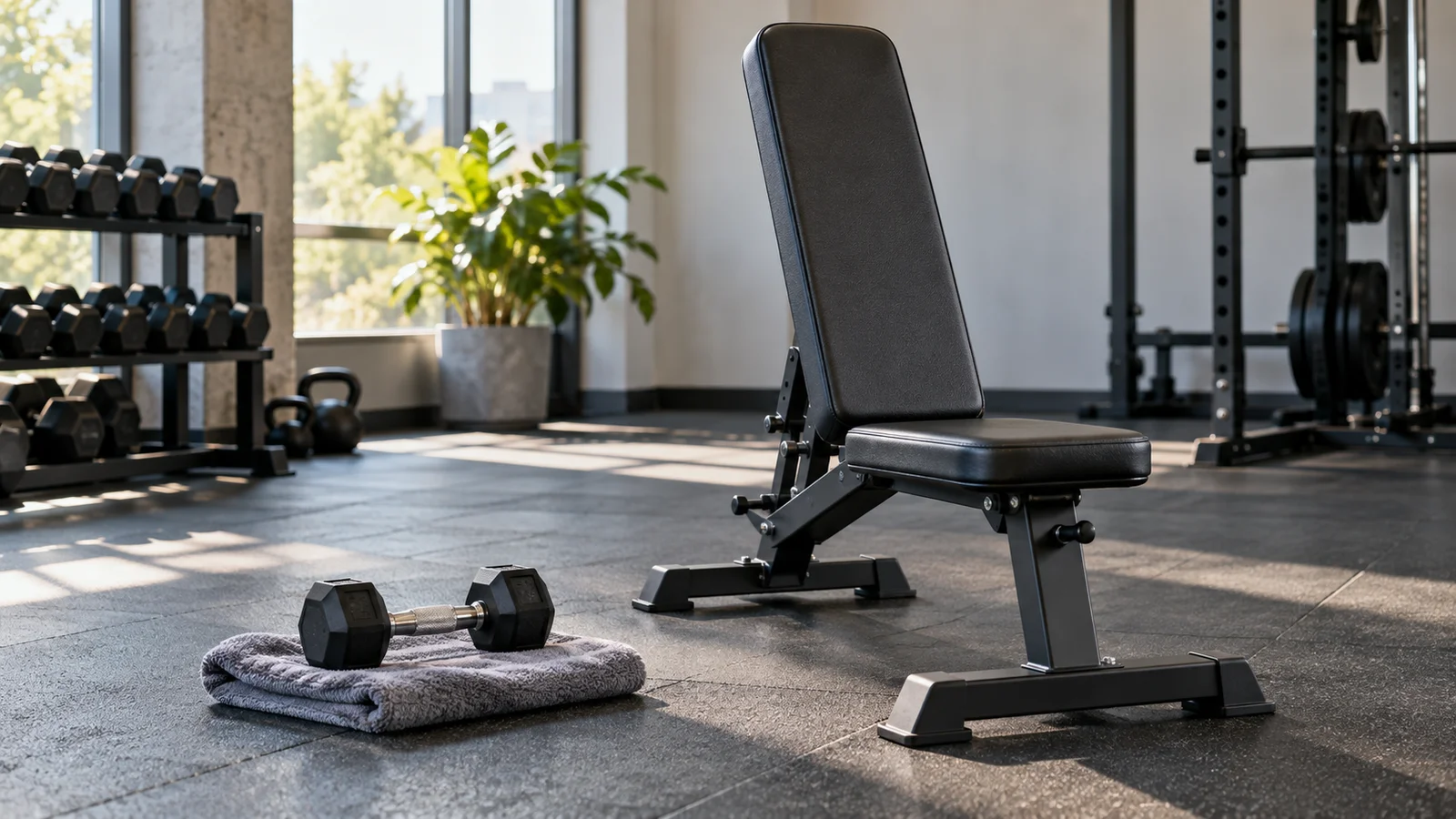
Stand with a stable stance or sit on a sturdy exercise bench with your feet supported. If you use a backrest, make sure it does not block the dumbbell’s path. Check overhead clearance and leave enough room behind you that the weight cannot hit a wall, mirror, or another person.
Begin with a very light dumbbell. You should be able to bring it to the starting position and return it without straining. If the setup is harder than the exercise itself, that is a reason to reduce the load or use another variation.
2. Bring the weight overhead under control
With a secure two-hand grip, bring the dumbbell into a comfortable overhead position. Keep your ribs and pelvis reasonably stacked rather than leaning backward to create room. Your head stays in a natural position; do not push your chin forward.
Keep the shoulders comfortably raised with the arms rather than aggressively pinning the shoulder blades down. Your upper arms should be reasonably stable, but not held rigidly in a forced position. Leave a clear path behind your head.
3. Bend the elbows smoothly
Lower the dumbbell behind your head by bending the elbows. Stop before the position becomes uncomfortable, your upper arms drift substantially, or the dumbbell approaches your head or the bench. Depth is determined by control and comfort, not by how far the weight can descend.
Keep the grip secure and the wrists comfortable. Avoid letting the weight fold your hands backward. You should feel able to reverse the movement without bouncing or suddenly changing your torso position.
4. Straighten the elbows without snapping
Extend the elbows to raise the weight again. Finish smoothly rather than striking a hard lockout. Keep breathing; a comfortable exhale during the upward movement is an easy rhythm to use.
The ACE triceps extension demonstration provides a visual reference for the standing dumbbell movement. Its emphasis on a controlled lowering phase and a steady body is more useful than copying the demonstrator’s exact depth.
5. Finish while you still control the weight
End the set before fatigue makes the return uncertain. Reverse the setup carefully, bringing the dumbbell to a supported position in front of you before putting it down. Do not drop it behind your back or suddenly swing it around your head.
If you cannot safely manage the transition, use a lighter weight or ask a qualified gym professional to demonstrate an appropriate alternative. A partner should not surprise you by pulling or releasing the weight while it is overhead.
How to set up a cable overhead extension
Begin with the weight stack resting. Adjust the pulley according to the station’s instructions, lock it in place, and attach an intact rope or suitable handle using the proper connector. Check that the connector closes and that the cable and attachment show no obvious damage.
For a high-pulley version, take hold of the attachment and move into a position facing away from the stack, using a comfortable split stance and a modest forward lean. Keep the load very light while learning the entry. Ask staff to show you how to turn and position yourself without the cable crossing your neck or wrapping around you.
Your upper arms are raised relative to your torso. The elbows bend as the hands return toward the sides of your head, then straighten as the hands move forward along the cable’s line. Keep your head clear of the rope and connector throughout.
Choose a distance from the station that allows the planned movement without the stack slamming down or the cable reaching its travel limit. More steps forward are not automatically better. You should feel stable rather than dragged backward.
Keep the torso angle fairly constant while the elbows move. Do not use a whole-body forward lunge to finish the repetition. If the cable pulls your shoulders back or makes you lose your stance, reduce the weight and reconsider the setup.
To finish, keep hold of the attachment and carefully reverse the entry until you can settle the stack. Never release a loaded handle or let the rope pull your hands abruptly behind you. Move the selector pin only when the stack is fully at rest.
A low-pulley overhead extension is another option, but it is not required. If the cable rubs across your body, your hands cannot clear your head, or entry requires an awkward twist under tension, choose a simpler setup instead of working around it.
How far should your elbows bend?
Use the deepest comfortable position that you can repeat without losing control. For one person that may be a modest elbow bend; another may comfortably move farther. A video angle cannot reveal whether a depth is appropriate for your shoulders and elbows.
Start with a conservative range and light resistance. After several comfortable practice sessions, you can explore whether a little more range remains easy to control. Do not add depth and weight together simply because the exercise feels familiar.
At the other end, complete the extension without aggressively snapping the elbow. Keeping every repetition tiny because the load is too heavy also misses the point. Adjust resistance so your chosen range stays recognizable from the first repetition to the last.
Fix common technique problems
Your lower back arches
Reduce the load and rehearse the overhead position again. A supported seated version may help some people, but a backrest is not permission to force the arms farther overhead. If you still need a large backward lean, use a different triceps exercise.
Your elbows flare outward
A little elbow separation can be comfortable and normal. Do not clamp the elbows together simply to satisfy a narrow visual rule. The concern is a large, uncontrolled change during the repetition, especially when it accompanies pain or the weight moving off its intended path.
Your upper arms swing on every repetition
Try less weight and a shorter set. Some small movement is inevitable, but repeated large shoulder motion can turn the exercise into a different task. Focus on elbow movement and stop when maintaining that emphasis becomes difficult.
Your wrists hurt
Check whether the dumbbell grip forces your hands into an awkward angle. A lighter single-arm version or rope attachment may feel more natural. If discomfort persists, stop. Do not tighten your grip harder and assume that wrist pain is necessary for training your triceps.
You feel elbow pain at the bottom
End the set rather than repeatedly testing the painful position. Review the load and setup only after symptoms settle, and seek individual guidance when symptoms persist or recur. A pushdown might be comfortable, but it is an alternative to assess, not a guaranteed treatment.
The dumbbell touches your head or backrest
Stop and change the arrangement. Reducing the range, using a smaller dumbbell, or choosing a cable version may create clearance. Do not move your neck abruptly out of the way on every repetition. Clearance must exist before the set begins.
The rope pulls you off balance
Reduce the stack setting and use a stable stance. Check pulley height and distance from the station. If maintaining position requires excessive leaning or bracing against nearby equipment, the setup is not ready for a working set.
Beginner sets, repetitions, and rest
One easy rehearsal set followed by one or two working sets of 10–15 repetitions is a cautious way to try the exercise. Leave roughly two or three controlled repetitions available at the end. The target is learning a repeatable movement while adding a modest amount of work.
Rest about 60–120 seconds between working sets. Take longer if breathing, grip, or shoulder fatigue prevents you from repeating the same setup. Rest is there to support another controlled effort, not to make the exercise feel as difficult as possible.
Start once or twice weekly within a balanced program. Chest presses, push-ups, and shoulder presses already involve your triceps. If you add overhead extensions after several pressing movements, you may need much less weight than when trying them fresh.
The 2026 ACSM resistance-training guidance supports regular training of major muscle groups and gradual progression. It also reports that training to momentary failure does not consistently change results for the average healthy adult. You do not have to attempt a final shaky repetition over your head.
A simple progression example
Choose one version and keep its setup consistent. Suppose your first working sets are 11 and 10 repetitions with a comfortable range and a few repetitions left. Keep the load at the next session and see whether another controlled repetition is available.
Over later sessions, the results might become 12 and 11, then 14 and 13, and eventually 15 and 15. These numbers illustrate the decision process, not a promise that progress happens every workout. A session of 12 and 10 after 12 and 11 does not automatically mean the plan has stopped working.
Once both sets reach your upper target with the same technique and intended effort, try the smallest manageable load increase. The repetitions may drop toward the lower end. If the new resistance disrupts your setup or makes a safe finish uncertain, return to the previous load.
Dumbbell jumps can be large relative to a small isolation exercise. You can keep building control at the current load, use a station with smaller increments, or choose another manageable rep range within your program. Do not attach improvised objects to a dumbbell to create an unsafe intermediate weight.
Our double progression guide explains this reps-first approach. Whatever method you choose, change one major variable at a time so you know whether the new challenge still fits.
Overhead extensions versus triceps pushdowns
Both exercises involve straightening the elbow, but the shoulder position differs. In a pushdown the upper arms remain near the sides; in an overhead extension they are raised. That changes the position of the triceps long head and the practical demands of the setup.
A pushdown often has an easier entry and exit, and it may suit someone who finds overhead positions uncomfortable. An overhead extension can provide a different training stimulus when the position feels good. Neither exercise needs to be uncomfortable to be useful.
A study by Maeo and colleagues compared cable elbow-extension training with overhead and neutral upper-arm positions. In its 12-week within-person design, the overhead condition produced greater triceps muscle-volume gains. The finding supports considering shoulder position, but it does not promise a specific result for every lifter or establish every dumbbell variation as superior.
You also do not need to copy a research training dose as your first workout. Research participants follow a defined protocol; your appropriate starting point depends on current training and tolerance. A study does not override pain, equipment fit, or your ability to control the load.
For the lower-arm-position alternative, see our triceps pushdown guide. Choose one useful variation first instead of assuming you must perform both at every session.
Where the exercise belongs in your routine
For a general upper-body day, complete the pressing and pulling movements that matter most before optional direct arm work. Overhead extensions can then be a small finishing exercise, provided fatigue has not made the overhead position unstable.
A sample sequence is a familiar chest press, a supported row, another planned upper-body movement, and one or two extension sets. It is an order example, not a complete workout prescription. Your broader routine still needs appropriate lower-body training and other major movement patterns.
If triceps strength or the extension itself is a particular focus, you can place it earlier. Expect later pressing performance to change when the triceps are already tired. The exercise order guide helps make that trade-off deliberate.
Adding overhead extensions does not require removing every other triceps exercise, but avoid increasing all of them at once. If you already perform substantial pressing and pushdowns, replacing some direct work may be more manageable than simply adding more sets.
Keep a useful training record
For dumbbells, record whether the weight is one shared dumbbell or a separate load in each hand. Note standing versus seated, the bench setup, and repetitions on each side for single-arm work. Those details prevent comparisons between different exercises.
For cables, record the station, pulley height, attachment, and stack setting. A setting on one machine is not necessarily equivalent to the same number on another because pulley systems differ. Treat a new station as a new baseline.
A concise entry could read: “High-pulley rope extension, same setup, 12/11, about two controlled reps left, comfortable shoulders.” If the set ended because the grip slipped or the setup became awkward, record that too. Our workout log template provides a simple place to start.
Frequently asked questions
Should my elbows touch?
No. Use comfortable elbow spacing that lets you keep the upper arms reasonably steady. Forcing the elbows together can make the position less comfortable without improving the basic elbow-extension movement.
Is seated better than standing?
Neither is universally better. Sitting may make balance easier, while standing may provide more clearance for the weight. Choose the version that allows a steady torso, comfortable shoulders, and a safe setup and finish.
Can this exercise remove fat from the backs of my arms?
It trains the triceps, but it does not selectively remove fat from that area. Judge it as a strength exercise rather than a targeted fat-loss technique. Visible changes depend on more than the exercise you choose.
Do I need overhead extensions for complete triceps training?
No single exercise is mandatory. Overhead extensions can be a useful option, but a comfortable and sustainable program matters more than forcing one movement. If the position does not suit you, choose other appropriate triceps and pressing work.
Your first-session plan
Rehearse the overhead position without weight. Choose a secure grip and a version with a clear path. Start light, perform one or two controlled sets, and stop while you can still return the equipment safely. Record what you did before deciding whether to add repetitions next time.
You can log sets, reps, and weights in Workit; a subscription is required. For now, prioritize a comfortable shoulder position, smooth elbow movement, and a safe finish.
If you are building an upper-body session, the chest press machine guide covers a compound press to consider before direct triceps work. Account for that pressing volume when choosing how many extension sets to add.