
Published October 7, 2026
A full body dumbbell workout with no bench can cover your legs, hips, chest, back, shoulders, arms and trunk with a small amount of equipment. Build it around a squat, a hip hinge, a floor press and a row, then add calf and trunk work. An overhead press is optional if your weights and available space suit it.
The important constraint is the dumbbells themselves. A pair that challenges your legs may be too heavy for your shoulders. A pair you can press comfortably may eventually become too light for your squat. The plan below explains how to handle both situations without relying on unstable furniture or pretending that one weight suits every exercise.
What you need before starting
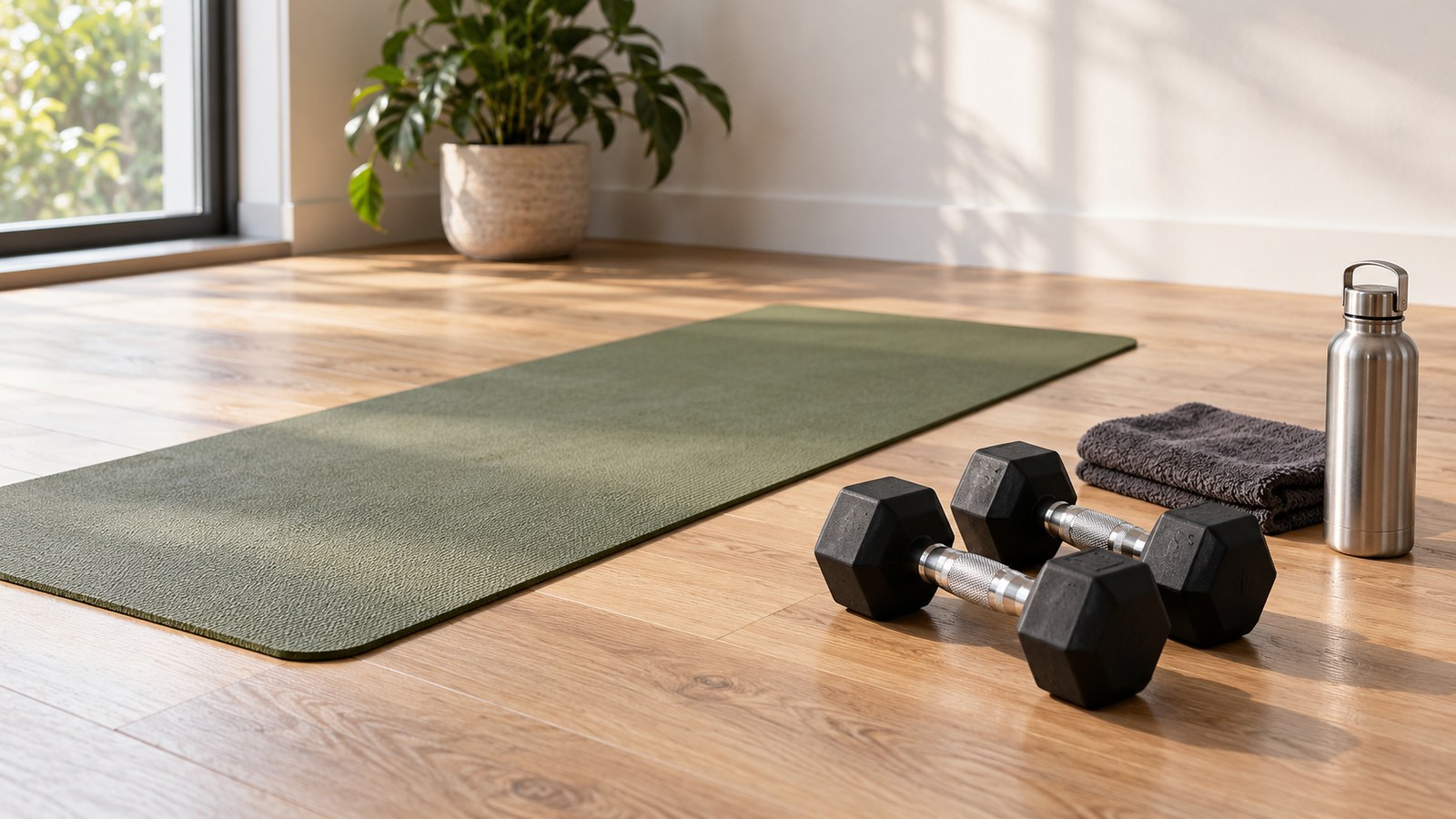
You need one or two secure dumbbells, clear floor space and a surface where your feet will not slip. A thin exercise mat can make lying exercises more comfortable. Adjustable dumbbells or several pairs offer more flexibility, but you can begin with a fixed pair if you choose appropriate variations.
- Clear enough space to lie down, extend your arms and move around the weights.
- Check overhead clearance, including ceiling fans and hanging lights.
- Check adjustable-dumbbell locks according to the manufacturer’s instructions before lifting.
- Keep children, pets, loose rugs and cables away from your training area.
- Place unused weights where they cannot roll into your feet.
This is a general routine for adults who can perform the movements comfortably. If you have an injury, a relevant medical condition or difficulty getting onto the floor, seek suitable guidance and use the standing alternatives where appropriate. A floor press is not automatically appropriate for an injured shoulder.
The complete no-bench dumbbell workout
Start with one working set of each main exercise for your first few sessions. Build toward the two-set version below as you become comfortable. Warm-up sets do not count toward these totals.
- Goblet squat: 2 sets of 8–15 reps; rest 90–120 seconds
- Dumbbell floor press: 2 sets of 8–15 reps; rest 90–120 seconds
- Dumbbell Romanian deadlift: 2 sets of 8–15 reps; rest 90–120 seconds
- One-arm dumbbell row: 2 sets of 8–15 reps per side; rest 60–90 seconds after both sides, longer if needed
- Standing calf raise: 2 sets of 12–20 reps; rest 60 seconds
- Dead bug: 2 sets of 5–8 controlled reps per side; rest 60 seconds
- Optional standing dumbbell press: 1–2 sets of 8–12 reps; rest 90–120 seconds
Perform all sets of one exercise before moving to the next. This makes it easier to learn the movements and judge the load. For the row, complete one side, switch, then rest; you can also rest between sides if that gives you better control.
Expect roughly 35–55 minutes for the full version, depending on transitions and rest. Finish most sets when you think you could perform another two or three controlled reps. That is a rough effort guide, not an exact measurement.
The program combines dumbbell and bodyweight movements intentionally. The CDC’s strengthening guidance includes multiple forms of resistance and emphasizes working the major muscle groups. Every exercise does not need a weight in your hands.
Warm up and rehearse the setup
Spend a few minutes marching, walking or moving easily around your available space. Follow with several bodyweight squats, unloaded hip hinges and gentle arm movements through a comfortable range. The warm-up sets versus working sets guide explains how to record preparation separately from the main workout.
Before your first working set, try an easier version of the exercise. Use a lighter dumbbell if you have one, or rehearse without external weight. Practice getting down to the floor and standing up before adding the floor-press weights.
If you only own a heavy pair, bodyweight practice is useful, but it does not make that pair appropriate for every lift. The working load still needs to pass the control and setup checks below.
Exercise instructions and practical substitutions
1. Goblet squat
Hold one dumbbell securely near your chest. Choose a comfortable stance, keep your feet planted and bend your knees and hips as you lower. Stand by pushing through the floor. Keep the weight close enough that you do not have to lean backward to balance it.
The ACE goblet squat demonstration shows the front-held dumbbell setup. For this routine, use a depth you can control comfortably rather than forcing a particular depth. Your stance and range may differ from someone else’s.
If it is too hard: Set the dumbbell aside and practice bodyweight squats. If gripping the top of the dumbbell is insecure, do not improvise with a loose plate or adjustable end cap.
If it is too easy: First add reps within the range. A supported split squat can later make leg training harder with a modest load, but learn it without weights before treating it as a progression.
2. Dumbbell floor press
Use weights you can position safely. Sit down with the dumbbells close to your body, then move into a lying position under control. Do not attempt a heavy setup you have never practiced. If getting the weights into position is the hardest part, choose wall push-ups instead.
Lie with knees bent and feet planted. Hold the dumbbells over your chest with wrists in line with your forearms. Lower until your upper arms gently meet the floor, keeping your elbows at a comfortable angle away from your sides. Press upward smoothly without banging the dumbbells together.
Keep your hips on the floor. Do not bounce your arms off the ground or force your elbows wider to reach a particular position. Finish before you lose control, lower the weights safely and set them down before getting up.
If it is too hard: Use lighter weights or wall push-ups. Do not replace a controlled press with partial repetitions you cannot manage simply to keep using your current pair.
3. Dumbbell Romanian deadlift
Stand holding the weights near your thighs. Keep a slight bend in your knees and push your hips backward. Let the dumbbells travel close to your legs as your torso inclines. Return to standing by bringing your hips forward without leaning back at the finish.
Stop lowering when you reach the limit you can control while keeping a steady back position. You do not need to touch the floor. ACE’s Romanian deadlift teaching guide emphasizes learning the hip hinge before adding external resistance.
If the hinge is unfamiliar: Practice without weights, then use a bodyweight glute bridge as your working exercise: 2 sets of 10–15 reps, resting 60–90 seconds. The bridge is a useful hip-extension alternative, but it does not reproduce every demand of a loaded Romanian deadlift.
For the bridge, lie on your back with knees bent and feet planted. Push through your feet to lift your hips, stopping before you overarch your lower back. Lower smoothly and keep breathing. If this position is uncomfortable or getting onto the floor is difficult, choose an alternative with qualified guidance.
4. One-arm dumbbell row without a bench
Take a staggered stance and hinge forward slightly. Rest your free hand on your front thigh, above the knee, while the other hand holds the dumbbell. Keep your torso steady as you pull the weight toward your hip or lower ribs. Lower it under control before repeating.
Choose an angle you can maintain. The goal is to move the arm while keeping the rest of your body reasonably still, rather than rotating your chest upward to lift a heavier dumbbell.
If your lower back becomes tired before your pulling muscles, stand up between sets, reduce the weight or get coaching on a more suitable setup. An unsupported row may not fit everyone. Do not brace yourself on a rolling chair or a lightweight table to force the exercise.
5. Standing calf raise
Stand with both feet on the floor. Rise onto the balls of your feet, pause briefly and lower your heels slowly. Begin with bodyweight. Lightly touch a wall with one hand if it helps you balance.
Add a dumbbell in the other hand only when the bodyweight version is controlled. Keep both feet on the ground for the starting version. You do not need a stair edge, a stack of books or another improvised platform.
If you eventually progress to one leg, start without weight and retain the wall support. Reassess the rep range; a harder variation is effectively a new exercise.
6. Dead bug or suitcase hold
For the dead bug, lie on your back with arms raised and hips and knees bent. Slowly extend one leg and the opposite arm, then return and switch sides. Use a reach that lets you keep your trunk steady and breathe normally. This exercise does not require a dumbbell.
If you prefer to stay standing, use a suitcase hold: stand tall with one dumbbell at your side for 15–30 seconds, switch sides and repeat for two rounds. Keep shoulders level and avoid leaning away from the weight. Rest 60 seconds between rounds.
The two movements challenge your trunk differently. Choose the one you can perform comfortably rather than treating them as identical tests.
7. Optional standing overhead press
With suitable weights, start with the dumbbells around shoulder height. Keep your feet stable and press upward through a comfortable path without leaning back. Lower smoothly. If you must use a big leg drive or back arch, the weights are too heavy for this version.
Skip this exercise when overhead clearance is limited, overhead motion is uncomfortable or the available pair is too heavy. Floor presses and rows already involve shoulder muscles; an optional press should improve the session, not become a setup problem.
What a bench-free workout can and cannot replace
The floor press is a useful horizontal press, but it has a different range of motion from a bench press. The floor stops the upper arms from traveling as far behind the torso. The NSCA describes this floor-limited movement. That mechanical difference does not establish that the floor press is universally safer or better for muscle growth.
Likewise, a dumbbell row provides useful pulling work, but it does not exactly replace a pull-up or pulldown. With a row, the arm pulls toward the torso from a bent-over position; an overhead pull challenges a different movement path.
A pair of dumbbells cannot reproduce every cable or pull-up exercise. You can begin without a vertical pull, then add suitable equipment later if your goals warrant it. Avoid improvised door, furniture or towel setups with uncertain load capacity. Our rows versus pull-ups guide explores the distinction.
Choose the load separately for every movement
There is no universal beginner dumbbell weight. Body size, previous training, exercise choice and confidence all affect what you can control. Start with the lightest useful option and use this three-part check:
- Setup: Can you pick up, position and put down the weight without an awkward struggle?
- Repetitions: Can you reach the bottom of the listed range with consistent movement?
- Effort: Are the later reps challenging while leaving a little controlled capacity?
A load is unsuitable if it fails the setup test, even when you think your muscles could press it once someone placed it in your hands. Home training needs a repeatable way into and out of each exercise.
For example, an imaginary pair of 10-kilogram dumbbells might suit one person’s rows, be too heavy for their overhead press and feel light during their deadlift. Those numbers illustrate a mismatch, not a recommended starting weight.
A realistic fixed-pair training log
Your exercise choices might look like this during the same session:
- Goblet squat: One dumbbell, 12 and 11 reps, with room for another controlled rep next time.
- Press: Wall push-ups, 10 and 10 reps, because the available dumbbells fail the floor-press setup test.
- Romanian deadlift: Two dumbbells, 15 and 15 reps, still easy; review a future equipment upgrade if this continues.
- Row: One dumbbell, 10 and 9 reps on each side, with steady technique.
This hypothetical log shows why one workout can contain different rep counts and bodyweight substitutions. Judge each movement on its own. You are not behind because your shoulder exercise uses less resistance than your leg exercise.
How to progress with adjustable dumbbells
Keep the exercise, sets and technique consistent while you add repetitions. For a 2-set exercise in the 8–15 range, you might record 10 and 9 reps, then 11 and 10, then eventually 15 and 15. These improvements can take multiple sessions and will not always happen in order. For a session-by-session example, see the double progression guide.
Once both sets reach the top with controlled technique and some capacity left, increase by the smallest practical increment. Return toward the lower end of the range. If you cannot reach the minimum, use the previous weight until you are ready or choose a smaller increment when available.
Research supports more than one way to increase training demand. In an eight-week randomized study of 43 resistance-trained adults, researchers compared adding load with adding repetitions during lower-body training. Both approaches produced adaptations under the tested conditions. This was not a direct test of this home routine, nor proof that a fixed weight remains sufficient indefinitely.
How to progress with one fixed pair
Use the pair where it fits. Combine it with bodyweight alternatives elsewhere. Then progress in a predictable order rather than changing the whole session each week.
Add controlled repetitions
Move toward the top of the prescribed range. When an exercise becomes easy there, you can cautiously extend some sets toward 20 reps while keeping the same technique. If breathlessness, grip or boredom becomes the main limitation, more repetitions may be an inefficient next step.
Add a modest amount of work
If recovery is good, add a third set to one exercise you want to prioritize. Reassess the following sessions before adding sets everywhere. More sets consume time and recovery; they do not solve every equipment mismatch.
Use a suitable harder variation
For legs, try a supported split squat with both feet on the floor. Hold a wall for balance, take a comfortable staggered stance, lower by bending both knees and stand again. Learn it with bodyweight, then add one dumbbell in the free hand if appropriate. Start with 6–10 reps per side.
A brief pause can also make a movement easier to standardize. It is a technique choice, not a promise that very slow repetitions produce superior results. Avoid inventing unstable variations simply to make light weights feel difficult.
Recognize the equipment ceiling
When your hardest sensible variation remains easy at a manageable rep count, you may need heavier dumbbells, bands with an appropriate setup or access to other equipment. No programming trick can guarantee unlimited progress from one light pair.
The ACSM’s 2026 guidance recognizes benefits from home-based and nontraditional resistance training. It also emphasizes matching a program to the person’s goals. A small home setup can be useful without being the final setup for every goal.
Fit the session into your week
Begin by repeating the routine twice weekly, such as Wednesday and Saturday. Keep at least one nonlifting day between these sessions when your schedule permits. Use the same exercise choices initially so your log shows comparable results.
If you later prefer three days, Monday, Wednesday and Friday is one option. Introduce the extra day with fewer sets rather than increasing frequency and volume sharply together. If performance or recovery worsens, return to the schedule you could manage.
Keep aerobic activity in your week too. Adult public-health guidance includes aerobic activity in addition to strengthening, so this dumbbell session is only one part of an active routine.
Fix common home-workout problems
- The weights slip: Stop and check your grip and handles. Do not continue a floor or overhead press with an insecure hold.
- Floor transitions are difficult: Use wall push-ups and the suitcase hold; seek guidance for suitable lower-body alternatives if needed.
- The session feels like nonstop cardio: Take the stated rests and avoid racing between exercises.
- You only have a short window: Warm up and complete one set of each main movement, leaving out the optional press.
- An exercise causes sharp or worsening pain: Stop it. Do not use a rep target as a reason to continue through pain.
Unusual severe breathlessness, chest discomfort or fainting requires prompt medical attention. Ordinary muscular effort should not be confused with a warning symptom.
Frequently asked questions
Can I build muscle with dumbbells and no bench?
You can make progress when the exercises provide sufficient challenge and you gradually increase the demand. Your results depend on starting point, consistency, recovery and available resistance. The absence of a bench mainly changes your exercise options; it does not make training pointless.
Can I do this workout with just one dumbbell?
Many movements work with one: goblet squats, one-arm rows, calf raises and suitcase holds. You can hold one suitable dumbbell with both hands for a hinge. Replace the two-dumbbell floor press with wall or floor push-ups unless you have learned a controlled single-arm pressing setup.
Do I need curls and triceps extensions?
Rows and presses already involve the arms. You can add 1–2 sets of 10–15 controlled curls if your weight is appropriate and arm training is a priority. Avoid adding overhead triceps work with a dumbbell that is too heavy simply because it is your only option.
Should I turn this into a circuit?
Learn it with straight sets first. If you later pair exercises, preserve enough rest to maintain quality. Our push and pull guide explains the movement categories, but being able to alternate exercises does not mean you must rush them.
How should I track progress?
Record the variation, weight per dumbbell, reps for each set and any important setup notes. For unilateral exercises, record both sides. Keep a weaker side’s control as the limit rather than adding extra sloppy reps to match the stronger side.
Build a home routine you can repeat
Start with weights you can handle, learn the floor transitions and log the exercises that fit your equipment. If a modest attendance goal helps, explore these fitness challenge ideas. For help organizing a home training plan, see Workit on the App Store.
Comments
One response to “Full-Body Dumbbell Workout With No Bench: A Practical Home Plan”
[…] home, a no-bench dumbbell workout can simplify equipment needs, but it still requires exercise-specific preparation and realistic […]